
Coded Welder South Africa: Can You Really Earn R30,000+ in 2026?
Updated: Sep 11
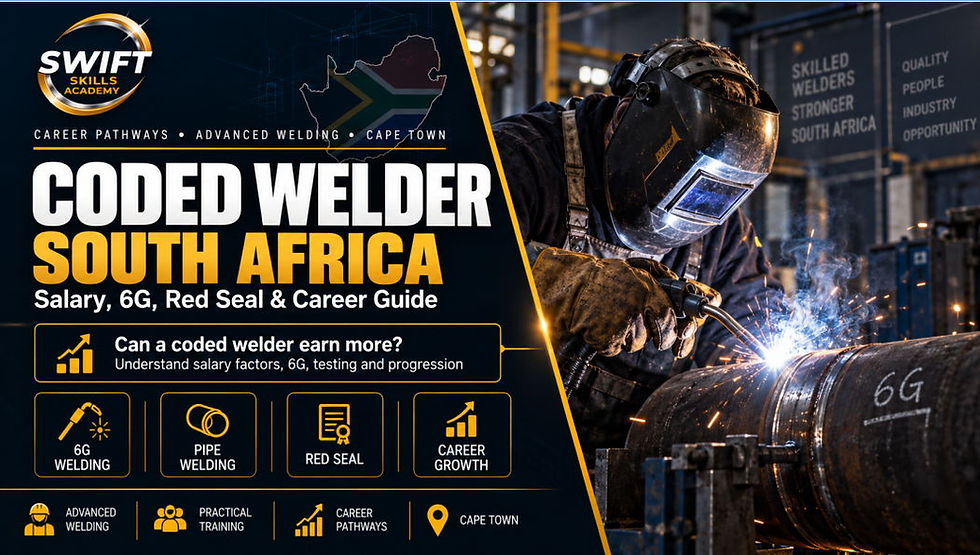
Yes — a coded welder in South Africa can earn R30,000 or more in some specialist jobs. But passing one welding test does not automatically create a R30,000 salary.
That distinction matters.
Current South African job-market evidence shows enormous variation. Recent advertised opportunities include coded-welding work below R30,000 per month as well as specialist positions at or above that level. The difference can come down to experience, welding process, material, pipe capability, project conditions, overtime, trade status and exactly what qualification the employer requires. (www.pnet.co.za)
So if someone tells you:
“Do one coded-welding course and you will earn R30,000 to R50,000 a month,”
that is not a responsible promise.
A better question is:
What combination of practical welding competence, qualification range, experience and artisan status makes a welder more valuable to an employer?
That is what this guide explains.
Coded Welder South Africa: The Quick Answer
A coded welder is generally a welder who has successfully demonstrated welding performance under the requirements of a particular welding code, standard or project qualification system.
For example, ISO 9606-1 specifies requirements for qualification testing of welders performing fusion welding of steels. Its purpose is to test the welder's ability to produce an acceptable weld under defined conditions. (ISO)
Other projects may work under systems such as:
ASME Boiler and Pressure Vessel Code Section IX;
AWS D1.1 for structural steel;
ISO 9606;
or another applicable project, customer or fabrication requirement.
ASME's current Boiler and Pressure Vessel Code continues to include Section IX — Welding, Brazing and Fusing Qualifications, while AWS D1.1:2025 addresses qualification, fabrication, inspection and acceptance requirements for structural steel welding. (American Society of Mechanical Engineers)
But there is a crucial point:
A coded-welding qualification is not a universal welding licence.
Passing one test does not mean you are automatically qualified for:
every welding process;
every metal;
every thickness;
every pipe diameter;
every position;
every joint;
every employer;
or every project.
The qualification applies within a defined scope.
Why Two Good Welders Can Have Completely Different Career Options
Two welders may both be capable of producing a visually good weld.
Yet one may have significantly stronger access to specialist work because that person can demonstrate:
relevant production experience;
a qualification matching the employer's required code;
competence in the required process;
difficult-position capability;
pipe experience;
specialist material experience;
traceable work history;
Red Seal artisan status where relevant;
and a record of reliable, low-repair work.
Employers do not only buy an attractive weld bead.
They buy repeatability, productivity, traceability and the ability to perform the specific work required by the job.
That is why coded welding should be viewed as part of a welder's professional profile — not as a magic certificate.
Coded Welder vs Red Seal Welder: They Are Not the Same Thing
This is one of the most important distinctions in welding careers.
A coded-welding qualification
Usually demonstrates welding performance within a defined qualification range under a particular code or standard.
Red Seal / artisan status
Relates to South Africa's national artisan-development and trade-test system.
South Africa's National Artisan Development Support Centre describes trade testing as the formal artisan assessment route regulated under the national Trade Test Regulations. (NADSC)
Therefore:
A Red Seal welder may still need a particular code qualification for a specific job.
And:
A welder who has passed a code qualification test is not automatically a Red Seal artisan.
They answer different questions.
One asks:
Can this person demonstrate the required welding performance within this qualification system?
The other asks:
Has this person achieved formal recognition as an artisan through the applicable South African trade pathway?
A strong welding career may eventually involve both.
What About the Occupational Certificate: Welder SAQA 94100 in 2026?
This requires especially careful wording.
SAQA currently records Occupational Certificate: Welder, SAQA ID 94100, NQF Level 4 and 373 credits, as having passed its registration end date.
The current SAQA record lists:
registration end date: 30 December 2025;
last date for enrolment: 30 December 2026;
last date for achievement: 30 December 2029. (SAQA)
The qualification's purpose includes preparing learners to join metal products according to Welding Procedure Specifications using electric-arc or gas-welding processes. (SAQA)
That means websites and training providers should not casually describe SAQA 94100 as though its registration status were unchanged.
Before enrolment, the current programme, provider scope, learner-registration route, assessment arrangements and certification outcome should be confirmed in writing.
Who Should Consider a Coded-Welding Pathway?
Coded welding is generally more relevant to someone who already has enough practical competence to pursue a defined welding requirement.
That may include:
an experienced fabrication welder;
a welder moving from plate to pipe;
a MIG welder developing TIG capability;
a welder preparing for structural work;
a pipe welder targeting specialist projects;
a Red Seal artisan who needs an employer-specific coding;
or an experienced worker preparing for a qualification test.
It may not be the right first step for a complete beginner.
A learner who is still struggling with:
arc control;
joint preparation;
travel speed;
fit-up;
distortion;
basic positions;
penetration;
porosity;
lack of fusion;
or process fundamentals
may gain more from developing practical competence before attempting a demanding qualification test.
Can a Coded Welder Really Earn R30,000+ Per Month?
Yes, it is possible. It is not automatic.
Current market information illustrates why fixed salary promises are dangerous.
A recent CareerJunction search included a coded-welder contract role at R89 per hour, while other welding-related specialist opportunities on the same market included roles exceeding R30,000 monthly. Another current listing showed a stainless-steel coded-welding opportunity advertised at R30,000 per month. (careerjunction.co.za)
Other salary sources also show wide variation rather than one reliable national “coded welder salary.” (Glassdoor)
So the correct answer is:
R30,000+ becomes more plausible when several value factors come together.
These include:
Factor | Why It Matters |
Practical experience | Employers need production competence, not only a training certificate |
Welding process | TIG, SMAW, MIG/FCAW and combinations serve different work |
Pipe capability | Specialist pipe work can have higher technical requirements |
Position | Vertical, overhead and fixed pipe can demand greater control |
Material | Stainless steel, aluminium and specialised alloys have different requirements |
Qualification scope | The test must match the work the employer requires |
Red Seal status | Can strengthen formal artisan recognition where the job requires it |
Low repair rate | Rework costs employers time and money |
Site/project work | Shutdowns, shifts, travel and project conditions can affect total earnings |
Reliability and safety | Productivity and safe work behaviour influence employability |
The words “coded welder” alone do not determine salary.
Why 6G Pipe Welding Gets So Much Attention
6G has developed a powerful reputation in welding because a fixed pipe at approximately 45 degrees requires the welder to manage changing positions around the joint.
It can therefore be a demanding practical test.
But there is a major misconception:
Passing a 6G test does not make someone qualified for every welding job on earth.
Qualification still depends on the applicable code and its variables.
For ISO 9606-1, for example, qualification testing is governed by defined technical rules and ranges rather than a simple concept of “I passed 6G, therefore I can weld anything.” (ISO)
The smarter approach is to ask:
What process, material, position, joint and qualification does the job I want actually require?
Then train toward that.
What Is a WPS — and Why Should a Coded Welder Understand It?
A Welding Procedure Specification (WPS) tells the welder how a particular weld is to be performed.
Depending on the applicable system, it can control important variables such as:
welding process;
parent material;
filler material;
joint preparation;
position;
electrical parameters;
preheat;
interpass requirements;
shielding gas;
and welding technique.
A welder working in controlled fabrication cannot simply decide:
“This is how I normally weld it.”
The job may require the weld to be produced according to the approved procedure.
That is one reason specialist welding is different from informal general fabrication.
WPS, Procedure Qualification and Welder Qualification: Do Not Confuse Them
Three ideas are frequently mixed together.
Welding Procedure Specification — WPS
The instruction for producing the weld.
Procedure qualification
Evidence supporting whether a welding procedure is capable of producing the required result under the applicable code or standard.
Welder-performance qualification
Evidence that a particular welder demonstrated the required ability under defined test conditions.
AWS D1.1, for example, distinguishes requirements relating to welding procedures, welder qualification, fabrication, inspection and acceptance. (AWS)
The procedure and the welder are related — but they are not the same thing.
What Happens During a Welder Qualification Test?
The exact process depends on the applicable code, testing organisation and qualification being sought.
But conceptually, the route normally involves several stages.
1. Define what qualification is required
Before training or testing, establish:
process;
material;
product form;
position;
joint;
test requirement;
and applicable code or standard.
2. Assess practical readiness
Can the welder reliably perform the required weld?
This is where a competency assessment can save time and money.
3. Prepare the test piece
Correct preparation, fit-up and cleanliness matter.
4. Weld under the specified conditions
The welder needs to remain within the relevant procedure or test requirements.
5. Inspect or test the completed weld
The required examination depends on the applicable qualification route.
ISO 9606-1 is specifically designed around systematic performance testing of the welder's ability to produce acceptable weld quality. (ISO)
6. Record the qualification
If the test is successfully completed, the resulting record should clearly show the actual qualification achieved.
A vague certificate saying “coded welder” without meaningful detail is less useful than documentation that clearly identifies the relevant qualification.
A Training Certificate Is Not Automatically a Coded-Welder Qualification
This deserves its own section because it is commercially important.
A person may:
attend coded-welding preparation;
practise the required welding process;
complete the training programme;
and still need to successfully complete the applicable formal qualification test before claiming that specific welder qualification.
Training prepares.
Testing demonstrates.
Certification or qualification documentation records the result.
Those stages should not be blurred.
Where Does Red Seal Fit Into Higher-Value Welding Work?
Red Seal status can strengthen a welder's position where employers specifically require a formally recognised artisan.
But Red Seal does not remove the need for project-specific welding qualification.
A company performing controlled fabrication may require:
formal artisan status;
a particular welding process;
experience on specific material;
a welder-performance qualification;
medical fitness;
safety training;
site experience;
and its own pre-employment practical test.
That is why career progression should be viewed as a stack of capability, not a single certificate.
What If You Have Years of Experience but No Red Seal?
This is where Artisan Recognition of Prior Learning — ARPL may become relevant.
NADSC states that prospective ARPL candidates apply at a Trade Test Centre accredited for the relevant trade. Candidates are assessed against the ARPL criteria and, where appropriate, assisted with building a Portfolio of Evidence. (NADSC)
NADSC currently identifies prior work in the trade as central to the ARPL route and describes the trade test as part of the pathway to formal artisan recognition. (NADSC)
So an experienced welder should not automatically assume:
“I need to start again as a beginner.”
The better starting question may be:
Can my existing workplace experience be recognised, what evidence can I prove, and what competency gaps remain?
The Strongest Career Path Is Usually Not “Course → Salary”
It is more realistic to think:
foundation → practice → production experience → assessment → specialist development → qualification → stronger employment opportunities
For some people, that process may be relatively fast because they already have years of experience.
For a beginner, it may take substantially longer.
There is no responsible universal answer to:
“How many weeks until I become a R30,000 coded welder?”
The correct duration depends on where you start and where you are trying to go.
Six Myths About Coded Welding That Can Cost You Money
Myth 1: “One coding qualifies me for every welding job”
False.
Qualification has a defined scope.
Myth 2: “6G automatically qualifies me for everything”
False.
Position is only one part of the qualification.
Myth 3: “Coded welder and Red Seal welder mean the same thing”
False.
They represent different forms of recognition.
Myth 4: “A course certificate automatically makes me coded”
False.
Training and formal performance qualification should not be confused.
Myth 5: “Every coded welder earns R30,000–R50,000”
False.
Current job-market evidence shows wide variation. Specialist earnings are possible, but there is no universal salary attached to the words “coded welder.” (www.pnet.co.za)
Myth 6: “An international welding qualification automatically gives me an overseas job”
False.
Employers, immigration systems and projects can impose separate requirements.
An international standard may improve the relevance of a qualification, but it does not guarantee a job offer or visa.
Practical Example: An Experienced Welder Who Wants Higher-Value Pipe Work
Imagine a welder with five years of general fabrication experience.
He can weld mild-steel plate using SMAW and MIG.
He hears:
“6G coded pipe welders make big money.”
The weak approach is:
choose the most expensive “6G” course;
ignore the process actually required by target employers;
assume any certificate will be accepted;
and expect R30,000 immediately.
The stronger approach is:
Identify the actual jobs being targeted.
Determine which process those jobs require.
Assess current welding capability.
Identify positional, pipe, root-control or TIG/SMAW gaps.
Develop the missing skills.
Understand the relevant WPS.
Prepare for the correct qualification test.
Build production experience and employer evidence.
Investigate Red Seal or ARPL where appropriate.
That approach may take more planning.
But it creates a much more defensible career pathway.
What Should You Train in First?
There is no one answer for every learner.
If you are a beginner
Start by building sound practical welding fundamentals.
If you already weld plate competently
You may need positional, process or pipe development rather than another beginner programme.
If you already have significant workplace experience
A competency assessment or ARPL discussion may be more useful than automatically starting from zero.
If an employer requires a specific coding
Train toward that requirement, not whichever coding sounds most impressive.
The target job should shape the training decision.
FAQ: Coded Welder South Africa
What is a coded welder in South Africa?
A coded welder is generally a welder who has demonstrated welding performance under a specified code, standard or qualification system. The resulting qualification has a defined scope rather than automatically covering every welding process and job. ISO 9606-1, for example, specifies requirements for qualification testing of welders working on steels. (ISO)
Can a coded welder earn R30,000 per month in South Africa?
Yes, some specialist roles can reach or exceed R30,000 per month, but this is not a guaranteed coded-welder salary. Current job-market evidence shows substantial variation according to experience, location, process, contract conditions and employer requirements. (www.pnet.co.za)
Is 6G the highest welding qualification?
It is better not to describe 6G as a universal “highest qualification.” It is a demanding pipe position, but the value of a qualification still depends on the process, material, applicable code and range qualified.
Is a coded welder the same as a Red Seal welder?
No. Coded-welding qualification and South African artisan recognition answer different questions. Trade testing forms part of South Africa's formal artisan pathway. (NADSC)
Do I need Red Seal before becoming coded?
Not necessarily in every circumstance. A particular employer or project may require a performance qualification without first requiring Red Seal, while other jobs may specifically require artisan status. Requirements should be checked against the actual role.
Can I become coded after completing a welding course?
Training can prepare you for a qualification test. Completing training alone should not automatically be presented as successful formal code qualification.
Is Occupational Certificate: Welder SAQA 94100 still registered?
SAQA currently records qualification 94100 as having passed its registration end date, with the last date for enrolment shown as 30 December 2026 and last date for achievement as 30 December 2029. Current registration, provider scope and certification arrangements should be confirmed before enrolment. (SAQA)
What if I already have years of welding experience?
You may need an assessment, targeted gap training, coded-welding preparation or an ARPL discussion rather than automatically starting at beginner level. NADSC's ARPL framework provides a route for evaluating prior trade learning and evidence. (NADSC)
The Real Goal Is Not to Become “Coded” — It Is to Become More Employable
The certificate is not the career.
The career is built from:
practical competence + qualification + production experience + reliability + the right specialisation.
Coded welding can be an important step because it creates more formal evidence of what a welder can do under defined conditions.
But the strongest welder is not necessarily the person with the longest list of certificates.
It is the person who can:
understand the job;
follow the required procedure;
produce repeatable work;
control defects;
operate safely;
meet the applicable qualification;
and deliver that quality consistently in production.
That is the profile that can open access to more specialised welding opportunities.
And that is a far stronger career promise than:
“Take one course and earn R30,000.”
You May Also Want to Read Further
ARPL South Africa: Requirements, Process, Evidence and Trade Test Pathway
ARPL for Welders Cape Town
Welding Course Costs South Africa
Welding Course Requirements South Africa
MIG Welding / CO2 Welding
TIG Welding
Pipe Welding
Red Seal / Trade Test Preparation
Accredited Welding Courses Cape Town
Sources
South African Qualifications Authority — Occupational Certificate: Welder, SAQA ID 94100. Current SAQA record showing qualification status, NQF level, credits and transitional dates. (SAQA)
ISO — ISO 9606-1:2012, Qualification Testing of Welders — Fusion Welding — Part 1: Steels. Defines systematic performance qualification testing for welders working with steels. (ISO)
American Welding Society — AWS D1.1/D1.1M:2025. Current structural-steel welding code covering procedure and welder qualification, fabrication, inspection and acceptance. (AWS)
ASME — 2025 Boiler and Pressure Vessel Code. Current code portfolio includes Section IX for welding, brazing and fusing qualifications. (American Society of Mechanical Engineers)
National Artisan Development Support Centre — Artisan Recognition of Prior Learning. Current ARPL application, evidence and Trade Test Centre pathway. (NADSC)
Department of Higher Education and Training / NADSC — Artisan and Trade Test Pathway. Confirms the national trade-test and artisan framework. (NADSC)


