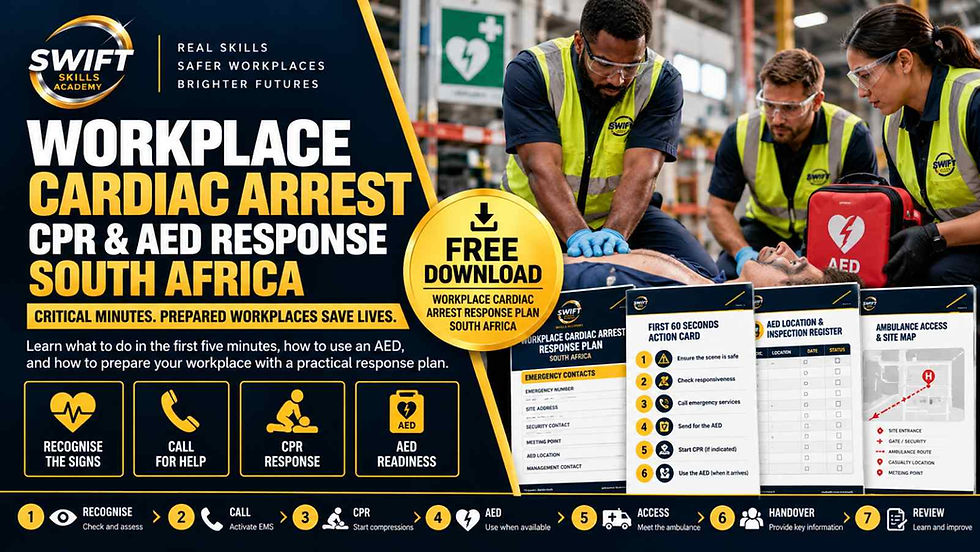
CPR Course Cape Town: Training, Cost, Certificate, Who Needs It & How to Book
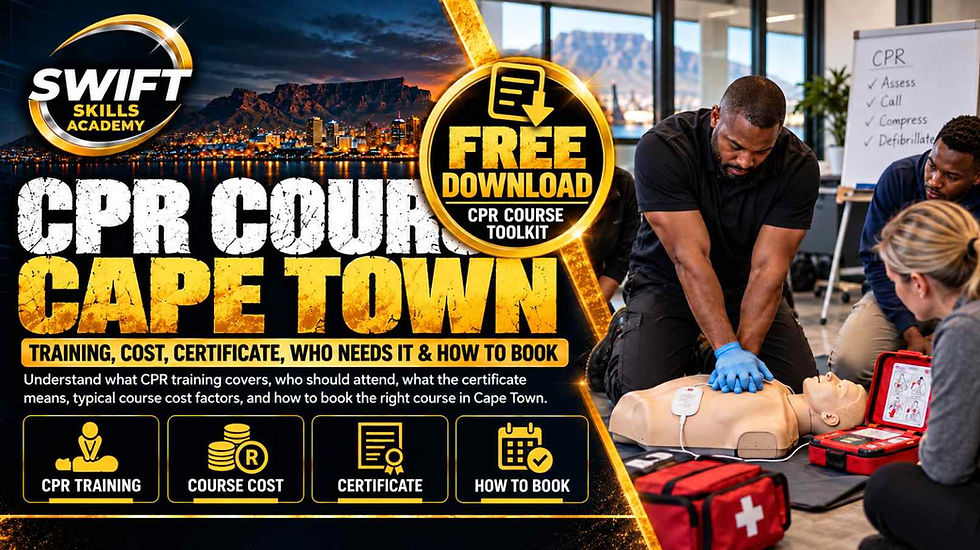
Someone collapses.
They are unresponsive.
They are not breathing normally.
The ambulance has not arrived yet.
That is the gap CPR training is designed to address: the minutes between recognising a life-threatening emergency and professional medical care taking over.
But if you search “CPR course Cape Town”, you will find very different kinds of training.
Some courses teach CPR awareness.
Some include CPR, choking and AED use.
Some are designed for parents or members of the public.
Some are healthcare-provider Basic Life Support programmes.
Others teach CPR as one component of a broader workplace First Aid qualification.
Those are not automatically the same course, certificate or outcome.
Quick Answer: Where Can I Do a CPR Course in Cape Town?
If you are looking for practical CPR training in Cape Town, first determine what outcome you actually need.
Swift Skills Academy’s current published Basic Emergency First Aid Responder SP-230801 programme includes practical CPR and basic life-support training as part of a broader workplace First Aid programme.
The current published course information is:
Programme: Basic Emergency First Aid Responder
Skills Programme: SP-230801
Curriculum: 900232-000-00-00
NQF Level: 2
Credits: 2
Duration: 2 days
Cape Town venue: Killarney Gardens
Current starting price: From R928 per learner
Company training: On-site options available
The course combines classroom learning, demonstrations, emergency scenarios and hands-on First Aid activities including CPR practice. Swift Skills Academy
If you specifically require a standalone CPR course, RCSA course, AHA programme or healthcare-provider BLS course, confirm that exact programme before paying.
Do not assume every course containing the word CPR produces the same certificate.
What Is a CPR Course?
CPR stands for cardiopulmonary resuscitation.
CPR training teaches a responder how to recognise a life-threatening collapse and provide resuscitation support while professional emergency medical assistance is being activated.
Practical training commonly focuses on recognising an emergency, activating emergency services and performing CPR correctly on a training manikin.
Depending on the exact course, training may also cover:
choking;
rescue breathing;
use of an Automated External Defibrillator;
adult CPR;
child CPR;
infant CPR;
team resuscitation; or
healthcare-provider Basic Life Support.
The exact scope matters.
Do not buy a course because the advertisement simply says “CPR certified.”
Ask what is actually taught and assessed.
CPR Course vs First Aid Course: What Is the Difference?
This is one of the most important distinctions for anyone comparing CPR training in Cape Town.
CPR Training
A CPR-focused course concentrates primarily on resuscitation and related life-support skills.
Depending on the programme, this may include:
recognising cardiac arrest;
activating emergency assistance;
chest compressions;
rescue breathing;
choking response;
AED use.
It may be relatively short compared with a full First Aid programme.
First Aid Training
A workplace First Aid programme is broader.
It can include CPR but also covers additional emergency-response capability such as:
scene assessment;
casualty assessment;
bleeding;
wounds;
choking;
other injuries;
monitoring;
escalation;
handover; and
workplace emergency-response procedures.
Swift Skills Academy’s current Basic Emergency First Aid Responder programme includes CPR and basic life support within this wider First Aid scope. Swift Skills Academy
Basic Life Support
BLS is another distinct term.
Healthcare-focused BLS programmes may involve more structured resuscitation skills, AED use, ventilation and team response.
The Resuscitation Council of Southern Africa distinguishes between programmes for lay rescuers and programmes intended for professional rescuers. Resus
That is why CPR, First Aid and BLS should not be treated as interchangeable labels.
What Do You Learn on a CPR Course?
The exact curriculum depends on the programme.
A strong practical CPR course should make the learner do more than watch a presentation.
Recognising a Medical Emergency
The learner should understand how to recognise when immediate emergency action may be required.
Activating Emergency Medical Help
CPR is not a substitute for professional medical treatment.
A responder must understand how emergency assistance is activated and how to reduce unnecessary delay.
Practical CPR
CPR is a physical skill.
Learners should practise rather than merely read about chest compressions.
Airway and Breathing Response
The exact techniques taught depend on the programme and learner category.
Choking Response
Many CPR-oriented programmes also cover choking because an obstructed airway can quickly become life-threatening.
AED Awareness or Training
Do not automatically assume every CPR course includes AED training.
Ask.
The Resuscitation Council of Southern Africa states that early defibrillation remains an important component of response to sudden cardiac arrest and continues to encourage access to AEDs. Its 2026 guidance also confirms continued AED-use principles under the 2025 emergency cardiovascular-care guidelines. Resus
Scenario Practice
Good training should help the learner connect separate skills into a response sequence.
The goal is not merely knowing what CPR stands for.
It is knowing what to do when someone actually collapses.
Does Swift Skills Academy's First Aid Course Include CPR?
Yes.
Swift Skills Academy's current Basic Emergency First Aid Responder page specifically includes CPR and basic life support within the training.
The published programme also includes emergency assessment, choking response, practical emergency scenarios and other First Aid activities. Swift Skills Academy
This makes it particularly relevant for someone searching for CPR training who also needs a broader workplace First Aid outcome.
Does Swift Skills Academy Currently Offer a CPR-Only Course?
Do not confuse a course that includes CPR with a separately certified CPR-only programme.
Swift Skills Academy's currently published offer positions CPR within Basic Emergency First Aid Responder SP-230801.
If you specifically require:
CPR-only training;
RCSA CPR certification;
AHA certification;
healthcare-provider BLS;
infant CPR;
paediatric CPR; or
another specialist resuscitation programme,
confirm the exact programme and certificate required before enrolling.
That single question can prevent booking the wrong training.
Who Should Learn CPR?
CPR is useful far beyond people working in hospitals.
Potential learners include:
workplace First Aiders;
safety representatives;
supervisors;
security personnel;
teachers;
coaches;
fitness staff;
hospitality employees;
reception teams;
parents;
caregivers;
community volunteers;
construction teams;
warehouse employees;
manufacturing personnel; and
members of the public who want emergency-response skills.
But “CPR would be useful for me” and “I need a particular certificate for my job” are different questions.
Start with the required outcome.
Do Employers Need CPR-Trained Employees in South Africa?
South African workplace law should not be reduced to the statement:
“Every company needs a CPR certificate.”
That is too simplistic.
General Safety Regulation 3 deals with workplace First Aid arrangements.
Following the December 2025 amendment, Regulation 3(4) refers to a valid certificate of competency in First Aid issued by an organisation approved by the Chief Inspector for the designated First Aider arrangements covered by that regulation. South African Government
The important implication is:
A CPR-only attendance certificate should not automatically be assumed to satisfy a workplace First Aider requirement.
Employers need to identify:
what the law requires;
what role the employee will perform;
which First Aid competency is required;
what certificate will be issued; and
whether the provider and issuing route are appropriate.
CPR Training for Workplace First Aiders
For a nominated workplace First Aider, CPR should sit inside a much broader capability framework.
The person may also need to respond to:
bleeding;
burns;
choking;
falls;
wounds;
medical collapse;
shock;
workplace injuries; and
emergency handover.
That is why an employer looking for workplace compliance should not automatically replace comprehensive First Aid training with a short CPR session.
The correct course depends on the role.
CPR Training for Parents and Caregivers
Parents and caregivers often search for CPR for a different reason.
Their main concern may be:
infant choking;
child CPR;
drowning;
home emergencies;
childcare.
If that is the objective, ask specifically whether the course includes infant and child CPR.
Do not assume an adult workplace programme automatically covers every paediatric skill you want.
CPR Training for Teachers, Coaches and Fitness Staff
These roles may involve large numbers of people, physical activity or children.
A useful training decision should consider:
who they supervise;
likely emergencies;
whether an AED is present;
emergency-service response time;
whether a certificate is required by the employer or organisation.
The correct course should follow that need.
Not simply the shortest advertised training session.
CPR Course for Healthcare Professionals
Healthcare professionals should be especially careful when searching for generic “CPR courses.”
A lay-rescuer CPR programme and a professional BLS programme are not the same thing.
The Resuscitation Council of Southern Africa has specific provider-course structures and distinguishes professional-rescuer training from general public CPR programmes. Resus
If your employer, professional body or clinical role requires a specific BLS or professional CPR certificate, book that exact programme.
Does a CPR Course Include AED Training?
Sometimes.
Not always.
AED stands for Automated External Defibrillator.
Dedicated CPR/BLS programmes frequently incorporate AED training, but the course specification should say so.
Do not assume.
Before booking, ask:
Is AED use included?
Is it demonstrated only, or practised?
Is an AED trainer used?
Is AED competence assessed?
Does the issued certificate specifically cover the programme completed?
RCSA's current guidance describes high-quality CPR and early defibrillation as complementary elements of cardiac-arrest response. Resus
What Is an AED?
An AED is designed to analyse a casualty's heart rhythm and, when appropriate, direct the rescuer to deliver a shock.
It does not replace CPR.
CPR and defibrillation form different parts of the response.
If your organisation already has an AED, training decisions should consider whether designated responders know:
where it is;
how to retrieve it;
how to operate it;
how to continue CPR around AED use; and
who maintains the device.
That operational topic belongs primarily to your emergency-response system, not merely the training certificate.
How Much Does a CPR Course Cost in Cape Town?
The price depends heavily on which course you mean.
A short CPR-awareness class cannot fairly be compared with:
a workplace First Aid programme;
an RCSA CPR programme;
an AHA programme;
professional BLS; or
a broader assessed occupational skills programme.
Swift Skills Academy currently publishes its Basic Emergency First Aid Responder SP-230801 course from R928 per learner.
That is a two-day First Aid programme which includes CPR and basic life support rather than a separately advertised CPR-only class. Swift Skills Academy
If you are comparing prices, compare like with like.
Why a Cheap CPR Course May Not Be the Cheapest Decision
Suppose Course A costs less.
But the employer later discovers that:
the wrong certificate was issued;
the course does not satisfy the workplace requirement;
AED training was assumed but not included;
there was no practical assessment;
the employee actually required broader First Aid competence.
The business may then pay twice.
Price should come after course purpose.
What Should Be Included in a CPR Training Quote?
Before paying, ask the provider to confirm:
Exact course title
Do not accept “CPR course” as the only description.
Target learner
Lay rescuer, workplace First Aider, caregiver or healthcare professional?
Duration
How many hours or days?
Practical training
Will learners physically practise CPR?
AED
Included or excluded?
Adult / child / infant
Which age groups are included?
Assessment
Is competence assessed, or is attendance enough?
Certificate
Exactly what document will the learner receive?
Issuing organisation
Who issues or endorses the certificate?
Validity
What renewal or retraining requirement applies to that specific certificate?
Price
What is included and excluded?
Delivery
Public class, private group or on-site employer training?
How Long Does a CPR Course Take?
There is no single universal answer.
Dedicated CPR courses can be much shorter than comprehensive First Aid programmes.
Healthcare BLS programmes have different structures again.
Swift Skills Academy's current Basic Emergency First Aid Responder SP-230801 route is published as a two-day programme because CPR forms part of broader practical First Aid training. Swift Skills Academy
The better question is:
How long does the exact course I need take?
Can You Do CPR Training in One Day?
Some CPR programmes can be delivered within a day or even within several hours.
That does not mean every First Aid or BLS programme can.
Course duration follows programme scope.
A short CPR session should not be marketed as equivalent to a broader assessed First Aid programme merely because both teach chest compressions.
Do You Get a Certificate After CPR Training?
This depends on the course.
Possible outcomes include:
attendance certificate;
participation certificate;
CPR course-completion certificate;
RCSA/AHA-associated course completion;
workplace First Aid competency certificate;
QCTO-related programme outcome.
Those documents are not automatically equivalent.
Before booking, ask:
“What exact certificate will I receive if I successfully complete this course?”
Then ask:
“Is that certificate appropriate for what my employer or professional role requires?”
Is a CPR Certificate the Same as a First Aid Certificate?
No.
A CPR certificate may evidence CPR-specific training.
A First Aid certificate relates to a broader First Aid programme.
A person can therefore know CPR without necessarily holding the First Aid competency evidence required for a particular workplace appointment.
Do not let the words certificate, accredited and CPR substitute for checking the actual programme.
Is a CPR Certificate Valid for Three Years?
Do not assume every CPR certificate has the same validity period.
Certificate duration can depend on:
training organisation;
programme;
issuing body;
professional requirements;
employer rules; and
current programme policy.
Confirm the renewal or retraining requirements for the exact certificate you are buying.
This is safer than applying one generic expiry period to every CPR programme.
What Is the Difference Between Attendance and Competency?
This is critical.
An attendance document may prove that somebody was present.
A competency certificate normally implies that defined learning and assessment requirements were successfully completed.
For workplace procurement, ask whether the learner is:
attending a session
or
being assessed against a defined competency outcome.
The difference can matter significantly.
What Should Practical CPR Training Look Like?
CPR is not a skill that should exist only in a slide deck.
A serious practical programme should provide appropriate opportunities to practise the required skills.
Depending on the course, equipment may include:
CPR manikins;
face shields or barrier devices;
AED training units;
ventilation equipment;
child or infant manikins.
RCSA training-site policies specify practical equipment requirements for its own BLS/provider programmes, reinforcing the importance of hands-on training infrastructure. Resus
Can Beginners Learn CPR?
Yes, many CPR and foundational First Aid programmes are designed for people without previous emergency-medical experience.
Swift Skills Academy's published Basic Emergency First Aid Responder information lists Open Access and does not prescribe a formal minimum academic qualification for entry.
Learners are currently required to provide the necessary identification/registration information, and training is delivered in English. Swift Skills Academy
Is CPR Training Difficult?
CPR training is practical and physically active.
Learners may need to:
kneel;
position themselves around a manikin;
perform repeated chest compressions;
practise emergency scenarios.
People who require reasonable accommodation should discuss this before training.
The objective is not to make the course intimidating.
It is to make the learner capable of performing the required practical skills safely.
Should Every Employee Be CPR-Trained?
There is no universal rule requiring every employee in every business to complete CPR training.
But employers may choose to develop broader emergency-response capability based on:
workplace risk;
workforce size;
shifts;
locations;
emergency-response time;
presence of an AED;
operational resilience.
For some employers, training only the mathematical minimum may leave practical gaps.
Can Companies Arrange CPR Training On-Site in Cape Town?
Swift Skills Academy currently offers on-site employer options for its First Aid programmes.
That can be useful where companies need to train:
several employees;
multiple departments;
several shifts;
emergency-response teams; or
employees at one workplace.
If the organisation specifically needs a CPR-only session rather than the broader First Aid programme, the exact training scope and certificate should be confirmed before booking.
CPR Training for Groups: What Should Employers Plan?
Do not simply choose ten random employees.
Start with the workplace.
Ask:
Which sites need responders?
Which shifts need coverage?
Which floors need coverage?
Who is regularly present?
Who works remotely?
Who is likely to remain with the company?
Who already has current First Aid competency?
Is an AED available?
What emergency risks exist?
Then choose learners.
Training should close an operational gap.
CPR Course Near Me in Cape Town: Does Location Matter?
Convenience matters.
But it should not outrank training quality or certificate suitability.
Swift Skills Academy's current public Basic First Aid training is delivered at:
6 Monaco Road, Killarney Gardens, Cape Town. Swift Skills Academy
For employer groups, on-site training may reduce travel and help coordinate multiple learners.
The best option depends on whether you need:
one learner;
several learners;
a company group;
workplace-specific scheduling.
How Do I Choose a CPR Training Provider in Cape Town?
Use this checklist before booking.
1. Identify the Exact Course
Ask for the formal title.
2. Identify the Intended Learner
Is it designed for:
the public;
workplace First Aiders;
caregivers;
healthcare workers?
3. Check the Practical Component
Does the learner physically practise CPR?
4. Check AED Scope
Included or excluded?
5. Check Child and Infant Content
Do not assume.
6. Check the Assessment
Is there a practical competency assessment?
7. Check the Certificate
What exact document is issued?
8. Check the Issuing Organisation
Who stands behind the certificate?
9. Check Provider Status Where Applicable
QCTO maintains databases of accredited Skills Development Providers for occupational programmes under its quality-assurance framework. QCTO
10. Check Workplace Suitability
If the employee will be appointed as a workplace First Aider, verify the actual First Aid requirement rather than assuming a CPR-only certificate is enough.
11. Check Price Inclusions
Materials?
Assessment?
Certificate?
Travel?
VAT?
12. Get It in Writing
A clear quotation protects both learner and employer.
CPR Course Red Flags
Be cautious if a provider cannot clearly answer:
What course is this?
Who is it designed for?
What practical skills will I perform?
What assessment will I complete?
What certificate will I receive?
Who issues it?
Is AED training included?
Is adult/child/infant CPR included?
What is the certificate's renewal requirement?
What exactly does the quoted price include?
A professional provider should not become vague when the questions become specific.
CPR Training vs Watching a CPR Video Online
Online videos can improve awareness.
They are not the same as supervised practical training.
CPR involves physical performance.
A learner benefits from:
practising compression technique;
receiving correction;
working through scenarios;
handling relevant equipment;
being assessed where assessment forms part of the programme.
Watching CPR and performing CPR correctly are different experiences.
What About the Latest CPR Guidelines?
Resuscitation guidance changes over time.
In October 2025, updated international CPR and Emergency Cardiovascular Care guidelines were released.
The Resuscitation Council of Southern Africa subsequently stated that major training providers, including the RCSA, had adopted the updated guidelines into training programmes and materials. Resus
This is another reason to train through a provider using current programme materials rather than relying on an old manual or an outdated video.
Is an AED Required in Every South African Workplace?
Do not claim that every South African workplace is legally required to purchase an AED.
The appropriate decision depends on the workplace and applicable requirements.
However, RCSA encourages wider implementation of public-access defibrillation and notes the importance of early defibrillation alongside high-quality CPR in sudden cardiac arrest. Resus
Employers considering an AED should think about:
placement;
visibility;
accessibility;
maintenance;
pad/battery expiry;
responder training;
emergency procedures.
CPR Training and Workplace Cardiac Arrest Are Different Search Intents
This page is about:
choosing and booking training.
If you are trying to build an actual workplace cardiac-arrest response plan, the questions become different:
Who recognises the collapse?
Who calls emergency services?
Who starts CPR?
Where is the AED?
Who brings it?
How do paramedics gain access?
Who reviews the incident?
That operational emergency-response topic should be treated separately from choosing a CPR course.
This separation matters both for employers and for search intent.
What Should an Employer Do Before Booking CPR or First Aid Training?
Use this order.
Step 1: Define the Required Outcome
CPR awareness?
Workplace First Aid competency?
Healthcare BLS?
CPR/AED training?
Step 2: Define the Learners
Who needs the skill and why?
Step 3: Define the Workplace Requirement
Do not start with the cheapest course.
Step 4: Check the Exact Programme
Title, scope, duration and learner category.
Step 5: Check Practical Training
Make sure learners actually practise.
Step 6: Check Assessment
Attendance or competency?
Step 7: Check Certification
Exactly what will be issued?
Step 8: Verify the Provider and Issuing Route
Use the relevant official verification route for the programme you are buying.
Step 9: Choose Public or On-Site Training
Match the delivery method to learner numbers and operational constraints.
Step 10: Deploy the Learner After Training
Training only becomes operationally useful when the right person is available where emergencies may occur.
How to Book CPR-Related Training in Cape Town
Before submitting an enquiry, have these details ready:
individual or company booking;
number of learners;
CPR-only or broader First Aid requirement;
workplace or personal training;
preferred dates;
public or on-site preference;
whether a specific certificate is required;
whether AED training is required;
whether adult, child or infant CPR is required.
That allows the training provider to identify the correct route rather than guessing from the words “I need CPR.”
Which Swift Skills Academy Programme Should I Investigate First?
If your goal is workplace First Aid training that includes CPR, the current starting point is:
Basic Emergency First Aid Responder SP-230801
It is currently published as:
NQF Level 2;
2 credits;
2 days;
practical First Aid training;
CPR and basic life support;
Cape Town public classes; and
company on-site options. Swift Skills Academy
If your need is specifically a specialist standalone CPR or healthcare-provider course, confirm that requirement before booking anything.
Frequently Asked Questions
How much is a CPR course in Cape Town?
Prices depend on the type of CPR training and certificate required.
Swift Skills Academy currently publishes its two-day Basic Emergency First Aid Responder SP-230801 programme, which includes CPR and basic life support, from R928 per learner. Swift Skills Academy
How long does CPR training take?
A dedicated CPR programme can be shorter than a full First Aid programme.
Swift Skills Academy's current Basic Emergency First Aid Responder programme is two days because CPR is taught within broader practical First Aid training. Swift Skills Academy
.
Does Swift Skills Academy offer CPR training?
Swift Skills Academy's current Basic Emergency First Aid Responder programme includes CPR and basic life support.
Do not assume this means a separate CPR-only certification programme is currently offered.
Can beginners do CPR training?
Yes. Many foundational programmes are suitable for beginners.
Swift Skills Academy's current Basic Emergency First Aid Responder route lists Open Access. Swift Skills Academy
Is CPR the same as First Aid?
No.
CPR is a specific resuscitation skill. First Aid training covers a wider range of emergency-response skills.
Is CPR the same as BLS?
Not necessarily.
BLS programmes, particularly those aimed at healthcare professionals, can have a broader or more structured clinical resuscitation scope.
Does a CPR course include AED training?
Some do and some do not.
Confirm AED content before booking.
Does CPR training include choking?
Many CPR-oriented programmes include choking response, but the exact syllabus should always be checked.
Swift Skills Academy's published Basic First Aid programme includes choking response within its broader training scope. Swift Skills Academy
Will I receive a CPR certificate?
That depends on the course.
Ask for the exact certificate title, issuing organisation and assessment requirements before paying.
Is a CPR certificate enough to be a workplace First Aider?
Do not assume so.
South African workplace First Aid requirements refer to First Aid competency and the relevant approved issuing arrangements. A CPR-only certificate may have a different purpose. South African Government
Can companies book on-site CPR or First Aid training?
Swift Skills Academy currently offers on-site company options for its First Aid training.
If a company specifically needs CPR-only training, confirm the precise course and certificate before booking. Swift Skills Academy
Where is Swift Skills Academy in Cape Town?
Swift Skills Academy's current First Aid training venue is at 6 Monaco Road, Killarney Gardens, Cape Town. Swift Skills Academy
Does CPR training cover child and infant CPR?
It depends on the programme.
If child or infant CPR is important to you, confirm it explicitly before enrolment.
Do I need CPR training if my workplace has an AED?
Having an AED does not eliminate the need for an emergency-response system.
RCSA guidance continues to position high-quality CPR and early defibrillation as complementary parts of cardiac-arrest response. Resus
How often should CPR skills be refreshed?
Do not apply one universal expiry rule to every CPR course.
Follow the renewal policy of the specific course or certificate and consider regular practical refreshers because CPR is a perishable hands-on skill.
Authoritative Sources & Regulatory References
South African Government — General Safety Regulations / 2025 Amendment
Supports the current workplace First Aid competency and approved-issuing-organisation wording applicable to Regulation 3(4). South African Government
Resuscitation Council of Southern Africa — 2025 ECC Guidelines: Effect on AEDs
Supports current South African resuscitation guidance relating to CPR, early defibrillation and AED use. Resus
Resuscitation Council of Southern Africa — Provider Course Entry Requirements
Supports the distinction between public/lay-rescuer CPR programmes and professional-rescuer courses. Resus
Quality Council for Trades and Occupations — Skills Programmes
Confirms that QCTO skills programmes are occupationally directed and focus on practical, simulation and/or work-experience components. QCTO
Quality Council for Trades and Occupations — Accredited Skills Development Provider Database
Provides the official QCTO verification route for accredited providers delivering applicable occupational programmes. QCTO
Swift Skills Academy — QCTO First Aid Training Cape Town
Confirms SSA's current Basic Emergency First Aid Responder programme, SP-230801, NQF Level 2, 2 credits, two-day duration, starting price, Cape Town venue, practical methodology and CPR/basic life-support component. Swift Skills Academy
Read More
Final Word
Someone searching CPR course Cape Town should not have to decode a wall of vague training language.
The buying decision can be much simpler:
WHO NEEDS THE TRAINING?
WHAT MUST THEY BE ABLE TO DO?
CPR ONLY OR BROADER FIRST AID?
IS AED TRAINING REQUIRED?
WHAT PRACTICAL ASSESSMENT TAKES PLACE?
WHAT CERTIFICATE WILL BE ISSUED?
WHO ISSUES IT?
IS THAT OUTCOME APPROPRIATE FOR THE LEARNER'S ACTUAL ROLE?
Then book.
For workplace learners who need broader First Aid capability including CPR, Swift Skills Academy's current Basic Emergency First Aid Responder SP-230801 provides a clear Cape Town pathway.