
First Aid Box Requirements South Africa: Contents, Location, Inspection & Employer Duties
Quick Answer: What Are the First Aid Box Requirements in South Africa?
Under Regulation 3 of South Africa's General Safety Regulations, an employer with more than five employees at a workplace must provide a first aid box or boxes that are available and accessible for treating injured persons.
The employer must consider:
the likely injuries at the workplace;
the work being performed;
the number of employees;
whether the legal minimum contents are sufficient for the workplace's actual risks;
whether the boxes are clearly identified and accessible; and
who is responsible for them.
The regulations also require a prominent notice or sign showing where the first aid box is kept and identifying the person in charge of it. Acts Online
Important: the December 2025 amendment changed the requirements dealing with the availability of certificated first aiders under Regulation 3(4). It did not replace the separate first aid box duties in Regulation 3(2), 3(3) and 3(6). South African Government
First Aid Box Requirements South Africa at a Glance
Workplace question | Practical answer |
When is a first aid box required? | Where more than five employees are employed at a workplace. |
Must it be accessible? | Yes. It must be available and accessible for treatment of injured persons. |
Is there a legal minimum contents list? | Yes. The Annexure to Regulation 3 lists minimum equipment. |
Can one standard box suit every workplace? | Not necessarily. Workplace risks, activities and employee numbers must also be considered. |
Must the box location be signposted? | Yes. A prominent notice or sign must indicate where it is kept. |
Must someone be responsible for the box? | The sign must identify the person in charge of the box or boxes. |
Can offices use reduced quantities? | Yes, specified Annexure items may be reduced by half for shops and offices. |
Does having a box replace the need for trained first aiders? | No. First aid equipment and trained-person requirements are separate obligations. |
What Does South African Law Actually Require?
The core workplace rule sits in Regulation 3 of the General Safety Regulations under the Occupational Health and Safety Act.
Regulation 3 does more than simply tell an employer to buy a first aid kit.
It requires the employer to take reasonable steps to ensure prompt first aid treatment is available when injury or an emergency occurs.
Where more than five employees work at the workplace, the employer must provide a first aid box or boxes at or near the workplace, and the equipment must be available and accessible to injured persons. Acts Online
This distinction matters.
A sealed kit locked inside an inaccessible office may physically exist, but that is not the same thing as having appropriate first aid resources readily available when an incident occurs.
How Many Employees Trigger the First Aid Box Requirement?
The specific threshold for the statutory first aid box requirement is:
More than five employees at a workplace.
That means an employer should pay attention to the exact wording.
A workplace with six or more employees falls within Regulation 3(2)'s first aid box requirement. Acts Online
Employers should also avoid confusing this threshold with the separate requirement dealing with certificated first aiders.
Since the December 2025 amendment, where more than 10 employees are employed, Regulation 3(4) requires at least one appropriately certificated first aid person to be readily available during normal working hours for every group of up to:
50 employees generally; or
100 employees in a shop or office. Acts Online
First Aid Box vs First Aider: They Are Not the Same Requirement
A common employer mistake is to treat these as interchangeable.
They are not.
Requirement | What it deals with |
First aid box | Equipment and supplies |
First aider | Competent person available to provide first aid |
Workplace first aid planning | Making sure both remain practically available when needed |
An employer can therefore have a properly stocked first aid box and still have a weakness in actual emergency readiness if nobody appropriately trained is available when an incident occurs.
What Must Be in a First Aid Box in South Africa?
The Annexure to Regulation 3 establishes the minimum contents of a workplace first aid box.
The listed items include:
Item | Minimum requirement |
Wound cleaner / antiseptic | 100 ml |
Swabs | For cleaning wounds |
Cotton wool | 100 g for padding |
Sterile gauze | Minimum quantity 10 |
Forceps | 1 pair |
Scissors | 1 pair, minimum 100 mm |
Safety pins | 1 set |
Triangular bandages | 4 |
Roller bandages | 4 × 75 mm × 5 m |
Roller bandages | 4 × 100 mm × 5 m |
Elastic adhesive | 1 roll, 25 mm × 3 m |
Non-allergenic adhesive strip | 1, 25 mm × 3 m |
Adhesive dressing strips | Minimum 10 assorted |
First aid dressings | 4 × 75 mm × 100 mm |
First aid dressings | 4 × 150 mm × 200 mm |
Straight splints | 2 |
Disposable gloves | 2 pairs large + 2 pairs medium |
CPR mouthpieces or similar devices | 2 |
Special Rule for Shops and Offices
The Annexure specifically allows the quantities of certain listed items to be reduced by half for shops and offices.
That concession applies to specified items in the Annexure rather than automatically reducing every item in the box. Acts Online
Employers should therefore avoid simply buying a smaller kit labelled “office first aid kit” and assuming that its contents automatically satisfy the legal requirement.
The actual contents should be checked against the Annexure.
Is the Legal Minimum Always Enough?
No.
This is one of the most important parts of Regulation 3.
The employer must consider:
the type of injuries likely to occur;
the nature of the work;
and the number of employees at the workplace.
The first aid box must contain suitable equipment that includes at least the Annexure equipment. Acts Online
In practice, that means the statutory list should be treated as a baseline, not as a universal risk assessment.
A small administrative office and a fabrication workshop do not present identical injury profiles.
Neither do:
warehouses;
restaurants;
construction sites;
engineering workshops;
schools;
manufacturing facilities;
logistics depots; or
workplaces using corrosive or toxic substances.
A workplace's first aid provision should therefore follow its actual hazard profile.
First Aid Box Requirements by Workplace Risk
Office and Administrative Workplaces
Office environments may typically face lower-frequency risks such as:
minor cuts;
falls;
strains;
minor burns;
sudden illness; and
medical emergencies.
The Annexure allows specified quantities to be reduced for shops and offices, but employers still need to maintain an accessible and usable box. Acts Online
Warehouses and Logistics Operations
Additional risk considerations can include:
cuts and lacerations;
crush incidents;
forklifts and moving equipment;
manual handling;
loading areas;
multiple shifts; and
employees working across large premises.
The real question becomes not only “Do we have a box?” but:
Can an injured employee actually receive first aid quickly from the area in which the incident occurs?
Engineering, Welding and Fabrication Workplaces
Possible risks include:
burns;
cuts;
sharp metal;
grinding incidents;
eye hazards;
heat;
tools and machinery.
Where an eye hazard can arise through contact with a biological or chemical substance, Regulation 3 separately requires an eyewash fountain or similar facility in the immediate vicinity, with employees trained to use it. Acts Online
Workplaces Handling Hazardous Substances
Regulation 3 contains additional provisions where high-risk, toxic, corrosive or similar substances are used or handled.
It may require specialised first aid training relevant to the potential injury or exposure, and in appropriate circumstances emergency eyewash or rapid deluge-shower facilities. Acts Online
This is why buying a generic first aid kit must never replace an actual workplace risk assessment.
Where Should a First Aid Box Be Located?
The regulations require the box or boxes to be available and accessible for treating injured people at the workplace. Acts Online
For employers, a sensible placement test is:
Could an employee reach appropriate first aid quickly during a real incident?
Factors worth considering include:
building size;
separate floors;
workshops;
warehouses;
remote work areas;
different departments;
locked rooms;
security-controlled areas;
night shifts;
mobile crews; and
travel time between the injury location and the box.
One box may technically exist, but a large or dispersed operation may need multiple boxes because of practical access and risk.
The regulation deliberately links suitable provision to the workplace's activities and employee numbers rather than imposing one universal box-per-X-workers formula. Acts Online
How Many First Aid Boxes Does a Workplace Need?
South Africa's General Safety Regulations do not simply state a universal formula such as “one box for every 50 employees.”
Instead, Regulation 3 requires a first aid box or boxes and requires the employer to consider:
workplace activities;
injury risks; and
number of employees. Acts Online
Therefore, an employer should not blindly apply an unofficial number.
A workplace with:
20 employees in one compact office,
may have a very different need from:
20 workers dispersed across several workshops or operational areas.
Practical employer decision test
Ask:
How quickly can the kit be reached?
Are workers spread across different buildings or floors?
Are teams geographically separated?
Does the workplace operate after hours or shifts?
Are there high-risk work areas?
Could one incident make the only first aid box inaccessible?
Does the workplace risk assessment indicate additional equipment or boxes?
That creates a much stronger first aid system than merely counting employees.
Must a First Aid Box Have a Sign?
Yes.
Regulation 3(6) requires the employer to place a prominent notice or sign in a conspicuous place indicating:
where the first aid box or boxes are kept; and
the name of the person in charge of the box or boxes. Acts Online
This is an often-overlooked requirement.
A compliant-looking first aid box mounted on a wall does not by itself satisfy the signage provision.
Who Should Be Responsible for the First Aid Box?
The regulations specifically require the workplace sign to identify the person in charge of the first aid box or boxes. Acts Online
From an operational perspective, that person should have a clear routine for checking:
stock quantities;
used items;
damaged packaging;
contamination;
expired products where applicable;
missing equipment;
gloves;
CPR barrier devices;
seals;
accessibility;
signage; and
whether the box still matches the workplace's current risks.
This is where many companies fail.
They buy the box once.
Then nobody owns it.
Months later, the box may contain:
empty packets;
used bandages;
missing gloves;
damaged equipment;
obsolete stock;
or supplies that no longer match the workplace.
How Often Should a First Aid Box Be Inspected?
Regulation 3 does not prescribe a universal sentence such as:
“Inspect the box every 30 days.”
So employers should not present a particular monthly interval as if it were explicitly mandated by Regulation 3.
Instead, the employer must ensure that the required first aid resources remain suitable and available.
A practical inspection schedule should therefore be based on:
frequency of use;
workplace risk;
number of employees;
stock turnover;
operating shifts;
previous incidents; and
the likelihood that items could expire, become contaminated or disappear.
Strong employer practice
A workplace can establish:
a formal inspection frequency;
a named responsible person;
an inventory checklist;
a restocking trigger after every use;
a record of inspection;
expiry checks;
and escalation when equipment is missing.
The important distinction is:
The inspection interval is an employer control measure; the legal duty is to maintain suitable, available first aid provision.
First Aid Box Inspection Checklist for South African Employers
A useful workplace inspection should check more than whether the box is hanging on the wall.
Box and Access
☐ Box is present
☐ Box is immediately identifiable
☐ Box is not obstructed
☐ Box can be opened when needed
☐ Box location remains appropriate
☐ Signage is visible
☐ Person in charge is correctly named
Contents
☐ Statutory minimum contents checked
☐ Quantities restored after use
☐ Sterile items remain sealed
☐ Dressings are undamaged
☐ Gloves are available
☐ CPR barrier devices are present
☐ Scissors and forceps remain available
☐ Splints remain present
☐ Additional risk-specific items remain available
Workplace Fit
☐ Number of employees reviewed
☐ New hazards considered
☐ New departments considered
☐ Shift arrangements reviewed
☐ Remote/mobile teams considered
☐ Recent incidents considered
☐ First aiders and certificates reviewed separately
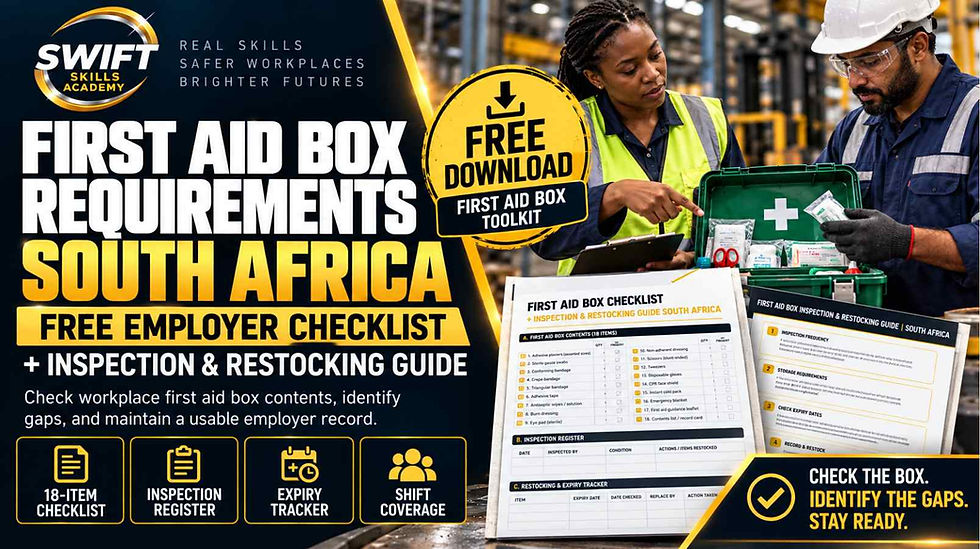
FREE DOWNLOAD:
Can Medicine Be Kept in a Workplace First Aid Box?
This needs careful interpretation.
Regulation 3(3)(b) says the employer must ensure that only the contemplated articles and equipment, other similar equipment or medicine, are kept in the first aid box. Acts Online
That wording should not be treated as blanket permission for an employer to stock and distribute arbitrary medication without appropriate controls.
Employers should distinguish between:
the statutory first aid equipment list;
any additional risk-assessed first aid equipment;
medicines;
workplace medical policies;
employee allergies and contraindications;
and situations requiring professional medical care.
Where medication is being considered, appropriate occupational-health or medical guidance is preferable to improvisation.
Can Employees Take Items from the First Aid Box?
First aid box requirements South Africa resources exist for treating workplace injuries and emergencies.
A strong control system should therefore ensure that:
items remain available for emergencies;
usage is reported;
used stock is replenished;
unnecessary removal is discouraged;
and the person in charge knows when contents have been used.
The purpose is not to create unnecessary bureaucracy.
It is to prevent discovering during an emergency that essential stock disappeared weeks earlier.
What Happens After the First Aid Box Is Used?
The process should not end when the injured person has been treated.
A well-managed workplace should trigger:
incident reporting where applicable;
restocking of used items;
inspection for contamination or damage;
review of whether the equipment was adequate;
review of the incident and underlying hazard;
confirmation that the workplace remains ready for another emergency.
If an incident reveals that the box was too far away, lacked appropriate equipment or could not be accessed promptly, that is useful information for improving the workplace system.
First Aid Box vs First Aid Kit: Is There a Legal Difference?
In everyday language, employers may use:
first aid box;
first aid kit;
first aid pack;
emergency kit.
But for general workplaces regulated under the OHS Act, the General Safety Regulations specifically use the term “first aid box or boxes.” Acts Online
The label on the container matters less than whether the workplace actually meets the applicable regulatory requirements.
Do not assume that a commercially sold product labelled:
“OHS compliant first aid kit”
is automatically sufficient.
Check its contents against the Annexure and your workplace's actual risk profile.
Do Vehicles Need First Aid Boxes?
This question depends on the operating context.
Regulation 3 focuses on first aid provision at or near the workplace, while other sectors, transport operations, mines, construction specifications or client requirements may create additional obligations.
Employers with:
mobile maintenance crews;
field technicians;
delivery teams;
travelling installation crews;
remote work groups;
should include mobile work in their risk assessment rather than assuming that a first aid box at head office adequately serves employees working elsewhere.
Construction Site First Aid Boxes
Construction environments deserve special attention because workers may be:
dispersed;
mobile;
exposed to tools and equipment;
working at height;
performing hot work;
operating machinery;
or working far from the main site office.
The General Safety Regulations remain an important baseline, while project-specific health and safety specifications may impose additional requirements.
For example, public-sector construction specifications sometimes explicitly require boxes to be stocked to the Regulation 3 minimum and supplemented according to risk assessment. eTenders Portal
Employers and contractors should therefore check both:
the law + the project/site-specific health and safety specification.
First Aid Boxes in Shops and Offices
The Annexure contains a specific concession for shops and offices.
For certain items, the prescribed quantities may be reduced by half. Acts Online
That does not mean shops and offices are exempt from:
having the box where required;
accessibility;
signage;
responsible-person requirements;
suitable equipment;
or the separate requirement for certificated First Aid personnel where applicable.
High-Risk Workplaces Need More Than a Generic Kit
Where a workplace uses or handles high-risk, toxic, corrosive or similar hazardous substances, Regulation 3 imposes additional first aid and emergency considerations.
These can include:
specialised first aid knowledge;
emergency procedures;
eyewash facilities; and
deluge showers where relevant. Acts Online
An employer should therefore avoid the dangerous assumption that:
“We bought the standard 18-item box, so First Aid is sorted.”
The correct question is:
“Does our emergency provision actually match the hazards our people face?”
First Aid Box Compliance Audit: 10 Questions Every Employer Should Ask
Before calling your workplace First Aid-ready, ask:
Do we employ more than five people at this workplace?
Do we have the required first aid box or boxes?
Have the contents been checked against the Annexure?
Have workplace-specific risks been considered?
Can employees reach the box quickly?
Is the location clearly signposted?
Is the responsible person's name displayed?
Is someone responsible for inspections and restocking?
Do we separately meet the applicable First Aider availability requirement?
Would the system still work during leave, shifts or an actual emergency?
If the answer to several of these is “I don't know”, the workplace has a planning problem worth correcting.
7 First Aid Box Mistakes Employers Should Avoid
1. Buying a kit and never inspecting it
The presence of a box is not the same as maintained first aid readiness.
2. Assuming every commercial kit is legally sufficient
Compare contents against Regulation 3's Annexure.
3. Keeping the box locked or difficult to access
Emergency equipment needs to be practically accessible.
4. Forgetting the sign
The workplace must display where the box is kept and identify the person in charge. Acts Online
5. Confusing the First Aid box requirement with First Aider ratios
These are different requirements.
6. Ignoring workplace risk
A generic kit may not adequately address the hazards of a specific operation.
7. Failing to restock immediately after use
A box that was compliant last month may be incomplete today.
Does a First Aid Box Make a Workplace Legally Compliant?
Not by itself.
First Aid readiness forms part of a broader employer safety system.
Depending on the workplace, that can involve:
first aid equipment;
competent First Aiders;
emergency procedures;
hazard-specific arrangements;
incident management;
emergency contact information;
eyewash or shower facilities;
and appropriate training.
The box is therefore one component of a workplace's emergency-preparedness system.
First Aid Training and the First Aid Box Must Work Together
Equipment is only useful if somebody knows how to respond.
Since the December 2025 amendment, workplaces with more than 10 employees must ensure appropriate certificated First Aid availability according to the updated employee-group rules in Regulation 3(4). Acts Online
Employers should therefore review:
equipment + people + shifts + workplace risks + accessibility
as one system.
For organisations needing current First Aid training in Cape Town, Swift Skills Academy provides a current QCTO Basic Emergency First Aid Responder training pathway for learners and workplace teams.
What Should an Employer Do Next?
Start with a physical inspection of every First Aid box in the workplace.
Do not rely on:
a purchase invoice;
an old checklist;
a photograph;
or the assumption that somebody else checked it.
Compare each box with the statutory Annexure, identify missing or used stock, confirm signage, review the responsible person, and compare the equipment against the workplace's current risk profile.
Then review your First Aider coverage separately.
That simple process can reveal gaps that would otherwise only become visible during an actual emergency.
Frequently Asked Questions
How many employees require a first aid box in South Africa?
Where more than five employees are employed at a workplace, Regulation 3 requires the employer to provide a first aid box or boxes at or near the workplace. Acts Online
What must be in a first aid box in South Africa?
The Annexure to Regulation 3 lists 18 categories of minimum first aid equipment, including wound cleaner, gauze, bandages, dressings, gloves, splints and CPR barrier devices. Acts Online
How many first aid boxes must a company have?
The regulation does not establish one simple universal ratio of boxes to employees. Employers must consider employee numbers, workplace activities, likely injuries and accessibility when deciding whether more than one box is needed. Acts Online
Do offices need first aid boxes?
Yes, where the employee threshold applies. The Annexure permits specified quantities to be reduced by half for shops and offices. Acts Online
Does a first aid box need a sign?
Yes. A conspicuous sign must indicate where the box is located and identify the person in charge. Acts Online
How often must a first aid box be checked?
Regulation 3 does not prescribe a single fixed inspection frequency. Employers should maintain a risk-appropriate inspection and restocking system that keeps required equipment available and suitable.
Can medicine be kept in a first aid box?
The regulation refers to contemplated articles and equipment, other similar equipment or medicine. Employers should nevertheless apply appropriate medical and occupational-health controls rather than treating this as blanket permission to distribute arbitrary medicines. Acts Online
Is a First Aider required if a workplace has a first aid box?
The requirements are separate. Where more than 10 employees are employed, the updated Regulation 3(4) sets requirements for certificated First Aid personnel to be readily available during normal working hours. Acts Online
Does a workplace need additional First Aid equipment for hazardous chemicals?
Potentially yes. Regulation 3 contains additional requirements for workplaces exposed to high-risk, toxic, corrosive or similar substances, including hazard-specific training and, where applicable, eyewash or deluge-shower facilities. Acts Online
Does buying an “OHS-compliant” First Aid kit guarantee compliance?
No. Employers should verify the contents against the applicable Annexure and make sure the kit is appropriate for workplace risks, employee numbers, access and emergency arrangements.
Authoritative Sources & Regulatory References
Authoritative Source | What It Supports |
Official government publication of the General Safety Regulations | |
Latest amendment to Regulation 3(4) dealing with First Aider availability | |
First aid box threshold, accessibility, risk considerations, signage, First Aiders and emergency facilities | |
Statutory minimum First Aid box contents and reduced quantities for shops/offices |
Final Word
The strongest South African First Aid system is not the workplace with the biggest green box on the wall.
It is the workplace where the right equipment is present, accessible, maintained, matched to the actual risks, supported by appropriately trained people, and ready when an emergency occurs.
For employers, that means treating the First Aid box as an operational safety control rather than a once-off purchase.


