
First Aid Training for Workplace Teams: Group & Shift Coverage Guide
Updated: 4 days ago
Training one employee in First Aid may tick a box on a training matrix.
It does not automatically mean your workplace has reliable First Aid coverage.
For South African employers operating across multiple departments, shifts, buildings, branches or work sites, the real question is:
Will an appropriately trained First Aider actually be available where and when an emergency occurs?
That is where First Aid training for workplace teams becomes more than booking several employees onto the same course.
It becomes a coverage-planning exercise.
This guide explains how employers can plan group First Aid training around employee numbers, shifts, sites, operational risks, absences, staff turnover and training batches — while understanding where QCTO First Aid training and current workplace requirements fit into the picture.
Quick Answer: How Should Employers Plan First Aid Training for a Workplace Team?
Start with the workplace — not the course booking.
An employer should first identify:
how many employees are normally present;
how many shifts operate;
how many sites or buildings require coverage;
where higher-risk work takes place;
which trained First Aiders are currently available;
when their certificates or competency records need review;
whether leave, sickness or staff turnover could remove coverage;
which employees are realistically available during normal operations.
Then plan training across those gaps.
For many businesses, the objective is not to train every employee. It is to create sufficient, dependable First Aider coverage across the organisation.
A useful planning principle
Workplace First Aid coverage = legal baseline + shift coverage + site coverage + absence contingency + workplace risk.
This is a practical planning model — not a substitute for the law or a workplace risk assessment.
What Is Group First Aid Training?
Group First Aid training means arranging training for a number of employees as part of a planned workplace rollout rather than treating each learner as an unrelated individual booking.
This can include:
one department;
several departments;
one shift;
several shifts;
supervisors;
health and safety representatives;
operational staff;
branch personnel;
employees across several sites.
For employers, the value is not simply putting more people through a course.
The real objective is to place trained people where they can provide meaningful coverage.
Group First Aid Training Is Not the Same as Training Everyone
A common mistake is assuming that “team training” or “bulk First Aid training” means the whole workforce should automatically be enrolled.
That is not necessarily the most effective strategy.
A more useful question is:
Which employees should be trained so that adequate First Aid capability exists across the workplace?
An organisation with 80 employees may require a very different deployment plan depending on whether those employees:
all work in one office;
operate across three warehouses;
work day and night shifts;
travel frequently;
work at client sites;
perform higher-risk industrial work;
work in isolated operational areas.
The training decision therefore needs to follow the workplace structure.
How Many Employees Should Your Company Train in First Aid?
There is no sensible one-number answer for every workplace.
The employer should distinguish between:
the applicable legal baseline, and
practical operational coverage.
The General Safety Regulations were amended in December 2025. The current framework retains requirements around suitably certificated First Aiders being readily available where the employee threshold is met. The precise regulatory position should be checked against the current regulations and the employer's circumstances. South African Government
But the minimum number on paper may still not solve a practical coverage problem.
Consider a company with two trained First Aiders.
If both work Monday to Friday on the same day shift, they may provide no useful First Aid coverage for a night shift.
That is why employers should map availability, not just headcount.
Legal Minimum Does Not Always Equal Operational Coverage
Imagine a business has enough trained people numerically.
Now ask:
Are they all based in the same department?
Do they work the same hours?
Are they regularly off-site?
Are they close enough to operational areas?
What happens during annual leave?
What happens when one resigns?
What happens when the night shift is operating?
What happens at a second warehouse or branch?
A training register can look healthy while actual emergency-response coverage remains fragile.
The goal should therefore be:
adequate coverage when work is actually happening.
What Is First Aider Coverage Resilience?
First Aider coverage resilience means your workplace does not lose practical First Aid capability because one trained employee is unavailable.
A resilient system does not depend entirely on a single person.
Example
Workplace situation | Paper appearance | Operational reality |
Two First Aiders on the same shift | Looks covered | Other shifts may be exposed |
One First Aider per shift | Better | Leave can still create a gap |
Three First Aiders at Site A | Strong at Site A | Site B may still be uncovered |
Trained staff spread across sites and shifts | Stronger | Better continuity |
Coverage plus backup employees | Strongest | Greater resilience |
This is why group training should be planned as a deployment exercise, not just a learner-number exercise.
Is Your Workplace Dependent on One First Aider?
One of the most common weaknesses in workplace First Aid planning is a single point of failure.
Your system may depend too heavily on one person if that individual is:
the only trained person on a shift;
the only trained person at a remote site;
frequently travelling;
frequently working away from the workplace;
approaching resignation or retirement;
often on leave;
regularly reassigned elsewhere.
Ask a simple question:
If this person is absent tomorrow, who covers the workplace?
If there is no clear answer, you may have a coverage vulnerability.
How to Map First Aid Coverage Across Shifts
Shift work changes the First Aid planning equation immediately.
For each shift, record:
Shift | Employees normally present | Existing First Aiders | Backup First Aider | Gap? |
Day | ||||
Afternoon | ||||
Night | ||||
Weekend |
Do not assume that a person appearing on the company training register is available across every shift.
Map people to the hours they actually work.
How to Map First Aid Coverage Across Multiple Sites
A multi-site employer should not treat all trained employees as one pooled number.
Map each location separately.
For example:
Site A — Head Office
employee headcount;
working hours;
existing trained personnel;
coverage gaps.
Site B — Warehouse
employee headcount;
shifts;
operational hazards;
trained personnel;
backup coverage.
Site C — Workshop
employee headcount;
operational risks;
trained personnel;
accessibility to emergency services.
The appropriate training plan may be very different for each location.
How to Choose Employees for First Aid Training
A suitable learner is not simply “the employee available for training next Tuesday.”
Where practical, choose people who are:
regularly present at the workplace;
dependable;
willing to undertake the responsibility;
distributed across shifts or departments;
likely to remain with the company;
positioned close to operational areas;
able to respond calmly in emergencies;
accessible to colleagues during normal operations.
This makes training investment more useful operationally.
Who Should Not Be Your Only First Aider?
Avoid building the entire system around an employee who is:
rarely on site;
constantly travelling;
working only one limited shift;
routinely deployed elsewhere;
frequently absent;
likely to leave soon;
unwilling to undertake the role.
That person may still benefit from training.
The point is that your only coverage should not depend on someone who is routinely unavailable.
Should Supervisors and Team Leaders Receive First Aid Training?
Often, supervisors and team leaders are useful candidates because they are present where work is taking place and usually understand:
the workforce;
operational areas;
incident-reporting processes;
escalation routes;
emergency procedures.
But designation should not be automatic.
A supervisor who moves between five sites may be less useful for local First Aid coverage than an employee who is permanently based at one operational area.
Choose based on availability and coverage requirements — not job title alone.
How to Train 20, 50 or 100 Employees Without Disrupting Operations
Large-group training does not necessarily mean removing everyone from operations at the same time.
Employers can plan training in cohorts.
Example training rollout
Cohort | Department / shift | Learners | Training period |
A | Production day shift | 8 | Batch 1 |
B | Production night shift | 6 | Batch 1 |
C | Warehouse | 7 | Batch 2 |
D | Administration | 4 | Batch 2 |
E | Maintenance | 5 | Batch 3 |
This approach can help employers:
preserve operational staffing;
train across multiple shifts;
maintain business continuity;
stagger First Aider availability;
build redundancy;
simplify learner administration.
Why Training Everyone in One Batch Can Create a Future Problem
There is another reason to consider staggered training.
If every First Aider completes training at exactly the same time, renewal or reassessment dates may also cluster.
That can create a future administrative risk.
A phased rollout can make future record management easier and reduce the likelihood that all trained employees require attention simultaneously.
What Happens When a First Aider Goes on Leave?
Annual leave should be part of the coverage plan.
Ask:
If our nominated First Aider is away for two weeks, what happens?
A robust system should account for foreseeable absence.
This is one reason some employers train backup employees rather than relying on the narrowest possible number.
What Happens When a Trained First Aider Resigns?
Staff turnover is one of the fastest ways for a previously adequate coverage plan to become outdated.
When a trained employee:
resigns;
transfers;
changes shifts;
moves to another branch;
becomes unavailable;
the First Aider matrix should be reviewed.
Do not wait for the annual safety review to discover a gap that has existed for months.
A Simple First Aider Replacement Trigger
Create an internal rule:
Any resignation, transfer or shift change involving a designated First Aider triggers an immediate coverage review.
That single process can prevent training records from drifting away from operational reality.
First Aid Coverage for Warehouses and Logistics Operations
Warehouses and logistics businesses often operate across:
loading areas;
storage areas;
yards;
dispatch sections;
receiving sections;
vehicle movements;
multiple shifts.
The planning question is therefore not simply:
How many First Aiders are on our employee list?
It is:
Where are trained people positioned while operations are active?
First Aid Coverage for Manufacturing and Workshops
Manufacturing environments may have:
production floors;
maintenance areas;
workshops;
stores;
fabrication areas;
machinery zones;
multiple shifts.
Training should be mapped to the actual operational layout.
A trained person based exclusively in administration may not provide the same practical coverage as one positioned closer to higher-risk work areas.
First Aid Coverage for Construction Teams
Construction introduces additional planning challenges because:
sites change;
teams move;
contractors rotate;
work areas can be large;
site access can be restricted;
emergency-response time can vary.
Employers and contractors should therefore map First Aid coverage to the active site rather than assuming a company-wide training number automatically covers every project.
For detailed sector guidance, use the dedicated construction and industrial First Aid article rather than turning this page into a duplicate sector guide.
First Aid Coverage for Offices
Office workplaces may have lower operational risk than many industrial environments, but practical coverage still matters.
Consider:
floor layout;
separate buildings;
hybrid working;
employees who travel;
reception areas;
working hours.
A designated First Aider who works remotely most days is not the same as a reliably available person in the workplace.
Public First Aid Training vs On-Site Group Training
Both options can work.
Public training may suit:
one or two learners;
smaller businesses;
employers with flexible scheduling;
businesses wanting individual employees to join scheduled classes.
On-site group training may suit:
larger teams;
multiple employees from one organisation;
shift-based businesses;
businesses wanting coordinated training batches;
employers seeking to minimise employee travel.
The correct format depends on the number of learners and operational requirements.
What Is QCTO Basic Emergency First Aid Responder SP-230801?
Swift Skills Academy's current basic First Aid route is the Basic Emergency First Aid Responder Skills Programme, SP-230801.
For this article, the important point is not to reproduce the entire programme curriculum.
The programme belongs in your wider First Aid planning as the training route used for selected employees.
For detailed programme information, employers should use the dedicated QCTO First Aid guide and commercial course page.
Why Employers Still Search for SAQA 12483
Many employers, HR departments, procurement teams and historical training records still use the phrase SAQA 12483.
That is legacy terminology.
SAQA's official record shows that Unit Standard 12483 — Perform basic first aid passed its end date and was replaced by Unit Standard 120496 — Provide risk-based primary emergency care/first aid in the workplace. SAQA also records Unit Standard 120496 as having passed its end date, although its published record includes later enrolment and achievement dates. SAQA
This matters because an employer searching for “SAQA 12483 training” may be using an old procurement specification, spreadsheet or internal policy.
The correct response is not to pretend the terminology is current.
It is to identify the current training route being offered and verify the programme and provider details before booking.
Do Not Treat SAQA 12483 and SP-230801 as the Same Thing
Avoid saying:
SAQA 12483 simply became SP-230801.
That is not what the SAQA record shows.
The official SAQA record specifically identifies 120496 as the replacement for 12483. SAQA
Swift Skills Academy's current QCTO basic First Aid offering should therefore be described separately as the applicable current training route offered by the Academy.
This distinction helps employers avoid carrying outdated terminology into new procurement documents.
What Should Employers Verify Before Booking Group First Aid Training?
Before placing a group booking, ask:
What exact programme will employees attend?
What programme or curriculum identifier applies?
What provider details should procurement retain?
What learner information is required?
What assessment requirements apply?
What evidence will the employer receive?
Can training be arranged for several staff members?
Is on-site delivery available for the proposed group?
How should shifts or training batches be scheduled?
What records should the employer retain after training?
This turns procurement from “send us a price” into a structured training decision.
How Should Employers Compare Group First Aid Training Quotes?
Price matters.
But a professional comparison should include:
Check | Provider A | Provider B | Provider C |
Programme identified | |||
Provider details supplied | |||
Learner cost | |||
Group/on-site option | |||
Assessment explained | |||
Training dates | |||
Employer records supplied | |||
Travel/site costs stated | |||
Cancellation terms clear |
A lower headline price may not be the strongest option if important delivery or documentation details are unclear.
How Should Employers Track Trained First Aiders?
Maintain a central register containing at least:
employee name;
employee number;
department;
site;
shift;
programme;
provider;
training date;
certificate or evidence reference;
renewal/review date where applicable;
current employment status.
But do not stop there.
A certificate register tells you who has trained.
A coverage matrix tells you whether those people are where you need them.
You need both.
Certificate Register vs Coverage Matrix
Certificate register | Coverage matrix |
Who completed training | Where they work |
Training date | Which shift they cover |
Programme/provider | Which site they cover |
Evidence reference | Who provides backup |
Review date | Where gaps remain |
This distinction is critical.
A company can have a perfectly maintained certificate register and still have poor operational coverage.
Build a First Aid Training Matrix That Changes When Your Workplace Changes
Review the matrix after:
new hires;
resignations;
promotions;
transfers;
new shifts;
new branches;
new projects;
workforce growth;
changes to operating hours;
major risk-profile changes.
The matrix should reflect the real workplace — not last year's organisation chart.
First Aider Coverage Planning by Workplace Type
Workplace profile | Main planning concern |
Single office | Availability during normal working hours |
Multi-floor office | Distribution across floors/areas |
Warehouse | Operational zones + shift coverage |
Manufacturing | Production areas + multiple shifts |
Construction | Active site coverage + changing workforce |
Hospitality | Extended trading hours |
Retail | Customer-facing hours + staff shifts |
Multi-branch employer | Coverage at each location |
Remote/field teams | Location and emergency access |
These are planning considerations, not universal legal formulas.
10 Group First Aid Training Mistakes Employers Should Avoid
1. Training only one employee
One absence can remove the entire practical response capability.
2. Training everybody from the same shift
The other shift remains exposed.
3. Counting employees who are rarely on site
Paper coverage is not operational coverage.
4. Treating the entire company as one location
Multiple sites need location-specific planning.
5. Booking before assessing coverage gaps
Choose learners because they solve a coverage need.
6. Using legacy programme terminology without verification
Old terms such as SAQA 12483 should be checked against current programme information.
7. Filing certificates without maintaining a coverage matrix
Training records and operational availability answer different questions.
8. Ignoring leave and staff turnover
Today's sufficient coverage can disappear tomorrow.
9. Training everyone in a single cohort without continuity planning
Batch planning can improve operational continuity.
10. Treating First Aid training as the entire OHS system
First Aid training is one part of broader workplace health and safety management.
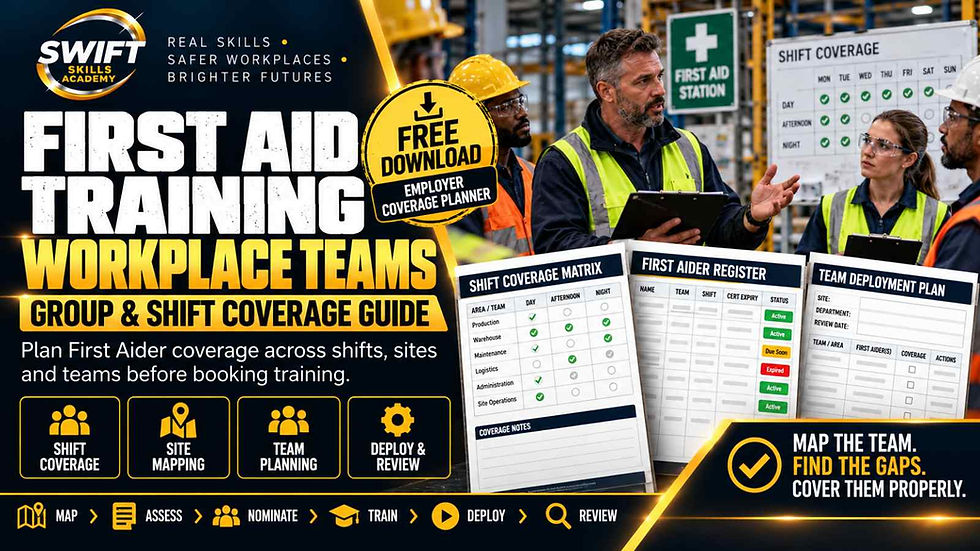
Download the First Aider Team Coverage Planner — South Africa
The First Aider Team Coverage Planner should help employers move from “How many people should we book?” to a much better question:
Where do we actually need trained people?
The employer workbook should include:
workforce headcount;
workplace/site register;
shift map;
department map;
existing First Aider register;
certificate tracking;
site coverage;
shift coverage;
leave contingency;
learner nomination;
training-batch planning;
replacement triggers;
post-training deployment;
review dates.
This becomes the practical companion to this article rather than another generic First Aid checklist.
What Should an Employer Do Next?
Use this sequence:
1. Map your workforce
Record people by:
site;
department;
shift;
normal working hours.
2. Map existing First Aiders
Do not count only names.
Record their actual location and availability.
3. Identify gaps
Look for:
uncovered shifts;
uncovered buildings;
single-person dependencies;
expiring or outdated records;
employees who have left.
4. Select suitable learners
Choose people who solve the identified gaps.
5. Decide between public and on-site training
Base the decision on group size and operational requirements.
6. Train in sensible batches
Avoid unnecessarily disrupting operations.
7. Update your coverage matrix
Training is not complete administratively until the employer's records reflect the new deployment.
8. Review after workforce changes
A First Aid plan should evolve as the workplace evolves.
Frequently Asked Questions
How many employees should a company train in First Aid?
There is no single planning number that suits every employer. Start with the applicable legal requirements and then evaluate employee numbers, shifts, sites, availability, operational risks and absence contingency.
Should every employee receive First Aid training?
Not necessarily. Many employers will gain more value by strategically training enough suitable employees to provide reliable coverage across departments, shifts and locations.
Can a company arrange group First Aid training?
Yes. Group arrangements may be suitable where several employees need training together, subject to provider scheduling and delivery requirements.
Can First Aid training be conducted on site?
On-site training may be suitable for employer groups where delivery requirements, learner numbers and facilities allow it.
How do we cover multiple shifts?
Map trained employees against the shift they actually work. Do not count a day-shift First Aider as night-shift coverage unless they are genuinely available then.
What if our only First Aider resigns?
Immediately review workplace coverage and arrange a replacement training plan if the resignation creates a gap.
Should supervisors receive First Aid training?
Supervisors can be suitable candidates, but availability and workplace placement matter more than job title.
Is group First Aid training the same as bulk certification?
No. Employers should think in terms of structured group training and competency, not purchasing certificates in bulk.
Can we train staff in several batches?
Yes. Cohort-based planning may help maintain operational staffing and spread First Aider coverage across the organisation.
How should we track First Aid training?
Maintain both a training/certificate register and an operational coverage matrix showing where each trained employee works.
Is SAQA 12483 still current?
SAQA records Unit Standard 12483 as having passed its end date and identifies Unit Standard 120496 as its replacement. SAQA
What is SP-230801?
SP-230801 refers to the QCTO Basic Emergency First Aid Responder skills programme used in Swift Skills Academy's current basic First Aid offering. Employers should verify current programme and provider information when booking.
Does group First Aid training make a business fully OHS compliant?
No. First Aid training may support an employer's broader occupational health and safety responsibilities, but compliance depends on a wider set of workplace duties, risks, systems and controls.
Authoritative Sources & Regulatory References
Authoritative source | What it supports |
South African Government — General Safety and Environment for Workplaces Amendment, Government Notice 6907 of 2025 | Current amended regulatory framework affecting workplace First Aid requirements. South African Government |
South African Qualifications Authority — SAQA Unit Standard 12483 | Confirms that 12483 has passed its end date and identifies 120496 as its replacement. SAQA |
South African Qualifications Authority — Unit Standard 120496 | Historical/current SAQA record for risk-based primary emergency care/First Aid in the workplace and its relationship to older unit standards. SAQA |
Final Word
The strongest workplace First Aid programme is not necessarily the one with the largest number of trained employees.
It is the one where appropriately trained people are available in the right places, on the right shifts, when an emergency actually happens.
For employers, that means moving beyond a certificate list.
Map your workforce. Map your trained people. Identify uncovered shifts and sites. Build backup capacity. Plan for absences and turnover. Train in sensible groups. Keep the records current.
That is how First Aid training becomes part of a functioning workplace system rather than another completed item on a training spreadsheet.
Swift Skills Academy assists Cape Town employers with QCTO First Aid training, employer group bookings and on-site training enquiries for workplace teams.
This rewrite gives the page a much stronger independent search role: team rollout + First Aider coverage resilience, rather than competing head-on with the Workplace First Aid, HR, QCTO programme and legal-ratio pages. SAQA


