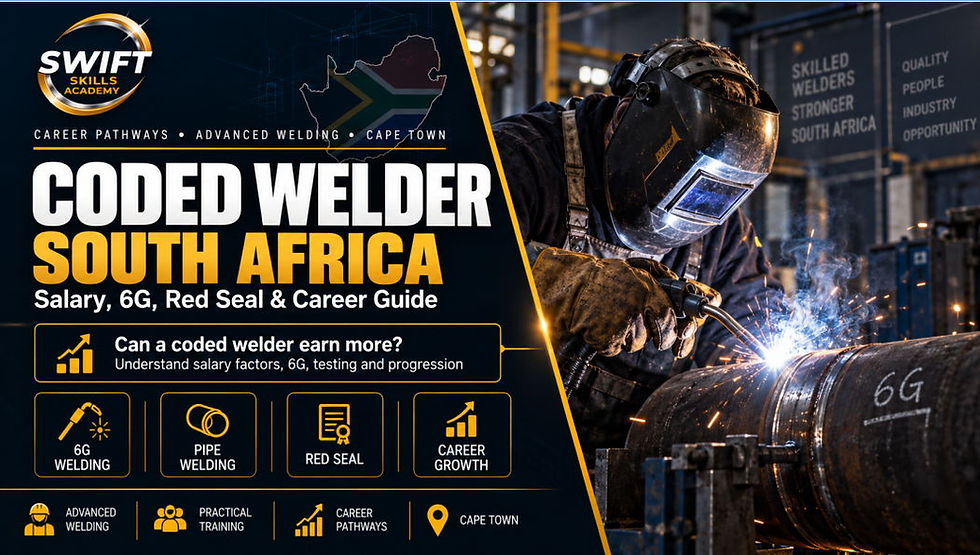
Coded Welding South Africa: How to Become a Coded Welder
Updated: Sep 29

QUICK ANSWER
Coded welding south africa means demonstrating welding performance against a defined code, standard, welding procedure or qualification requirement. A coded welder has passed a practical welding test within a specific test range — which can depend on the welding process, material, plate or pipe, thickness, diameter, joint configuration and welding position.
A coded-welder qualification is not automatically a Red Seal, not automatically an Occupational Certificate: Welder and not an unlimited certificate covering every welding job. The first question a welder or employer should ask is:
“Coded for what?”
ISO 9606-1, for example, establishes qualification-testing requirements for welders performing fusion welding of steels, while SAIW notes that ISO 9606 is widely used in South Africa alongside standards such as ASME IX and AWS D1.1. ISO
Question | Fast answer |
What is a coded welder? | A welder who has passed a defined practical performance qualification test |
Is every coding the same? | No |
Is coded welding the same as Red Seal? | No |
Can one coding cover every welding job? | No |
Can beginners work toward coded welding? | Yes, but strong welding foundations should come first |
Does 6G automatically make somebody qualified for every pipe job? | No — the applicable code and qualification range still matter |
Can employers require their own/project-specific testing? | Yes, depending on the project and specification |
Coded Welding South Africa: What Does “Coded” Actually Prove?
The word coded should never be treated as a vague badge meaning “advanced welder”.
A welder-performance qualification proves that a person demonstrated acceptable welding performance within the conditions and variables covered by the applicable test.
That distinction matters because two people can both describe themselves as coded welders while holding qualifications covering completely different work.
Coded for what?
A meaningful qualification record may need to be understood in terms of:
Variable | Why it matters |
Welding process | SMAW, GTAW, GMAW, FCAW or another applicable process |
Material | The material or material grouping included by the qualification |
Plate or pipe | Qualification scope can differ |
Thickness | A test does not necessarily cover unlimited thickness |
Pipe diameter | Relevant to pipe qualification ranges |
Welding position | Flat, horizontal, vertical, overhead or pipe positions |
Joint configuration | Butt/groove, fillet and other defined configurations |
Backing | Can affect qualification scope |
Welding procedure | The WPS or applicable test requirement |
Code or standard | Determines the rules governing the qualification |
This is why the question “Do you offer coded welding?” is incomplete.
A better question is:
“What exact welding performance do I need to prove, and which qualification test proves it?”
That single question can prevent a welder from spending money on training that does not match the employer, project or industry requirement.
Is a Coded Welder the Same as a Red Seal Welder?
No.
These are different forms of recognition.
Path | What it demonstrates | What it does not automatically prove |
Coded-welder qualification | Performance within a defined welding test range | Broad artisan status |
Trade test / Red Seal pathway | National artisan competence through South Africa's trade-test system | Qualification for every specific welding code or project |
Occupational Certificate: Welder | Structured occupational learning and assessment across the trade | Automatic qualification for every code-specific welding test |
South Africa's national trade-test framework is governed separately from code-specific welder testing. National trade testing takes place through accredited trade-test centres, with the quality-assurance and certification process involving NAMB and QCTO. Government of South Africa
A qualified artisan may therefore still need to pass a particular welder-performance test for a project.
Likewise, somebody who passes a specific welding performance test does not automatically become a qualified artisan.
Important 2026 qualification update
The SAQA record for Occupational Certificate: Welder, SAQA ID 94100, NQF Level 4, 373 credits now records the qualification as having passed its registration end date. The record currently gives 30 December 2026 as the last date for enrolment and 30 December 2029 as the last date for achievement. SAQA
That status should be explained accurately to learners instead of simply advertising SAQA 94100 as though its registration status had not changed.
How Does a Coded-Welder Qualification Test Work?
Although the exact process depends on the applicable standard, testing arrangement and employer requirement, the logic is generally straightforward.
Step 1 — Identify the actual requirement
Before training begins, establish the welding process, material, position, plate or pipe configuration and applicable code or procedure.
Someone preparing for carbon-steel structural SMAW does not necessarily need the same development route as somebody preparing for stainless-steel GTAW pipe work.
Step 2 — Assess the welder's current ability
Experienced welders may need targeted preparation rather than a beginner course.
A genuine assessment should identify problems such as poor joint preparation, inconsistent root control, lack of positional ability, incorrect machine setup, contamination, slag inclusions, undercut or difficulty following a WPS.
Step 3 — Practise to the required welding conditions
Preparation should increasingly resemble the conditions under which the candidate will be tested.
The objective is not simply to produce one attractive weld in comfortable workshop conditions. It is to demonstrate repeatable control.
Step 4 — Weld the qualification test piece
The candidate produces the required test piece or coupon under the applicable test conditions.
The test variables matter because the resulting qualification has a defined range rather than universal coverage.
Step 5 — Inspect or test the weld
Acceptance may involve visual examination and, depending on the applicable qualification route, destructive or non-destructive testing.
ISO 9606-1 focuses specifically on systematic qualification testing of the welder's ability to produce welds of acceptable quality. ISO
Step 6 — Record the qualification scope
The useful question is not merely whether a certificate exists.
The useful question is:
What does the certificate or qualification record actually cover?
Coded Welding Positions: What Do 1G, 2G, 3G, 4G, 5G and 6G Mean?
Position terminology helps describe how the joint is oriented during welding.
Position | General description | Typical challenge |
1G | Flat groove welding | Basic positional control |
2G | Horizontal groove welding | Controlling the pool horizontally |
3G | Vertical groove welding | Vertical progression and heat control |
4G | Overhead groove welding | Pool control against gravity |
5G | Fixed horizontal pipe | Welding around fixed pipe |
6G | Fixed pipe positioned at approximately 45° | Multiple welding orientations in one test |
The exact qualification range still depends on the applicable welding standard. Passing a position does not erase the importance of process, material, pipe diameter, thickness or other essential variables.
Why does everybody talk about 6G welding?
A fixed 6G pipe position forces the welder to work through changing orientations while the pipe remains stationary.
That makes it demanding and valuable for developing pipe-welding ability.
But 6G is not a magic certificate.
A candidate must still ask:
Which process?
Which material?
Which standard?
Which procedure?
Which qualification range?
Which Welding Processes Can Be Used for Coded Welding?
Coded-welding requirements can involve different welding processes depending on the work.
Process | Common name | Core skill emphasis |
SMAW | Stick / Arc welding | Electrode control, arc length, slag management and positional welding |
GTAW | TIG welding | Precision, heat input, filler control, shielding and root quality |
GMAW | MIG / MAG / CO₂ welding | Voltage, wire feed, transfer characteristics, travel and consistency |
FCAW | Flux-Cored Arc Welding | Wire control, slag management, deposition and positional technique |
A welder should therefore avoid choosing a process because it sounds more advanced.
The process should follow the work the welder wants to perform.
What Does “Single-Coded” or “Double-Coded Welder” Mean?
This is one of the terms South African welders regularly encounter in advertisements and recruitment.
There is no useful reason to treat double coded as a universal certificate title with one identical meaning everywhere.
In current South African recruitment, the term can be used to describe a welder qualified in two welding processes. For example, a 2026 petrochemical-sector vacancy described a double-coded welder as proficient in two qualified processes such as SMAW and GTAW/TIG. Salt Contractors
The important lesson is:
Never stop at the words “single coded” or “double coded”.
Ask for the actual process, procedure, standard, material and position required.
That is what determines whether your qualification matches the job.
WPS vs WPQR/PQR vs Welder Qualification: What Is the Difference?
These terms are connected, but they do not mean the same thing.
Term | What it relates to |
WPS — Welding Procedure Specification | Instructions controlling how a weld should be produced |
PQR / WPQR | Evidence associated with qualification of the welding procedure, depending on the terminology used by the applicable code |
Welder qualification | Evidence that the individual welder demonstrated acceptable performance within a defined test range |
A WPS can include variables such as welding process, material, filler, joint preparation, position, electrical parameters, shielding gas and other controls relevant to producing the weld.
The coded welder's job is not to invent their own procedure during the test.
It is to demonstrate that they can weld within the applicable requirements.
How Do You Become a Coded Welder in South Africa?
There is no single universal course that makes every learner coded for every industry.
Step 1 — Decide what welding work you are targeting
Start with the destination.
Structural steel, workshop fabrication, pipe, pressure equipment, maintenance and specialised materials can require different processes and qualification routes.
Step 2 — Assess your present skill level
A beginner may need foundational welding development.
An experienced welder may only need targeted preparation for a specific process, position or test.
Step 3 — Build strong process control
The candidate should be able to set up equipment correctly, prepare the joint, select suitable consumables, control the weld pool and repeat acceptable welds.
Step 4 — Learn positional welding
A welder who performs well only in the flat position may struggle when the qualification requires vertical, overhead or fixed-pipe welding.
Step 5 — Understand the WPS
Do not treat the WPS as paperwork belonging only to an inspector.
The welder must understand what the procedure requires and remain within the applicable parameters.
Step 6 — Practise test conditions
Practice should increasingly resemble the actual qualification requirement rather than random workshop exercises.
Step 7 — Complete the applicable qualification test
The test must correspond with the actual code, procedure or employer requirement.
Step 8 — Understand what happens after passing
Keep the qualification documentation.
Check its scope.
Understand any continuity, validity, renewal or employer requirements that apply under the relevant standard or project.
Do not assume a coding lasts forever under all circumstances.
What Skills Should You Have Before a Coded-Welding Test?
A candidate does not become test-ready simply by accumulating certificates.
Capability | What test readiness looks like |
Joint preparation | Consistent fit-up and preparation |
Machine setup | Correct parameters for the process |
Arc / torch control | Stable control throughout the weld |
Positional welding | Ability beyond comfortable flat welding where required |
Root control | Appropriate penetration and root consistency |
Filler / consumable control | Correct selection and handling |
Defect recognition | Ability to identify and correct recurring problems |
WPS interpretation | Ability to follow the required welding procedure |
Consistency | Repeated acceptable performance, not one lucky weld |
Test discipline | Ability to perform under assessment conditions |
This is where preparation should become individual.
Two welders booking the same generic course can have completely different skill gaps.
What Does a Coded-Welding Certificate Actually Prove?
A meaningful welder qualification document should allow the employer or welder to understand what was tested.
Depending on the applicable qualification system, relevant information can include the standard, welding process, material, test-piece type, thickness, pipe diameter, position, joint configuration, backing conditions and test date.
A generic course-completion certificate is therefore not automatically the same thing as a code-specific welder-performance qualification.
Before paying for something marketed as a “coded welding certificate”, ask:
Question | Why ask it? |
What exact certificate or qualification record is issued? | Prevent vague expectations |
Which code or standard applies? | Establishes the test framework |
Which process is tested? | Coding does not automatically transfer between processes |
Which material is covered? | Qualification ranges can differ |
Plate or pipe? | The work and qualification scope can differ |
Which position? | Positional qualification matters |
Who conducts or verifies the test? | Establishes the testing route |
What does the qualification range cover? | Prevents assuming unlimited scope |
What Should Employers Check Before Accepting a “Coded Welder”?
The words on a CV should not be the end of the competency check.
Employers should compare the qualification evidence with the actual work that needs to be performed.
Employer check | Key question |
Applicable standard | Does the record correspond with the project requirement? |
Welding process | Is the welder qualified for the process on the WPS? |
Material | Does the qualification range match the work? |
Plate / pipe | Is the configuration appropriate? |
Thickness / diameter | Does the qualification cover the required range? |
Position | Does the tested position suit the work? |
WPS | Can the welder understand and follow the procedure? |
Qualification status | Are any applicable continuity or validity requirements satisfied? |
Practical competence | Does current performance still meet the employer's quality expectations? |
For employers working under formal welding-quality systems, welder qualifications form part of a much broader quality-control environment involving procedures, supervision, inspection, equipment, materials and records. SAIW's current welding-inspection training explicitly covers ISO 9606, ASME IX and AWS D1.1 welder qualifications alongside inspection and quality topics. SAIW
Seven Expensive Coded-Welding Mistakes to Avoid
Mistake | Better approach |
Booking a “coded welding course” without knowing the required code | Establish the target first |
Assuming Red Seal and coding are the same | Treat artisan status and welder qualification separately |
Believing one coding covers every welding job | Check the qualification range |
Chasing 6G before mastering the process | Build repeatable foundations first |
Ignoring the WPS | Learn to work to procedure |
Treating a training certificate as a welder qualification | Confirm exactly what certificate will be issued |
Choosing training by course name alone | Match training to process, position, material and intended work |
This is one of the areas where a technically accurate training provider should be willing to tell a prospective learner:
“You may not need this course yet.”
That answer can save the learner both money and time.
Does Becoming a Coded Welder Guarantee Better Pay or Employment?
No.
A coded-welder qualification can be highly relevant when an employer needs proven welding performance for defined work, but no qualification guarantees employment, salary or project access.
Employers can still consider experience, fabrication ability, drawings, safety competence, productivity, project history, trade status and additional site-specific requirements.
The value of coding is therefore not a promise of a particular salary.
Its value is credible evidence that the welder has demonstrated performance within a defined qualification range.
Frequently Asked Questions
What is a coded welder?
A coded welder is a welder who has passed a defined practical welder-performance qualification test. The resulting qualification applies within the range permitted by the relevant code or standard rather than proving unlimited welding competence.
What is coded welding?
Coded welding refers to welding performed under defined code, standard, procedure or qualification requirements where the welder's ability is tested against specified acceptance criteria.
Is a coded welder the same as a Red Seal welder?
No. Coded-welder qualification demonstrates welding performance within a defined test range. Red Seal artisan status relates to South Africa's national artisan trade-test pathway.
How do I become a coded welder in South Africa?
First identify the process, material, position and qualification you actually need. Build or assess your welding competence, develop positional and WPS skills, practise under appropriate test conditions, and then undertake the applicable welder qualification test.
Do I need a Red Seal before becoming coded?
Not necessarily. The requirements depend on the employer, project and qualification route. However, coded-welder qualification does not replace artisan recognition where Red Seal or trade status is separately required.
What is a double-coded welder?
The phrase is commonly used to describe a welder qualified across more than one welding process or defined welding requirement. Because employers use the terminology differently, candidates should establish exactly which processes, standards, materials and positions the employer expects. A current South African petrochemical vacancy, for example, used the term for dual-process competence such as SMAW and GTAW/TIG. Salt Contractors
What is 6G welding?
6G is a fixed-pipe welding position in which the pipe is positioned at roughly 45 degrees. The welder encounters multiple orientations while completing the joint, making it a demanding pipe-welding position.
Is a coded-welding certificate permanent?
Do not assume so. Continuity, validity, renewal and requalification requirements depend on the applicable standard, qualification scheme and employer or project requirements.
How much does a coded-welding course cost?
There is no meaningful universal price because the cost can vary with the candidate's starting ability, process, material, position, practical preparation required, test materials, testing route and whether external qualification testing is included. Request a written quotation stating exactly what preparation, testing and certification are included.
Can a beginner become a coded welder?
A beginner can work toward coded welding, but jumping directly into advanced qualification testing is rarely the strongest route. Process control, joint preparation, positional welding, defect prevention and WPS understanding should be developed first.
Where can I prepare for coded welding in Cape Town?
Swift Skills Academy provides welding development in Cape Town across processes and pathways that can support coded-welder preparation. The appropriate code, process, testing body, material, position and intended qualification outcome should be confirmed before the learner is placed into the preparation route. The live SSA commercial welding page makes the same distinction between practical training, artisan status and code-specific welder qualification. Swift Skills Academy
Authoritative Sources & Regulatory References
Authoritative source | What it supports |
Current qualification status, NQF level, credits, final enrolment and achievement dates | |
Welder qualification testing for fusion welding of steels | |
South African industry context for ISO 9606 and other relevant welding standards | |
Occupational certification and trade-certificate process | |
National artisan trade-testing framework |
Read More
Next article | Why read it |
Continue into career and earning-potential intent without bloating this article | |
Understand the artisan / trade-test pathway | |
Understand the employer-quality system around procedures, qualifications and welding control |
Final Word
Coded welding is not about collecting the most impressive-sounding certificate.
It is about proving the right welding ability for the right requirement.
Before choosing training, establish what you need to weld, which process you need, which material and position matter, what procedure or standard applies and what evidence the employer or project expects.
Then train toward that outcome.
The most useful question in coded welding remains remarkably simple:
“Coded for what?”
If a training provider, employer or welder can answer that accurately, the correct pathway becomes much easier to identify.