
Confined Space Training Cape Town SAQA 15034: Permit, Gas Testing, Rescue and Employer Duties
- Jun 16
- 11 min read
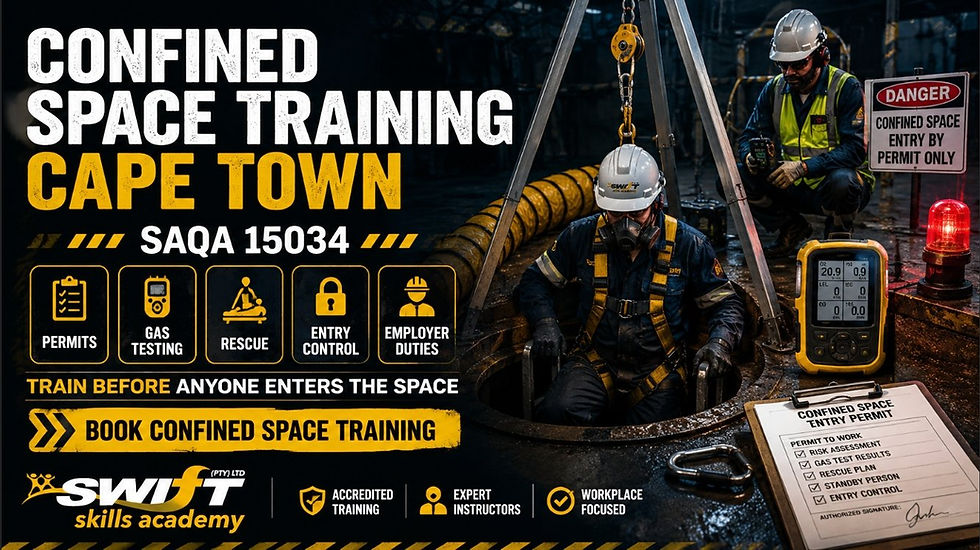
Quick Answer: What Is Confined Space Training Cape Town SAQA 15034?
Confined space training Cape Town SAQA 15034 is safety training for workers who may need to work in, enter, support or control work in confined spaces on construction sites or similar high-risk environments.
It is linked to SAQA Unit Standard 15034: Work in confined spaces on construction sites.
In plain English, this training helps learners understand the hazards of confined spaces, the protective clothing and equipment needed, the training needs of workers entering confined spaces, and the emergency procedures required when something goes wrong.
The official SAQA record for 15034 includes outcomes around hazard identification, protective equipment, training requirements and emergency procedures.
For employers, confined space training is not a box-ticking exercise.
It is a life-protection system.
A confined space can look harmless from the outside and still contain invisible dangers inside.
No smell.
No warning.
No second chance.
Need confined space training for your workers, supervisors or safety team?
Explore Here: 👉 Book Confined Spaces Training Cape Town SAQA 15034
There Are Two Types of Employers Managing Confined Spaces
There are two types of Cape Town employers dealing with confined spaces right now.
The first employer treats confined space entry like normal work.
They say:
“It will only take five minutes.”
“We have done this before.”
“The worker knows what to do.”
“Just open the cover.”
“Just go inside quickly.”
“No need for all this paperwork.”
That mindset is dangerous.
The second employer treats confined space entry as a controlled high-risk operation.
They ask:
Has the confined space been identified?
Has the air been tested?
Has a permit been issued?
Is ventilation required?
Is there a trained standby person?
Is rescue planned?
Are workers trained?
Is the equipment ready?
Is the entry authorised?
Is there proof?
Same space.
Same job.
Completely different risk.
The worst time to discover your confined space system is weak is when someone is already inside.
What Counts as a Confined Space?
A confined space is not simply a small room.
A confined space is usually an area that is large enough for a person to enter and perform work, but has limited or restricted entry or exit and is not designed for continuous occupation.
Examples may include:
tanks,
vessels,
silos,
manholes,
pits,
pipelines,
sewers,
trenches,
sumps,
ducts,
tunnels,
boilers,
storage bins,
vaults,
chambers,
and certain construction-site spaces.
The dangerous part is this:
A space does not need to look dramatic to be deadly.
The hazard may be invisible.
Why Confined Spaces Are So Dangerous
Confined spaces are dangerous because the worker may be exposed to hazards that are difficult to detect, escape from or control quickly.
These may include:
oxygen deficiency,
oxygen enrichment,
toxic gases,
flammable atmospheres,
vapours,
fumes,
engulfment risk,
poor ventilation,
heat stress,
restricted movement,
poor visibility,
biological hazards,
mechanical hazards,
electrical hazards,
slips and falls,
and difficulty rescuing a person in distress.
A normal workplace emergency becomes much harder inside a confined space.
That is why entry must be controlled.
General Safety Regulation 5: The Rule Employers Cannot Ignore
In South Africa, confined spaces are addressed under the Occupational Health and Safety Act framework and the General Safety Regulations.
General Safety Regulation 5 deals specifically with work in confined spaces and requires employers or users of machinery to take steps to ensure confined spaces are only entered after appropriate precautions are taken.
The Department of Employment and Labour’s General Safety Regulations include Regulation 5 on work in confined spaces.
For employers, the practical message is clear:
You cannot treat confined space entry as casual work.
You need a system.
That system may include:
identifying confined spaces,
assessing hazards,
testing the atmosphere,
controlling entry,
issuing permits,
ventilating the space,
training workers,
appointing standby support,
planning rescue,
and keeping records.
Confined space safety is not only about the person entering.
It is about the entire control system around the entry.
Confined Space Permit South Africa: Why Permits
Matter
A confined space permit is not paperwork for the sake of paperwork.
It is a control document.
It helps confirm whether the space is ready for entry, whether hazards have been assessed, whether controls are in place and whether the entry has been authorised.
A permit should help answer:
What space is being entered?
What work will be done?
Who is entering?
Who is supervising?
Who is the standby person?
Has the atmosphere been tested?
What were the gas readings?
Is ventilation required?
What PPE is required?
What tools are allowed?
What hazards are present?
What rescue plan is in place?
When does the permit start and end?
Who authorised the entry?
Without a permit system, employers may rely on memory, assumptions and verbal instructions.
That is weak control.
Gas Testing Before Confined Space Entry
Gas testing is one of the most important confined space controls.
A confined space can contain an unsafe atmosphere even when it looks normal.
Workers cannot rely on smell, sight or instinct.
Gas testing may check for:
oxygen level,
flammable gases,
toxic gases,
hydrogen sulphide,
carbon monoxide,
vapours,
and atmosphere changes during work.
The air may be safe at the top and unsafe at the bottom.
The air may be safe before work begins and unsafe after welding, cleaning, cutting, chemical use or disturbance.
That is why gas testing must be done by competent people using suitable equipment.
A gas monitor is only useful when the person understands how to use it, interpret it and respond to unsafe readings.
Ventilation: When Fresh Air Becomes a Control
Ventilation can help remove or dilute dangerous gases, vapours or fumes.
But ventilation must be planned.
The employer should ask:
Is natural ventilation enough?
Is forced ventilation required?
Where should air be introduced?
Where should contaminated air exit?
Will work create fumes?
Will ventilation disturb dust or vapours?
Is continuous monitoring required?
What happens if ventilation fails?
Ventilation is not “open the lid and hope.”
Confined space air must be treated as a controlled risk.
The Standby Person: The Person Outside May Save the Life Inside
A confined space standby person is not a spectator.
The standby person is a critical control.
Their role may include:
monitoring the entry,
maintaining communication,
checking entry and exit,
watching for signs of distress,
preventing unauthorised entry,
keeping emergency contacts ready,
activating rescue procedures,
and ensuring the person inside is not forgotten.
The standby person should not enter the confined space impulsively during an emergency.
Many confined space fatalities happen when untrained rescuers rush in and become victims themselves.
Rescue must be planned before entry.
Confined Space Rescue Plan: Why “We Will Pull Him Out” Is Not a Plan
A rescue plan must exist before anyone enters the confined space.
A vague promise is not a rescue plan.
A real rescue plan should consider:
how the worker will be retrieved,
whether non-entry rescue is possible,
whether a tripod or retrieval system is needed,
who will call emergency services,
how communication will be maintained,
whether rescue personnel are trained,
what first aid support is available,
what equipment is ready,
and what happens if the entrant becomes unconscious.
The official SAQA 15034 record includes planning and implementing emergency procedures as one of the specific outcomes, which reinforces that emergency planning is part of confined space competence.
If the rescue plan begins only after the incident, it is too late.
Who Must Attend Confined Space Training?
Confined space training is relevant for people who enter, supervise, support or control confined space work.
This may include:
construction workers,
maintenance teams,
contractors,
safety officers,
site supervisors,
standby persons,
sewer and drainage teams,
tank cleaning teams,
municipal workers,
industrial workers,
engineering teams,
plant maintenance teams,
confined space entrants,
permit issuers,
and workers involved in emergency procedures.
The key question is not job title.
The key question is:
Can this person be exposed to confined space risk or be responsible for controlling entry?
If yes, training may be required.
Which Cape Town Workplaces Need Confined Space Training?
Confined space risk can exist in many Cape Town and Western Cape industries, including:
construction,
civil engineering,
water and sanitation,
manufacturing,
food processing,
petrochemical support,
wastewater treatment,
facilities maintenance,
property management,
municipalities,
logistics,
ship repair,
marine services,
industrial cleaning,
and maintenance contracting.
If your workplace has tanks, chambers, manholes, pits, ducts, sumps, pipelines or restricted-access spaces, do not assume the risk is low.
Assess it.
Confined Space Training Cost Cape Town: What Affects the Price?
The cost of confined space training in Cape Town may depend on:
number of learners,
course duration,
public course vs group booking,
on-site vs training centre delivery,
practical simulation requirements,
PPE and equipment needs,
gas testing demonstrations,
learning material,
assessment requirements,
certificate administration,
travel requirements,
and whether training is part of a broader safety training package.
Employers should not choose only by price.
The cheaper course is not always the safer course.
The better question is:
Will this training help our team understand the real confined space risks before entry?
Need current pricing for your team?
Explore Here: 👉 Request Confined Space Training Pricing in Cape Town
Confined Space Certificate Validity and Refresher Planning
Employers should track confined space training validity carefully.
The training evidence must be current, accessible and aligned to the worker’s actual role.
Track:
learner name,
ID number,
department,
site,
course title,
SAQA ID,
certificate date,
refresher date,
role,
and evidence location.
Refresher training may be needed when:
certificates are close to expiry,
workers have not entered confined spaces recently,
new equipment is introduced,
gas testing procedures change,
rescue procedures change,
the work environment changes,
a client requests current proof,
a near miss occurs,
or supervisors identify unsafe habits.
A stale certificate does not create confidence.
Entry Control: The Difference Between Managed Risk and Chaos
Entry control is the heart of confined space safety.
No one should enter a confined space casually.
Entry control should include:
authorised entry only,
permit checks,
sign-in and sign-out records,
gas testing confirmation,
PPE checks,
equipment checks,
communication checks,
standby person confirmation,
rescue readiness,
and clear stop-work authority.
If a worker can enter without anyone noticing, your system is weak.
If a worker exits and no one records it, your system is weak.
If no one knows who is inside, your system is dangerous.
Confined Space Training Matrix for Employers
Every employer should track confined space training properly.
Use this structure:
Employee Name | Department | Site / Branch | Course | SAQA ID | Certificate Date | Refresher Date | Confined Space Role | Evidence Location |
Name | Department | Site | Confined Space Training | 15034 | Date | Date | Entrant / Standby / Supervisor | File / Drive / HR System |
This helps HR, safety officers, SDFs, supervisors and managers avoid last-minute panic.
Explore Here: 👉 Training Needs Analysis Template South Africa
Common Confined Space Mistakes Employers Make
Mistake | Why It Hurts | Better Move |
Treating confined spaces like normal work areas | Hidden atmospheric risks can kill quickly | Identify and classify confined spaces |
No gas testing | Unsafe air may be invisible | Test atmosphere before entry |
No permit system | Entry becomes uncontrolled | Use a permit-to-work process |
No standby person | Entrants may be unmonitored | Assign trained standby support |
No rescue plan | Panic rescue can create more victims | Plan rescue before entry |
No ventilation plan | Fumes or gases may accumulate | Use suitable ventilation controls |
Training only entrants | Supervisors and standby persons may stay weak | Train role-based teams |
Not tracking certificates | Evidence expires quietly | Use a training matrix |
Relying on experience only | Experience without procedure creates risk | Use documented controls |
Waiting for an incident | Too late | Train before entry is needed |
Confined space safety fails when people treat invisible hazards like ordinary work.
Buyer Checklist Before Booking Confined Space Training
Before booking, ask:
Is the course aligned to SAQA 15034?
Does it cover confined space hazards?
Does it explain protective clothing and equipment?
Does it address emergency procedures?
Does it connect to permit-to-work systems?
Does it explain gas testing and atmospheric risk?
Does it cover standby person awareness?
Does it support employer evidence?
Can group training be arranged?
Can the provider also support other OHSA training?
Can this training fit into our safety training matrix?
Do not book blind.
Book for role, risk and evidence.
Confined Space and the Bigger OHSA Training Stack
Confined Space Training should not sit alone.
Depending on your workplace, your team may also need:
Basic Health and Safety,
Basic First Aid,
Basic Fire Fighting,
Working at Heights,
Scaffold Erector,
Scaffold Inspector,
OHSA / SHE Compliance,
and role-specific safety training.
Explore Here: 👉 Basic Health and Safety Course Cape Town SAQA 259639
Explore Here: 👉 Basic First Aid Course Cape Town SAQA 12483
Explore Here: 👉 Basic Fire Fighting Course Cape Town SAQA 12484
Explore Here: 👉 Working at Heights Training Cape Town SAQA 229998
Explore Here: 👉 Scaffold Erector Course Cape Town SAQA 263245
Explore Here: 👉 Scaffold Inspector Course Cape Town SAQA 263205
A confined space incident may require first aid, fire response, rescue, fall protection and emergency coordination.
Train the system, not only the individual.
Confined Space, WSP/ATR, SDL and B-BBEE Skills Development
Confined space training can also support wider skills development planning when recorded properly.
HR teams, SDFs and safety officers should capture:
learner names,
ID numbers,
department,
course title,
SAQA ID,
training date,
certificate evidence,
cost,
provider,
and evidence location.
Explore Here: 👉 Training Needs Analysis Template South Africa
Explore Here: 👉 Skills Development Levy Calculator South Africa
Explore Here: 👉 SDF Consulting South Africa
Training is not only a safety expense.
When planned correctly, it becomes part of your workplace skills strategy.
Why Choose Swift Skills Academy for Confined Space Training in Cape Town?
Swift Skills Academy provides practical workplace safety training for South African employers, teams and learners who need training that connects to real workplace readiness.
For Confined Space Training, the value is simple:
SAQA 15034 training route,
Cape Town training access,
practical confined space awareness,
group booking potential,
safety training pathway,
employer compliance support,
internal linking to other OHSA training,
and one provider for broader workplace safety needs.
If your business needs Confined Space, Working at Heights, Basic Health and Safety, First Aid, Fire Fighting, Scaffold Erector or Scaffold Inspector training, Swift Skills Academy can help you build a complete safety training pathway.
Ready to train your team before anyone enters the space?
Explore Here: 👉 Book Confined Spaces Training Cape Town SAQA 15034
Explore Here: 👉Basic Health and Safety Course Cape Town SAQA 259639
Explore Here: 👉Basic First Aid Course Cape Town SAQA 12483
Explore Here: 👉Basic Fire Fighting Course Cape Town SAQA 12484
Explore Here: 👉Working at Heights Training Cape Town SAQA 229998
Explore Here: 👉 Scaffold Erector Course Cape Town SAQA 263245
Explore Here: 👉 Scaffold Inspector Course Cape Town SAQA 263205
Explore Here: 👉 Training Needs Analysis Template South Africa
FAQs About Confined Space Training Cape Town SAQA 15034
1. What is SAQA 15034?
SAQA 15034 is the unit standard titled Work in confined spaces on construction sites. It covers confined space hazards, protective equipment, worker training needs and emergency procedures.
2. Who needs confined space training in Cape Town?
Confined space training is relevant for workers, contractors, maintenance teams, standby persons, supervisors, safety officers and employees who enter, monitor or control work in tanks, pits, manholes, chambers, pipelines or restricted-access spaces.
3. Do confined spaces require gas testing?
Yes, confined spaces may contain unsafe atmospheres that cannot be detected by sight or smell. Gas testing helps confirm oxygen levels, flammable gases and toxic atmospheres before and during entry where required.
4. Why is a confined space rescue plan important?
A rescue plan is critical because confined space emergencies can trap or overcome workers quickly. Rescue must be planned before entry so untrained rescuers do not become additional victims.
5. Can employers book group confined space training in Cape Town?
Yes. Group confined space training is ideal for employers with maintenance teams, construction teams, contractors, municipal workers, safety officers or multiple staff exposed to confined space risk.
Contact Swift Skills Academy
Swift Skills Academy
📞 021 828 0772
💬 WhatsApp: +27 60 998 7412
📍 6 Monaco Rd, Killarney Gardens, Cape Town
Need Confined Space, Working at Heights, First Aid, Fire Fighting, Scaffold Erector or other workplace safety training?
Contact Swift Skills Academy before anyone enters the space.
The wrong training gives false confidence.
The right training protects lives.
Sources
Source | Type | Why It Matters for Readers |
Official SAQA unit standard | Confirms the official unit standard and outcomes linked to confined space hazards, protective equipment and emergency procedures | |
Swift Skills Academy course page | Main Cape Town enrolment page for Confined Space Training | |
Official regulation | Includes Regulation 5 on work in confined spaces under the South African OHS framework | |
South African legislation | Provides the broader legal framework for employer health and safety duties | |
Official SAQA unit standard | Supports the distinction between confined space entry training and specialised confined space rescue operations | |
Swift Skills Academy course page | Supports emergency readiness where confined space incidents may require first aid | |
Swift Skills Academy course page | Supports emergency preparedness for high-risk workplaces | |
Swift Skills Academy course page | Relevant where confined space access also involves fall-risk controls |


