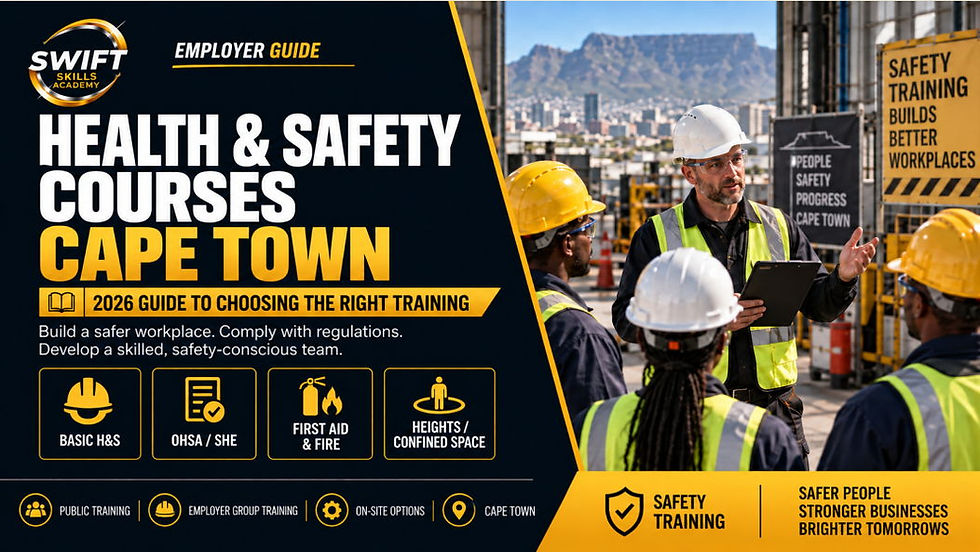
Occupational Health and Safety Training Western Cape: Courses, Costs and Enrolment
Updated: Sep 1

Occupational health and safety training in the Western Cape is not one universal course that every employee should complete.
The correct training depends on the work being performed, the hazards employees are exposed to, their responsibilities, the equipment or substances involved and the employer's existing risk-control system.
For employers, the important question is therefore not:
“Which health and safety course should we send everyone on?”
It is:
“What must this employee know, understand or be competent to do because of the work they actually perform?”
That distinction matters when selecting between Basic Health & Safety, OHSA/SHE Compliance, First Aid, Fire Fighting, Working at Heights, Confined Spaces, Scaffold Erector, Scaffold Inspector and other specialised safety training.
Occupational Health and Safety Training Western Cape: Quick Answer
South Africa's Occupational Health and Safety Act places broad duties on employers to provide and maintain, as far as reasonably practicable, a working environment that is safe and without risk to employees' health.
Section 8 specifically addresses matters including identifying workplace hazards, determining precautionary measures, providing the means to apply those precautions and providing the information, instruction, training and supervision necessary to protect employees.
Section 13 also requires employers, as far as reasonably practicable, to make employees conversant with hazards connected to the work they perform and the relevant precautions. (Government of South Africa)
That does not mean every worker requires the same occupational health and safety course.
Training should be selected according to factors such as:
workplace hazards;
employee job function;
machinery, equipment and substances used;
level of responsibility;
whether the learner is an employee, supervisor, safety representative or emergency responder;
workplace risk assessments;
site procedures;
applicable regulations;
client requirements; and
project or site-access rules.
For a person needing broad foundational knowledge, Basic Health & Safety training may be the better starting point.
For someone responsible for workplace SHE procedures, inspections, unsafe-condition reporting and corrective-action processes, OHSA/SHE Compliance training may be more appropriate.
A person expected to perform First Aid, fight a workplace fire, use fall-arrest systems, enter confined spaces or inspect scaffolding requires a different and more specific training route.
A certificate is evidence of training. It is not evidence that every hazard in the workplace has been controlled.
Why Occupational Health and Safety Training Matters
After a workplace incident, the investigation rarely stops at the question:
“Was the employee trained?”
Management may also need to demonstrate:
whether the hazard was identified;
whether the risk was assessed;
whether suitable controls were implemented;
whether employees understood the hazard;
whether appropriate training was selected;
whether the employee was properly supervised;
whether safety rules were enforced;
whether equipment was suitable and maintained;
whether required PPE was available and used;
whether procedures were communicated;
whether training records could be produced; and
whether changing workplace conditions had been reassessed.
Section 8 of the OHS Act makes this broader context important. Training is only one component of the employer's overall duty to provide a workplace that is safe and without risk to health as far as reasonably practicable. (Government of South Africa)
A company can therefore spend money on occupational health and safety training and still have significant weaknesses if the underlying workplace system remains inadequate.
Training should support the risk-control system — not substitute for it.
What Does Occupational Health and Safety Training Cover?
The phrase occupational health and safety training covers several very different training needs.
General Workplace Health and Safety Knowledge
Employees who require a broad introduction to workplace safety may need training covering topics such as:
employer and employee responsibilities;
common workplace hazards;
basic hazard identification;
workplace safety rules;
PPE awareness;
housekeeping;
emergency procedures;
hazard and incident reporting; and
general workplace responsibilities.
SAQA Unit Standard 259639 — Explain Basic Health and Safety Principles in and Around the Workplace is recorded at NQF Level 2 with 4 credits.
Its stated purpose includes employer and employee duties, general workplace safety rules, PPE, housekeeping and emergency procedures. SAQA currently records its last-enrolment date as 30 June 2029 and last-achievement date as 30 June 2032. (regqs.saqa.org.za)
This makes Basic Health & Safety a logical route to investigate where the learner requires broad workplace-safety knowledge rather than a specialised emergency-response or inspection role.
Safety, Health and Environmental Procedures
SAQA Unit Standard 13223 — Apply Safety, Health and Environmental Protection Procedures is recorded at NQF Level 3 with 6 credits.
Its purpose and outcomes include:
understanding statutory safety, health and environmental responsibilities;
explaining workplace safety objectives, standards and regulations;
conducting safety and environmental inspections;
identifying unsafe conditions;
identifying or supporting corrective action; and
reporting safety, health and environmental conditions.
The unit standard originated in the manufacturing and engineering environment, and its learning outcomes go considerably further into workplace inspection and SHE procedures than a basic awareness presentation. (regqs.saqa.org.za)
Hazard-Specific and Role-Specific Training
General health and safety knowledge does not automatically make an employee competent to perform specialised safety-related functions.
Separate training or competence may be required where an employee is expected to:
provide workplace First Aid;
respond to an incipient workplace fire;
work where there is fall exposure;
use fall-protection or fall-arrest equipment;
work in or around confined spaces;
erect scaffolding;
inspect scaffolding;
work with hazardous substances;
perform rescue functions;
operate specialised machinery; or
perform technical inspections.
The correct course should therefore follow the workplace requirement, not simply the training catalogue.
Important 2026 Status of SAQA 13223
This part of the article needs to be particularly accurate.
SAQA records Unit Standard 13223 — Apply Safety, Health and Environmental Protection Procedures as having passed its registration end date on 30 June 2023.
However, that is not the same thing as saying new enrolment ended in 2023 or 2026.
SAQA's current record states:
SAQA 13223 status | Current SAQA record |
Registration end date | 30 June 2023 |
Last enrolment date | 30 June 2029 |
Last achievement date | 30 June 2032 |
NQF level | Level 3 |
Credits | 6 |
Anyone considering a credit-bearing programme should still ask the provider to confirm in writing:
the exact programme being offered;
the applicable programme or unit-standard code;
whether the learner can currently be registered;
the provider's applicable approved scope;
the quality-assurance route;
assessment arrangements;
moderation arrangements where applicable;
what certification or results documentation will be issued; and
whether credits are expected to be formally recorded.
A familiar SAQA number in advertising does not by itself prove that every provider is approved to register learners against that programme.
Basic Health & Safety vs OHSA/SHE Training
These two training routes should not be treated as interchangeable.
Basic Health & Safety
Basic Health & Safety is more appropriate where the learning requirement is broad foundational workplace-safety knowledge.
Typical subject areas may include:
employer and employee duties;
workplace hazards;
general safety rules;
PPE;
housekeeping;
emergency procedures; and
basic hazard awareness.
Swift Skills Academy's current starting price for Basic Health & Safety Training is from R988. (swiftskillsacademy.com)
OHSA/SHE Compliance
OHSA/SHE training is a stronger fit where the person's role involves more direct participation in areas such as:
SHE procedures;
inspections;
identifying unsafe conditions;
reporting;
corrective actions;
workplace safety standards; and
broader safety, health and environmental responsibilities.
Swift Skills Academy's current advertised starting price for OHSA/SHE Compliance Training is from R928. (swiftskillsacademy.com)
Neither course should be selected merely because one sounds more senior than the other.
The correct choice depends on what the employee is expected to do after the training.
Which Safety Course Does Your Employee Need?
Use the employee's work and risk exposure as the starting point.
Workplace requirement | Possible training pathway | Swift Skills starting price |
General SHE procedures, inspections and reporting | OHSA/SHE Compliance Training | From R928 |
General workplace health and safety knowledge | Basic Health & Safety Training | From R988 |
Workplace emergency First Aid | Basic Emergency First Aid Responder | From R928 |
Basic workplace fire response | Fire Fighting Training | From R528 |
Work involving exposure to falls | Working at Heights Training | From R928 |
Work in or around confined spaces | Confined Spaces Training | From R928 |
Erecting and dismantling access scaffolding | Scaffold Erector Training | From R988 |
Inspecting access scaffolding | Scaffold Inspector Training | From R1,028 |
These are starting prices, not automatic final quotations. The current live article identifies them as Swift Skills Academy's advertised starting rates. (swiftskillsacademy.com)
Final pricing can depend on factors such as:
number of learners;
public or workplace delivery;
employer location;
programme scope;
assessment requirements;
learner material;
travel;
scheduling;
venue arrangements; and
other delivery requirements.
For programmes associated with legacy SAQA unit standards, employers should also confirm the current registration, assessment and certification route before payment rather than relying only on a historic unit-standard number.
Does One Occupational Health and Safety Course Make a Company Compliant?
No.
Completing a course may strengthen part of an employer's occupational health and safety system, but a certificate does not make the entire organisation legally compliant.
A functioning OHS system may require:
hazard identification;
risk assessments;
safe operating procedures;
employee training;
induction;
supervision;
PPE;
machinery safeguards;
maintenance controls;
emergency procedures;
competent appointments;
incident reporting;
incident investigation;
contractor management;
health and safety representation;
inspection records;
medical surveillance where applicable;
refresher or retraining decisions; and
evidence that required controls are actually implemented.
Section 8 requires considerably more than training alone. It refers to safe systems of work, hazard elimination or mitigation, precautionary measures, training, supervision and enforcement.
A training certificate cannot correct:
an uncontrolled machine;
a missing guard;
an absent risk assessment;
inadequate supervision;
a defective procedure;
inappropriate PPE; or
an employer failing to enforce its own controls.
Training supports compliance. It does not replace the workplace system.
Who Should Consider Occupational Health and Safety Training?
Training may be relevant to employees and employers across manufacturing, engineering, construction, warehousing, logistics, maintenance, facilities management, hospitality and other workplaces.
Potential learners may include:
production employees;
engineering and fabrication workers;
warehouse staff;
construction employees;
maintenance personnel;
supervisors;
team leaders;
safety representatives;
operations personnel;
facilities staff;
contractors;
employees conducting workplace inspections; and
staff expected to identify and report unsafe conditions.
But job title alone is not enough to select a course.
Safety Representatives
A Health and Safety Representative may require training that supports the person's actual representative duties, including understanding workplace hazards, inspections, consultation, reporting and participation in the workplace's health and safety structure.
That is different from specialised competence to work at height, enter a confined space or inspect scaffolding.
Supervisors and Team Leaders
Supervisors may require a broader understanding of workplace rules, hazards, employee responsibilities, escalation procedures, supervision and implementation of controls.
Their training should match their authority and the hazards under their supervision.
Employees Performing Hazardous Work
An employee exposed to a specific hazard may require specialised training in addition to general safety knowledge.
Examples include:
working at height;
confined spaces;
fire response;
scaffolding;
First Aid;
hazardous machinery; or
hazardous substances.
General OHS training should never be used as a substitute for competency required for a specialised task.
How to Enrol in Occupational Health and Safety Training in the Western Cape
Step 1: Identify the Work and the Hazards
Do not start by asking:
“Which course is cheapest?”
Start with the work.
Ask:
What work will the employee perform?
What can injure or expose the employee?
What equipment will be used?
Are hazardous substances involved?
Is there a fall risk?
Is the person expected to inspect anything?
Will the employee supervise others?
Must the learner respond to an emergency?
Does a client or project require specific evidence?
What does the workplace risk assessment identify?
This makes course selection far more defensible.
Step 2: Define What the Employee Must Be Able to Do
Training selection becomes easier when the required outcome is clear.
For example:
“Understand basic workplace safety responsibilities” may indicate a foundational course.
“Conduct workplace SHE inspections and report unsafe conditions” points toward a different learning requirement.
“Use fall-arrest equipment while performing work at height” is a specialised practical competence.
Do not confuse these outcomes.
Step 3: Select the Appropriate Training Route
Compare the employee's required outcome against available programmes.
One employee may require only general workplace-safety training.
Another may need a combination of:
Basic Health & Safety;
First Aid;
Fire Fighting;
Working at Heights;
Confined Spaces; or
another role-specific programme.
Training matrices should therefore be organised around roles and risks, not around the number of certificates an employee can accumulate.
Step 4: Request Written Programme Information
Before paying, obtain written confirmation of:
programme title;
programme or unit-standard code where applicable;
current programme status;
provider approval or accreditation relevant to that programme;
course duration;
delivery method;
assessment process;
certification process;
learner requirements;
total price;
additional charges;
cancellation terms; and
postponement terms.
If a legacy unit standard is referenced, verify the current last-enrolment and last-achievement dates directly rather than relying on old brochures or articles.
Step 5: Confirm Learner Requirements
Different programmes can have different requirements.
The provider should tell you what is needed, which may include:
identity documentation;
registration forms;
previous learning;
existing certificates;
literacy or numeracy requirements;
employer details;
PPE;
workplace evidence; or
medical fitness where relevant.
Do not assume that the documentation required for one safety course applies to every other course.
Step 6: Choose Public or On-Site Training
Public training can be appropriate for:
individuals;
job seekers;
smaller employers;
one or two employees; or
learners who can attend scheduled Cape Town classes.
On-site training may be more practical where an employer needs to:
train a group;
reduce employee travel;
train employees from one department together;
work around shifts;
minimise operational disruption;
incorporate site-relevant examples; or
coordinate several workplace training requirements.
The correct option depends on the course and number of learners.
Step 7: Complete the Learning and Assessment Process
Attendance and competence are not automatically the same thing.
Where formal assessment applies, employers and learners should understand:
what knowledge is assessed;
whether practical performance is assessed;
what evidence is required;
what happens if the learner is not yet competent;
whether reassessment is available;
how results are processed; and
what document is issued after successful completion.
A certificate of attendance should not be represented as a certificate of competence where formal competence has not been established.
Step 8: Store and Manage the Evidence
After training, employers should maintain a clear evidence trail.
Useful records can include:
learner registration information;
attendance registers;
assessment evidence where available;
certificates;
provider details;
programme details;
invoices;
proof of payment;
renewal or reassessment information;
training-matrix entries; and
workplace authorisations or competency sign-off where required.
Do not wait for an audit or workplace incident to discover that nobody knows where the evidence is stored.
Public Training vs On-Site Employer Training
The lowest advertised course price does not necessarily represent the lowest total cost to an employer.
Public Training May Work Better When
only one or two employees require training;
the employees can attend scheduled dates;
the employer does not have a suitable training venue;
operational disruption is minimal; or
the employee is booking independently.
On-Site Training May Work Better When
several employees require the same programme;
multiple shifts must be coordinated;
travel time would be significant;
employees are located at the same site;
operational downtime must be reduced; or
site-specific examples would improve relevance.
Employers should compare the total operational cost, not just the advertised per-learner fee.
That can include:
employee travel;
transport;
accommodation where relevant;
working time lost;
overtime;
replacement labour;
venue requirements; and
administrative coordination.
Employer Group-Booking Checklist
Before requesting a group quotation, prepare the information that will allow the training provider to understand your requirement.
Information | Why it matters |
Number of learners | Helps determine class structure and quotation |
Employee job titles | Helps match training to responsibility |
Workplace location | Affects delivery and travel |
Main workplace hazards | Helps identify appropriate programme |
Preferred dates | Supports scheduling |
Shift arrangements | Helps minimise operational disruption |
Public or on-site preference | Determines delivery logistics |
Existing certificates | Helps identify gaps or duplication |
Client or project requirements | Reduces incorrect course selection |
Required outcome | Clarifies what employees must be able to do |
Training deadline | Helps manage project or site-access requirements |
A useful employer enquiry therefore contains far more information than:
“Please send me your health and safety course price.”
Questions to Ask an Occupational Health and Safety Training Provider
Before enrolling learners, ask:
What Exact Programme Are You Offering?
Get the programme title in writing.
If a SAQA unit standard or QCTO programme is being referenced, ask for the exact identifier.
Is the Programme Currently Open to New Enrolment?
Check current registration and transition information, particularly where legacy unit standards are involved.
What Provider Approval Applies?
Do not rely simply on a general statement that a provider is “accredited.”
Ask whether the provider's applicable approval or accreditation covers the specific programme being purchased.
How Is Competence Assessed?
Ask whether the course involves:
knowledge assessment;
practical assessment;
workplace evidence;
simulation; or
another method.
What Will the Learner Receive?
Clarify whether the document is:
an attendance certificate;
competency certificate;
statement of results;
other programme documentation; or
part of another formal certification route.
What Does the Price Include?
Confirm:
tuition;
learning material;
assessment;
moderation where applicable;
certification administration;
venue;
travel;
VAT;
reassessment; and
any additional charges.
Common Occupational Health and Safety Training Mistakes
Buying the Same Course for Every Employee
Different jobs create different hazards.
Training should follow the risk and employee responsibility.
Assuming a Certificate Equals Compliance
A certificate proves only what that certificate genuinely evidences.
It does not prove that the workplace itself is compliant.
Selecting Training by Course Name Alone
A course called “Safety Officer”, “OHSA”, “SHE”, “Health & Safety” or “Level 1” can mean very different things depending on the actual programme.
Always confirm the underlying programme and outcome.
Ignoring Programme Status
SAQA records can change and legacy programmes have last-enrolment and last-achievement dates.
Use the current official record.
For example, SAQA currently records 30 June 2029 as the last-enrolment date and 30 June 2032 as the last-achievement date for Unit Standard 13223. (regqs.saqa.org.za)
Failing to Verify Provider Scope
A provider may legitimately offer multiple programmes but that does not mean one approval automatically applies to every programme advertised.
Verify the route relevant to the programme you intend to purchase.
Failing to Update the Workplace After Training
Training employees while leaving unsafe procedures, inadequate equipment or poor supervision unchanged severely limits the value of the training.
Keeping Certificates Without a Training Matrix
A training matrix should allow an employer to see:
who requires training;
which training applies;
when it was completed;
what evidence exists;
where that evidence is stored; and
when action is next required.
How Much Does Occupational Health and Safety Training Cost in the Western Cape?
There is no single price for all occupational health and safety training because the term covers multiple programmes.
Current Swift Skills Academy starting prices displayed in the live article include:
OHSA/SHE Compliance Training — from R928
Basic Health & Safety Training — from R988
Basic Emergency First Aid Responder — from R928
Fire Fighting Training — from R528
Working at Heights Training — from R928
Confined Spaces Training — from R928
Scaffold Erector Training — from R988
Scaffold Inspector Training — from R1,028
The final quotation may differ according to:
programme;
learner numbers;
delivery location;
public or on-site delivery;
assessment;
material;
travel;
schedule; and
other course-specific requirements.
Employers should obtain a written quotation before budgeting or issuing a purchase order.
How Swift Skills Academy Can Help
Swift Skills Academy supports individuals and employers looking for workplace safety training in Cape Town and the wider Western Cape.
The starting point should be the training need.
Swift Skills Academy can help a prospective learner or employer:
compare general and hazard-specific training;
distinguish Basic Health & Safety from OHSA/SHE requirements;
identify likely training routes for different employee roles;
compare public and on-site options;
request training for workplace teams;
obtain current course information and pricing;
clarify assessment and certification arrangements; and
plan training around a wider workplace training matrix.
For OHSA/SHE enquiries, request written confirmation of:
the exact programme;
applicable programme status;
provider route;
duration;
assessment;
certification;
learner requirements;
delivery format; and
final price.
Final Employer Warning
The weakest training strategy asks:
“Did we send the employee on a health and safety course?”
A stronger strategy asks:
“What hazard or responsibility required the training, why did we select this programme, what competence was developed, how was it assessed, what workplace controls support it and can we produce the evidence?”
That difference matters during routine operations.
It matters during a client audit.
And it matters significantly more after a serious incident.
Frequently Asked Questions
Is Occupational Health and Safety Training Legally Required in South Africa?
Employers have duties under the Occupational Health and Safety Act to protect employees and provide the information, instruction, training and supervision necessary for health and safety, taking into account the workplace and hazards involved. The Act does not prescribe one universal OHS course that every employee must attend. (Government of South Africa)
Can New Learners Still Enrol Against SAQA Unit Standard 13223?
SAQA currently records Unit Standard 13223 as having passed its registration end date, but lists 30 June 2029 as the last-enrolment date and 30 June 2032 as the last-achievement date. Actual learner registration still depends on an appropriate current provider and quality-assurance route. (regqs.saqa.org.za)
What Is SAQA 13223?
SAQA 13223 is Apply Safety, Health and Environmental Protection Procedures, recorded at NQF Level 3 with 6 credits. Its outcomes include workplace SHE rights and responsibilities, inspections, identifying unsafe conditions, corrective action and reporting. (regqs.saqa.org.za)
What Is the Difference Between Basic Health & Safety and OHSA/SHE Training?
Basic Health & Safety is better aligned with foundational workplace-safety knowledge such as duties, hazards, PPE, housekeeping and emergency procedures. OHSA/SHE training is more closely associated with SHE procedures, inspections, unsafe-condition identification, corrective action and reporting.
The exact programme should be selected according to the learner's role and workplace requirements.
How Much Does Occupational Health and Safety Training Cost in the Western Cape?
Swift Skills Academy currently advertises OHSA/SHE Compliance Training from R928 and Basic Health & Safety Training from R988. Other hazard-specific safety programmes have separate starting prices. Final pricing should be confirmed in a written quotation.
Does an Occupational Health and Safety Certificate Make a Company Compliant?
No. Training can support an employer's compliance system, but workplace health and safety also depends on hazard identification, risk controls, safe systems of work, supervision, enforcement and other legal and operational measures. (Government of South Africa)
Can Swift Skills Academy Provide On-Site Training?
The current Swift Skills Academy article identifies both public training and employer on-site delivery as available routes. Employers should provide learner numbers, job roles, hazards, location, preferred dates and the programmes being considered when requesting a quotation. (swiftskillsacademy.com)
What Information Should I Provide When Requesting a Training Quote?
For a useful quotation, provide:
number of learners;
employee roles;
workplace location;
main hazards;
required course or outcome;
preferred dates;
shift requirements;
public or on-site preference; and
any client or project requirements.
Swift Skills Academy Contact Details
Swift Skills Academy (Pty) Ltd
6 Monaco RoadKillarney GardensCape TownSouth Africa
Telephone: 021 828 0772
WhatsApp: +27 60 998 7412
Authoritative Sources
Source | Type | Why it matters |
Primary legislation | Establishes employer duties, hazard-control obligations, training, supervision and the duty to inform employees about workplace hazards and precautions. | |
Official SAQA record | Confirms the programme title, NQF level, credits, learning outcomes and current registration, last-enrolment and last-achievement dates. | |
Official SAQA record | Confirms the Basic Health & Safety programme scope, NQF level, credits, learning outcomes and current programme-status dates. | |
Provider information | Supports Swift Skills Academy's current Occupational Health & Safety training positioning, advertised starting prices and public/on-site training information. | |
Course information | Provides current Swift Skills Academy information for the OHSA/SHE Compliance training route, including programme positioning and enrolment options. | |
Course information | Provides current Swift Skills Academy information for the Basic Health & Safety training route and its workplace-training context. |