top of page
swift-skills-academy-official-transparent-logo.png.png

Fire Fighting Refresher Training Cape Town: When Should Employers Review Competence in 2026?

  • Apr 22
  • 13 min read

Updated: Jul 31

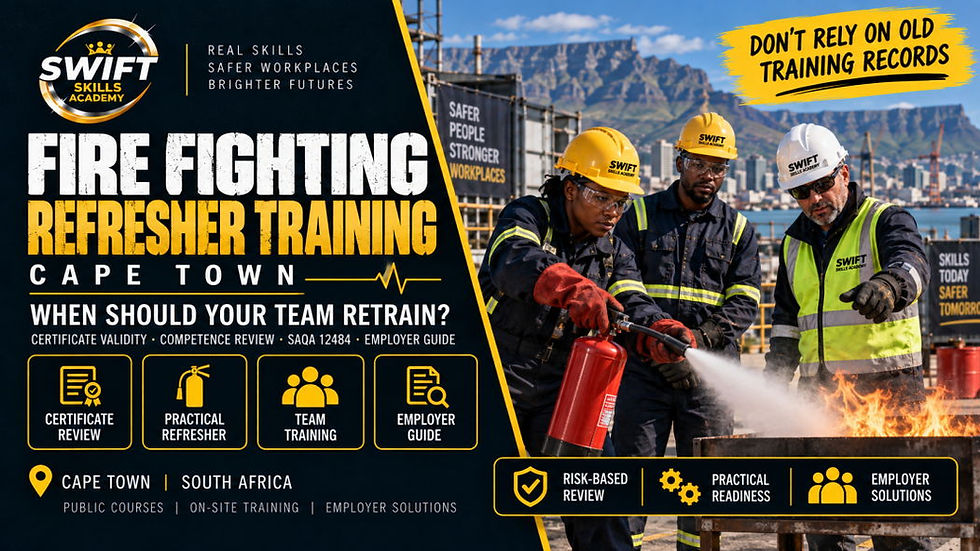
South African worker completing practical fire fighting refresher training with a fire extinguisher in Cape Town, covering workplace fire response, emergency readiness, safe retreat procedures and documented practical competence.

.

A fire-fighting certificate may still be sitting safely in an employee’s file—but can that employee confidently identify the fire, select the correct extinguisher, respond without placing others in danger and retreat when the situation becomes unsafe?


That is the real compliance question.


South African law does not prescribe one universal two-year or three-year expiry period for every basic fire-fighting certificate. Employers are instead required to maintain a safe workplace, identify hazards, provide appropriate precautions and give employees the information, instruction, training and supervision necessary for their responsibilities.


Fire-fighting refresher training should therefore not be presented as an automatic national recertification requirement. It should form part of a risk-based system for maintaining practical fire-response competence.


Employers seeking formal practical training can explore Swift Skills Academy’s Basic Fire Fighting Course in Cape Town early in their compliance review.


Quick Answer: When Does a Fire-Fighting Certificate Expire?


There is no single statutory expiry date applying to every basic fire-fighting certificate in South Africa.


A certificate may contain:


  • a provider-defined expiry or review date;

  • a client or contractor requirement;

  • an employer policy review period;

  • an insurer-related condition;

  • or an industry-specific refresher expectation.


These conditions should be checked individually.


The official SAQA record for Unit Standard 12484 does not state that every achievement expires automatically after two or three years. It identifies the programme, its outcomes and its current transitional status. (SAQA)


Even where a certificate has no formal expiry date, the employer must still be able to demonstrate that the employee remains suitable and competent for the fire-response role assigned.


What South African Workplace Fire-Safety Law Requires


The Employer’s General Duty Under Section 8


Section 8 of the Occupational Health and Safety Act requires every employer to provide and maintain, as far as reasonably practicable, a working environment that is safe and without risks to employees’ health.


The employer’s responsibilities include:


  • identifying workplace hazards;

  • determining appropriate precautionary measures;

  • providing safe systems of work;

  • supplying necessary information and instruction;

  • providing suitable training and supervision;

  • enforcing safety requirements;

  • and ensuring that hazardous work is supervised by someone who understands the risks and has authority to implement precautions. (Government of South Africa)


The Act does not say that a certificate alone establishes compliance.


The employer must show that the overall fire-safety system is appropriate, implemented and maintained.


Fire Precautions and Means of Escape


Regulation 13J of the amended General Safety Regulations requires employers to maintain appropriate fire-escape arrangements.


Among other things, employers must ensure that:


  • emergency exits can be opened quickly;

  • escape doors and passages remain clear;

  • escape staircases are unobstructed;

  • exit routes are suitable for the number of people using them;

  • workplaces have adequate means of egress;

  • suitable fire-fighting equipment is provided at strategic locations;

  • and fire-fighting equipment is kept in good working order. (Government of South Africa)


The amount and type of equipment should reflect the size, construction, location and activities of the workplace, as well as the flammable materials used, handled or stored.


Where appropriate, recommendations from the relevant local fire authority should also be considered. (Government of South Africa)


Is Fire-Fighting Refresher Training Mandatory?


There is no blanket national rule stating that every employee must repeat SAQA 12484 every two or three years.


However, refresher or repeat training may become necessary where the employer can no longer demonstrate current competence or where another applicable requirement specifies a review period.


A review may be appropriate when:


  • the employer’s risk assessment identifies a need;

  • the employee’s certificate contains an expiry or review date;

  • practical drills reveal uncertainty or poor performance;

  • workplace equipment has changed;

  • new flammable substances or processes have been introduced;

  • the workplace layout or evacuation routes have changed;

  • employees have not practised their response for a long period;

  • designated fire-team members have changed roles;

  • a near miss, fire or emergency has exposed weaknesses;

  • a principal contractor or client requires updated evidence;

  • or an applicable policy, standard or contractual arrangement specifies refresher training.


The correct approach is therefore:

Review competence according to the actual workplace risk—not according to an invented universal expiry rule.

Certificate Validity and Practical Competence Are Not the Same


An employee may possess an older certificate but no longer remember:


  • which extinguisher is suitable for a particular fire;

  • how to operate the equipment correctly;

  • when not to fight the fire;

  • how to approach the incident safely;

  • when to withdraw;

  • where the assembly point is;

  • or who must be contacted during an emergency.


Conversely, a recent certificate does not prove that the employer has:


  • suitable extinguishers;

  • unobstructed exits;

  • current evacuation procedures;

  • functioning alarms;

  • adequate supervision;

  • or a tested emergency plan.


A certificate is evidence of training or assessment at a particular point in time.


It is not a substitute for continuous workplace readiness.


Employers should also review Swift Skills Academy’s fire-fighting legal-requirements guide for a broader explanation of fire equipment, emergency arrangements and employer duties.


What Is the Current Status of SAQA Unit Standard 12484?


SAQA Unit Standard 12484 is titled Perform Basic Fire Fighting.


Its official record shows:


  • NQF Level 2;

  • four credits;

  • registration end date: 30 June 2023;

  • last date for enrolment: 30 June 2029;

  • last date for achievement: 30 June 2032.


The unit standard is marked as having passed its registration end date, but it remains within the published teach-out period. (SAQA)


This means employers and learners should not assume that any provider can automatically offer nationally recorded SAQA 12484 training.


Before enrolling, confirm:


  • the provider’s current approved scope;

  • the programme being delivered;

  • the approved delivery location;

  • how learners will be enrolled;

  • the assessment process;

  • whether credits will be recorded;

  • and what certificate or statement of result will be issued.


QCTO states that providers offering programmes and qualifications falling within its occupational-quality-assurance mandate must hold the appropriate accreditation. (QCTO)


Refresher Training Versus Full Credit-Bearing Training


These are not necessarily the same service.


Workplace Fire-Fighting Refresher


A refresher may be designed to:


  • revisit fire classes and common workplace hazards;

  • practise extinguisher selection;

  • review emergency communication;

  • reinforce evacuation and retreat procedures;

  • familiarise employees with the current workplace layout;

  • and test practical readiness.


A workplace refresher does not automatically result in new nationally recorded credits.


Formal Training and Assessment


Formal programme delivery may involve:


  • structured learning outcomes;

  • theory and practical instruction;

  • evidence collection;

  • formal assessment;

  • moderation or quality-assurance requirements;

  • learner enrolment;

  • and certification or results recording through the applicable system.


The employer should first determine which outcome is required.


Do not advertise a short workplace refresher as formal SAQA recertification unless the actual programme, provider approval, enrolment and assessment arrangements support that claim.


When Should an Employer Review Fire-Response Competence?


There is no universal interval, but employers should establish a documented review cycle appropriate to their risks.


Review After a Practical Drill


A drill may reveal that employees:


  • cannot locate the nearest extinguisher;

  • choose the wrong equipment;

  • do not know the alarm procedure;

  • congregate in unsafe areas;

  • block emergency access;

  • or attempt to fight a fire that requires immediate evacuation.


These findings should lead to corrective action and, where necessary, refresher training.


Review When the Workplace Changes


Competence should be reconsidered when the business introduces:


  • new machinery;

  • hot-work activities;

  • flammable liquids or gases;

  • battery-charging areas;

  • welding operations;

  • new storage arrangements;

  • different extinguishing equipment;

  • or changes to escape routes.


Review After an Incident or Near Miss


A small fire, smoke event, overheated electrical installation or extinguisher discharge may expose failures that had not previously been visible.


The employer should investigate:


  • what happened;

  • whether the alarm was raised;

  • whether the correct equipment was selected;

  • whether evacuation began promptly;

  • whether employees acted outside their competence;

  • and which corrective measures are required.


Review When Employees Change Roles


An employee transferred to a different department may encounter completely different hazards.


Training that was suitable for an office environment may not be enough for:


  • a workshop;

  • warehouse;

  • fabrication facility;

  • commercial kitchen;

  • fuel-storage area;

  • laboratory;

  • or construction site.


What Should Effective Fire-Fighting Refresher Training Cover?


The content should be aligned with the employee’s actual responsibilities and workplace hazards.


A practical programme may include:


Fire Prevention


Employees should understand:


  • common ignition sources;

  • combustible and flammable materials;

  • electrical fire risks;

  • housekeeping failures;

  • hot-work precautions;

  • and the importance of keeping fire equipment and escape routes unobstructed.


Fire Recognition


Employees should be able to identify:


  • the likely type of material burning;

  • surrounding hazards;

  • whether electrical energy is involved;

  • whether gases or pressurised containers are present;

  • and whether the fire is small enough to approach safely.


Equipment Selection


Employees should understand the limitations and correct applications of equipment such as:


  • portable extinguishers;

  • fire blankets;

  • hose reels;

  • and other workplace-specific fire-response equipment.


Safe Response and Retreat


Training must make clear that employees are not professional firefighters merely because they completed a basic course.


They should know:


  • when to raise the alarm;

  • when evacuation takes priority;

  • when equipment may be used;

  • how to maintain a safe escape route;

  • and when immediate withdrawal is required.


SAQA 12484 itself includes identifying the fire, selecting equipment, controlling or extinguishing containable fires, monitoring changing conditions, retreating and handing the scene over to appropriate personnel. (SAQA)


Emergency Communication


Employees should know:


  • who raises the alarm;

  • who contacts emergency services;

  • who coordinates evacuation;

  • where personnel assemble;

  • how visitors and contractors are accounted for;

  • and who meets responding emergency personnel.


Which Employees Should Receive Fire-Fighting Training?


Not every employee necessarily requires the same level of fire-response training.


The employer’s risk assessment and emergency plan should determine:


  • how many trained people are needed;

  • where they should be positioned;

  • which shifts require coverage;

  • what hazards they may encounter;

  • and what they are authorised to do.


Possible participants include:


  • designated fire-team members;

  • health and safety representatives;

  • supervisors;

  • security personnel;

  • maintenance teams;

  • workshop staff;

  • warehouse employees;

  • hot-work teams;

  • and employees responsible for emergency coordination.


Other employees still need suitable induction and evacuation information, even where they are not expected to use fire-fighting equipment.


For a broader foundation, link this section to Swift Skills Academy’s Basic Health and Safety Course and OHSA/SHE Compliance Training pages.


Fire Readiness Is More Than Fire-Fighting Training


A defensible fire-safety system may include:


  • current fire-risk assessments;

  • suitable and serviced equipment;

  • clear emergency exits;

  • visible signage;

  • evacuation plans;

  • emergency contact procedures;

  • workplace induction;

  • practical drills;

  • trained fire-response personnel;

  • inspection records;

  • incident and near-miss investigations;

  • corrective-action registers;

  • and management review.


Employers should also coordinate fire readiness with appropriate workplace first-aid arrangements, because burns, smoke inhalation, falls and other injuries may occur during an emergency.


Training is one component of this system.


Is Enforcement Increasing in 2026?


The Department of Employment and Labour has expanded its inspection and enforcement capacity and continued multidisciplinary high-impact blitz inspections during 2026.


Official statements describe Project 20,000, the recruitment and deployment of additional inspection personnel and stronger consequence management for non-compliance. (Department of Labour)


This does not mean inspectors apply a fictional three-year expiry rule to every fire-fighting certificate.


It means employers should be prepared to demonstrate that their fire precautions, exits, equipment, risk controls, training and emergency arrangements are genuine and effective.


A Practical Employer Action Plan


Step 1: Review Your Fire-Risk Assessment


Confirm that it reflects the actual:


  • equipment;

  • substances;

  • occupancy;

  • work processes;

  • storage;

  • ignition sources;

  • and emergency arrangements.


Step 2: Inspect Escape Routes and Equipment


Check whether:


  • exits are unlocked and accessible;

  • passages are clear;

  • equipment is visible;

  • inspection and service records are current;

  • signs are present;

  • and the equipment is appropriate for the hazards.


Step 3: Audit Existing Training Records


Record:


  • employee names;

  • training dates;

  • programme completed;

  • provider details;

  • assessment results;

  • certificate conditions;

  • departments and shifts;

  • and assigned emergency roles.


Step 4: Test Practical Competence


Do not rely only on certificate dates.

Use supervised drills, questions and demonstrations to determine whether employees understand their responsibilities.


Step 5: Identify the Correct Training Route


Decide whether employees need:


  • site-specific induction;

  • a practical refresher;

  • full formal training and assessment;

  • new training because their role changed;

  • or broader emergency-response preparation.


Step 6: Close the Gaps


Document:


  • the weakness identified;

  • the corrective action;

  • the responsible person;

  • the deadline;

  • and evidence of completion.


Step 7: Schedule Future Reviews


Set a review period that reflects:


  • the level of fire risk;

  • frequency of drills;

  • staff turnover;

  • operational changes;

  • practical performance;

  • and any applicable certificate, client or policy conditions.


Training Larger Teams in Cape Town


Employers with multiple employees may consider coordinated on-site training where the facilities, safety controls and provider approvals allow it.


Potential benefits include:


  • reduced travel and operational disruption;

  • consistent instruction across departments;

  • scenarios based on the actual workplace;

  • coordinated emergency roles;

  • and easier record management.


Link this section to the supporting guide: How to Train 10 or More Employees On-Site.


On-site delivery does not reduce the need for proper enrolment, assessment, suitable facilities or provider scope where formal credit-bearing training is intended.


Frequently Asked Questions


Does a Basic Fire-Fighting Certificate Automatically Expire After Three Years?

Not universally.

There is no national rule in the sources reviewed that makes every basic fire-fighting certificate automatically invalid after three years. Check the actual certificate, provider terms, employer policy and any applicable contractual or sector requirements.


Is Fire-Fighting Refresher Training Mandatory Every Two Years?

There is no blanket two-year statutory cycle applying to every South African workplace.

Refresher training may nevertheless be necessary where risk assessments, drills, changed conditions, competence reviews or other applicable requirements show that employees need renewed instruction or practical training.


Does an Old Certificate Prove Current Competence?

Not necessarily.

It proves that training or assessment occurred previously. Current competence should be considered in relation to the employee’s present role, workplace hazards, equipment and practical performance.


Must Every Employee Complete a Fire-Fighting Course?

Not necessarily.

The employer must determine who requires specific fire-response competence. All employees should still receive appropriate information about alarms, evacuation, assembly points and emergency procedures.


Can SAQA 12484 Still Be Offered?

The unit standard has passed its registration end date, but its official record lists 30 June 2029 as the last enrolment date and 30 June 2032 as the last achievement date. Delivery remains subject to the appropriate provider scope, enrolment and quality-assurance arrangements. (SAQA)


Does Refresher Training Automatically Award New Credits?

No.

A workplace refresher and formal credit-bearing programme delivery are not automatically the same. Ask the provider to confirm the programme, assessment, enrolment and certification route in writing.


How Long Does Fire-Fighting Training Take?

Duration depends on:

  • the programme selected;

  • group size;

  • existing competence;

  • practical activities;

  • assessment requirements;

  • and whether formal credit-bearing delivery is involved.


Do not assume that every programme or refresher must take exactly one day.


Final Word: Maintain Competence, Not Just Certificates


The strongest fire-safety evidence is not merely a certificate with a recent date.

It is proof that:


  • workplace fire risks were assessed;

  • suitable equipment was available and maintained;

  • exits were clear;

  • employees understood their responsibilities;

  • designated personnel remained competent;

  • drills were conducted;

  • weaknesses were corrected;

  • and management maintained a functioning emergency system.


South African law does not impose one universal expiry date on every fire-fighting certificate.


It does require employers to maintain a safe workplace and provide the training,

supervision and precautions necessary for the risks present.


Book Fire-Fighting Training in Cape Town


Swift Skills Academy provides practical fire-fighting training options for individuals and workplace teams in Cape Town.


Before booking, confirm:


  • the exact programme;

  • whether it is formal training or a workplace refresher;

  • the provider’s current approved scope;

  • delivery-location approval;

  • assessment requirements;

  • certification arrangements;

  • and whether nationally recorded credit is intended.


Primary CTA anchor text:

Explore Basic Fire Fighting Training in Cape Town

Swift Skills Academy

6 Monaco Road, Killarney Gardens, Cape Town

Tel: 021 828 0772

WhatsApp: +27 60 998 7412


You May Also Want to Read Further

Recommended guide

Why it is worth reading

Best suited to

Review the practical training outcomes, delivery format, assessment arrangements and booking options available through Swift Skills Academy. Employers should request written confirmation of the exact programme route, current provider scope, practical component and certification issued before enrolment. (Swift Skills Academy)

Employers and individuals ready to request training

A detailed planning guide explaining why training must connect to the workplace risk assessment, equipment, evacuation procedures, shift coverage, emergency communication and safe-retreat decisions. It also provides a useful checklist of questions to ask a provider before approving a quotation. (Swift Skills Academy)

Safety managers, HR teams and business owners

Explains the purpose of basic workplace fire-response training, the role of practical extinguisher competence and the difference between having a certificate and maintaining an effective fire-safety system. It is a useful next step for readers comparing formal training, workplace refreshers and employer evidence requirements. (Swift Skills Academy)

Employers comparing training routes and costs

Examines how poor training records, neglected equipment, weak evacuation planning, undisclosed risk changes and failure to meet policy conditions may complicate a commercial fire claim. It correctly explains that an insurance outcome depends on the policy wording, evidence, cause of loss and facts of the incident—not on one certificate alone. (Swift Skills Academy)

Directors, risk managers and insurance decision-makers

Expands fire-fighting training into the complete emergency-response system: alarms, evacuation routes, assembly points, emergency roles, roll calls, visitor control, first-aid arrangements and post-drill corrective actions. This helps employers connect individual competence with a coordinated site-wide response. (Swift Skills Academy)

Fire wardens, supervisors and emergency coordinators

Provides a wider workplace inspection framework covering fire extinguishers, access, signage, emergency routes, hot-work controls, flammable materials and hazardous substances. Use it to identify conditions that training alone cannot correct. (Swift Skills Academy)

Safety representatives and workplace inspectors

Shows how basic safety awareness, employer and employee duties, PPE, housekeeping, hazard recognition and emergency procedures form the foundation beneath specialised fire-response training. It is particularly useful when building a structured training pathway for new employees and general workers. (Swift Skills Academy)

New employees, general workers and supervisors

Fire emergencies may involve burns, smoke inhalation, falls, electrical injuries and multiple casualties. This guide explains workplace first-aid boxes, first-aider coverage, shift planning, certificate verification and the need to match emergency competence to the actual workplace risk. (Swift Skills Academy)

Employers coordinating fire and medical response

Helps employers position fire-fighting training within a broader safety-training matrix that may include First Aid, Basic Health and Safety, Working at Heights, Confined Spaces and scaffolding programmes. It reinforces that course selection should follow tasks, hazards, legal requirements and required evidence. (Swift Skills Academy)

HR managers building an annual training plan

Final funnel paragraph

Fire-fighting refresher training should not be selected according to an invented universal expiry period. Employers should review the workplace risk assessment, emergency plan, practical drills, employee performance, certificate conditions and any applicable client, insurer or operational requirements. When renewed instruction or formal training is needed, explore Swift Skills Academy’s Fire Fighting Training in Cape Town and request written confirmation of the programme, practical assessment, provider scope and certification route.

Authoritative Sources

Source

Type

Why it matters

South African Government — Occupational Health and Safety Act 85 of 1993 (Government of South Africa)

Primary legislation

Establishes employer duties relating to safe systems, hazards, training and supervision.

South African Government — General Safety Regulations amendment, Regulation 13J (Government of South Africa)

Current regulation

Covers escape routes, means of egress and suitable fire-fighting equipment.

SAQA — Unit Standard 12484: Perform Basic Fire Fighting (SAQA)

Official programme record

Confirms the outcomes, registration status and teach-out dates.

QCTO — Information for Skills Development Providers (QCTO)

Official quality-assurance guidance

Explains accreditation requirements for programmes falling under QCTO’s mandate.

Department of Employment and Labour — 2026 inspection and enforcement expansion (Department of Labour)

Official enforcement context

Confirms expanded inspectorate capacity and stronger compliance enforcement.

Legal notice: This article provides general educational information and does not constitute legal advice. Employers should assess their specific workplace, applicable regulations, contractual obligations, insurance conditions and local-authority requirements with qualified occupational health and safety and legal professionals.

Send Us Your Enquiry

Complete the form below and a team member will be in touch

Which province
Enquiring As

Enquiry Type

enquiry type single choice
Welding Programmes
Health & Safety Training
Workplace Training
Skills Development Consulting
Fees & Payment Enquiries
General Enquiry

Message

Prefer another way?

Email Us: info@swiftskillsacademy.co.za

WhatsApp : +27 60 998 7412

Call us: 021 828 0772


swift-skills-academy-professional-consultant-logo-brooch-cape-town.jpg.jpg
54580.png

Subscribe for Compliance Insights

Contact Swift Skills Academy Cape Town Get in Touch for Accredited Training & Skills Development

Fast Response | Cape Town Office | Nationwide On-Site Training | WhatsApp, Call or Email Today

bottom of page