Monthly Fire Extinguisher Inspection Checklist South Africa: 30 Checks + Free Employer PDF
Updated: Sep 27
A fire extinguisher mounted on a wall is not automatically a fire extinguisher that is ready for an emergency.
It may have been moved.
Its access may be blocked.
A safety seal may be broken.
The hose may be damaged.
The pressure indicator may show an obvious problem.
Its service record may be overdue.
Or the extinguisher may be perfectly serviceable — while the employees standing next to it have no idea which equipment to use, when to use it or when they should evacuate instead.
That is why a fire extinguisher inspection checklist South Africa should form part of a wider workplace fire-readiness system. For a broader review, use our workplace fire safety checklist for employers.
Quick Answer: What Should Employers Check on a Fire Extinguisher?
A routine workplace visual check should confirm that the extinguisher is still in its intended location, clearly visible, readily accessible, apparently undamaged, correctly secured, fitted with its expected pin and seal, showing no obvious signs of discharge or leakage, and carrying readable identification and service information.
Where an extinguisher has a pressure indicator, an obvious abnormal reading should be reported.
But there is an important distinction:
A routine employer visual check does not replace professional fire-equipment servicing, technical examination or repair.
South Africa's amended General Safety Regulations require an employer to provide an adequate supply of suitable fire-fighting equipment, considering the workplace and fire risk, and to maintain that equipment in good working order. Department of Labour
For Cape Town workplaces, the City of Cape Town additionally advises that commercial, industrial, healthcare and accommodation facilities maintain fire equipment and states that fire equipment should be serviced at least annually. Cape Town City Council
Visual Check vs Professional Service
Routine workplace visual check | Professional servicing |
Is the extinguisher present? | Technical examination |
Is access clear? | Servicing components |
Is it visibly damaged? | Repair or replacement decisions |
Is the pin/seal apparently intact? | Recharge where required |
Is the gauge visibly abnormal, where fitted? | Pressure/testing procedures where applicable |
Is the label readable? | Compliance with applicable servicing standards |
Does the service information appear current? | Formal service records/labels |
Has a defect been reported and closed? | Work by an appropriately qualified/approved service provider |
The two controls complement each other.
One does not replace the other.
Does South African Law Require a Monthly fire extinguisher inspection checklist South Africa?
This needs a precise answer.
There is not a simple national OHS rule saying every employer must complete this exact monthly checklist on every extinguisher.
Regulation 13J of the General Safety Regulations requires suitable fire-fighting equipment to be provided at strategic locations according to the workplace's circumstances and requires that equipment to be maintained in good working order. Department of Labour
A monthly visual inspection is therefore a practical internal control employers can use between formal servicing intervals to identify deterioration, obstruction, relocation, apparent discharge or other problems early.
It should not be marketed as though the checklist itself is a statutory certificate.
Why Check Extinguishers Between Services?
A lot can change inside a workplace after a fire-equipment service technician leaves.
Stock can be stacked in front of equipment.
Furniture can move.
Construction work can affect access.
An extinguisher can be knocked.
A seal can be broken.
Someone may partially discharge equipment and fail to report it.
New machinery or materials can alter the fire-risk profile.
A contractor may temporarily obstruct an escape route or extinguisher position.
Routine inspection helps employers detect these operational changes instead of discovering them during an emergency.
The City of Cape Town specifically emphasises keeping fire equipment ready for emergency use and maintaining safe workplace fire precautions. Cape Town City Council
30 Fire Extinguisher Inspection Checks for South African Workplaces
The following checklist is deliberately focused on visible workplace readiness.
It is not a technical servicing procedure.
A. Location, Access and Visibility
# | Check |
1 | Is the extinguisher still in its designated location? |
2 | Can employees reach it without moving stock, furniture or equipment? |
3 | Is the approach to the extinguisher clear? |
4 | Is the extinguisher clearly visible? |
5 | Is fire-equipment signage visible where required? |
6 | Has the extinguisher been moved without authorisation? |
7 | Is the mounting bracket, cabinet or stand visibly secure? |
8 | Can a cabinet or enclosure be opened without obstruction? |
B. Visible Physical Condition
# | Check |
9 | Is the extinguisher body free from obvious major dents or impact damage? |
10 | Is there no obvious severe corrosion? |
11 | Is there no visible evidence of leakage? |
12 | Is the hose visibly intact? |
13 | Is the nozzle visibly intact and unobstructed? |
14 | Are handles and operating levers visibly intact? |
15 | Is there no obvious evidence that the unit has been discharged? |
Do not dismantle or attempt to repair the extinguisher during a routine visual workplace check.
Report abnormalities through the employer's defect-management process and escalate them to the appropriate fire-equipment service provider.
C. Pin, Seal and Pressure Indication
# | Check |
16 | Is the operating pin present where applicable? |
17 | Is the tamper seal apparently intact? |
18 | Where a pressure indicator is fitted, does it appear to be within its normal operating indication? |
19 | Is there no visible evidence that the extinguisher has been interfered with? |
An employee conducting the checklist should identify and report an apparent problem rather than attempt technical servicing.
D. Identification and Service Information
# | Check |
20 | Is the extinguisher identification visible? |
21 | Are operating instructions readable? |
22 | Is the service label or service information present? |
23 | Does the available service information indicate that the unit requires attention? |
24 | Can the extinguisher be matched to the workplace's extinguisher register or asset record? |
25 | Have previously reported extinguisher defects been closed out? |
For Cape Town workplaces, the City says commercial, industrial, healthcare and accommodation facilities must maintain their fire equipment and states that equipment should be serviced at least annually. Cape Town City Council
E. Workplace Risk and Readiness
# | Check |
26 | Have new materials, equipment or processes changed the local fire risk? |
27 | Is the extinguisher still readily accessible given the current workplace layout? |
28 | Do employees know how to raise the alarm? |
29 | Are appropriately trained employees available for the workplace's fire-response arrangements? |
30 | Has every defect found during this inspection been recorded, assigned and followed through to corrective action? |
That final check is important.
An inspection that repeatedly finds problems but does not close them out becomes paperwork rather than risk control.
What Should Happen When an Extinguisher Fails a Visual Check?
Do not simply tick FAIL and continue with the inspection.
The employer should have a defect-management process.
A useful workflow is:
CHECK → IDENTIFY → REPORT → CONTROL → ASSIGN → CORRECT → VERIFY
The response should depend on the defect.
A blocked extinguisher may require immediate removal of the obstruction.
A damaged bracket may require maintenance.
A broken seal, suspicious pressure indication, discharged extinguisher or physical damage may require assessment by the appropriate fire-equipment service provider.
A newly introduced fire hazard may require a wider review of equipment suitability rather than simply replacing like-for-like equipment.
And a training problem requires a training response.
Not every failed checklist item is solved by sending employees on a course.
Who Should Perform the Workplace Visual Inspection?
An employer can nominate a suitable person to conduct routine workplace checks according to its own fire-safety system.
That person should understand:
what they are expected to inspect; what they are not authorised to repair; what constitutes an obvious defect; how to record a finding; who receives the report; and how corrective action is verified.
This does not automatically turn that employee into a fire-equipment technician.
Routine inspection, technical servicing and workplace fire-fighting competence are different functions.
Can an Employer Service Its Own Fire Extinguishers?
A routine visual check should never be confused with technical fire-equipment servicing.
In Cape Town, the City's published guidance specifically states that fire equipment should be serviced by approved fire-equipment companies and identifies SABS 1475 in its guidance. Cape Town City Council
If a visual inspection finds an equipment defect, the correct response is normally to escalate the equipment issue to the appropriate service provider, not improvise a repair.
Fire Extinguisher Inspection Is Only One Part of Fire Readiness
A perfectly serviced extinguisher does not solve every workplace fire risk.
The employer must also consider:
fire hazards; means of escape; emergency exits; alarm arrangements; evacuation procedures; employee responsibilities; suitable equipment; emergency communication; contractor and visitor arrangements; staff availability across shifts; drills; incident reporting; and corrective action.
Regulation 13J specifically addresses both fire-fighting equipment and means of egress. It requires escape doors and exit routes to support rapid evacuation and requires suitable equipment considering the workplace's size, construction, location and fire hazards. Department of Labour
The City of Cape Town's workplace fire-safety material similarly covers fire prevention, equipment, emergency escape arrangements and workplace preparedness rather than extinguishers alone. Cape Town City Council
Your Extinguishers May Be Serviced — But Can Your Employees Use Them?
This is where many employers confuse equipment compliance with human capability.
Professional servicing addresses the extinguisher.
Training addresses the employee.
A person faced with a workplace fire may need to understand:
how to raise the alarm; what type of equipment may be appropriate; how to preserve an escape route; the limitations of portable fire-fighting equipment; when initial intervention may be reasonable; when conditions have deteriorated beyond basic workplace fire fighting; and when to retreat and evacuate.
The presence of an extinguisher should never pressure an employee into remaining in an unsafe fire environment.
Swift Skills Academy's separate Workplace Fire Smoke Safety guide explains why deteriorating smoke, heat, visibility and escape conditions should trigger retreat rather than heroic behaviour. Swift Skills Academy
SAQA Unit Standard 12484: What Is Its Current Status?
This is where the existing article needed correction.
SAQA currently records Unit Standard 12484 — Perform basic fire fighting as:
NQF Level: 2Credits: 4Registration end date: 30 June 2023Last date for enrolment: 30 June 2029Last date for achievement: 30 June 2032. SAQA
Therefore it is inaccurate to say that the last enrolment date has already passed.
The standard includes workplace basic fire-fighting outcomes and remains relevant to employers evaluating training linked to this unit standard during the permitted enrolment period. SAQA
Employers should still confirm the current programme, assessment, certification and quality-assurance route with the training provider before booking rather than relying only on an old course advertisement.
Fire Extinguisher Inspection vs Fire Fighting Training
These controls solve different problems.
Control | Main question |
Extinguisher visual inspection | Is the equipment visibly ready and accessible? |
Professional servicing | Is the equipment technically maintained? |
Fire-risk assessment | What fire hazards and controls apply here? |
Emergency procedure | What should people do when fire occurs? |
Fire drill | Does the emergency arrangement work in practice? |
Fire-fighting training | Can designated people respond within their role and limitations? |
Corrective-action process | Are identified weaknesses actually fixed? |
An employer should avoid treating any one of these as a substitute for all the others.
What Records Should Employers Keep?
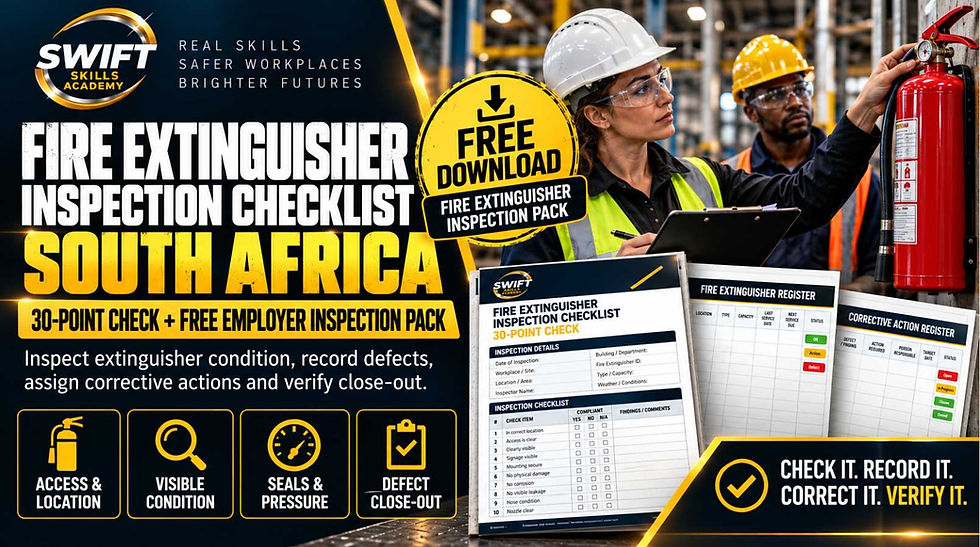
A useful extinguisher inspection record should identify the workplace or area, inspection date, extinguisher or asset reference, location, check result, identified defect, immediate control taken, person responsible for corrective action, target date and verification of close-out.
The purpose is not to create paperwork for its own sake.
The record should help management answer:
What was wrong? Who was supposed to fix it? Was it fixed? Can we prove that?
This is why the downloadable Swift Skills Academy pack should contain more than a simple tick sheet.
It should provide:
Extinguisher register → monthly inspection checklist → defect record → corrective-action tracker → verified close-out
Should an Extinguisher Be Checked After It Has Been Used?
Yes.
Do not simply return a used extinguisher to its wall position and assume it remains ready.
Any suspected use, discharge, damage or tampering should be reported and dealt with through the appropriate fire-equipment servicing process before the employer relies on that unit again.
A routine checker should not attempt to recharge or technically repair it.
What If the Pressure Gauge Looks Wrong?
Where an extinguisher has a pressure indicator and the reading appears abnormal, record the defect and escalate it.
The inspection checklist is intended to identify the problem.
It is not a technical troubleshooting guide.
Similarly, an apparently normal gauge should not be treated as proof that every internal component of the extinguisher has been technically verified.
What If an Extinguisher Is Blocked?
Treat accessibility problems seriously.
Fire equipment that cannot be reached quickly may provide little practical value during an emergency.
Remove the obstruction where it is safe and appropriate to do so, determine why the area became obstructed, and prevent the same storage or housekeeping problem from recurring.
Repeated obstruction is a management-system problem, not merely a monthly inspection problem.
What If the Workplace Layout or Fire Risk Changes?
This is one of the most overlooked questions.
A fire extinguisher may still be in perfect physical condition while no longer being suitable for the risk around it.
Changes such as new machinery, flammable materials, electrical equipment, battery-storage systems, altered partitions, additional stock, new production processes or changed occupancy should trigger a wider fire-risk review.
A routine visual inspector should flag the change, not make unsupported technical equipment-selection decisions.
Fire Safety in Cape Town: Employers Have Local Responsibilities Too
Cape Town businesses should consider national occupational health and safety requirements together with applicable municipal fire-safety requirements.
The City of Cape Town publishes dedicated fire-safety guidance and a workplace Fire & Life Safety Checklist addressing prevention, workplace conditions, escape arrangements and fire preparedness. Cape Town City Council
That means a good employer fire-safety programme should never be reduced to:
“The extinguishers were serviced, therefore we are compliant.”
Equipment condition is one part of a larger system.
Frequently Asked Questions
How often should fire extinguishers be visually inspected in South Africa?
Employers can use a monthly visual inspection as a practical internal fire-readiness control. However, do not describe an exact monthly checklist as a universal national legal requirement unless a specific applicable standard, authority, risk assessment or site requirement imposes that frequency.
The legal obligation is broader: suitable fire-fighting equipment must be provided and maintained in good working order. Department of Labour
Does a monthly fire extinguisher inspection replace annual servicing?
No.
A visual workplace inspection and professional servicing perform different functions.
For Cape Town workplaces, City guidance states that fire equipment should be serviced at least annually. Cape Town City Council
Can an ordinary employee conduct the monthly visual check?
An employer may designate a suitable employee to conduct routine visual checks under the employer's system, provided that the person's role and limitations are clear.
That does not authorise the person to service, dismantle, recharge or technically certify extinguishers.
What should I do if the extinguisher seal is broken?
Record and escalate the issue according to the workplace's fire-equipment defect procedure so that the extinguisher can be appropriately assessed.
Do not simply replace a seal and assume the equipment is serviceable.
What should I do if an extinguisher has been partially discharged?
Report it and arrange appropriate assessment or servicing before returning the unit to emergency readiness.
Does a green pressure gauge mean the extinguisher is definitely safe?
Not necessarily.
A pressure indication is only one visible indicator. Routine inspection does not establish the complete technical condition of an extinguisher.
Does every employee need fire-fighting training?
South African legislation does not create a simple rule requiring every employee to complete one identical fire-fighting course.
Employers should determine fire-response responsibilities according to the workplace's hazards, size, layout, staffing, shifts and emergency arrangements.
Is SAQA Unit Standard 12484 still available for enrolment?
SAQA currently records the last date for enrolment as 30 June 2029 and the last date for achievement as 30 June 2032, although the unit standard itself has passed its registration end date. SAQA
Authoritative Sources
Department of Employment and Labour — General Safety Regulations Amendment, 2025Regulation 13J: Fire precaution and means of egress. Department of Labour
South African Qualifications Authority — Unit Standard 12484: Perform Basic Fire FightingCurrent registration, enrolment and achievement dates. SAQA
City of Cape Town — Fire SafetyLocal fire-safety, equipment, workplace and servicing guidance. Cape Town City Council
City of Cape Town — Fire & Life Safety Workplace ChecklistWorkplace prevention and preparedness guidance. Cape Town Resource
Read More
Fire Fighting Training Cape Town: 2026 Employer Guide
Understand workplace fire-response training, employer responsibilities and what to verify before booking.
Workplace Fire Smoke Safety: Visibility, Retreat and When It’s No Longer Safe to Fight
Understand why smoke, heat, spreading fire and compromised escape routes should trigger withdrawal.
Workplace Emergency Procedures South Africa
Connect extinguisher readiness to alarms, evacuation routes, assembly points, responsibilities and emergency procedures.
Final Word
A fire extinguisher inspection checklist is valuable because it can find a problem before somebody needs the equipment.
But the checklist should never create false confidence.
A fire-ready workplace requires suitable equipment, clear access, professional servicing, safe exits, emergency procedures, competent people, appropriate training and corrective action that is actually completed.
The strongest employer question is therefore not:
“Do we have extinguishers?”
It is:
“If a fire starts today, are our equipment, people and emergency arrangements actually ready?”