Fire Safety Insurance Risk South Africa: Can a Business Fire Claim Be Rejected?
Updated: Sep 28

A workplace fire can cause two separate disasters.
The first is the fire itself.
The second can begin afterwards, when the insurer starts asking questions.
Was the risk properly disclosed?
Were fire-protection systems maintained?
Were extinguishers available and serviceable?
Did the business comply with specific policy conditions?
Had the insurer been told that the nature of the business had changed?
Were employees expected to respond to a fire?
Was there evidence showing that fire risks had actually been managed?
That does not mean every fire-safety failure automatically causes an insurance claim to be rejected.
South African fire-insurance disputes show why the answer is much more dependent on the actual policy wording, the facts of the loss and the defence the insurer relies upon. In Renasa Insurance Company v Watson, the Supreme Court of Appeal dealt with a reasonable-precautions defence following a fire and confirmed that the insurer carried the burden of establishing the policy defence on which it relied. SAFLII
More recently, the 2025 Biovac v Guardrisk matter also demonstrated that regulatory non-compliance does not automatically mean an insurer succeeds in avoiding liability. The court examined the precise policy wording, alleged misrepresentation and whether the insured had acted merely negligently or had recklessly disregarded a known risk. SAFLII
The practical lesson for employers is:
Do not assume one missing certificate automatically destroys cover — but do not assume weak fire controls will be irrelevant either.
Quick Answer: Can Poor Fire Safety Affect a Business Insurance Claim?
Potentially, yes.
A fire claim may become more difficult where an insurer alleges that the insured:
breached a specific policy condition;
failed to disclose a material change in risk;
misrepresented important information;
ignored a stated fire-protection requirement;
failed to maintain required equipment or systems;
did not take precautions required by the policy;
failed to comply with a warranty or endorsement; or
cannot produce evidence needed to support the claim.
But the consequences depend on the policy and facts.
The National Financial Ombud Scheme reports that non-disclosure, misrepresentation and failures involving due care or precautions are recurring reasons raised in insurance disputes. NFOSA
A training provider cannot promise that a future claim will be paid.
What an employer can do is build a better-documented fire-safety system before an incident occurs.
Your Fire Safety Insurance Risk South Africa Policy Comes First
Fire safety insurance risk South Africa is a critical issue for employers, as no universal commercial insurance clause applies identically to every business.
Your insurance policy comes first, and insurers may scrutinize fire prevention systems, extinguisher servicing, alarms, hot work permits, and employee training records after a workplace fire. The real risk lies in failing to disclose material changes, ignoring defects, or missing documentation.
Building a defensible fire‑safety evidence file ensures that your business can demonstrate compliance, manage hazards, and protect insurance cover in South Africa’s regulatory environment.
One policy may contain broad wording requiring reasonable precautions.
Another may contain specific conditions involving:
fire extinguishers;
automatic sprinkler systems;
alarms;
electrical installations;
cooking equipment;
fire doors;
hot work;
dangerous goods;
flammable substances;
security;
building occupancy;
housekeeping;
maintenance;
business activities; or
notification of changes in risk.
This is why copying a generic internet checklist into a safety file is not enough.
An employer should know what its own policy requires.
Useful questions for a broker or insurer include:
What fire-protection conditions apply to our premises?
Are any requirements stated as warranties or endorsements?
What systems must be serviced or inspected?
Do any requirements apply to sprinklers, alarms or extinguishers?
Are there special requirements for hot work?
Must we disclose changes in equipment, occupancy or business activities?
Are there conditions relating to flammable liquids, gas or batteries?
What records would be requested after a major fire?
Are there any employee-training conditions?
What happens if a stated condition is not met?
Do not assume the broker, insurer and safety officer are all thinking about the same risk.
Ask.
Record the answer.
Fire Safety Insurance Risk Is Not the Same as OHS Compliance
Insurance and occupational health and safety are related, but they are not the same legal system.
Section 8 of South Africa's Occupational Health and Safety Act requires an employer, as far as reasonably practicable, to provide and maintain a working environment that is safe and without risk to employees' health. The duties include identifying hazards and providing necessary information, instruction, training and supervision. Government of South Africa
That does not mean:
“If there is any OHS non-compliance, insurance is automatically void.”
The Biovac judgment is particularly useful here. The court dealt with an insured business that did not possess certain electrical certificates of compliance. The policy nevertheless insured against negligence, and the court found that the insurer had not demonstrated the level of reckless disregard required by the policy defence being relied upon. SAFLII
The correct approach is to examine separately:
What does the law require?
and:
What does the insurance contract require?
Both matter.
But they are not interchangeable.
What Fire Controls Might Matter After a Claim?
After a serious workplace fire, the insurer may investigate far more than the cause of ignition.
Depending on the policy and loss, attention may turn to:
Area | Evidence that may matter |
Risk disclosure | Proposal forms, surveys, broker correspondence |
Fire equipment | Registers, service records, defect reports |
Alarm systems | Testing and maintenance records |
Suppression systems | Inspection and service evidence |
Electrical installations | Relevant certificates and maintenance records |
Hot work | Permits, procedures, authorisations |
Flammables | Storage controls and risk assessments |
Employee training | Training records and assigned responsibilities |
Emergency procedures | Current plans and communication arrangements |
Evacuation | Drills, route checks, assembly arrangements |
Corrective action | Evidence that identified failures were actually closed |
Business changes | Notifications to insurer or broker |
Incident records | Reports, photographs and investigation evidence |
The precise documents needed will depend on the circumstances.
The principle is simple:
If the business says it controlled a fire risk, it should ideally be able to show how.
Fire Equipment: “We Had Extinguishers” Is Not Enough
Having an extinguisher attached to a wall does not prove that the equipment was ready for an emergency.
It may have been:
inaccessible;
damaged;
discharged;
incorrectly located;
overdue for servicing;
missing a seal or pin;
unsuitable for the hazard; or
obstructed by stock or equipment.
The City of Cape Town states that commercial and industrial facilities must install and maintain appropriate fire-safety equipment, and that portable fire equipment must be ready for use. Its guidance also states that staff should be trained and equipped with the knowledge to deal with a workplace fire emergency. Cape Town City Council
South Africa's 2025 General Safety Regulations also address suitable fire-fighting equipment and means of egress. Government of South Africa
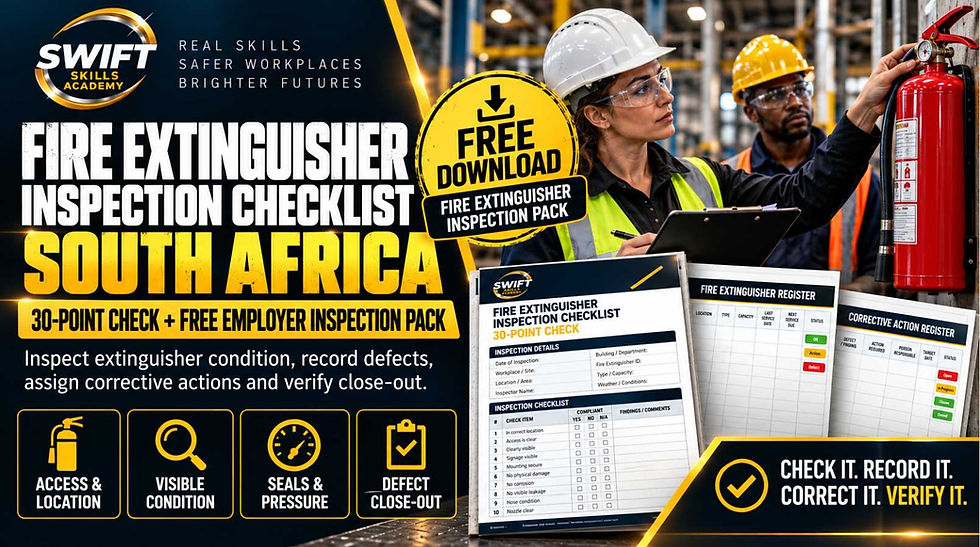
Use the Monthly Fire Extinguisher Inspection Checklist South Africa for routine employer visual checks.
Routine visual checks do not replace professional servicing, technical examination or competent-person requirements.
What About Fire Fighting Training?
Training can become relevant to both workplace safety and insurance evidence, particularly where employees have assigned fire-response responsibilities.
But a Fire Fighting certificate should never be represented as an insurance guarantee.
It proves only what the certificate and associated assessment legitimately prove.
It does not automatically prove:
the whole premises complies;
the alarm works;
exits are clear;
extinguishers are serviced;
enough people are trained;
the policy conditions have been met;
the insurer has accepted the risk;
every shift has adequate coverage; or
a future insurance claim will be paid.
The more useful employer question is:
If employees are expected to perform a workplace fire-response role, can the business show that suitable people were trained for that responsibility?
SAQA 12484: Important Current Status
SAQA Unit Standard 12484 — Perform basic fire fighting is recorded at NQF Level 2 with 4 credits.
The current SAQA record shows:
Status | Date |
Registration end date | 30 June 2023 |
Last date for enrolment | 30 June 2029 |
Last date for achievement | 30 June 2032 |
The record states that the unit standard has passed its registration end date and is not replaced by another unit standard. SAQA
Those are the current official dates.
This is important because the old version of this article incorrectly stated that last enrolment was 30 June 2026 and last achievement 30 June 2029.
Do not retain those old dates.
What Does SAQA 12484 Actually Teach?
The official unit-standard outcomes go beyond simply operating an extinguisher.
They include elements related to:
fire procedures;
identifying the nature and context of a fire;
selecting appropriate equipment;
isolating hazards;
approaching a containable fire;
monitoring changing conditions;
retreating when necessary;
containment or extinguishment;
handover; and
reporting. SAQA
That distinction matters.
Effective basic workplace Fire Fighting training should not create a belief that a trained employee must always attempt to extinguish a fire.
Sometimes the correct decision is to leave.
When Should an Employee Stop Trying to Fight a Fire?
A workplace employee should not continue attempting basic fire response when conditions exceed the limits of the person's training, equipment or safe escape.
Warning signs can include:
rapidly increasing smoke;
deteriorating visibility;
fire growth;
heat becoming severe;
threatened gas cylinders;
hazardous chemical involvement;
explosion risk;
an unsuitable extinguisher;
uncertainty about the hazard; or
loss of a safe escape route.
Can an Expired Fire Fighting Certificate Automatically Void Insurance?
No.
There is no responsible basis for saying that one outdated Fire Fighting certificate automatically renders every South African business insurance policy void.
Whether a claim is affected depends on:
policy wording;
the specific alleged breach;
relevant warranties or conditions;
disclosure;
the facts of the loss;
the evidence available;
and the legal principles applicable to the policy defence.
The Renasa fire case illustrates that an insurer relying on a reasonable-precautions defence still had to establish the defence under the policy. SAFLII
The Biovac case likewise demonstrates the importance of distinguishing negligence from the stronger state of mind required under the particular reasonable-precautions wording considered by the court. SAFLII
The safer statement for employers is:
An outdated training record may be evidence of a management gap, but its insurance consequence depends on the policy and the facts.
What Can Actually Weaken a Fire Claim?
Potential problems include:
1. Material non-disclosure
A business may introduce new processes or risks without telling the insurer or broker where disclosure is required.
Examples could include:
new manufacturing processes;
gas;
flammable substances;
commercial cooking;
large battery installations;
solar and inverter systems;
significant hot work;
changes in occupancy; or
major building alterations.
Whether a change is material or requires notification should be checked with the insurer or broker.
2. Failure to meet a specific policy condition
If a policy expressly requires a system to be inspected, serviced or maintained, that requirement should not be ignored.
3. Poor maintenance
Fire equipment or protection systems that exist on paper but do not function create both safety and evidentiary problems.
4. Ignored defects
A documented defect followed by no corrective action can be more problematic than a business that did not know the defect existed.
5. Missing records
An employer may have done the right thing and still struggle to demonstrate it if records cannot be produced.
6. Misrepresentation
Information given during policy placement, renewal, surveys or claims should be accurate.
The 2025 Biovac decision turned partly on whether the alleged representation relied on by the insurer had actually been made. The court found that it had not been proved. SAFLII
The Fire-Safety Evidence File Employers Should Build Before an Incident
A good fire-evidence file does not exist purely for insurance.
It also supports operational control.
Consider maintaining:
Risk evidence
fire-risk assessments;
hazard registers;
hot-work controls;
flammable-material controls.
Equipment evidence
extinguisher register;
service records;
alarm test records;
suppression-system records;
defect and repair evidence.
People evidence
training records;
certificates;
assigned roles;
shift coverage;
induction records.
Emergency evidence
emergency procedures;
evacuation plans;
drill records;
assembly arrangements;
emergency-contact information.
Corrective-action evidence
identified failure;
person responsible;
target date;
completion date;
verification.
Insurance evidence
current policy;
endorsements;
warranties;
insurer surveys;
broker correspondence;
disclosure of material changes.
This is how fire safety becomes a managed system rather than a folder of disconnected certificates.
Start With a Workplace Fire Safety Checklist
Before worrying about an insurance dispute that has not happened yet, identify the visible fire-readiness gaps that already exist.
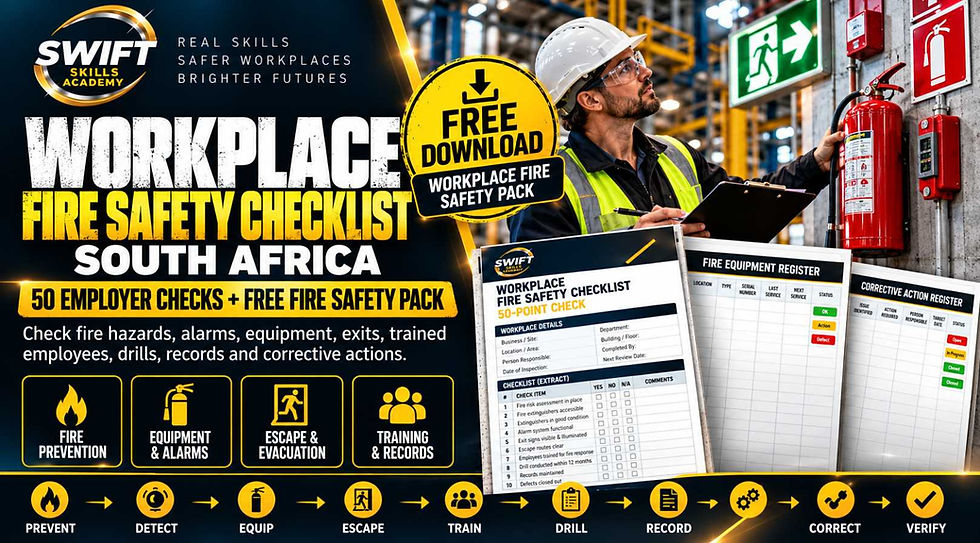
Swift Skills Academy's Workplace Fire Safety Checklist South Africa: 50 Employer Checks + Free PDF covers:
fire prevention;
alarms;
extinguishers;
escape routes;
trained employees;
drills;
records;
corrective action; and
verification.
A checklist is not a certificate of compliance and does not replace specialist or competent-person work.
Its value is that it helps employers find obvious problems early enough to act on them.
The Strongest Question Is Not “Are We Compliant?”
That question is too broad.
Ask instead:
What exact fire risks exist here?
What does the law require for those risks?
What does our insurance policy require?
What does the insurer believe our risk looks like?
What equipment is supposed to protect us?
Who is expected to respond?
Can they do so safely?
What evidence proves that these controls are functioning?
That produces a much better fire-risk conversation.
Fire Drills Matter Because Procedures Must Work in Practice
An emergency plan that has never been tested may contain weaknesses that only appear when people actually try to evacuate.
A drill can reveal:
unclear alarm procedures;
blocked or confusing routes;
slow evacuation;
poor accountability;
uncertainty about roles;
employees going to the wrong assembly point;
failure to assist vulnerable persons; or
poor communication.
The point is not to manufacture paperwork.
The point is to identify failures before an actual emergency.
Fire Training Must Connect to Emergency Procedures
Fire response should work as one system:
DETECT → ALARM → RESPOND → EVACUATE → ACCOUNT → ESCALATE → RECORD → CORRECT
Fire Fighting training cannot replace emergency planning.
Emergency planning cannot replace equipment.
Equipment cannot replace prevention.
Each control supports the others.
Questions to Ask Your Broker or Insurer Now
Do not wait until after a fire.
Ask:
What specific fire-protection conditions apply to our policy?
What systems must be maintained or serviced?
Are there insurer-specific inspection requirements?
Do we have any fire-related warranties?
What material changes must be disclosed?
Are there special conditions for batteries, solar, gas, hot work or flammables?
Does the insurer expect any employee training?
What documents should we retain?
What evidence would be requested following a major fire?
Is our current business description still accurate?
Keep the answers.
Questions to Ask Internally
Then ask management:
Who owns fire safety?
Who checks equipment?
Who closes defects?
Who controls hot work?
Who updates the risk assessment?
Who maintains the emergency plan?
Who is trained?
Which shifts are covered?
Who keeps the records?
Who communicates material risk changes to the broker?
If nobody owns the answer, that itself is a control weakness.
Why Fire Fighting Training Still Matters
The purpose of training is not to protect an insurance policy.
It is to prepare suitable people for workplace responsibilities.
Training can help employees understand:
fire hazards;
basic fire behaviour;
equipment selection;
safe response;
emergency communication;
evacuation;
retreat; and
reporting.
Those outcomes support fire readiness.
The insurance value is secondary: good training and proper records can become part of the wider evidence showing how the business managed its risk.
When Should an Employer Contact Swift Skills Academy?
Contact SSA where your review shows a training problem, for example:
no suitable employees have been trained;
shift coverage is weak;
trained employees have left;
assigned responders lack confidence;
the workplace has expanded;
fire-response responsibilities have changed; or
an employer needs individual, group or on-site training.
Do not use training to disguise an equipment or engineering problem.
If the gap is a broken alarm, damaged extinguisher, unsafe electrical installation or defective fire door, that problem requires the appropriate technical corrective action.
Frequently Asked Questions
Can poor fire safety cause a business insurance claim to be rejected?
Potentially, but not automatically. The outcome depends on the policy wording, the alleged breach, the facts of the fire and the evidence supporting the insurer's position. South African fire-insurance cases demonstrate why the exact policy defence matters. SAFLII
Does an expired Fire Fighting certificate automatically void insurance?
No. There is no universal rule that one expired Fire Fighting certificate automatically voids every commercial policy. Its relevance depends on the particular policy and circumstances.
Can an insurer consider failure to take precautions?
Some policies contain reasonable-precautions or similar clauses. Their application depends on the wording. Renasa v Watson involved such a clause and the insurer's attempt to rely on it following a fire. SAFLII
Does OHS non-compliance automatically mean a fire claim fails?
No. Occupational safety obligations and insurance-contract obligations are distinct. In the 2025 Biovac case, regulatory non-compliance was not by itself sufficient to establish the policy defence relied upon by the insurer. SAFLII
What should employers keep as fire-safety evidence?
Depending on the workplace, useful records may include risk assessments, equipment registers, service documents, training records, emergency plans, drill records, hot-work controls and corrective-action records.
Is SAQA 12484 still current?
The unit standard has passed its registration end date. SAQA lists its registration end as 30 June 2023, last enrolment as 30 June 2029 and last achievement as 30 June 2032. SAQA
Does a Fire Fighting certificate prove the workplace is compliant?
No. It is evidence relating to the training or assessment completed by the learner. Overall workplace fire safety depends on a wider system of prevention, equipment, evacuation, procedures, competent technical work and corrective action.
Can Swift Skills Academy guarantee that an insurer will pay a fire claim?
No. No training provider can guarantee an insurance decision. Insurance outcomes are governed by the contract, disclosures, conditions, evidence and circumstances of the loss.
Should employees always try to extinguish a workplace fire?
No. Employees should not attempt basic fire response where conditions are unsafe or exceed their training, equipment or ability to retreat safely.
Authoritative Sources & Official Guidance
Source | Why it matters |
South African Government — Occupational Health and Safety Act 85 of 1993 | Establishes the employer's broader duties relating to workplace hazards, controls, information, training and supervision. Government of South Africa |
South African Government — General Safety Regulations, 2025 | Current national regulation addressing fire precautions, means of egress and fire-fighting equipment. Government of South Africa |
SAQA — Unit Standard 12484: Perform Basic Fire Fighting | Confirms the unit-standard scope, NQF level, credits and current official lifecycle dates. SAQA |
City of Cape Town — Fire Safety | Provides local guidance concerning fire equipment, servicing and workplace staff preparedness. Cape Town City Council |
Renasa Insurance Company Ltd v Watson | South African fire-insurance case dealing with policy defences including reasonable precautions. SAFLII |
Biologicals and Vaccines Institute of Southern Africa v Guardrisk | 2025 business-fire insurance judgment examining misrepresentation, regulatory compliance and reasonable-precautions wording. SAFLII |
National Financial Ombud Scheme | Demonstrates that exclusions, precautions, misrepresentation and non-disclosure are recurring issues in insurance disputes. NFOSA |
Recommended legal note below the table:
This article provides general employer information and is not insurance or legal advice. Insurance cover and claim outcomes depend on the wording of the individual policy, disclosures, endorsements, conditions and facts of the loss. Employers should obtain policy-specific guidance from their insurer, broker or appropriately qualified adviser.
Read More
Recommended guide | Why read it |
Review the wider workplace fire-safety system and identify obvious gaps before an incident. | |
Understand training scope, provider checks, evidence and workforce coverage before booking. | |
Review routine visual extinguisher checks, defect reporting and employer records. |
Final Word
The dangerous question is:
“Will our Fire Fighting certificate protect our insurance?”
That is the wrong question.
The better questions are:
What does our policy require?
What fire risks exist?
What controls are supposed to manage them?
Are those controls working?
Are the right people trained?
Can we prove what we have done?
A certificate is one piece of evidence.
A defensible workplace fire-safety system is much bigger.
And if your review identifies a genuine training gap, that is where Swift Skills Academy should enter the picture.