Solar & Inverter Fire Safety South Africa: Lithium Battery Risks & Workplace Response
Updated: Sep 28

Solar Inverter Fire Safety South Africa
Solar power has changed the South African workplace.
Businesses now commonly operate with combinations of:
rooftop solar PV;
hybrid inverters;
lithium-ion batteries;
battery cabinets;
UPS systems;
backup-power systems;
electrical distribution equipment; and
generators.
These systems provide valuable energy resilience.
They can also introduce fire and emergency-response hazards that an old workplace fire plan may never have considered.
A solar or battery emergency can combine fire, stored energy, live electrical components, toxic or flammable gases, smoke, heat and potential re-ignition.
That means the response cannot simply be:
“Grab the nearest extinguisher.”
The first question should be:
What exactly is burning, what remains energised, and is this incident still within the limits of workplace response?
Quick Answer: What Should a Workplace Do During a Solar, Inverter or Battery Fire?
If smoke, unusual heat, venting or fire is detected around a solar, inverter or battery installation:
Raise the alarm.
Warn people in danger.
Activate the workplace emergency procedure.
Keep unauthorised employees away from the equipment.
Contact emergency services where required.
Provide responders with information about the installed system.
Follow documented isolation procedures only through authorised competent persons.
Evacuate when conditions exceed safe workplace intervention.
Do not encourage employees to experiment with unfamiliar electrical or battery fires.
A trained employee may be able to deal with a small, containable fire under appropriate conditions.
That does not mean an employee trained in basic workplace Fire Fighting becomes a specialist lithium-battery, electrical or hazardous-material emergency responder.
That distinction is critical.
Why Solar and Battery Fires Need a Different Risk Conversation
Not every fire near an inverter is caused by the battery.
Potential incidents can involve:
loose electrical connections;
damaged conductors;
overheating;
equipment faults;
installation defects;
overloaded components;
combustible materials stored too close to equipment;
insufficient ventilation;
damaged batteries;
charging faults;
internal battery failure; or
fire spreading from another source.
When lithium-ion batteries become involved, however, additional hazards can arise.
What Is Lithium-Ion Battery Thermal Runaway?
Lithium-ion batteries contain significant stored energy.
Under certain failure conditions, a cell can enter thermal runaway — a self-heating chain reaction that can cause neighbouring cells to fail.
OSHA describes thermal runaway as a potential lithium-ion battery fire hazard and notes that it may be triggered by factors including internal short circuits, physical damage, temperature extremes or improper charging. OSHA
Possible warning signs can include:
unusual heat;
swelling;
hissing;
popping;
venting;
vapour;
smoke;
unusual odours; and
flames.
The important employer lesson is not to turn employees into battery experts.
It is to teach them that an unusual battery event can escalate quickly and may require immediate withdrawal and specialist response.
Battery Smoke Should Never Be Treated as Harmless
Damaged lithium-ion batteries can create more than a burn hazard.
OSHA notes that failures may expose workers to fire, explosion and harmful chemicals, including contaminants released during battery damage, leakage or fire. OSHA
That means a worker should not enter a smoke-filled inverter or battery area simply because visible flames are small.
Smoke conditions themselves may make intervention unsafe.
This connects directly to SSA's guide:
Can Solar Panels Still Produce Electricity During a Fire?
Yes.
Solar photovoltaic modules can continue producing electrical energy when exposed to light.
The U.S. Department of Energy warns first responders about the risk of electrical shock from live PV components and notes that solar systems require specific shutdown and emergency-response awareness. The Department of Energy's Energy.gov
That is why:
Switching off the normal building supply does not automatically prove every component of a PV system is electrically safe.
Technical isolation must follow the design and documented procedure for the actual installation.
Employees who are not authorised or competent to perform electrical isolation should not improvise.
Solar Fire Safety Starts Before a Fire
The best time to decide what employees should do during an inverter or battery incident is before smoke appears.
A workplace review should consider:
solar panel locations;
inverter locations;
battery location;
battery chemistry;
equipment capacity;
DC cabling;
electrical isolation points;
emergency shutdown procedures;
ventilation;
surrounding combustible materials;
fire detection;
extinguishing or suppression systems;
escape routes;
employee access;
emergency-service access;
equipment signage;
maintenance arrangements; and
installer/manufacturer emergency information.
Do not wait for an emergency responder to discover the installation by accident.
Cape Town Businesses Have Additional Solar Responsibilities
The City of Cape Town currently states that new solar PV and/or battery applications are treated as grid-tied systems and require City-approved inverters, professional sign-off and authorisation before switching on, subject to the City's applicable process and exemptions. The City also warns that unauthorised systems can increase fire and other safety risks. Cape Town City Council
The City's Fire & Rescue Service has separately highlighted the changing fire risks associated with solar installations, inverters and rechargeable battery systems, including overheating, fire and the need for appropriate firefighting methods. Cape Town City Council
For Cape Town employers, solar fire readiness therefore should not sit only with the electrician.
It should connect:
INSTALLATION → MAINTENANCE → FIRE RISK → EMERGENCY PLAN → PEOPLE → TRAINING → RESPONSE
What Information Should Employers Keep About Their Solar System?
Create an accessible system-information file.
Depending on the installation, it may include:
installer contact details;
equipment manufacturer;
inverter model;
battery manufacturer;
battery chemistry;
battery capacity;
system drawings;
isolation locations;
shutdown instructions;
maintenance requirements;
manufacturer warnings;
emergency contact details;
electrical Certificate of Compliance where applicable;
municipal authorisation documentation where applicable;
inspection or maintenance records; and
insurer correspondence.
The objective is simple:
Do not make employees or emergency responders guess what is installed.
Who Should Be Allowed to Isolate a Solar or Battery System?
Technical electrical isolation is not something an untrained employee should improvise during an emergency.
The emergency plan should establish:
who may perform isolation;
what controls they may operate;
where isolation points are;
what those controls actually isolate;
what may remain energised;
what PPE or procedures apply;
how unauthorised access is prevented; and
how emergency responders obtain this information.
The presence of an isolator does not automatically mean every component beyond it is safe.
What Fire Extinguisher Should Be Used on a Solar or Lithium Battery Fire?
This is one area where employers should avoid oversimplified internet advice.
There is no responsible universal answer for every solar, inverter and lithium-battery incident.
The correct equipment may depend on:
battery chemistry;
system design;
voltage;
fire conditions;
surrounding fuels;
equipment manufacturer instructions;
competent fire-risk advice;
applicable standards; and
local fire-authority requirements.
The City of Cape Town specifically warns that fires involving lithium-ion batteries and alternative-energy installations may require different firefighting approaches. Cape Town City Council
Employers therefore should not purchase extinguishers merely because a label says “electrical.”
The equipment must match the actual hazard.
Routine Extinguisher Checks Still Matter
Even correctly selected equipment is useless if it is:
blocked;
missing;
discharged;
visibly damaged;
inaccessible;
out of position; or
showing obvious servicing or condition problems.
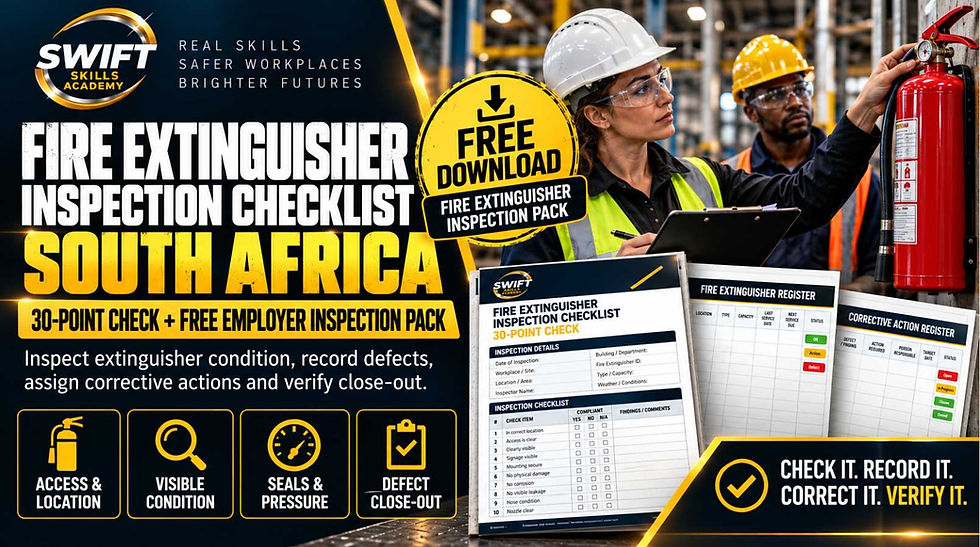
Use SSA's:
That checklist supports routine employer visual checks.
It does not replace professional servicing, competent technical assessment or specialist fire-protection requirements.
The Most Important Fire Fighting Skill May Be Knowing When to Retreat
Training should never create false bravery.
Employees should withdraw when conditions exceed the safe limits of workplace response.
Examples include:
rapidly increasing smoke;
deteriorating visibility;
spreading fire;
battery venting;
hissing or popping;
explosion risk;
toxic atmosphere concerns;
unknown battery chemistry;
equipment remaining energised;
inability to identify suitable equipment;
fire inside a battery cabinet;
threatened escape route; or
conditions the employee does not understand.
No certificate turns a workplace employee into an emergency-service firefighter.
What Does Basic Fire Fighting Training Actually Cover?
This distinction matters because the old article leaned too heavily on the phrase advanced fire fighting course.
SAQA Unit Standard 12484 — Perform basic fire fighting is a basic workplace Fire Fighting unit standard.
SAQA currently records it at:
NQF Level 2
4 credits
Registration end: 30 June 2023
Last enrolment: 30 June 2029
Last achievement: 30 June 2032
SAQA also states that it has passed its registration end date and is not replaced by another unit standard. SAQA
The outcomes include workplace fire procedures, identifying a fire, selecting equipment, approaching the incident, monitoring conditions, retreating, handing over and reporting.
Those are valuable workplace skills.
But completing SAQA 12484 does not automatically make someone:
a municipal firefighter;
an electrician;
a solar technician;
a battery specialist;
a HazMat responder;
a fire engineer;
a breathing-apparatus responder; or
competent to fight every lithium-battery incident.
That is why I would remove “advanced fire fighting course” as the core SEO concept from this page.
Why Fire Fighting Training Still Matters
The fact that solar and battery incidents can exceed basic workplace response does not make Fire Fighting training irrelevant.
It makes decision-making more important.
A trained workplace responder should understand:
how fires develop;
workplace alarm procedures;
basic fire classification;
equipment selection;
equipment limitations;
approach and escape;
changing fire conditions;
when to stop;
when to evacuate;
scene handover; and
reporting.
The objective is not:
“Fight every fire.”
It is:
“Recognise what you can safely manage — and what you must leave.”
Who Should Employers Consider Training?
The correct number and roles depend on the workplace.
Potential candidates may include:
designated workplace fire responders;
supervisors;
SHE personnel;
security staff;
maintenance employees;
facilities personnel;
warehouse personnel;
shift leaders;
workshop employees; and
selected employees working near higher-risk areas.
Training coverage should consider:
different shifts;
leave;
absenteeism;
multiple buildings;
remote areas;
workforce turnover; and
actual emergency responsibilities.
Training one person and assuming the workplace is covered is rarely a robust strategy.
Solar Fire Training Is Not a Substitute for Electrical Competence
This boundary should be explicit.
Fire Fighting training does not authorise someone to:
modify a PV installation;
open electrical cabinets;
repair inverters;
isolate equipment outside their competence;
test live electrical systems;
work on battery internals; or
override manufacturer procedures.
Electrical and fire-response responsibilities should be clearly separated.
Update Your Workplace Fire-Risk Assessment
Installing solar, an inverter or a battery system changes the workplace.
That should trigger a review of the hazards.
South Africa's Occupational Health and Safety Act places broad duties on employers concerning a working environment that is safe and without risk, including identifying hazards and providing information, instruction, training and supervision where required. Government of South Africa
A solar-fire review should therefore look beyond the new hardware.
Ask:
Equipment
Is the installation properly located, protected and maintained?
Combustibles
Is combustible storage accumulating near electrical equipment?
Ventilation
Does the installation require ventilation, and is it unobstructed?
Detection
How will occupants know that something is overheating or burning?
Isolation
Who understands the shutdown arrangement?
Escape
Could smoke from the inverter or battery location compromise an escape route?
Response
Who raises the alarm?
Training
Who has an assigned fire-response role?
Information
Can emergency responders quickly identify the system?
Records
Can management prove that identified defects were addressed?
Do Not Put Batteries Where a Failure Traps People
Location matters.
Employers should consider whether an inverter or battery installation:
obstructs a route;
threatens an emergency exit;
is in an occupied area;
exposes employees to smoke;
is accessible to unauthorised people;
has adequate ventilation;
is vulnerable to physical damage; or
would make emergency intervention difficult.
The answer may require input from competent electrical, fire-safety or engineering professionals.
A generic blog cannot determine installation suitability for a specific site.
What About Battery Rooms and Enclosures?
Battery installations vary enormously.
A small wall-mounted residential-style battery and a commercial battery-energy-storage installation should not be treated as identical hazards.
As system size and stored energy increase, employers may need more specialised consideration of:
ventilation;
fire detection;
gas detection;
segregation;
enclosure design;
suppression;
emergency shutdown;
access control;
thermal monitoring;
emergency-response procedures; and
specialist fire-engineering requirements.
OSHA's current lithium-ion guidance specifically identifies ventilation and, for larger storage locations, monitoring for flammable and toxic gases among potential protective measures. OSHA
What Should Employees Do If a Battery Begins Hissing or Venting?
Treat it as a warning sign.
Do not crowd around it.
Do not ask an untrained employee to investigate closely.
The workplace response should prioritise:
ALARM → CLEAR PEOPLE → ACTIVATE PLAN → ESCALATE → EVACUATE IF REQUIRED
A changing battery condition can be more important than the absence of a visible flame.
What If the Fire Appears to Be Out?
A visually extinguished incident should not automatically be treated as safe for immediate re-entry..
Battery incidents may involve continued internal heating or changing conditions.
The area should remain controlled until an appropriately competent person or emergency responder has determined what further action is required.
This is particularly important where batteries, electrical equipment or unknown damage remain present.
Emergency Services Need Information
When emergency responders arrive, somebody should be able to tell them:
solar is installed;
where PV equipment is located;
where the inverter is;
where batteries are;
what battery technology is installed if known;
where isolation controls are;
whether employees attempted suppression;
whether anybody is missing or injured; and
whether smoke has spread elsewhere.
Do not make the fire service discover all of this while the incident is developing.
Your Fire Plan Should Include Solar and Batteries by Name
Avoid vague wording such as:
“In case of electrical fire, use appropriate extinguisher.”
A useful emergency procedure should explain actual responsibilities.
For example:
Employee discovers smoke near inverter
→ raises alarm→ warns occupants→ reports location→ prevents unauthorised approach→ emergency procedure activated→ authorised isolation considered according to site procedure→ evacuation initiated where required→ emergency services informed of solar/battery installation
The exact procedure must match the workplace and installation.
Connect Solar Fire Safety to Evacuation Planning
Fire response is only one piece of the emergency system. - solar inverter fire safety South Africa
SSA's existing guide covers:
Solar and battery installations should be incorporated into those procedures where they create relevant emergency hazards.
Run Drills That Test Decisions, Not Just Walking Speed
A useful drill can test:
whether the alarm is recognised;
who calls emergency services;
whether solar/battery information is available;
whether staff know restricted areas;
whether evacuation routes remain usable;
who accounts for employees;
how contractors and visitors are handled;
who communicates with responders; and
whether corrective actions are recorded afterwards.
The purpose is not theatre.
It is to discover failures before the real event.
Ten Solar & Battery Fire-Safety Questions for Employers
Ask these today:
Where exactly are our batteries and inverters?
What battery chemistry is installed?
Is the system properly authorised and documented where required?
Who understands its shutdown procedure?
What remains energised after shutdown?
What fire equipment has been selected for the actual risk?
Could smoke affect an evacuation route?
Do employees know when not to intervene?
Can emergency responders identify the system quickly?
When did we last review the emergency plan after the installation changed?
If management cannot answer these questions, the system deserves another look.
Common Solar and Battery Fire-Safety Mistakes
Mistake 1: Assuming “electrical fire” describes every incident
Battery, inverter, wiring and surrounding-material fires can involve different hazards.
Mistake 2: Buying extinguishers without assessing the actual system
Fire equipment should match the hazard rather than a generic internet recommendation.
Mistake 3: Believing the mains switch makes everything safe
PV components may remain electrically hazardous while exposed to light. The Department of Energy's Energy.gov
Mistake 4: Putting all responsibility on the electrician
Electrical compliance does not automatically create an emergency response plan.
Mistake 5: Training employees but never updating the procedure.
Training and site procedures need to agree.
Mistake 6: Treating basic Fire Fighting training as specialist battery-response qualification
It is not.
Mistake 7: Ignoring smoke because there are no visible flames
Battery failure can produce hazardous conditions before or without a dramatic visible fire.
Mistake 8: Failing to tell the insurer about relevant changes
Where an installation materially changes a business's risk, employers should check disclosure requirements with their broker or insurer.
Mistake 9: Forgetting night shift or weekend coverage
A fire does not wait for the trained employee to arrive on Monday morning.
Mistake 10: Never testing the emergency plan
A written procedure can fail spectacularly when nobody has practised it.
Where Fire Fighting Training Fits
Think of the workplace system as:
PREVENT → DETECT → ALARM → ISOLATE → RESPOND → EVACUATE → HAND OVER → RECORD → CORRECT → VERIFY
Fire Fighting training supports the human-response portion.
It does not replace:
competent electrical installation;
municipal authorisation where required;
electrical compliance;
preventative maintenance;
manufacturer guidance;
fire detection;
suitable fire equipment;
technical isolation;
emergency planning;
equipment servicing;
evacuation arrangements;
engineering controls; or
specialist emergency services.
That distinction increases the credibility of the training rather than diminishing it.
Frequently Asked Questions
Can a solar inverter catch fire?
Yes. Potential causes can include electrical faults, overheating, damaged conductors, poor connections, defective equipment, inadequate ventilation or fire spreading from surrounding materials. The exact cause requires competent investigation.
Can lithium-ion batteries catch fire?
Lithium-ion batteries can present fire and explosion hazards if damaged or subjected to certain failure conditions. Thermal runaway is one potential mechanism. OSHA
What is thermal runaway?
Thermal runaway is a self-heating chain reaction in which heat from a failing battery cell can lead to further cell failure and escalation. OSHA
Is smoke from a lithium battery dangerous?
Potentially. Battery failures can release harmful substances, so employees should not assume battery smoke is harmless. OSHA
Does switching off mains electricity make solar panels safe?
Not necessarily. PV modules can continue generating electricity when exposed to light, meaning parts of the system may remain electrically hazardous. The Department of Energy's Energy.gov
Which extinguisher should be used on a lithium battery fire?
There is no single responsible recommendation for every battery installation. Equipment selection should consider the battery chemistry, manufacturer instructions, installation design, electrical hazards and competent fire-risk advice.
Should employees fight a lithium battery fire?
Only where the incident falls within their training, authorisation, available equipment and safe workplace procedures. Where conditions are escalating, unfamiliar, electrically hazardous, smoke-filled or potentially explosive, evacuation and emergency-service response should take priority.
Does basic Fire Fighting training make someone a lithium-battery firefighter?
No. SAQA Unit Standard 12484 covers basic Fire Fighting. It does not automatically qualify a learner as a specialist battery, HazMat, electrical or professional firefighter. SAQA
Is SAQA 12484 still available?
SAQA lists its registration end as 30 June 2023, last enrolment as 30 June 2029, and last achievement as 30 June 2032. SAQA
Does Cape Town require solar systems to be authorised?
The City's current solar guidance says new PV and/or battery applications are treated as grid-tied systems and generally require approved equipment, professional sign-off and authorisation under the City's process, with specified exemptions. Businesses should check their particular installation against the City's current requirements. Cape Town City Council
Authoritative Sources
Source | Why it matters |
SAQA — Unit Standard 12484: Perform Basic Fire Fighting | Confirms the course scope, NQF level, credits and current enrolment/achievement dates. SAQA |
South African Government — Occupational Health and Safety Act | Establishes the overarching workplace health and safety framework. Government of South Africa |
South African Government — General Safety Regulations | Current national general safety regulatory source. Government of South Africa |
City of Cape Town — Solar PV guidance | Sets out Cape Town's current solar/battery authorisation framework and warns of safety risks from unauthorised installations. Cape Town City Council |
City of Cape Town — Alternative-energy fire risks | Specifically addresses fire risks involving inverters, batteries, solar installations and generators. Cape Town City Council |
U.S. OSHA — Lithium-ion battery safety | Technical guidance on thermal runaway, fire, explosion, ventilation and hazardous exposures. OSHA |
U.S. Department of Energy — Solar Fire Safety | Technical guidance explaining PV electrical hazards and first-responder considerations. The Department of Energy's Energy.gov |
Legal/safety note: This guide provides general workplace fire-safety information. It does not replace site-specific electrical, fire-engineering, municipal, manufacturer, insurer or competent-person advice.
Read More
Use exactly these three:
Recommended guide | Why read it |
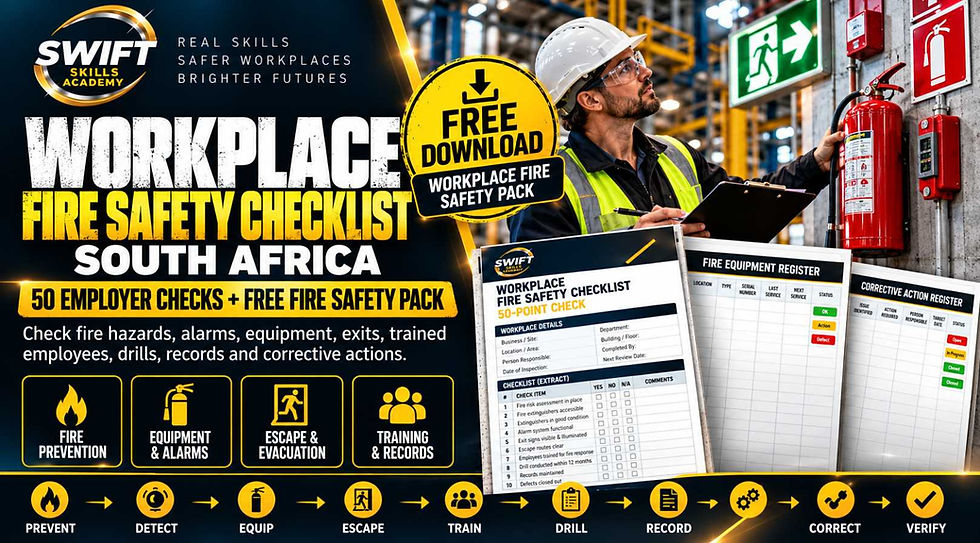
Review the wider workplace fire-safety system beyond solar and battery equipment. | |
Review extinguisher access, visible condition, servicing information and corrective actions. | |
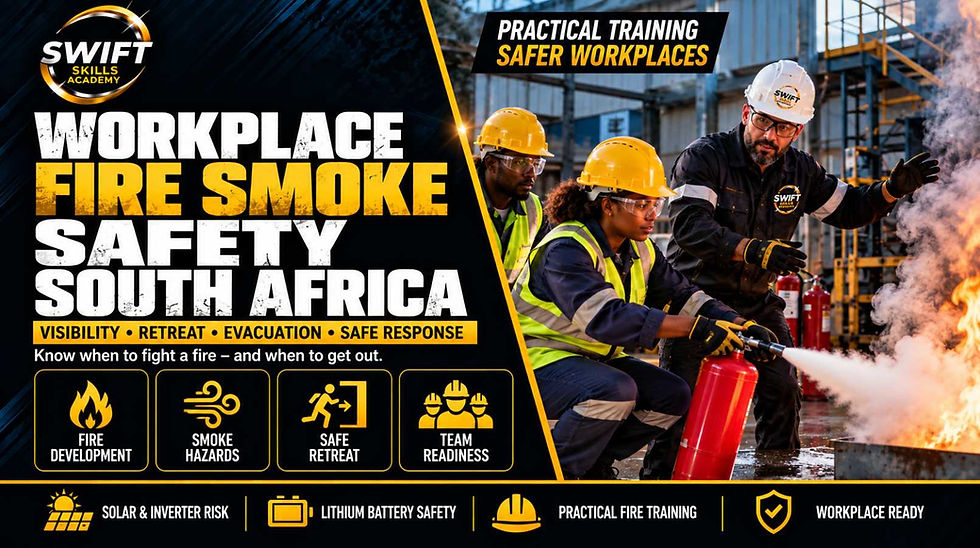
Understand why deteriorating smoke and visibility should trigger early retreat. |
Final Word
The biggest solar-fire mistake is assuming that because the installation was designed by a professional, employees automatically know what to do when something goes wrong.
They may not.
A professionally installed inverter can still begin smoking while an employee stands beside it unsure whether to isolate it, attack it, call someone or evacuate.
A serviced extinguisher can still be useless if nobody knows whether it is appropriate.
A battery can still become dangerous while employees wait for visible flames.
And a written emergency plan can still fail if nobody has practised it.
The objective is therefore not to turn ordinary employees into specialist battery firefighters.
It is to create a workplace where people understand:
what the hazard is, how the alarm is raised, who is authorised to act, when intervention is appropriate, and when everybody needs to get out.
That is what genuine fire readiness looks like.