
How to Become a Welder in South Africa: Complete 2026 Career Pathway
Updated: Sep 11
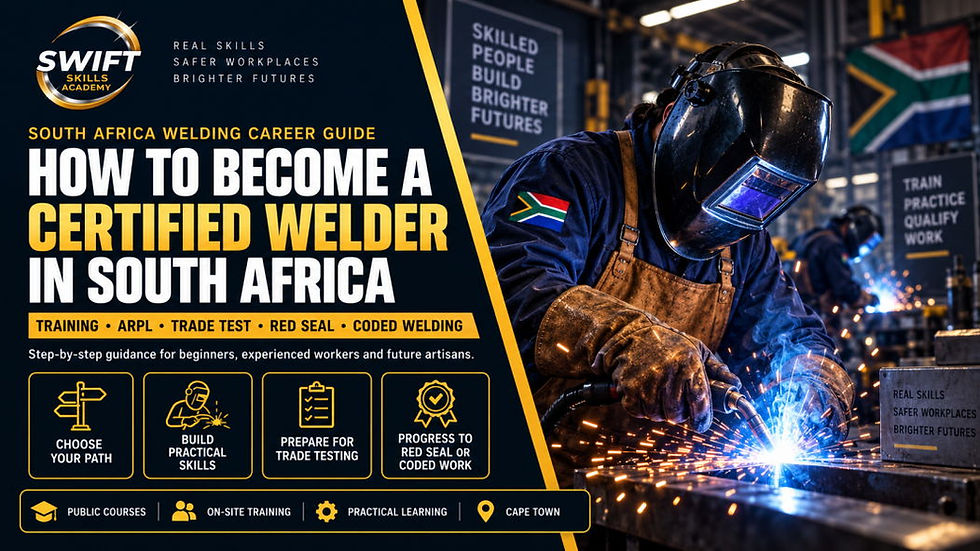
If you want to become a welder in South Africa, the first thing to understand is that there is more than one welding pathway.
You can learn practical welding skills without immediately becoming a qualified artisan.
You can work as a welder without automatically holding Red Seal artisan status.
You can become an experienced welder without automatically becoming a coded welder.
And a short welding course, occupational qualification, trade test and coded-welder test are not the same thing.
The correct route depends on what you actually want to achieve:
learn welding → find welding work → become formally qualified → gain artisan recognition → specialise → become coded for particular work.
This guide explains each route so you can avoid paying for the wrong programme or assuming that one certificate gives you an outcome it does not.
How Do You Become a Welder in South Africa? Quick Answer
There is no single certificate that every person must complete before they can begin developing welding skills.
A beginner may start with practical process training.
Someone pursuing the national artisan pathway may need occupational learning, workplace experience and a successful trade test.
An experienced person who has already worked in the trade may be able to investigate Artisan Recognition of Prior Learning (ARPL).
A welder targeting coded work may later need a separate performance qualification appropriate to the welding process, material, position and applicable standard.
The QCTO states that a person is formally recognised as an artisan after passing the trade test and being issued a trade certificate. (QCTO)
The pathways at a glance
Your goal | Likely route | What it does not automatically mean |
Learn practical welding | Short/process-specific welding training | You are not automatically a qualified artisan |
Become employable in fabrication | Practical training + workplace experience | Employment is not guaranteed |
Follow an occupational pathway | Occupational qualification + required workplace learning + assessment | Not the same as a short welding course |
Formalise years of experience | ARPL assessment and gap-development route | Experience alone does not automatically create artisan status |
Become a recognised artisan | Meet trade-test requirements + pass trade test + receive trade certificate | Not automatically a coded-welder qualification |
Become coded for particular work | Appropriate practical welder qualification test | Not a universal lifetime qualification for every welding job |
That distinction should guide every decision that follows.
Step 1: Decide What “Becoming a Welder” Means for You
This is where most learners make their first mistake.
Someone who wants basic workshop welding does not necessarily need the same pathway as someone pursuing Red Seal artisan recognition.
Someone with ten years of fabrication experience should not automatically be placed into the same beginner course as someone who has never held a welding torch.
Before choosing a programme, determine your actual goal.
Do you want to:
learn a welding process?
get better at fabrication?
prepare for employment?
specialise in MIG, TIG, Stick or pipe?
formalise existing workplace experience?
become a trade-tested artisan?
prepare for coded-welding work?
Your answer changes the pathway.
Step 2: Do You Need Matric to Become a Welder?
Not necessarily.
The answer depends on the programme.
For selected practical welding courses, learners may be considered without Matric, subject to the programme's own entry requirements, basic literacy and numeracy, age and safety considerations.
The formal Occupational Certificate: Welder, SAQA ID 94100, however, has specific entry requirements.
SAQA records it at NQF Level 4 with 373 credits, with entry at NQF Level 1 with Mathematics and Science. SAQA also records an equivalent Grade 9 route involving an appropriate Metal Work and Welding special-skills programme. (SAQA)
So instead of asking:
“Do I need Matric to become a welder?”
ask:
“Which welding programme or qualification am I trying to enter?”
For a deeper breakdown, link internally to your Welding Course Requirements South Africa guide.
Step 3: Build Practical Welding Skills
Whatever long-term route you choose, practical welding ability matters.
A beginner normally needs to build competence in areas such as:
workshop safety, equipment setup, joint preparation, cutting and grinding, tack welding, arc control, travel speed, welding positions, weld appearance and defect prevention.
The welding process should also match the type of work you want to pursue.
Process | Common development direction |
Stick / SMAW | Structural work, maintenance, repairs and site applications |
MIG / GMAW | Fabrication, manufacturing and production environments |
TIG / GTAW | Stainless steel, aluminium and precision fabrication |
FCAW | Structural and heavier production work |
Pipe welding | Industrial piping and specialist applications |
Multi-process development | Broader fabrication and specialist progression |
Do not choose processes merely because one sounds more advanced.
Choose them according to the work you intend to perform.
Step 4: Understand the Occupational Welder Qualification
South Africa has an occupational pathway for the welder trade.
One of the key qualifications is Occupational Certificate: Welder — SAQA ID 94100.
SAQA records this qualification as:
Qualification detail | Current SAQA record |
Qualification | Occupational Certificate: Welder |
SAQA ID | 94100 |
NQF Level | 4 |
Credits | 373 |
Quality assurance | QCTO |
Registration end date | 30 December 2025 |
Last enrolment date | 30 December 2026 |
Last achievement date | 30 December 2029 |
This matters enormously in 2026.
The qualification has passed its registration end date, but SAQA still records a transitional last-enrolment date of 30 December 2026 and last-achievement date of 30 December 2029.
Learners should therefore verify the current enrolment route and provider scope before committing to a programme. (SAQA)
The qualification was designed to combine knowledge, practical skills and workplace experience rather than operating like a five-day welding course. (Swift Skills Academy)
Short Welding Course vs Occupational Qualification
This distinction deserves its own section because it is one of the biggest areas of confusion online.
A short practical welding course may teach you to use a particular process or improve a specific skill.
An occupational qualification is a broader national programme with formal curriculum and assessment requirements.
A trade-test preparation programme prepares an eligible candidate for assessment.
An ARPL pathway recognises existing learning and identifies gaps.
A coded-welder test tests welding performance against defined variables.
These should never be marketed as though they are interchangeable.
Step 5: Gain Workplace Experience
Welding is a practical trade.
Workshop training develops controlled skills, but the workplace adds dimensions that are difficult to reproduce completely in a classroom:
production deadlines, fabrication tolerances, drawing interpretation, material preparation, teamwork, quality control, equipment maintenance and real operating conditions.
For an artisan pathway, workplace learning is not merely helpful — it can form part of the formal route.
The National Artisan Development Support Centre describes an apprenticeship as structured trade learning under qualified artisan supervision, combining theory and workplace training before trade-test access. It states that apprenticeship durations can vary, commonly around 18 to 36 months, depending on the programme. (DHET Nadsc)
That duration should therefore not be advertised as the time required for every person to “become a welder.”
A short skills learner, apprentice, experienced ARPL candidate and coded welder are on very different timelines.
Step 6: What Is a Welding Apprenticeship?
An apprenticeship is one recognised route toward artisan development.
The learner works and trains in the listed trade under appropriate supervision while developing the required theoretical and practical competence.
The National Artisan Development Support Centre identifies Grade 9 or a relevant N2 as a general entry reference for apprenticeship pathways and explains that apprenticeship training combines theory with on-the-job experience before trade-test access. (DHET Nadsc)
Availability depends on employers, programmes, funding and intake opportunities.
Completing an ordinary welding short course does not automatically mean you have completed an apprenticeship.
Step 7: What If You Already Have Years of Welding Experience?
Do not automatically start again.
An experienced welder may be a candidate for Artisan Recognition of Prior Learning.
ARPL exists so that prior learning acquired through work and experience can be formally evaluated.
The national ARPL process requires candidates to apply through an appropriately accredited trade-test centre, provide evidence and undergo evaluation against the requirements of the trade. (DHET Nadsc)
Evidence may include:
employment history, CV, previous qualifications, employer confirmation, trade-related duties, photographs or other supporting evidence.
A technical evaluation can then identify what has already been demonstrated and what gaps still need to be addressed. (DHET Nadsc)
ARPL is therefore not a shortcut around competence.
It is a structured route for recognising competence already gained.
Step 8: Pass the Trade Test for Artisan Recognition
This is another area where the current article needs correction.
You do not simply complete welding training and then “register yourself with NAMB.”
The QCTO states that a person becomes recognised as an artisan after:
meeting the applicable requirements → passing the trade test at an accredited trade-test centre → being issued a trade certificate. (QCTO)
The certification process involves the trade-test centre, relevant SETA, NAMB and QCTO.
According to QCTO guidance, after a candidate passes the trade test, documentation moves through the required quality-assurance process and the QCTO ultimately issues the trade certificate. (QCTO)
So the accurate pathway is:
eligibility → preparation → trade test → quality-assurance process → trade certificate
—not:
course → register with NAMB → Red Seal.
What Is a Red Seal Welder?
“Red Seal” is widely used in South Africa to describe a trade-tested artisan.
For the purposes of career planning, the important point is that artisan recognition follows the applicable trade-test and certification process.
A five-day welding course does not make someone a Red Seal welder.
A MIG certificate does not make someone a Red Seal artisan.
Years of experience alone do not automatically make someone Red Seal.
The trade-test pathway matters.
Step 9: Understand Coded Welding Separately
Coded welding and Red Seal artisan recognition are different things.
A coded welder has demonstrated welding performance against a particular code, specification, procedure or test range.
That performance qualification can depend on variables such as:
process, material, thickness, joint type and welding position.
A person can therefore be an experienced artisan and still need a separate coding test for particular work.
Equally, passing a specific coding test does not automatically create national artisan status.
This is why someone targeting pipe, pressure, structural or specialist fabrication should first determine which actual test the employer or project requires.
Your Coded Welding South Africa guide should own the technical detail; this article only needs to explain where coding fits in the broader career pathway. (Swift Skills Academy)
How Long Does It Take to Become a Welder in South Africa?
There is no single honest answer.
Someone learning basic MIG skills follows a different timeline from someone completing an occupational qualification.
An apprentice follows a different timeline from an experienced welder entering ARPL.
And a competent welder preparing for a specific coding test may already have years of experience behind them.
Therefore:
short course duration ≠ career duration
and
career duration ≠ time to Red Seal
The National Artisan Development Support Centre notes that apprenticeship programmes may range from roughly 18 to 36 months, but that is an apprenticeship reference — not a universal welding timeline. (DHET Nadsc)
Do You Need a University Degree to Become a Welder?
No.
Welding is a technical trade rather than a university-degree profession.
But “you don't need a degree” should not be turned into:
“No qualifications matter.”
They do.
Different pathways may require educational entry criteria, occupational learning, workplace experience, assessment, trade-test eligibility or process-specific testing.
The correct message is:
You don't need a university degree, but you do need competence appropriate to the pathway you want to follow.
Which Welding Course Should a Beginner Start With?
There is no single process that is automatically best for every beginner.
Stick welding can build strong fundamentals around arc control.
MIG can provide an accessible introduction to production-style welding.
The better choice depends on:
the learner's goal, intended industry, available time, current ability and the type of work they want to perform.
A beginner targeting fabrication may make a different choice from someone ultimately targeting industrial pipe welding.
This is why course selection should start with the desired outcome, not whichever welding process appears first in an advertisement.
Can a Welding Course Get You a Job?
Training can improve employability.
It cannot guarantee employment.
Employers may look at:
practical welding ability, process, material experience, fabrication capability, drawings, positions, quality, workplace behaviour, trade status and whether you can pass a practical welding test.
Can You Become a Welder Through ARPL?
ARPL is designed primarily for people who already possess substantial learning and workplace experience.
It is not the starting route for somebody who has never welded.
National Artisan Development states that an ARPL applicant is evaluated against the trade requirements and must provide supporting evidence of prior learning and experience. (DHET Nadsc)
If gaps are identified, development may be required before further progression.
Beginner vs Experienced Welder: Which Route Fits You?
Current position | Strong starting direction |
Never welded | Practical beginner training |
Basic workshop experience | Process and fabrication development |
Comfortable with one process | Positional / advanced skills |
Experienced production welder | Assessment and targeted gap training |
Years of undocumented experience | Investigate ARPL |
Eligible for trade test | Trade-test preparation |
Targeting pipe / coded work | Specialist process preparation |
Qualified artisan | Advanced/coded development where required |
Frequently Asked Questions
What qualifications do I need to become a welder in South Africa?
That depends on the outcome you want. Practical short courses, occupational qualifications, apprenticeships, ARPL, trade testing and coded-welder testing all have different entry and assessment requirements.
Do I need Matric to become a welder?
Not necessarily for all practical welding training. Formal occupational and artisan pathways can have specific entry requirements. The SAQA record for Occupational Certificate: Welder 94100 specifies NQF Level 1 with Mathematics and Science, with an alternative Grade 9 route described in the qualification. (SAQA)
How long does it take to become a qualified welder?
There is no universal duration. A short process course may take days or weeks, whereas an apprenticeship or occupational pathway can take much longer. National Artisan Development notes apprenticeship durations commonly ranging between 18 and 36 months. (DHET Nadsc)
What makes someone a qualified artisan?
The QCTO states that a person is recognised as an artisan after passing the relevant trade test and being issued a trade certificate. (QCTO)
Is a welding certificate the same as Red Seal?
No. A provider-issued short-course certificate and a national trade certificate are different outcomes.
What is ARPL for welders?
Artisan Recognition of Prior Learning provides a formal process for experienced workers to have prior learning and workplace experience evaluated against trade requirements. (DHET Nadsc)
Is coded welding the same as Red Seal?
No. Red Seal refers to trade-tested artisan recognition, while coded welding relates to practical welding performance tested against defined technical requirements.
Can I become a welder without experience?
Yes, you can begin welding training as a complete beginner where programme requirements allow it. Experience is then developed through training, practice and workplace exposure.
Can welding training guarantee employment?
No. Training can develop competence and improve job readiness, but employment depends on employer demand, practical ability, experience and the requirements of the vacancy.
Where can I study welding in Cape Town?
Swift Skills Academy provides practical welding training in Cape Town across beginner and advanced welding processes, with pathway discussions available for experienced welders, employers, ARPL and trade-test preparation.
Start Your Welding Career From the Correct Point
The biggest mistake you can make is asking:
“Which welding certificate is best?”
before asking:
“What welding outcome do I actually need?”
If you are a beginner, build real practical skill.
If you already weld, strengthen the process and positions employers require.
If you have years of workplace experience, investigate whether ARPL is appropriate.
If you want artisan recognition, understand the trade-test pathway.
If you want coded welding, identify the exact test requirement.
And if you are uncertain, get the pathway clarified before paying for training.
Swift Skills Academy
6 Monaco Road, Killarney Gardens, Cape Town
021 828 0772
WhatsApp: +27 60 998 7412
Explore Welding Courses Cape Town:
Read More
Read more | Why it is relevant |
Best next read for beginners who want to know whether they meet the entry requirements, what documents they need and whether Matric or previous welding experience is required. | |
Connects the training pathway to real employment intent by explaining welding jobs, employer expectations, skills in demand and salary considerations. | |
Ideal for experienced welders progressing toward ARPL, trade-test preparation and formal artisan recognition instead of repeating beginner training. |
Authoritive Sources
Authoritative source | What it supports in the article |
Supports the formal occupational welder pathway, NQF Level 4, 373 credits, qualification purpose, welding processes, entry requirements, external assessment requirements and the current transition dates for enrolment and achievement. (regqs.saqa.org.za) | |
Supports the distinction between short-course training and formal artisan recognition. QCTO confirms that a person is recognised as an artisan after passing a trade test and being issued a trade certificate. (qcto.org.za) | |
Supports the ARPL pathway for experienced workers, including prior-learning recognition, evidence requirements, accredited trade-test centres and evaluation against trade requirements. (nadsc.dhet.gov.za) | |
Supports the trade-test-to-certification sequence, including the role of the accredited trade-test centre, SETA, NAMB and QCTO before the trade certificate is issued. (qcto.org.za) |


