Women in Welding South Africa: How Female Welders Can Build Careers, Break Barriers and Shape the Future of Skilled Trades
- Mar 1
- 15 min read
Updated: Jun 2

Quick Answer: Why Women in Welding South Africa Matters
Women in Welding South Africa Is Not Just a Diversity Story
Women in Welding South Africa is about far more than representation.
It is about solving a real skills problem.
South Africa needs more practical, work-ready artisans who can support manufacturing, construction, fabrication, engineering, transport, energy, maritime work, maintenance and industrial growth.
Welding is one of the trades that physically holds the economy together.
Every gate, pipe, bracket, tank, trailer, platform, beam, vessel, frame and steel structure starts with somebody who can work with metal.
That person does not have to be a man.
Women can enter welding.
Women can master welding.
Women can specialise in welding.
Women can build proof, certification, confidence and long-term career pathways in the welding trade.
The real message is simple:
Women do not need to “fit into” welding. Women can help redefine what the next generation of South African welding looks like.
👉 Explore accredited welding courses in Cape Town:
Explore Here: 👉 Accredited Welding Courses Cape Town - Swift Skills Academy
The Truth Nobody Says Loud Enough
Two Women. Same Opportunity. Completely Different Future.
There are two types of women looking at welding in South Africa right now.
1. The Woman Who Thinks Welding Is Not for Her
She looks at the workshop.
She sees sparks.
She sees heavy steel.
She sees men who have been there for years.
She wonders:
“Will I be accepted?”
“Am I strong enough?”
“Will I be taken seriously?”
“Can I really build a career from this?”
“Is welding only for men?”
So she waits.
She doubts herself.
She chooses something safer.
And another career door stays closed.
2. The Woman Who Sees Welding as a Career Weapon
She understands that welding is not about stereotypes.
It is about:
skill
safety
discipline
patience
practice
technique
certification
confidence
specialisation
proof
She starts with training.
She builds the basics.
She learns the processes.
She practises.
She collects certificates.
She explores MIG, TIG, ARC, coded welding, pipe welding, Red Seal and ARPL pathways.
Same trade.
Completely different mindset.
That is why women in welding matter.
Because the future belongs to the people who build skill before the opportunity arrives.
Why Welding Is a Serious Career Option for Women
Welding Is a Practical Skill With Real Economic Value
Welding is not a hobby skill when it is trained properly.
It is a technical trade used across:
engineering workshops
steel fabrication
construction
manufacturing
transport
mining support
ship repair
marine work
renewable energy fabrication
agriculture
property maintenance
factory maintenance
pipeline and pipework projects
industrial shutdowns
coded welding environments
stainless steel and aluminium fabrication
This matters because women entering welding are not entering a narrow career.
They are entering a trade with multiple pathways.
A beginner can start with basic welding.
A committed learner can move into MIG, TIG or ARC.
A stronger welder can specialise in pipe, coded welding, stainless steel, aluminium, Red Seal preparation or ARPL.
A future leader can move into supervision, quality control, inspection-related routes, training or business ownership.
The first spark can become a career ladder.
Women in Welding South Africa and the Skills Gap
The Country Needs More Skilled Hands
South Africa’s technical sectors cannot grow without skilled people.
Companies need workers who can fabricate, repair, maintain and produce quality work.
But too many young people, especially women, are never exposed to welding as a serious career route.
That is a missed opportunity.
For learners, welding can offer:
practical skill
career confidence
employability
self-employment potential
artisan progression
Red Seal awareness
coded welding opportunities
technical identity
business potential
For employers, training women in welding can support:
scarce-skills development
employment equity goals
B-BBEE Skills Development planning
internal talent pipelines
SETA-aligned workforce development
learnership strategies
workforce transformation
production capability
stronger workshop diversity
Women in welding should not be treated as a charity idea.
It should be treated as a serious skills development strategy.
What Is Welding?
Welding in Plain English
Welding is the process of joining metal parts together using heat, pressure, filler material or a combination of these methods.
But welding is not one single skill.
It includes different processes such as:
ARC welding
MIG welding
TIG welding
flux core welding
gas welding
pipe welding
coded welding
stainless steel welding
aluminium welding
structural welding
fabrication welding
Each process has its own equipment, technique, difficulty level and career value.
This is why women entering welding should not only ask:
“Can I learn welding?”
The better question is:
Which welding pathway gives me the strongest career future?
The Main Welding Processes Women Can Learn
ARC Welding
ARC welding, also called stick welding or SMAW, is one of the most common welding processes.
It is useful for:
site repairs
structural steel
general fabrication
maintenance
construction
farm and industrial repairs
ARC welding can be a strong foundation because it teaches control, patience, safety and positional discipline.
MIG Welding
MIG welding, also called GMAW, uses a continuously fed wire electrode and shielding gas.
It is common in:
fabrication workshops
production welding
automotive work
mild steel fabrication
manufacturing
repetitive weld applications
MIG welding is often a strong entry point for beginners because the process can be easier to understand at first, but quality still requires proper setup, technique and practice.
TIG Welding
TIG welding, also called GTAW, is known for precision and control.
It is commonly used for:
stainless steel
aluminium
thin materials
pipe root passes
high-quality visible welds
food-grade fabrication
clean fabrication environments
specialist workshop work
TIG welding is valuable because it rewards patience, clean preparation, hand control and attention to detail.
That does not mean women are automatically better TIG welders.
It means well-trained women can compete strongly in a process where precision and consistency matter more than brute force.
Flux Core Welding
Flux core welding is useful in heavier fabrication and industrial settings.
It can be used for:
thick materials
structural work
heavy fabrication
site work
high-deposition welding
It requires good knowledge of settings, slag control, penetration and safe working practice.
Pipe Welding
Pipe welding is one of the more respected welding pathways.
It can involve:
5G and 6G positions
TIG root passes
ARC welding
pressure systems
petrochemical environments
industrial maintenance
shutdown work
coded welding tests
Pipe welding is not usually where a complete beginner starts.
It is a progression route for welders who have built strong foundations.
Coded Welding
Coded welding means the welder has passed a specific test against a required code, standard, procedure, material, process or position.
Coded welding can be important in:
pressure welding
pipe welding
marine work
petrochemical work
structural steel
shutdown projects
high-integrity fabrication
energy infrastructure
For women who want to move beyond general welding, coded welding can become a powerful specialisation pathway.
The Career Ladder for Women in Welding South Africa
From Beginner to Specialist
A woman entering welding should not think only about the first certificate.
She should think about the pathway.
Career Stage | Training Focus | Career Meaning |
Beginner | Learn the workshop environment and build confidence | |
Foundation Welder | ARC, MIG or introductory welding | Develop basic welding control |
Skilled Welder | Multiple positions and materials | Become more useful to employers |
TIG / Stainless / Aluminium Welder | Precision welding processes | Move into cleaner, higher-value fabrication |
Pipe / Positional Welder | 3G, 4G, 5G, 6G progression | Enter more technical industrial work |
Coded Welder | Test-based proof against standards | Prove ability for high-trust welding environments |
Red Seal / ARPL Candidate | Formal artisan recognition pathway | Convert experience into recognised trade credibility |
Supervisor / Quality / Training Pathway | Leadership, mentoring and quality awareness | Move from doing the work to leading or checking the work |
This matters because many people treat welding as one course.
But welding is not one course.
It is a ladder.
The women who win in this trade will be the ones who understand the ladder early.
Why TIG Welding Can Be a Strong Pathway for Women
The Value Is Precision, Discipline and Proof
TIG welding is often viewed as one of the more demanding welding processes.
Why?
Because it requires:
clean preparation
steady hand control
heat control
filler rod control
puddle control
patience
consistency
discipline
attention to detail
TIG welding can be valuable in:
stainless steel fabrication
aluminium work
food-grade fabrication
medical or clean-environment fabrication
pipe root passes
high-quality visible welds
thin material work
specialist Cape Town fabrication
marine and workshop environments
For employers, this matters because poor welding creates rework.
Rework costs money.
A welder who can produce cleaner, more consistent welds becomes more valuable.
For learners, this matters because TIG welding can become a route into specialist work where skill, proof and consistency matter.
The message to women is clear:
Do not only ask:
“Can I weld?”
Ask:
“Which welding process can make me difficult to replace?”
What Employers Actually Want From Women Welders
Employers Are Not Hiring a Stereotype. They Are Hiring Proof.
A serious employer does not only want motivation.
They want evidence.
Women entering welding should build proof in five areas.
1. Practical Skill
Can you prepare material, strike an arc, control the puddle, follow instructions and produce a usable weld?
2. Safety Discipline
Can you work with PPE, understand hazards, follow workshop rules and protect yourself and others?
3. Process Knowledge
Do you understand the difference between ARC, MIG, TIG, flux core, pipe welding and coded welding?
4. Certificate Trail
Can you show training records, certificates, assessments or pathway evidence?
5. Career Direction
Are you building toward general fabrication, TIG welding, coded welding, Red Seal, ARPL, pipe welding or supervisor development?
This is where many learners make a mistake.
They think the certificate is the end.
It is not.
The certificate is the start of your proof file.
Your proof file is what helps an employer take you seriously.
Women in Welding and B-BBEE Skills Development
Female Artisan Training Should Be a Strategic Investment
For employers, training women in welding can support more than workplace diversity.
It can support:
scarce-skills development
employment equity goals
technical workforce growth
B-BBEE Skills Development planning
learnership strategies
internal talent pipelines
succession planning
SETA-aligned workforce development
audit-ready training evidence
transformation with practical business value
The key employer question is not:
“How many women can we send on training?”
The stronger question is:
“How do we create a female artisan pipeline that supports production, compliance, transformation and long-term capability?”
That is where real value sits.
A woman trained in welding is not just a statistic.
She can become a skilled worker, a specialist, a supervisor, an artisan, a contractor, a mentor or a business owner.
The Barriers Women Face in Welding
Barrier 1: “Welding Is Not for Women”
This is outdated thinking.
The welding industry needs skill, discipline, accuracy, safety awareness and commitment.
None of those are limited by gender.
Barrier 2: Lack of Exposure
Many women never consider welding because nobody introduces it as a serious career option.
That is why career guidance, employer awareness, visible female role models and practical training opportunities matter.
Barrier 3: Confidence Around Tools and Workshop Culture
Confidence grows through exposure.
A beginner does not need to know everything on day one.
She needs the right training environment, supportive facilitation and enough practice time to build control.
Barrier 4: Weak Pathway Information
Many learners do not understand the difference between:
short courses
accredited training
coded welding
QCTO qualifications
MERSETA pathways
ARPL
Red Seal preparation
trade test readiness
A serious provider must explain the pathway, not just sell the course.
Barrier 5: Employer Bias
Some employers still underestimate women in technical trades.
The best answer to bias is proof:
training records
practical competence
portfolio evidence
safety discipline
attendance
consistency
performance
specialist skill development
The market respects proof.
Build it.
The 12-Month Career Plan for Women in Welding South Africa
A Practical Roadmap for New Entrants
Month | Focus | Action |
Month 1 | Career decision | Understand welding careers and choose your starting route |
Month 2 | Safety foundation | Learn PPE, workshop safety and basic welding hazards |
Month 3 | Beginner training | Start ARC, MIG or introductory welding training |
Month 4 | Practice | Build consistency with basic welds and material preparation |
Month 5 | Process choice | Decide whether to progress into MIG, TIG, ARC or pipe welding |
Month 6 | Certificate trail | Build your proof file with certificates, photos and training evidence |
Month 7 | Workplace exposure | Seek workshop experience, internship, assistant role or practical projects |
Month 8 | Specialisation | Move toward TIG, stainless steel, pipe welding or coded welding preparation |
Month 9 | Employability | Update your CV, add certificates and build a simple welding portfolio |
Month 10 | Advanced pathway | Explore coded welding, ARPL, QCTO or Red Seal direction |
Month 11 | Employer targeting | Apply to fabrication, manufacturing, marine, construction and maintenance employers |
Month 12 | Growth plan | Choose next step: coded welding, trade test preparation, Red Seal, pipe welding or supervisor route |
This roadmap gives women something more powerful than motivation.
It gives direction.
What to Put in a Welding Proof File
Your Certificate Alone Is Not Enough
A woman entering welding should build a proof file from the beginning.
Include:
ID copy
updated CV
welding course certificates
safety certificates
photos of completed welds
videos of practical welding work
project examples
facilitator feedback
employer references
attendance records
logbook or practice record
process list: ARC, MIG, TIG, pipe or coded preparation
PPE and safety training records
ARPL or Red Seal documents if applicable
This proof file helps when applying for:
jobs
internships
learnerships
workplace experience
ARPL screening
Red Seal preparation
coded welding pathways
employer interviews
In welding, skill matters.
But documented skill travels further.
ARPL for Experienced Women Welders
Turning Experience Into Recognition
Some women already have welding experience.
They may have worked in:
family businesses
workshops
fabrication
maintenance
informal repair work
manufacturing
construction environments
assistant roles
practical project work
But they may not have formal recognition.
This is where ARPL, or Artisan Recognition of Prior Learning, becomes important.
ARPL can help experienced workers have their existing trade experience reviewed against recognised requirements.
For women who can already weld but lack formal proof, ARPL can become a powerful pathway toward:
trade test readiness
Red Seal preparation
recognition of experience
gap training
stronger career credibility
formal artisan progression
To prepare for ARPL, women should collect:
ID copy
highest qualification
updated CV
employer service letters
previous training certificates
photos or videos of welding work
project examples
payslips or job cards
work references
employment history
safety training records
portfolio of evidence
Experience is valuable.
But experience must be documented.
Red Seal Welding Pathway for Women
Why Formal Recognition Matters
A Red Seal welder is a recognised artisan who has completed the trade test pathway.
For women in welding, Red Seal recognition can support:
stronger employer trust
better career mobility
formal artisan identity
access to more serious technical roles
long-term earning potential
career credibility
possible supervisory progression
recognition across sectors
Red Seal does not happen by accident.
It requires training, experience, practical competence and preparation.
Women who want to pursue Red Seal should start thinking early about:
foundational welding skills
workplace experience
evidence collection
ARPL options
trade test preparation
QCTO and occupational qualification pathways
The earlier you understand the route, the less time you waste later.
Coded Welding for Women
The Specialist Route That Can Change Career Value
Coded welding is not a beginner concept.
It is a specialist pathway.
A coded welder has passed a test against a specific welding code, procedure, position, material or process.
This can matter in industries such as:
oil and gas
marine
energy
petrochemical
pressure systems
pipe welding
structural steel
high-integrity fabrication
industrial shutdowns
For women who want to stand out, coded welding can become a powerful next step after building strong foundations.
The market pays more attention when a welder can prove skill under test conditions.
That is why the pathway matters:
foundation → practice → specialisation → coding → recognition → stronger opportunity
Why Cape Town Needs More Women Welders
Local Opportunity Meets National Need
Cape Town and the Western Cape have a strong need for practical technical skills.
Women welders can contribute to:
fabrication workshops
construction supply chains
marine repair
stainless steel work
manufacturing
property maintenance
engineering support
renewable energy fabrication
food-grade fabrication
transport and trailer repair
industrial maintenance
entrepreneurship and mobile welding
The region needs more than people looking for jobs.
It needs people building skills that solve real problems.
Welding is one of those skills.
For women willing to train, practise and specialise, the opportunity is real.
Women Welders and Entrepreneurship
Welding Can Become a Business Skill
Welding is not only a job skill.
It can also become a business skill.
Women with welding ability can eventually explore services such as:
gates
brackets
repairs
trailers
custom metalwork
furniture
balustrades
stainless steel work
mobile repair work
farm repairs
property maintenance
small fabrication projects
workshop services
Not every woman will choose entrepreneurship.
But it matters to know that welding can create more than employment.
It can create independence.
A skilled woman with tools, training, proof and business discipline can build something powerful.
What Makes a Good Welding Training Provider for Women?
The Buyer Checklist
Before booking a welding course, ask:
Does the provider offer practical welding training?
Does the course explain safety and PPE properly?
Can beginners start here?
Are MIG, TIG and ARC pathways available?
Is there progression into coded welding or pipe welding?
Does the provider understand Red Seal and ARPL pathways?
Are certificates clearly explained?
Can the provider support both individuals and companies?
Is the environment supportive for women entering trades?
Are learners shown how to build proof and career direction?
A weak provider sells a course.
A strong provider builds a pathway.
Why Swift Skills Academy Is the Right Route for Women in Welding South Africa
Training Must Build Confidence, Skill and Career Direction
Swift Skills Academy supports women who want to enter welding, grow in welding or convert practical experience into recognised career pathways.
The training pathway can support:
beginner welding foundations
ARC welding
MIG welding
TIG welding
flux core welding
coded welding preparation
pipe welding direction
Red Seal awareness
ARPL / RPL trade test preparation
QCTO welding qualification guidance
practical career confidence
employer-readiness
company training initiatives
skills development planning
For women, the goal is not only to enter the workshop.
The goal is to build a future inside the trade.
That future can include:
fabrication
coded welding
pipe welding
Red Seal recognition
business ownership
supervision
quality control
artisan development
mentoring other women in trades
The future of welding in South Africa needs more skilled women.
And the women who start now will not only break stereotypes.
They will build the next standard.
👉 Explore accredited welding courses in Cape Town:
Explore Here: 👉 Accredited Welding Courses Cape Town - Swift Skills Academy
Welding Trade Test Preparation Cape Town
Specialized TIG Welding Courses
This builds a full authority cluster around women in welding, welding careers, training pathways, certification and employer strategy.
FAQ: Women in Welding South Africa
Is welding a good career for women in South Africa?
Yes. Welding can be a strong career for women who want practical technical skills, workshop experience, fabrication opportunities and long-term artisan pathways. Women can progress from beginner welding into TIG, coded welding, pipe welding, Red Seal or ARPL routes.
What welding process is best for women to start with?
The best starting process depends on the learner’s goal. ARC or MIG welding can build strong foundations, while TIG welding is valuable for precision work such as stainless steel, aluminium and specialist fabrication.
Can women become coded welders in South Africa?
Yes. Women can become coded welders if they build the required practical skill, prepare for the relevant welding test and meet the procedure, process, position or standard required by the employer or project.
How can employers benefit from training women welders?
Employers can build scarce technical skills, strengthen workforce diversity, support B-BBEE Skills Development planning, improve internal talent pipelines and create better audit-ready training evidence.
Where can women study welding in Cape Town?
Women can explore welding training through Swift Skills Academy in Cape Town, including beginner welding, MIG, TIG, ARC, coded welding preparation, pipe welding direction and ARPL / Red Seal pathway support.
Final Word: The Future of Welding Needs Women Who Are Ready to Build
Women in welding South Africa is not a slogan.
It is a skills movement.
It is a career opportunity.
It is an employer strategy.
It is a transformation pathway.
It is a practical answer to South Africa’s shortage of skilled technical workers.
But the women who win in welding will not be the ones who wait for permission.
They will be the ones who start.
The ones who train.
The ones who practise.
The ones who collect proof.
The ones who specialise.
The ones who move from beginner welding to MIG, TIG, ARC, coded welding, pipe welding, Red Seal, ARPL and beyond.
Welding is not only about joining metal.
It is about building futures.
And the future of welding in South Africa needs more women with the courage to pick up the torch.
Contact Swift Skills Academy
Start your welding pathway with Swift Skills Academy.
📞 021 828 0772📧 info@swiftskillsacademy.co.za💬 WhatsApp: +27 60 998 7412📍 6 Monaco Rd, Killarney Gardens, Cape Town🌍 www.swiftskillsacademy.com
Swift Skills Academy — Cape Town’s practical training partner for welding courses, coded welding preparation, ARPL, Red Seal pathways and women in skilled trades.
👉 Explore accredited welding courses in Cape Town:
Explore Here: 👉 Accredited Welding Courses Cape Town - Swift Skills Academy
Sources
Source | Type | Why It Matters for Readers |
National qualification register | Confirms the formal South African welder pathway and the role of Welding Procedure Specifications in the qualification. | |
B-BBEE regulatory source | Supports the Skills Development scorecard element and employer strategy angle. | |
National skills planning source | Shows how occupations in high demand inform career guidance, enrolment planning and skills planning. | |
SETA authority | Confirms merSETA’s role in promoting skills development for manufacturing, engineering and related services. | |
Internal course pathway | Main funnel page for welding course enquiries and progression into MIG, TIG, ARC, coded welding, pipe welding and RPL trade test preparation. | |
Internal supporting blog | Supports the coded welding, salary acceleration and specialist welding pathway discussion. | |
Internal supporting blog | Supports the QCTO, SAQA and formal welding qualification pathway discussion. | |
Internal supporting blog | Supports ARPL, trade test preparation and Red Seal pathway relevance for experienced welders. |
Other important Blogs
How Much Do Welding Courses Cost in South Africa? A 2026 Price Guide
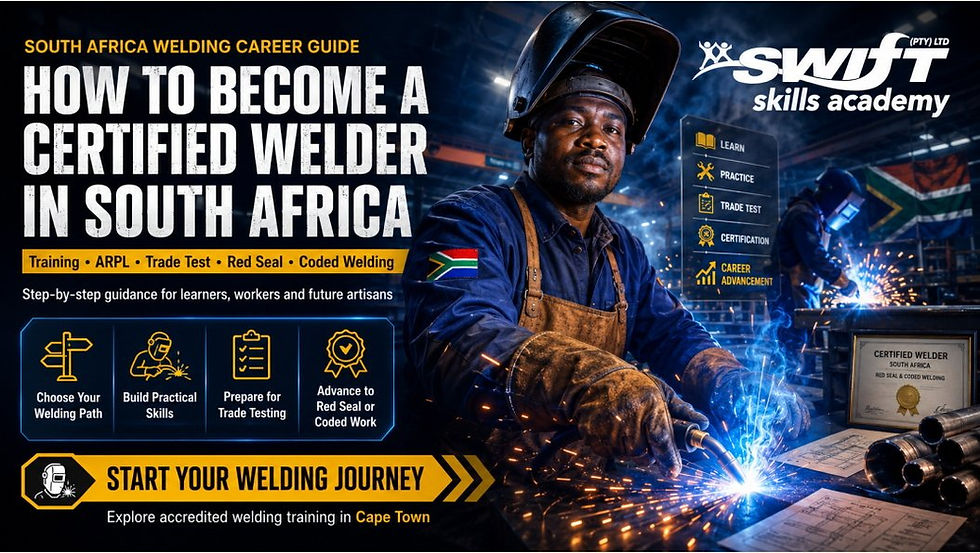
How to Become a Certified Welder in South Africa: Your Complete Step-by-Step Guide
Red Seal Welding Salary South Africa: The Roadmap to Doubling Your Pay in 6 Months
Women in Welding South Africa: Beyond the Stereotype, Building the Future
The R30k+ Club: How to Become a Coded Welder South Africa in Under 6 Months
How to Start a Backyard Welding Business in South Africa with Zero Capital (2026 Guide)
Digital-Ready Welders South Africa: The Death of the Transformer Machine
Green Hydrogen TIG Specialists Western Cape: The New Elite of South African Industry
Stainless vs. Aluminium: Why Cape Town’s Top 1% of Fabricators are Dropping "General" Welders
From Ship Repair to Oil Rigs: A Guide to SAMSA-Aligned Welding Certifications in Cape Town
Workplace Skills Planning (WSP) for Welding Compliance in South Africa
Contact Swift Skills Academy → 📞 021 828 0772 | 📧 info@swiftskillsacademy.co.za