On-Site Fire Fighting Training Cape Town for Companies & Employee Teams
Updated: Sep 2

Training one employee is relatively simple.
Training 10, 20, 50 or more employees without unnecessarily disrupting operations is a different problem.
HR managers, Safety Officers, SHEQ teams, operations managers and business owners need to consider far more than the course itself:
How many employees actually need training?
Which shifts and departments require coverage?
Can training take place at the workplace?
Is the venue suitable for practical activities?
Should the workforce be trained together or in smaller groups?
What equipment and practical arrangements are required?
What assessment and certification pathway applies?
How much operational downtime should be planned?
What documentation will the employer receive afterwards?
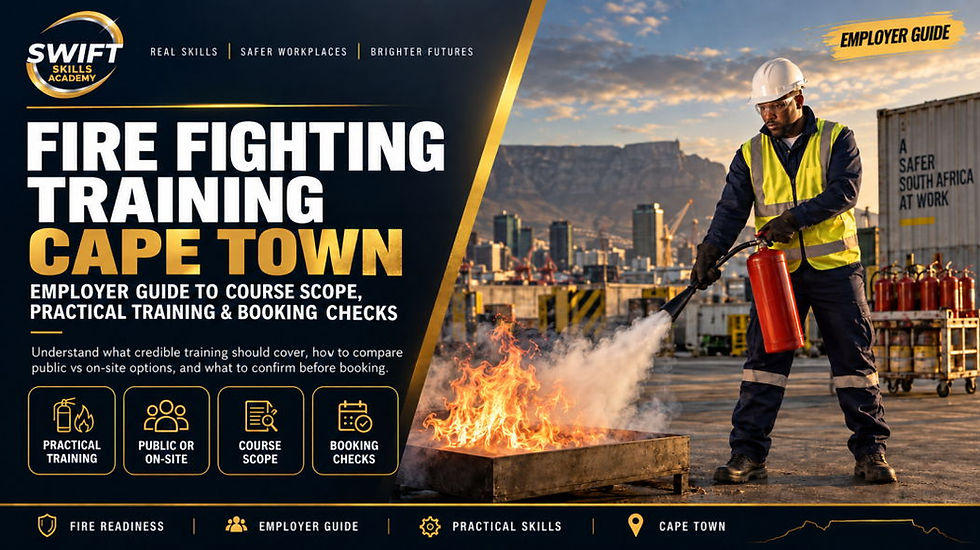
For suitable company groups, on-site fire fighting training in Cape Town can make the process considerably easier.
Instead of moving an entire team to an external training venue, the training can potentially be arranged at the employer's premises, subject to group size, venue suitability, practical requirements, trainer availability and the confirmed delivery arrangement.
Swift Skills Academy offers both public Cape Town training and on-site delivery for suitable company groups. The current programme is workplace-focused training referencing SAQA Unit Standard 12484: Perform Basic Fire Fighting. The exact assessment, moderation and certification route should be confirmed in writing before enrolment. (Swift Skills Academy)
Why Companies Choose on-site fire fighting training Cape Town
The strongest reason is not simply convenience.
It is training logistics.
Taking 20 employees away from a workplace can involve transport, travel time, production interruptions, shift replacements and administrative coordination.
On-site training may reduce some of those complications.
Less Employee Travel
Employees attend training at an agreed workplace location rather than travelling individually to another venue.
That may reduce:
travel administration;
transport costs;
late arrivals;
time away from the workplace; and
logistical complexity for larger teams.
Easier Group Coordination
Departments, shifts or emergency-response teams can be scheduled as organised groups.
For larger employers, this can be particularly useful where employee availability differs between:
production;
maintenance;
warehousing;
administration;
security;
night shift; and
weekend operations.
Greater Workplace Context
Training at the employer's premises can allow discussions to connect more naturally with the environment employees recognise.
That does not mean that a generic course becomes a professional fire-risk assessment.
It means workplace examples can be discussed in a context that is more familiar to the learners.
Better Training Administration
HR and Safety teams can coordinate:
learner lists;
attendance;
identity documents;
training records;
departmental allocations;
assessment requirements; and
post-training documentation
through one employer-controlled process.
Is There a Legal Rule That Companies With 10+ Employees Must Do Fire Fighting Training?
No universal South African rule says that every company reaching exactly 10 employees must automatically send a fixed number of people on the same fire-fighting course.
That was one of the weaknesses in the old version of this article.
Section 8 of the Occupational Health and Safety Act places a broader duty on employers to identify hazards and provide the information, instruction, training and supervision necessary, as far as reasonably practicable, to protect employees. (Department of Labour)
The General Safety Regulations also require employers, having regard to workplace size, construction, location and flammable materials, to provide suitable fire-fighting equipment at strategic locations and maintain it in good working order. (Government of South Africa)
The correct question is therefore not:
“We have 10 employees. How many certificates do we legally need?”
The better question is:
“Based on our hazards, workplace layout, equipment, shifts and emergency procedures, which employees need sufficient competence to perform the fire-response duties assigned to them?”
Construction Sites Have a More Specific Fire-Training Requirement
Construction employers and contractors need to pay particular attention.
Construction Regulation 29 requires, among other fire precautions, suitable and sufficient fire-extinguishing equipment and a sufficient number of workers trained in the use of fire-extinguishing equipment. It also addresses escape routes and an effective evacuation plan. (Government of South Africa)
Notice the wording:
a sufficient number
It does not prescribe one universal numerical ratio for every construction site.
The appropriate number will therefore depend on the actual site, fire risks, workforce, layout, work activities and operational arrangements.
How Many Employees Should Your Company Train?
Do not choose the number solely because a provider offers a group rate.
Begin with workplace coverage.
Consider the Number of Work Areas
A large warehouse with employees spread across different zones may require a different training strategy from a small office occupying one floor.
Consider:
buildings;
floors;
warehouses;
workshops;
production areas;
yards;
kitchens;
plant rooms; and
remote work areas.
Consider Every Operating Shift
Training 15 employees on day shift does little for a facility operating through the night if none of those employees is present at 02:00.
Map training against:
day shift;
afternoon shift;
night shift;
weekends;
overtime;
shutdown work; and
skeleton staffing periods.
Build Backup Coverage
Employees take leave.
People resign.
People are transferred.
Someone may be off site when an emergency happens.
Training only the exact minimum number identified in an internal plan can create immediate gaps when one person is unavailable.
Match People to Their Actual Duties
Not every employee needs the same emergency role.
Your emergency arrangement may distinguish between employees responsible for:
raising the alarm;
initial extinguisher response;
evacuation assistance;
shutdown procedures;
assembly-point coordination;
emergency communication;
first aid; and
liaison with emergency services.
Training should support the responsibilities people are actually expected to perform.
Training 10, 20, 50 or More Employees: How to Plan It
Large groups require deliberate scheduling.
10–15 Employees
Depending on the agreed delivery arrangement and practical capacity, this may be manageable as one employer group.
Confirm:
venue;
practical arrangements;
timing;
learner documentation;
equipment;
assessment requirements; and
trainer availability.
20–30 Employees
It may be more practical to divide learners into groups.
This can improve:
learner participation;
supervision during practical exercises;
assessment flow;
operational coverage; and
workplace continuity.
50+ Employees
At this scale, do not approach training as a single booking.
Treat it as a training rollout.
A sensible rollout may separate employees by:
department;
shift;
building;
site;
job role; or
emergency responsibility.
Your quotation should therefore be based on the actual operational requirement rather than simply:
“Please quote for 50 people.”
TRAINING 10, 20, 50+ EMPLOYEES?
Get a quotation built around your actual workforce—not a generic per-person estimate.
Before requesting the quote, have these five details ready:
Employer information | What to provide |
Learner numbers | Estimated number requiring training |
Location | Workplace/suburb where training is required |
Operations | Normal working hours and shifts |
Scheduling | Preferred dates or operational windows |
Delivery | On-site company training required |
GET AN ITEMISED COMPANY TRAINING QUOTATION
Cape Town · Company Groups · On-Site Delivery Subject to Suitability
Call: 021 828 0772
WhatsApp: +27 60 998 7412
What Should On-Site Fire Fighting Training Cover?
The course should not create the impression that employees are being trained to enter major structural fires.
Basic workplace fire-response training has clear limits.
SAQA Unit Standard 12484 is titled Perform basic fire fighting and includes basic workplace fire-response competence. SAQA currently records it at NQF Level 2 with four credits.
Swift Skills Academy's current course scope focuses on recognising fire hazards, selecting suitable equipment, responding to containable fires within safe limits, withdrawing when conditions become unsafe, handing over to emergency responders and reporting incidents. (Swift Skills Academy)
Fire Types and Hazards
Learners should understand how fuels and conditions influence fire behaviour and why the type of material burning matters when choosing a response.
Fire-Extinguisher Selection
An extinguisher is not useful merely because it is nearby.
Learners need to understand why equipment selection matters and why inappropriate equipment can create additional danger.
Pre-Use Equipment Checks
Before attempting any response, employees should understand the basic condition and readiness checks relevant to portable fire-fighting equipment.
Raising the Alarm
Employees must not become so focused on using an extinguisher that the wider emergency response is delayed.
Initial action should connect with:
alarm procedures;
communication;
evacuation;
escalation; and
emergency services.
Practical Extinguisher Use
Where included in the agreed practical format, learners should receive supervised opportunities to apply the principles taught.
Maintaining an Escape Route
Nobody should position themselves so that a changing fire blocks their path to safety.
Knowing When to Retreat
This is one of the most important outcomes.
The correct decision may be:
Do not attempt to fight the fire. Evacuate and hand over to professional emergency responders.
Your own course page expressly frames the training around responding to containable fires when conditions permit and withdrawing safely when necessary. (Swift Skills Academy)
On-Site Fire Fighting Training Does Not Make a Workplace Automatically Compliant
This needs to be stated clearly.
A training certificate is one piece of the employer's fire-safety system.
It does not automatically prove that the entire workplace complies with every occupational safety, municipal, building, insurer or industry requirement.
Cape Town's own fire-safety guidance emphasises appropriate fire equipment, escape arrangements and staff knowledge, alongside the broader requirements applicable to commercial, industrial, healthcare and accommodation facilities. (capetown.gov.za)
A credible fire-readiness system may therefore include:
fire-risk assessment;
suitable and serviced equipment;
clear escape routes;
alarms;
emergency procedures;
evacuation arrangements;
responsible employees;
practical training;
drills;
incident reporting; and
corrective-action tracking.
Training must connect with this system.
It cannot replace it.
What Venue Is Needed for On-Site Training?
Do not assume that any boardroom or parking area is automatically suitable.
Before confirming workplace delivery, discuss venue requirements with the training provider.
Theory Area
A suitable indoor area may be required for:
facilitator instruction;
learner seating;
visual material;
written activities; and
assessment administration.
Practical Area
Where practical activities are included, the area must be suitable for the agreed exercise and should not introduce additional uncontrolled risk.
The provider should confirm what is required before training day.
Operational Separation
Practical training should not interfere dangerously with:
vehicle movements;
loading areas;
hazardous processes;
public access;
fuel storage;
gas cylinders;
production machinery; or
other operations.
Emergency Arrangements Remain Active
Training itself must not compromise the workplace's normal emergency systems or access routes.
What Should HR or the Safety Officer Send Before Requesting a Quote?
The better the information supplied, the more useful the quotation can be.
Provide:
Information | Why it matters |
Number of learners | Determines group planning |
Workplace address | Determines delivery location |
Preferred dates | Helps determine availability |
Shift structure | Helps plan operational coverage |
Industry | Provides workplace context |
Main fire hazards | Helps identify relevant discussions |
Training objective | Clarifies why employees are being trained |
Existing certificates | Helps identify refresher or new-training needs |
Required evidence | Clarifies employer documentation requirements |
Site restrictions | Identifies access or practical limitations |
Do not wait until the morning of training to disclose major site restrictions.
Public Training vs On-Site Company Training
Neither format is automatically superior.
Choose according to the employer's situation.
Consideration | Public Cape Town Course | On-Site Company Training |
One or two employees | Often practical | Usually less efficient |
Larger employer group | May require multiple bookings | Often easier to coordinate |
Employee travel | Required | Reduced |
Workplace context | General | Greater opportunity for workplace examples |
Shift coordination | Individual attendance | Can be planned around groups |
Venue responsibility | Training centre | Employer/site suitability must be confirmed |
Company quotation | Available | Recommended |
Operational planning | Lower complexity for a few learners | Potentially stronger for larger teams |
Swift Skills Academy's current programme page confirms both public Cape Town training and on-site delivery for suitable company groups and venues. (Swift Skills Academy)
How Long Does the Training Take?
Do not use the old article's blanket claim that employer team training is automatically a one-day course.
Swift Skills Academy's current Fire Fighting Training page states a planned duration of two days and instructs clients to confirm current dates, daily times and delivery schedules when booking. (Swift Skills Academy)
For company groups, scheduling may also depend on:
learner numbers;
agreed delivery format;
assessment arrangements;
group division;
workplace operations; and
venue availability.
Get the confirmed schedule in writing before removing employees from their normal duties.
How Much Does On-Site Fire Fighting Training Cost?
Do not judge a company quotation purely by multiplying a public per-person price.
Swift Skills Academy currently advertises Fire Fighting Training from R528 per learner, while stating that fees depend on delivery format, venue, group size and current assessment requirements. (Swift Skills Academy)
An on-site quotation may therefore consider:
number of learners;
workplace location;
training format;
practical requirements;
consumables;
assessment requirements;
number of training groups;
scheduling requirements; and
the applicable certification route.
For a larger workforce, request an itemised written quotation rather than relying on an assumed price.
What Must Employers Verify Before Booking?
This section is critical.
Do not choose a provider because a webpage simply displays the words “SAQA accredited.”
SAQA records qualifications and unit standards; the training and certification arrangement depends on the applicable provider approval, enrolment, assessment, moderation and certification route.
For SAQA Unit Standard 12484, the official SAQA record currently shows:
Item | Official record |
Unit Standard | 12484 |
Title | Perform basic fire fighting |
NQF Level | 2 |
Credits | 4 |
Registration status | Passed end date |
Registration end | 30 June 2023 |
Last date for enrolment | 30 June 2029 |
Last date for achievement | 30 June 2032 |
Before authorising training, request written confirmation of:
the exact programme;
the provider's applicable scope;
enrolment route;
assessment requirements;
moderation arrangement where applicable;
evidence required from learners;
certificate or result to be issued; and
expected turnaround process.
Swift Skills Academy's current money page already adopts this transparent approach rather than promising automatic credits or certification merely for attending. (Swift Skills Academy)
What Records Should the Employer Keep After Training?
A strong workplace training file should allow HR or Safety personnel to determine quickly:
Who was trained?
When?
Against which programme?
What result was achieved?
What evidence was issued?
Which site or shift do they support?
When should competence be reviewed?
Useful records may include:
quotation and booking confirmation;
learner list;
attendance records;
programme information;
assessment evidence where supplied;
results or certificates;
invoice and proof of payment;
internal appointment records;
training matrix;
drill records; and
refresher/review dates.
Do not allow certificates to sit in isolated employee files without being connected to the training matrix and workplace emergency structure.
The Biggest Mistake Companies Make After Training
They assume:
“The employees have certificates, so the fire problem is handled.”
That is not the objective.
The objective is operational readiness.
A few months after training, ask:
Can employees identify who has a fire-response role?
Can they locate the nearest suitable equipment?
Do they know how to raise the alarm?
Are exits unobstructed?
Can night shift respond?
Have new employees joined?
Has machinery changed?
Have flammable materials changed?
Are trained people still employed?
Has a drill exposed weaknesses?
Is equipment still properly maintained?
Do responders know when not to intervene?
That review is more valuable than simply counting certificates.
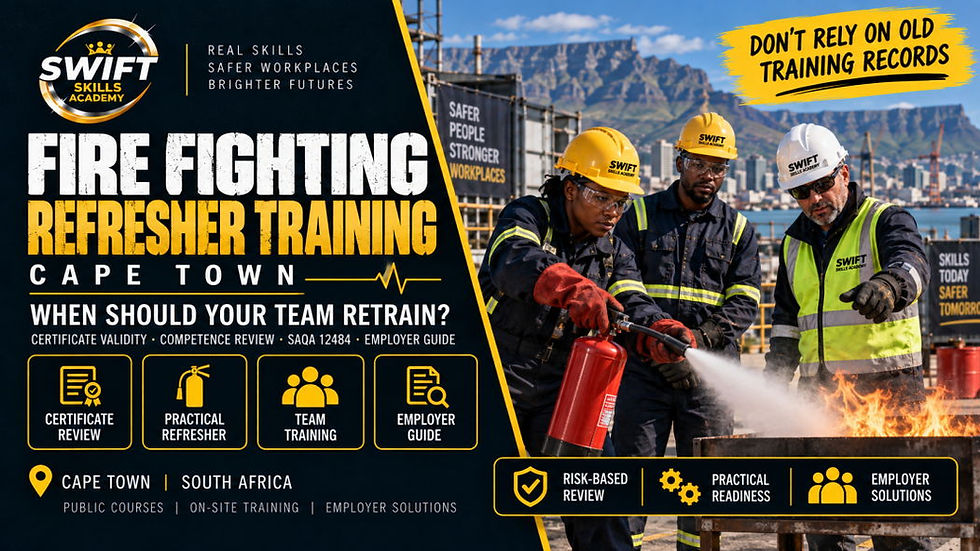
When Should Companies Consider Refresher Training?
There is no responsible basis for claiming one universal refresher interval automatically applies to every workplace and certificate.
Instead, consider:
the validity or conditions stated on issued evidence;
employer procedures;
risk-assessment findings;
practical drill performance;
changes in equipment;
new workplace hazards;
employee turnover;
role changes;
client or principal-contractor requirements;
insurer requirements; and
deterioration in practical confidence.
A refresher should address a genuine readiness need—not exist merely to generate another certificate.
Who Is On-Site Fire Fighting Training Best Suited To?
Manufacturing and Engineering Companies
Potential risks may involve hot work, electrical installations, flammable liquids, machinery, gas cylinders and combustible materials.
Warehouses and Logistics Operations
Large floor areas, vehicle activity, charging areas, packaging materials and night shifts can complicate emergency response.
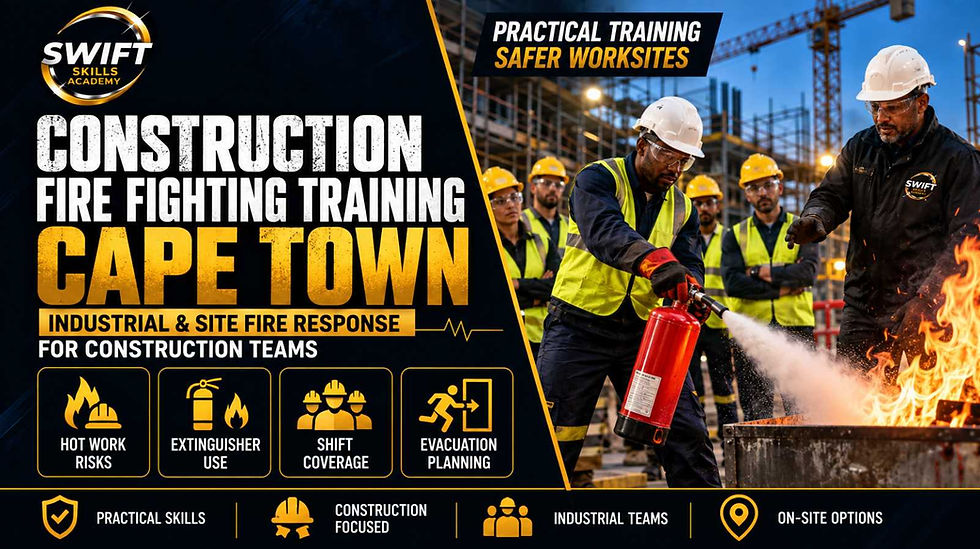
Construction Companies
Construction Regulation 29 specifically requires a sufficient number of workers to be trained in the use of fire-extinguishing equipment. (Government of South Africa)
Hospitality Businesses
Hotels, kitchens, restaurants and accommodation facilities may involve cooking equipment, electrical loads, guest evacuation and after-hours staffing.
Offices and Commercial Buildings
Lower fire risk does not mean no risk. Electrical equipment, kitchens, public visitors and high occupancy can still require an organised emergency plan.
Schools and Training Centres
Staff responsibilities must be coordinated around learners, visitors, evacuation, assembly and emergency communication.
Security and Facilities Teams
These employees are often present across extended operating hours and may have direct roles in alarm activation, evacuation support and emergency access.
How to Plan Your Company Training Rollout
Step 1: Assess the Fire Risks
Identify:
ignition sources;
combustible materials;
hot work;
electrical risks;
flammable substances;
high-risk processes; and
areas where fires could develop.
Step 2: Map the Workplace
Record:
buildings;
departments;
floors;
shifts;
emergency exits;
equipment locations; and
assembly arrangements.
Step 3: Select Suitable Employees
Choose employees who are:
regularly present;
able to understand the procedures;
willing to perform the role;
positioned across relevant work areas; and
available across the required shifts.
Step 4: Decide Public or On-Site Delivery
For a few learners, public training may be straightforward.
For larger groups, on-site delivery may make more operational sense.
Step 5: Request a Written Quote
Give the provider enough information to quote properly.
Step 6: Confirm the Programme Route
Get assessment and certification arrangements in writing.
Step 7: Complete the Training
Ensure employees participate in the required theory, demonstrations and practical activities.
Step 8: Update the Training Matrix
Record the outcome and evidence.
Step 9: Test the Workplace Response
Use drills and internal reviews to identify whether the system works under realistic conditions.
Step 10: Correct Weaknesses
Training is wasted if deficiencies identified afterwards are never corrected.
Employer Fire Fighting Training Checklist
Before booking, confirm:
Question | Status |
Have workplace fire hazards been identified? | ☐ |
Do we know which employees require training? | ☐ |
Have all shifts been considered? | ☐ |
Do we have backup responders? | ☐ |
Is on-site delivery operationally preferable? | ☐ |
Has venue suitability been discussed? | ☐ |
Have we provided learner numbers? | ☐ |
Have we requested an itemised quote? | ☐ |
Has the exact programme been confirmed? | ☐ |
Has the provider route/scope been confirmed? | ☐ |
Are assessment requirements clear? | ☐ |
Is the certification/result pathway clear? | ☐ |
Do we know what records will be supplied? | ☐ |
Will the training matrix be updated? | ☐ |
Are drills and refresher reviews planned? | ☐ |
Why Use Swift Skills Academy for Company Fire Fighting Training?
Swift Skills Academy provides practical workplace fire-fighting training for individual learners and employer groups in Cape Town.
The current programme:
references SAQA Unit Standard 12484;
combines theory, demonstrations and supervised practical activities;
covers fire hazards and equipment selection;
develops decision-making around containable fires;
emphasises withdrawal when conditions become unsafe;
supports public training and suitable on-site company delivery; and
confirms assessment and certification arrangements before enrolment.
For employers, the objective is not merely to get employees through a course.
It is to create a training plan that supports the workplace's real fire-response needs.
Swift Skills Academy
6 Monaco Road, Killarney Gardens, Cape Town
Tel: 021 828 0772
WhatsApp: +27 60 998 7412
Training referencing SAQA Unit Standard 12484.
Confirm the applicable programme scope, assessment, moderation and certification pathway in writing before enrolment.
Frequently Asked Questions
Can Swift Skills Academy provide fire fighting training at our company premises?
On-site delivery is available for suitable company groups and venues. The employer should provide learner numbers, location and preferred dates so that venue suitability, practical arrangements and scheduling can be confirmed. (Swift Skills Academy)
Do we need at least 10 employees for on-site training?
Do not treat 10 as a universal legal or booking threshold. On-site suitability depends on the employer's group size, venue, location, practical requirements, scheduling and the quotation issued for that booking.
How many employees should our company train?
There is no single general national ratio applying to every workplace. Determine training coverage from the risk assessment, fire-response responsibilities, workplace layout, operating shifts and employee availability. Construction Regulation 29 specifically requires a sufficient number of workers to be trained in the use of fire-extinguishing equipment on construction sites. (Government of South Africa)
Is the training one day?
Swift Skills Academy's current course page states a planned duration of two days. Confirm the exact dates, daily times and company-group delivery schedule before booking. (Swift Skills Academy)
Is this a professional firefighter qualification?
No. The workplace Basic Fire Fighting course does not qualify somebody to work as a professional firefighter. (Swift Skills Academy)
Does everyone automatically receive SAQA credits after attending?
No. Attendance alone does not automatically guarantee competence, credits or certification. The applicable assessment, moderation, approved enrolment and certification pathway must be confirmed for the booking. (Swift Skills Academy)
Can employees practise using fire-fighting equipment?
The current programme includes supervised practical activities. The exact practical format and venue requirements should be confirmed for the booked delivery arrangement. (Swift Skills Academy)
Can we train different shifts separately?
Potentially, yes. Company-group scheduling should be discussed during quotation so the provider can consider learner numbers, training groups, operational requirements and available dates.
You May Also Want to Read Further
Recommended page | Why the employer should read it |
Current programme scope, training outcomes, duration, public/on-site routes and booking information. | |
Broader employer planning covering fire readiness, costs, legal context and public versus on-site training. | |
Explains when employers should review practical competence instead of assuming one universal renewal interval. | |
Helps connect training with equipment readiness and routine workplace inspections. | |
Reinforces the limits of basic response and the importance of safe withdrawal. | |
More specialised guidance for hot work, industrial operations, construction and higher-risk workplaces. |
Sources
The legal/technical foundation of this article should retain visible links to the primary sources:
South African Qualifications Authority — Unit Standard 12484: Perform Basic Fire Fighting — confirms title, NQF level, credits, registration status and current recorded enrolment/achievement dates. (regqs.saqa.org.za)
Occupational Health and Safety Act 85 of 1993 — Section 8 — establishes the employer's broader duty concerning workplace hazards, information, instruction, training and supervision. (Government of South Africa)
General Safety Regulations — Regulation 13J — addresses workplace fire precautions, equipment and escape provisions. (Government of South Africa)
Construction Regulations 2014 — Regulation 29 — specifically requires sufficient fire-extinguishing equipment and a sufficient number of workers trained in its use on construction sites. (Government of South Africa)
City of Cape Town Fire Safety Guidance — provides local fire-safety guidance concerning equipment, building safety and staff readiness. (capetown.gov.za)