Fire Fighting Training Requirements South Africa: Employer Booking & Provider Guide
Updated: Sep 27
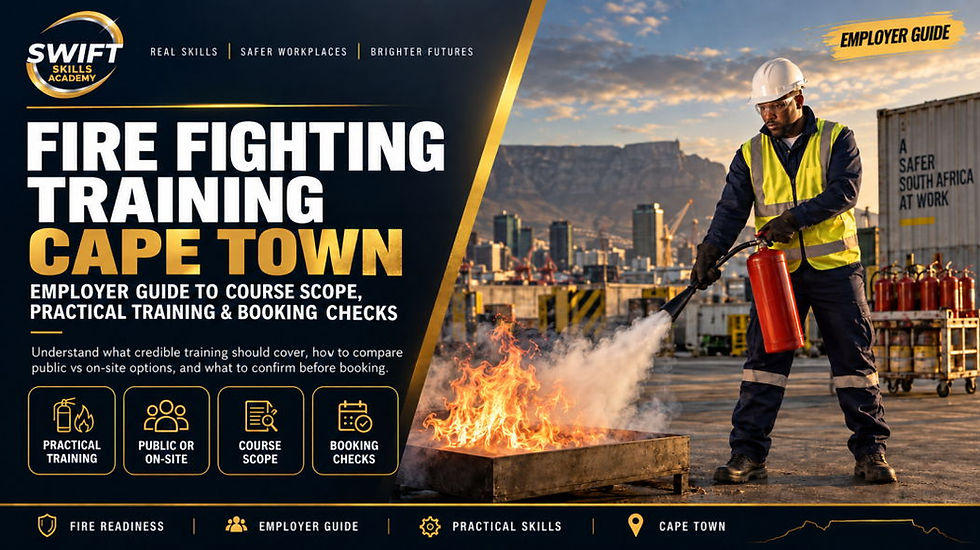
A fire-fighting certificate in an HR file will not stop a fire from spreading.
What matters is whether the right employees are present, know how to raise the alarm, can select suitable initial-response equipment and understand when intervention is no longer safe.
That is the difference between booking a course and building workplace fire readiness.
This guide explains what credible fire fighting training requirements South Africa should cover, what employers must verify before booking and how to choose between public and on-site training in Cape Town.
For current programme information, review the Fire Fighting Course Cape Town page.
Quick Answer: What Should an Employer Do?
Employers should:
Identify workplace fire hazards.
Assign clear fire-response and evacuation responsibilities.
Train suitable employees for those responsibilities.
Maintain appropriate equipment, alarms and exits.
Provide coverage across relevant shifts and work areas.
Test emergency procedures through drills.
Record defects and complete corrective actions.
Confirm the programme, assessment and certification pathway in writing before booking.
Swift Skills Academy currently advertises workplace fire-fighting training from:
From R528 per Learner
This is an advertised starting price, not a universal fixed quotation.
Public Cape Town and on-site employer options are available by written quotation.
Training is one control. Fire readiness also depends on prevention, suitable equipment, clear exits, emergency procedures, drills and documented corrective action. Employers can also use the workplace fire-readiness checklist to review the wider system beyond training.
Is Fire Fighting Training Legally Required in South Africa?
South African law does not state that every employee must complete one identical fire-fighting course.
The employer’s duty is broader and risk-based.
Section 8 of the Occupational Health and Safety Act requires employers, as far as reasonably practicable, to provide and maintain a safe working environment, identify hazards and provide the information, instruction, training and supervision necessary for safety. (South African Government)
The General Safety Regulations were amended in March 2025. Regulation 13J addresses fire precautions, suitable fire-fighting equipment, escape arrangements and equipment maintenance. (South African Government)
What This Means for Employers
Fire-response training becomes necessary where employees are assigned responsibilities such as:
Raising the alarm.
Operating portable extinguishers.
Supporting evacuation.
Monitoring fire equipment.
Acting as fire-team members.
Coordinating emergency communication.
The number of employees trained should follow the workplace’s risk assessment, layout, fire load, operating shifts, emergency procedures and staff availability.
There is no universal national rule requiring one trained workplace firefighter for every fixed number of employees.
A Certificate Does Not Make the Workplace Compliant
A training certificate does not prove that:
The correct extinguishers are installed.
Equipment is professionally serviced.
Fire exits are clear.
Alarm systems work.
Every shift has trained coverage.
Emergency procedures have been tested.
Problems identified during drills have been corrected.
Training is one part of a wider fire-safety system.
A workplace can have trained employees and still fail during an emergency because the equipment, evacuation procedure or management controls around them are defective.
What Should Practical Fire-Fighting Training Cover?
The exact programme must be confirmed before enrolment, but credible training should prepare learners to make safe initial-response decisions.
Learners should develop an understanding of:
Common workplace ignition sources.
Basic fire behaviour and fire spread.
Different fire types and surrounding hazards.
Suitable fire-fighting equipment.
The limitations of portable extinguishers.
Alarm and emergency procedures.
Safe approach and escape positioning.
When intervention is no longer safe.
Retreat and emergency-service handover.
Incident and equipment reporting.
The Correct Response Sequence
Learners should be taught to:
Raise the alarm.
Warn people in immediate danger.
Activate the workplace emergency procedure.
Contact professional emergency services.
Preserve a clear escape route.
Attempt initial control only when safe, authorised and within their competence.
Retreat when conditions deteriorate.
Training should not encourage employees to become heroes.
Basic workplace training does not automatically establish competence in structural firefighting, breathing-apparatus use, hazardous-material intervention, large hose lines or rescue operations.
SAQA Unit Standard 12484: Current Status
SAQA Unit Standard 12484 is titled Perform Basic Fire Fighting.
It is recorded at NQF Level 2 with four credits and includes outcomes relating to workplace fire procedures, equipment selection, containable fires, safe retreat, handover and reporting.
The current official SAQA record shows:
Status point | Official date |
Registration end date | 30 June 2023 |
Last date for enrolment | 30 June 2029 |
Last date for achievement | 30 June 2032 |
SAQA records the unit standard as having passed its registration end date. It also states that it was not replaced by another unit standard. (SAQA Unit Standard 12484)
What Employers Should Confirm
Before booking, request written confirmation of:
The exact programme title.
Whether the training is credit-bearing or non-credit-bearing.
The current provider and assessor arrangements.
The practical activities included.
The assessment method.
The certificate or training record issued.
Whether credits will be recorded.
The applicable quality-assurance pathway.
Do not rely only on “SAQA 12484” appearing in a page title, URL or advertisement.
The appropriate wording is:
This training references legacy SAQA Unit Standard 12484. The applicable programme, assessment and certification pathway will be confirmed in writing before booking.
What Employers Should Compare in a Fire-Training Quote
Swift Skills Academy currently advertises a starting price of from R528 per learner.
The final quotation may depend on:
Learner numbers.
Public or on-site delivery.
Venue and travel.
Practical equipment and consumables.
Assessment and certification arrangements.
Shift or weekend scheduling.
VAT treatment.
A written quotation should identify what is included and what may attract an additional fee.
Use the Fire Fighting Course cost and refresher guide when comparing providers.
The cheapest advertised course is not necessarily the lowest business cost. A programme with unclear practical content, assessment or certification can create further administrative and operational problems.
Public or On-Site Training: Which Delivery Model Fits the Workplace?
Public Training May Suit
Individuals.
Small businesses.
Employers training one or two people.
Learners able to attend scheduled Cape Town dates.
Companies without a suitable training area.
On-Site Training May Suit
Larger employer groups.
Warehouses and manufacturing plants.
Construction and engineering teams.
Hospitality operations.
Multiple shifts.
Employers requiring workplace-specific examples.
On-site delivery may reduce travel, time away from operations and the administrative difficulty of training an entire department.
It does not replace a professional fire-risk assessment or equipment service.
Employers planning group delivery should review the guide to on-site fire training for Cape Town teams.
Which Employees Should Be Trained?
Select employees who are:
Present during the relevant shift.
Familiar with the work area.
Able to understand emergency instructions.
Physically capable of participating.
Willing to accept the responsibility.
Able to communicate clearly.
Available when supervisors are absent.
Do not train only senior managers who are regularly travelling, in meetings or away from operational areas.
Build coverage across the required buildings, departments and shifts, with suitable backup for leave and absenteeism.
Higher-Risk Workplaces Need More Than Generic Awareness
Construction and industrial workplaces may involve welding, hot work, fuel, gas cylinders, chemicals, electrical installations, machinery, battery systems or combustible dust.
Fire training in these environments should connect with:
Hot-work permits.
Fire-watch duties.
Gas-cylinder controls.
Shutdown and isolation procedures.
Contractor supervision.
Specialist escalation.
Read the Construction and Industrial Fire Fighting Training guide before selecting a generic programme for a higher-risk site.
Your Equipment May Be Serviced — But Is Your Team Ready?
Professional servicing addresses the equipment.
Employee training addresses whether a person can find, identify, select and use that equipment safely.
Routine visual checks should consider:
Equipment location.
Clear access.
Visible signage.
Pins and seals.
Visible damage.
Pressure indication where applicable.
Service labels.
Reported defects.
Use the Monthly Fire Extinguisher Inspection Checklist to identify readiness gaps.
A visual check does not replace professional technical servicing.
Fire Training Must Connect to Evacuation and First Aid
The employer must also decide:
Who raises the alarm.
Who calls the fire service.
Who directs evacuation.
Who manages the assembly point and roll call.
Who assists visitors and contractors.
Who provides first aid.
Who records the incident.
Who closes corrective actions.
Connect fire-response training with workplace emergency and evacuation procedures and suitable workplace First Aid training.
Employer Checklist Before Booking
Before choosing a provider, ask:
Programme and Practical Training
What is the exact programme title?
Is it credit-bearing or non-credit-bearing?
What practical activities are included?
Will learners handle extinguishers under supervision?
What is excluded from the programme?
Assessment and Certification
How will learners be assessed?
What exact certificate or training record is issued?
Does the document record attendance, assessment or competence?
Will credits be recorded?
What quality-assurance route applies?
Price and Delivery
What is included in the quoted fee?
Are VAT, travel and consumables included?
Do reassessment fees apply?
What is the minimum on-site group?
What are the postponement and cancellation terms?
If a provider will not answer these questions in writing, do not assume the advertisement will protect your organisation later.
Frequently Asked Questions
What Should Employers Compare When Reviewing Fire-Training Costs?
Swift Skills Academy currently advertises a starting price of from R528 per learner.
Final pricing depends on learner numbers, location, delivery format, practical requirements, assessment, certification, scheduling and VAT.
Must Every Employee Complete Fire-Fighting Training?
No.
The risk assessment, emergency plan, site layout, shifts and assigned responsibilities should determine who requires training.
Can Learners Still Enrol Against SAQA Unit Standard 12484?
The official SAQA record currently lists 30 June 2029 as the last date for enrolment and 30 June 2032 as the last date for achievement.
The applicable provider, assessor and quality-assurance pathway must still be confirmed before enrolment.
Can Training Be Delivered at Our Workplace?
Yes. On-site employer training can be arranged by quotation, subject to learner numbers, location, venue suitability, scheduling and practical requirements.
Does a Fire-Fighting Certificate Make the Workplace Compliant?
No.
Training supports the employer’s fire-safety system. Readiness also depends on suitable equipment, maintenance, clear exits, alarms, emergency procedures, drills and corrective-action records.
Final Employer Warning
Do not assume the workplace is prepared because extinguishers are mounted on the walls and an old certificate exists in a file.
A real fire will test:
Whether the alarm works.
Whether exits are clear.
Whether suitable equipment is accessible.
Whether trained employees are present.
Whether they understand their limits.
Whether evacuation works.
Whether management can produce the necessary evidence.
A certificate is one record. Fire readiness is a maintained and tested workplace system.
Swift Skills Academy6 Monaco Road, Killarney Gardens, Cape Town
Tel: 021 828 0772
WhatsApp: +27 60 998 7412
Related Fire-Safety Resources
Guide | Purpose |
Review current course information | |
Compare quotations and refresher planning | |
Plan employer group delivery | |
Consider higher-risk environments | |
Improve routine equipment checks |