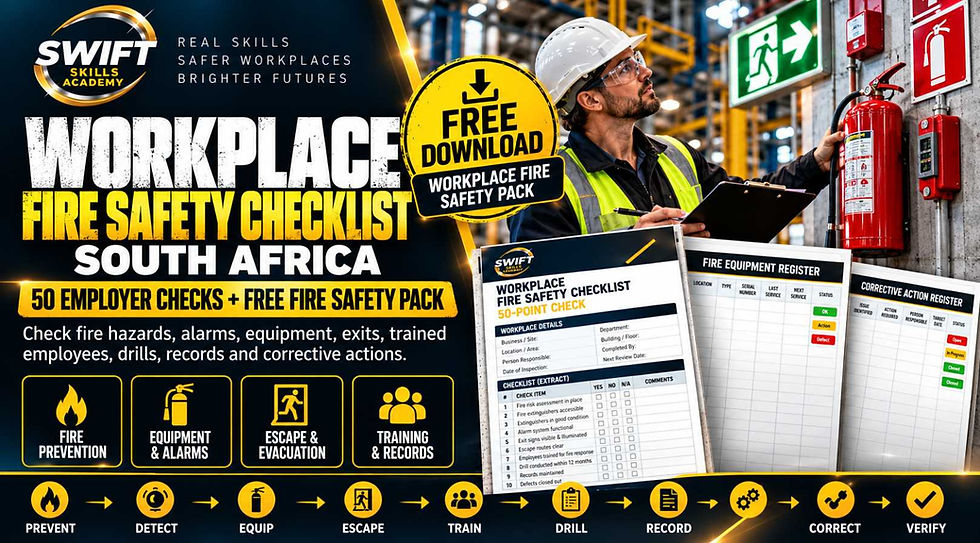
Workplace Fire Safety Checklist South Africa: 50 Employer Checks + Free PDF
Quick Answer: What Should an Employer Check for Workplace Fire Safety Checklists South Africa?
A useful workplace fire-safety review should look beyond whether extinguishers are hanging on the wall.
Employers should examine the complete system:
PREVENT → DETECT → EQUIP → ESCAPE → TRAIN → DRILL → RECORD → CORRECT → VERIFY
That means checking fire hazards, housekeeping, alarms, extinguishers, escape routes, emergency procedures, trained employees, shift coverage, drills, records and whether identified problems are actually corrected.
This 50-point workplace fire safety checklist is designed to help South African employers identify obvious readiness gaps and assign corrective actions.
It is not a certificate of legal compliance, does not replace a workplace-specific risk assessment, and does not replace inspections or servicing that must be completed by appropriately competent or authorised persons.
Workplace Fire Safety in South Africa: The Employer's Bigger Responsibility
Fire safety should not be treated as a once-a-year paperwork exercise.
Section 8 of the Occupational Health and Safety Act places a general duty on employers to provide and maintain, as far as reasonably practicable, a working environment that is safe and without risk to employees' health. This includes identifying hazards and providing appropriate information, instruction, training and supervision.
The General Safety Regulations were amended in March 2025. Regulation 13J deals specifically with fire precautions and means of egress, including matters affecting evacuation and escape from the workplace.
Local fire-safety requirements, building requirements, the nature of the premises, occupational risks, insurer requirements and other applicable rules may add further obligations.
The City of Cape Town also encourages workplaces to use fire-safety checklists and maintain measures intended to prevent fires and support an effective response.
The practical lesson for employers is simple:
Fire readiness is a system — not an extinguisher, certificate or checklist viewed in isolation.
The 50-Point Workplace Fire Safety Checklist
Use each item as:
YES — satisfactoryNO — corrective action requiredN/A — not applicable to this workplace
Record the person responsible and target completion date for every identified problem.
A. PREVENT — Fire Hazards and Housekeeping
1. Are combustible waste materials removed regularly?
Cardboard, packaging, timber offcuts, oily materials and other combustible waste should not be allowed to accumulate unnecessarily.
2. Are work areas kept reasonably clean and orderly?
Poor housekeeping can increase both the probability of ignition and the amount of combustible material available to a fire.
3. Are ignition sources identified?
Look at welding, grinding, heating equipment, open flames, hot surfaces, electrical equipment and other possible ignition sources relevant to the workplace.
4. Are flammable or combustible materials stored appropriately?
Storage arrangements should reflect the properties of the substances and the risks associated with the workplace.
5. Are electrical leads, plugs and equipment visibly free from obvious damage?
A general workplace observation can identify visible problems, but it does not replace electrical inspection, testing or maintenance where required.
6. Are overloaded plugs, adaptors and makeshift electrical arrangements avoided?
Temporary arrangements should not become permanent uncontrolled hazards.
7. Are hot-work activities controlled?
Where welding, cutting, grinding or similar work can generate heat, flame or sparks, the employer should have appropriate controls for the actual risk.
8. Are areas around buildings kept reasonably clear of combustible waste?
External rubbish, vegetation, packaging or stored combustible materials may increase fire spread or obstruct emergency access.
B. DETECT — Alarm and Warning Arrangements
9. Is there an appropriate way to raise the alarm?
Employees must know how a fire or suspected fire is communicated to other people in the workplace.
10. Can the alarm or warning be recognised throughout the relevant workplace?
Consider noisy areas, isolated workspaces, workshops, warehouses and outside work areas.
11. Do employees know what the alarm means?
An alarm that people do not understand is not an effective emergency control.
12. Are alarm or detection systems maintained where installed?
Systems should form part of an appropriate maintenance and testing programme.
13. Are problems with alarms or warning systems recorded and escalated?
A known defect should not disappear into verbal communication.
C. EQUIP — Fire-Fighting Equipment
14. Is fire-fighting equipment provided where required for the workplace risk?
The type and arrangement should suit the actual workplace and applicable requirements.
15. Is equipment clearly visible or appropriately indicated?
Employees should be able to locate equipment without searching for it during an emergency.
16. Is access to fire-fighting equipment unobstructed?
Boxes, furniture, stock, machinery or vehicles should not block access.
17. Are extinguishers visibly in place?
Missing equipment should trigger immediate investigation and corrective action.
18. Is obvious damage, corrosion, leakage or tampering absent?
Routine visual checks can identify visible concerns.
19. Are pins, seals and pressure indicators visually satisfactory where applicable?
This is a routine readiness check and does not replace professional servicing.
20. Are servicing and maintenance records current for equipment that requires them?
Workplace visual inspections and professional servicing are different controls.
For a more detailed equipment review, use the Monthly Fire Extinguisher Inspection Checklist South Africa:
D. ESCAPE — Exits, Escape Routes and Emergency Access
21. Are emergency routes kept clear?
Stock, equipment and temporary storage should not compromise evacuation.
22. Are emergency exit doors readily openable where required?
The March 2025 General Safety Regulations include requirements relating to fire precautions and means of egress.
23. Are exits clearly identifiable?
People should not need to guess where to go during smoke, noise or confusion.
24. Are passageways and stairways reasonably free from obstruction?
Escape depends on the entire route, not only the final door.
25. Is emergency lighting provided and maintained where applicable?
The specific requirements will depend on the premises and applicable rules.
26. Are assembly arrangements understood?
Employees should know where to proceed after evacuation and how accountability will be managed.
27. Have workplace changes affected evacuation?
New partitions, storage layouts, machinery, security gates or occupancy changes can undermine an old emergency plan.
E. TRAIN — People and Workplace Coverage
28. Have suitable employees been assigned fire-response responsibilities?
Do not assume everybody has the same role.
29. Are employees trained for the duties they are actually expected to perform?
Training should correspond with assigned responsibility and workplace risk.
30. Is trained coverage available during relevant operating periods?
A workplace may have trained employees on paper while having no appropriate person present during another shift.
31. Is coverage considered across departments, buildings and work areas?
One trained person in an administration office may not provide meaningful coverage for a separate warehouse.
32. Is backup coverage considered for leave, absenteeism and staff turnover?
Fire readiness should not depend entirely on one individual.
33. Do employees understand the limits of their fire-response role?
Basic workplace fire-fighting training does not turn an employee into a professional structural firefighter.
Where the inspection identifies a training gap, review:
Employers researching who should be trained, provider verification and training evidence should also read:
What Should Fire-Fighting Training Prove — and What Should It Not Prove?
A training certificate is an important record, but employers should not treat it as proof that the entire workplace is fire-safe.
Depending on the programme and assessment pathway, training may provide evidence relating to a learner's participation and assessed outcomes.
It does not automatically prove that:
the workplace's extinguishers are correctly selected or located;
equipment is professionally serviced;
alarms work;
emergency exits are clear;
every shift has adequate trained coverage;
employees will respond correctly months later;
evacuation procedures work;
site-specific hazards are controlled; or
the organisation is legally compliant in every respect.
A certificate relates to the training or assessment undertaken.
Workplace fire readiness requires the wider system to work.
SAQA Unit Standard 12484: Current Position
SAQA Unit Standard 12484 — Perform Basic Fire Fighting is recorded as a Level 2 unit standard worth four credits.
The current SAQA record shows:
Registration end date: 30 June 2023
Last date for enrolment: 30 June 2029
Last date for achievement: 30 June 2032
SAQA records the unit standard as having passed its registration end date and states that it has not been replaced by another unit standard.
Employers should therefore verify the exact programme, provider arrangements, assessment process, certification route and quality-assurance pathway applicable to the training they intend to book.
Do not treat the words “SAQA 12484” in an advertisement as sufficient evidence on their own.
F. DRILL — Emergency Procedures and Testing
34. Does the workplace have a documented fire/emergency response procedure?
The procedure should reflect the real workplace rather than a generic template copied from elsewhere.
35. Do employees know what to do when fire is discovered?
The first actions may include raising the alarm, warning others and initiating evacuation procedures.
36. Are evacuation arrangements periodically tested?
A plan that has never been tested may contain problems management has not discovered.
37. Are problems observed during drills recorded?
Examples may include slow evacuation, blocked routes, confusion, communication failures or accountability problems.
38. Are drill findings converted into corrective actions?
The purpose of testing is improvement, not merely producing a completed attendance sheet.
For broader workplace evacuation planning, read: HERE
G. RECORD — Evidence Employers Should Keep
39. Is there a record of relevant fire-safety inspections?
The record should make it possible to understand what was checked, when and by whom.
40. Are extinguisher and equipment records retained?
Separate routine visual checks from professional servicing or maintenance records.
41. Are training records available?
The employer should be able to identify who was trained, on what programme and when.
42. Are drill records retained?
A drill record should be useful enough to support improvement rather than simply proving an event took place.
43. Are defects and corrective actions traceable?
A record of the problem without evidence of correction has limited value.
H. CORRECT — Close the Problems You Find
44. Is every significant defect assigned to somebody?
Avoid vague actions such as “maintenance to investigate”.
Record an accountable person or function.
45. Is a target date recorded?
This allows overdue fire-safety actions to be identified.
46. Are urgent risks controlled while permanent correction is pending?
Some problems cannot responsibly remain open while procurement, maintenance or construction work is awaited.
47. Is completion verified rather than merely reported?
Someone should confirm that the corrective action actually resolved the problem.
I. VERIFY — Confirm the System Still Works
48. Are previously identified defects checked again?
Recurring defects often reveal a deeper management or maintenance problem.
49. Is the checklist repeated when the workplace materially changes?
Examples include:
layout changes;
increased occupancy;
additional shifts;
new machinery;
altered storage;
construction work;
new hazardous materials; or
changes to emergency exits.
50. Can management demonstrate the complete fire-readiness chain?
The employer should be able to connect:
hazards → controls → equipment → emergency arrangements → trained people → drills → records → corrective action
That is far more meaningful than an isolated certificate or tick-box inspection.
How to Score This Checklist
Do not treat the following as an official statutory scoring method. It is simply an internal management tool.
GREEN
No significant gaps identified and existing controls appear maintained.
AMBER
One or more deficiencies require planned corrective action.
RED
A serious fire-safety concern, blocked escape route, missing critical control or other significant issue requires prompt escalation and appropriate interim control.
The seriousness of an individual defect matters more than the percentage score.
A single blocked emergency exit can be more important than ten minor administrative gaps.
A Checklist Does Not Replace Competent Technical Work
This distinction is critical.
An employer checklist can help identify visible conditions and management gaps.
It does not replace specialist activities such as:
professional fire-equipment servicing;
electrical testing;
fire-detection system servicing;
engineering assessment;
statutory building inspections;
specialist fire-risk assessment;
certification required by an applicable authority;
technical inspection of suppression systems; or
other competent-person activities required for the particular workplace.
If a checklist identifies a technical defect, escalate it to the appropriate competent person or service provider.
Common Fire-Safety Failures Employers Miss
“The extinguisher is there, so it must be fine.”
Not necessarily.
It may be blocked, damaged, discharged, incorrectly positioned or overdue for appropriate servicing.
“We trained somebody two years ago.”
Ask whether that person still works there, is present on the relevant shift and understands the current workplace.
“We have an emergency plan.”
Has it been tested?
“The fire exit exists.”
Can people reach and open it quickly?
“We completed the checklist.”
Were the problems corrected?
The most dangerous checklist is one that identifies defects and then becomes another document in a file.
Who Should Complete the Workplace Fire Safety Checklist?
The person completing the routine checklist should understand the workplace, its emergency arrangements and the limits of what they are competent to assess.
Depending on the organisation, that may involve:
a health and safety representative;
SHE/OHS personnel;
a facilities or maintenance representative;
a supervisor;
an appointed fire coordinator;
management; or
another suitably informed person.
Different technical systems may still require specialist inspection or servicing.
How Often Should Employers Complete the Checklist?
There is no single universal frequency in this article that should be imposed on every South African workplace.
The appropriate review frequency should reflect:
the workplace risk assessment;
applicable legislation and regulations;
local fire requirements;
equipment requirements;
insurer requirements;
occupancy;
operational changes;
incident history; and
the organisation's own procedures.
The checklist should also be reconsidered whenever material workplace changes could affect fire risk or evacuation.
What Happens When the Checklist Identifies a Training Gap?
Do not automatically send every employee on the same course.
First determine:
What fire-related responsibility must be covered?
Which departments or areas require coverage?
Which operating shifts require coverage?
Who is normally present?
What backup is needed for leave or absenteeism?
What workplace hazards should the training take into account?
What assessment and training evidence does the employer require?
Then evaluate the appropriate programme.
For current Swift Skills Academy programme information:
Frequently Asked Questions
What should be included in a workplace fire safety checklist?
A practical checklist should cover fire hazards, housekeeping, alarms, fire-fighting equipment, escape routes, emergency procedures, trained personnel, shift coverage, drills, records, corrective actions and verification.
Is a fire safety checklist a legal compliance certificate?
No.
A general checklist can help identify visible hazards and management gaps, but it does not by itself certify legal compliance or replace workplace-specific risk assessments, specialist inspections, professional servicing or competent-person processes.
Must every employee receive fire-fighting training?
Not necessarily.
Training decisions should reflect the workplace's hazards, risk assessment, emergency arrangements, assigned responsibilities, operating shifts and actual coverage requirements.
How many trained fire responders does a workplace need?
There is no universal national ratio stated here that applies identically to every workplace.
Employers should consider site size, layout, occupancy, fire risk, shifts, work areas, emergency arrangements and staff availability.
Does having trained employees mean the workplace is fire compliant?
No.
Training is only one element of a workplace fire-safety system. Equipment, exits, alarms, prevention measures, emergency procedures, drills, maintenance and corrective actions also matter.
Can a workplace check its own fire extinguishers?
Routine visual readiness checks can identify obvious problems such as blocked access, missing equipment or visible damage.
They do not replace professional servicing, maintenance or other technical requirements applicable to the equipment.
Is SAQA Unit Standard 12484 still available for enrolment?
The current SAQA record lists 30 June 2029 as the last date for enrolment and 30 June 2032 as the last date for achievement.
Employers should still confirm the applicable programme, provider, assessment and quality-assurance pathway before booking.
Should fire drills be recorded?
Keeping a record of the drill, observations, deficiencies and corrective actions provides considerably stronger management evidence than simply recording attendance.
What should happen after a fire-safety defect is identified?
Record the problem, assess its seriousness, assign responsibility, establish an appropriate completion date, implement any necessary interim controls and verify that the final corrective action has resolved the issue.
Authoritative Sources
Authoritative source | Why it matters |
Core South African workplace health and safety legislation. Section 8 establishes the employer’s general duty to provide and maintain a working environment that is, as far as reasonably practicable, safe and without risk to employees. | |
Current General Safety Regulations published under the Occupational Health and Safety Act. Relevant when considering workplace safety arrangements, emergency precautions and employer controls. (Government of South Africa) | |
Official Department of Employment and Labour source confirming the 2025 promulgated occupational health and safety regulations, including the General Safety Regulations amendment. (Department of Labour) | |
Practical municipal fire-safety guidance covering workplace housekeeping, evacuation, emergency escapes and workplace fire-safety checklists. (Cape Town City Council) | |
Official SAQA record for Unit Standard 12484, including its outcomes, NQF Level 2, 4 credits and current last-enrolment and last-achievement dates. (SAQA) |
Requirements may differ according to the workplace, building, municipality, risk profile and applicable technical standards.
Read More
Monthly Fire Extinguisher Inspection Checklist South Africa
Identify blocked access, visible damage, service-record problems and other extinguisher-readiness defects.
Fire Fighting Training Requirements South Africa: Employer Booking & Provider Guide
Understand who should be trained, workplace coverage, provider verification and what evidence employers should request.
Workplace Emergency Procedures South Africa
Strengthen evacuation, emergency communication and workplace response arrangements.
Final Word
Workplace fire safety does not succeed because a checklist was completed.
It succeeds when hazards are prevented, warning systems work, equipment is ready, exits remain usable, the right employees are trained, emergency procedures are tested and problems are corrected.
Use this checklist to find the gaps.
Then close them.
PREVENT → DETECT → EQUIP → ESCAPE → TRAIN → DRILL → RECORD → CORRECT → VERIFY
ire Safety hub.