Construction Fire Fighting Training Cape Town: Industrial & Site Fire Response Guide
Updated: Sep 28
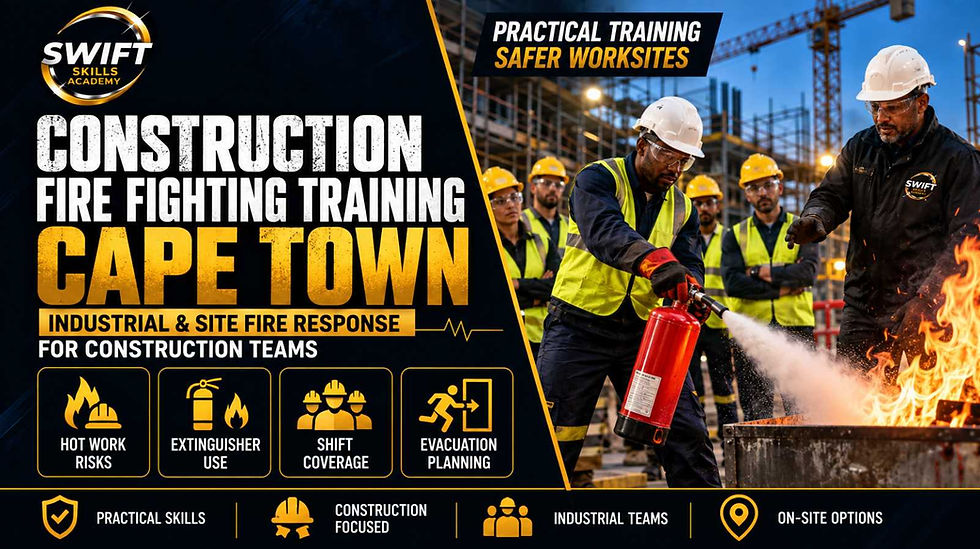
Construction and industrial workplaces are not ordinary fire environments.
A site can change from one day to the next.
New contractors arrive. Temporary electrical systems are installed. Welding begins in a new area. Fuel is stored closer to operations. Packaging and timber accumulate. Machinery runs hotter. A new shift starts. Access routes move.
That means fire readiness cannot be reduced to:
“We have extinguishers.”
For construction and industrial employers, a more useful question is:
If a fire starts during normal work, are the right people, equipment, routes and procedures actually in place to respond safely?
Quick Answer: What Should Construction Fire Fighting Training Cape Town Cover?
Construction fire fighting training Cape Town should help suitable employees understand:
common site fire hazards;
fire prevention;
fire behaviour;
different types of fires;
selection and use of appropriate basic fire-fighting equipment;
safe approach and retreat decisions;
emergency communication;
evacuation;
reporting;
workplace fire procedures; and
when conditions are no longer suitable for basic employee response.
SAQA Unit Standard 12484 specifically addresses workplace fires and includes identifying the nature and context of a fire, selecting equipment, isolating hazards, monitoring changes in fire conditions and retreating according to appropriate procedures. SAQA
The unit standard is NQF Level 2, 4 credits. Its registration end date was 30 June 2023, while SAQA currently lists the last enrolment date as 30 June 2029 and the last achievement date as 30 June 2032. SAQA
Why Construction Sites Need a Different Fire-Safety Mindset
Construction sites often combine temporary conditions with high-energy work.
The risk profile may include welding, grinding, flame cutting, temporary power, generators, combustible waste, timber, packaging, paints, solvents, fuel, gas cylinders and hot equipment.
South Africa's Construction Regulations specifically address fire precautions on construction sites. The regulations require contractors to take appropriate measures to avoid fire risk, control storage of flammable materials, manage hot work, provide suitable fire-extinguishing equipment, keep escape routes clear and maintain an evacuation plan. They also require a sufficient number of workers to be trained in the use of fire-extinguishing equipment. Government of South Africa
This is much more specific than saying:
“Everyone on site must do a Fire Fighting course.”
The law focuses on the workplace risk and on ensuring that a sufficient number of workers are trained for the equipment and arrangements in place. Government of South Africa
What Fire Hazards Are Common on Construction Sites?
Hot work
Welding, flame cutting, brazing, grinding and similar activities can generate heat, sparks and ignition sources.
Construction Regulations require appropriate precautions before welding, flame cutting and other hot work are performed. Government of South Africa
Training should therefore be connected to the workplace's actual hot-work controls — not treated as a separate classroom exercise.
Combustible materials
Timber, packaging, insulation, formwork, waste, rags and other combustible materials can increase fire loading.
The Construction Regulations specifically require that combustible materials not be allowed to accumulate on site. Government of South Africa
Flammable liquids and gases
Fuel, solvents, paints and gas cylinders need controlled storage and handling.
The Construction Regulations require sufficient and suitable storage for flammable liquids, solids and gases. Government of South Africa
Electrical risks
Temporary electrical installations, extension leads, portable tools, distribution boards and generators can introduce ignition hazards if damaged, overloaded or poorly controlled.
Changing escape routes
Unlike a completed building, a construction site may have temporary stairs, scaffolding, barriers, trenches, material storage and changing access routes.
That is why evacuation arrangements must be reviewed as the work changes.
What About Industrial Workplaces?
Factories, engineering workshops, warehouses and manufacturing sites may face a different fire profile.
Their risks can include:
machinery and hot surfaces;
electrical installations;
flammable or combustible materials;
fuel;
gas;
welding and fabrication;
battery systems;
stored goods;
conveyor systems;
maintenance operations; and
multiple departments or shifts.
The 2025 General Safety Regulations require employers, having regard to factors such as workplace size, construction, location and the amount and type of flammable materials, to provide an adequate supply of suitable fire-fighting equipment at strategic locations and maintain it in good working order. Government of South Africa
The same regulations also deal with means of egress and the need for escape routes to support quick and safe evacuation. Government of South Africa
Fire Fighting Training Is Only One Part of the System
A trained employee cannot compensate for a broken fire-safety system.
Construction and industrial fire readiness should connect:
PREVENT → CONTROL → EQUIP → TRAIN → ESCAPE → DRILL → RECORD → CORRECT → VERIFY
That means employers should look at both people and physical controls.
A person may be trained and still be placed at unacceptable risk if:
the extinguisher is inaccessible;
the exit is blocked;
the fire has escalated;
smoke obscures the escape route;
the wrong equipment is available;
flammable material has not been controlled; or
the worker has no safe retreat route.
Basic fire fighting training should support judgement, not encourage employees to remain in unsafe conditions.
How Many Workers Should Be Trained?
There is no responsible universal number for every construction or industrial workplace.
The Construction Regulations use the concept of a “sufficient number of workers” being trained in the use of fire-extinguishing equipment. Government of South Africa
The employer or contractor should therefore consider:
Factor | Why it matters |
Number of workers | Larger sites may require broader coverage |
Number of shifts | Training only day shift may leave a gap |
Site size | Large or dispersed sites may need multiple trained people |
Risk areas | Hot-work, fuel or fabrication areas may need stronger coverage |
Contractor turnover | Trained people may leave or move between projects |
Multiple floors / work zones | One responder may not be accessible everywhere |
Leave and absenteeism | Coverage must remain functional |
Site changes | New phases may create new fire risks |
The objective is not to train an arbitrary number of people.
The objective is to make sure suitable trained workers are actually available where and when fire-response responsibilities may arise.
Who Should Employers Consider Training?
Training decisions should be based on duties and workplace risk rather than job titles alone.
Possible candidates may include supervisors, appointed fire responders, SHE personnel, maintenance teams, fabrication teams, warehouse personnel, security personnel, shift leaders and workers operating in higher-risk areas.
But the correct selection depends on the specific workplace.
An employee who is never present in the risk area may not solve the coverage problem.
Why On-Site Fire Fighting Training Can Make Sense for Construction Teams
On-site delivery can be particularly useful where an employer needs to train a larger group without sending workers away from operations individually.
Potential advantages include:
reduced learner travel;
coordinated training dates;
easier shift planning;
group administration;
the ability to discuss site-specific hazards;
alignment with workplace emergency arrangements; and
simpler training-record management.
But “on-site” does not automatically make a course better.
The venue must be appropriate, practical activities must be controlled and the training still needs to meet the required learning and assessment outcome.
Does On-Site Training Mean Employees Practise on Their Actual Hazards?
Not necessarily.
Workplace training may use practical exercises or simulation rather than reproducing dangerous site conditions.
SAQA 12484 explicitly allows assessment in the workplace or by simulation. SAQA
A training provider should never create unnecessary risk just to make an exercise feel realistic.
Hot Work: Where Fire Training and Site Controls Meet
Hot work is one of the clearest examples of why Fire Fighting training cannot stand alone.
Before welding, flame cutting or similar work takes place, the site should control the surrounding fire risk.
The current construction rules address hot work directly and require appropriate precautions to reduce fire risk. Government of South Africa
Depending on the task, controls may include:
clearing combustible materials;
controlling sparks;
protecting adjacent areas;
providing suitable extinguishing equipment;
checking gas cylinders and hoses;
controlling ignition sources; and
monitoring the area after work.
Training can support employees' understanding of these risks, but it does not replace the employer's broader hot-work management system.
What Should Employers Check Before Booking Construction Fire Fighting Training?
Do not ask only:
“How much per person?”
Ask whether the training fits the workforce and the site.
A useful employer comparison should examine:
Question | Why it matters |
What programme is being delivered? | Confirms the actual training outcome |
Does it include practical learning? | Fire response requires more than theory |
What evidence is issued? | Important for HR and SHE records |
Can multiple workers be trained together? | Useful for construction teams |
Is on-site delivery available? | May reduce operational disruption |
What venue requirements apply? | Practical delivery needs planning |
How are learners assessed? | Helps employers understand evidence |
Can the provider support multiple shifts? | Important for workforce coverage |
Can training be coordinated with other safety courses? | Useful for broader site planning |
What current SAQA pathway applies? | Avoids assumptions based only on the unit-standard number |
What Does SAQA 12484 Actually Cover?
The official SAQA record is more useful than marketing summaries.
It includes outcomes relating to:
procedures for dealing with fires;
identifying fire type and context;
selecting suitable equipment;
isolation of hazards;
appropriate approach;
monitoring changes;
safe retreat;
containment or extinguishment;
handover;
reporting and recording. SAQA
That is why this training should not be described simply as:
“how to use an extinguisher.”
The decision-making around the extinguisher matters just as much.
When Should an Employee Retreat Instead of Fighting the Fire?
Employees should not be encouraged to fight a fire simply because they have completed basic training.
Conditions can deteriorate rapidly.
Retreat may be necessary where, for example:
the fire is growing beyond the person's training or equipment;
smoke is increasing rapidly;
visibility is deteriorating;
the escape route is threatened;
hazardous substances are involved;
there is risk of explosion; or
the employee is uncertain whether it is safe to continue.
SAQA 12484 specifically includes monitoring fire conditions and retreat procedures. SAQA
For the detailed decision framework, link internally to:
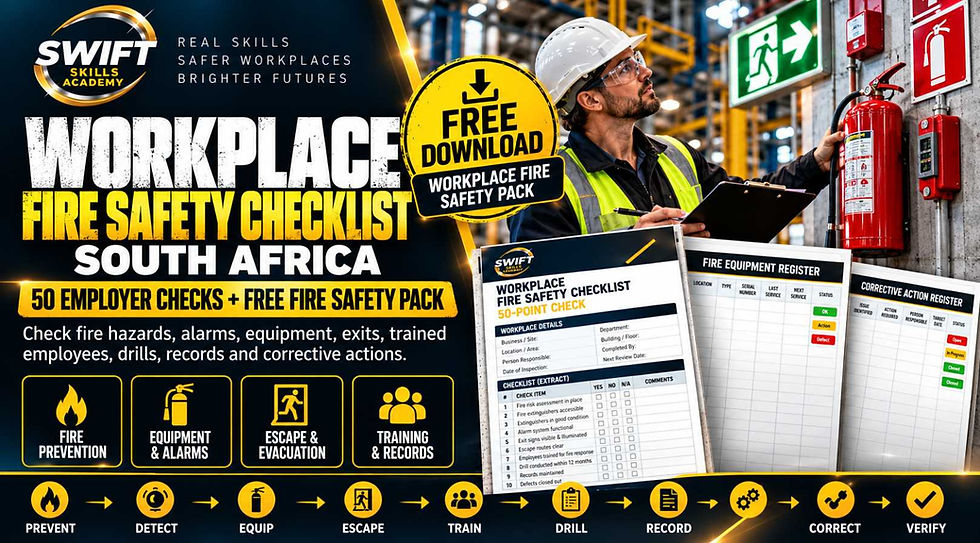
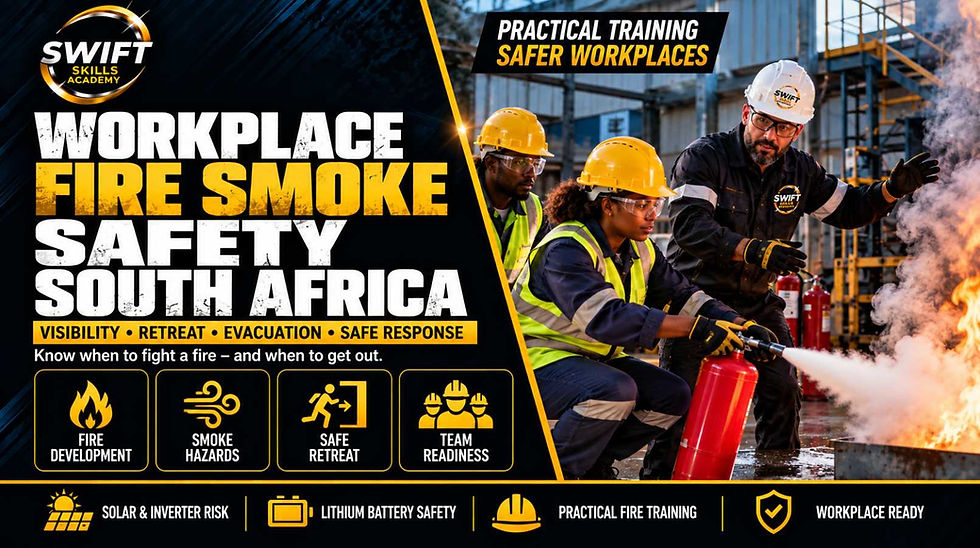
Workplace Fire Smoke Safety: Visibility, Retreat and When It's No Longer Safe to Fight
Construction Fire Equipment: Training Does Not Replace Inspection
Another important distinction:
training employees to use extinguishers is not the same thing as inspecting or servicing fire equipment.
Construction Regulations require suitable fire-extinguishing equipment to be provided and maintained, and also address inspection by a competent person appointed for that purpose. Government of South Africa
Routine workplace visual checks may help identify obvious problems between services, but they do not replace professional servicing or other competent technical inspection requirements.
What About Evacuation?
Fire-response training and evacuation planning must work together.
Construction Regulations require an effective evacuation plan dealing with rapid evacuation, accounting for persons and, where relevant, shutdown of plant and processes. They also address clear escape routes and fire alarms. Government of South Africa
This matters because fighting a fire is never the only priority.
Life safety and safe evacuation remain fundamental.
Fire Training Records for Contractors and Employers
Construction companies often need training records that can be retrieved quickly.
A useful record should identify:
Record | Purpose |
Learner name | Confirms who was trained |
Department / contractor | Supports coverage planning |
Project / site | Shows where the worker is deployed |
Course completed | Clarifies training scope |
Training date | Supports record control |
Evidence / certificate | Supports verification |
Assigned role | Helps distinguish general training from role assignment |
Review date | Supports future planning |
A certificate should not be treated as proof that the worker is automatically competent for every fire-related task or that the construction site is compliant in every respect.
The Biggest Construction Fire-Training Mistakes
The recurring mistakes are usually systemic rather than academic:
Training only one person.
Coverage disappears when that person leaves the site.
Ignoring night shift or weekend operations.
Coverage should reflect when work actually takes place.
No connection to hot-work controls.
High-risk activities need practical site controls.
Blocked or changing escape routes.Construction sites change constantly.
No equipment verification.Training is of limited value if equipment is missing or unusable.
No refresher review.
Workforce changes and risk changes can affect readiness.
Choosing learners randomly.
Train for coverage, responsibility and presence.
How Construction Fire Fighting Training Fits Into the Wider Safety Matrix
Fire Fighting training may sit alongside:
First Aid;
Working at Heights;
Basic Health and Safety;
Confined Spaces;
Scaffold Erector;
Scaffold Inspector;
emergency procedures;
hot-work controls;
induction;
contractor management; and
risk assessment.
The best training matrix is not the one with the most certificates.
It is the one that maps training to actual workplace responsibilities and hazards.
Why Workplace Fire Readiness Matters Beyond Training
Section 8 of the Occupational Health and Safety Act requires employers, as far as reasonably practicable, to provide and maintain a working environment that is safe and without risk to employees' health, and includes duties relating to hazard identification, precautionary measures, information, instruction, training and supervision. Government of South Africa
That means employers should not treat Fire Fighting training as a substitute for eliminating or controlling hazards where possible.
Training should support the control system.
It should not be used to justify leaving unsafe conditions in place.
Cape Town Fire-Safety Context
The City of Cape Town also emphasises that commercial and industrial facilities need suitable fire equipment and that staff should be trained and equipped with the knowledge to deal with workplace fire emergencies. It also provides guidance on exits, equipment servicing and building fire-safety measures. Cape Town City Council
For construction and industrial employers in Cape Town, municipal and building-specific requirements may apply in addition to occupational safety obligations.
When Should You Contact Swift Skills Academy?
Contact SSA when you know:
approximately how many employees need training;
whether they are individual learners or a workplace team;
the site location;
whether multiple shifts require coverage;
whether on-site delivery is preferred;
the nature of the workplace; and
whether other safety training is being planned.
That lets the training discussion start with the actual operational requirement rather than a generic course booking.
Frequently Asked Questions
Is Fire Fighting training mandatory on construction sites?
South Africa's Construction Regulations do not simply say every worker must complete the same Fire Fighting course. They require a sufficient number of workers to be trained in the use of fire-extinguishing equipment and contain broader requirements around fire prevention, equipment, evacuation and escape. Government of South Africa
What is SAQA Unit Standard 12484?
SAQA 12484 is titled Perform basic fire fighting. It is NQF Level 2 and carries 4 credits. Its outcomes include workplace fire procedures, selecting equipment, controlling fires, monitoring conditions, retreat and handover. SAQA
Is SAQA 12484 still registered?
The current SAQA record shows that the unit standard has passed its registration end date of 30 June 2023. The listed last enrolment date is 30 June 2029 and last achievement date is 30 June 2032. SAQA
Can construction workers receive Fire Fighting training on-site?
On-site delivery may be possible where learner numbers, venue conditions, safety controls and practical training requirements make it suitable.
How many construction workers should be trained?
There is no universal number for every site. The Construction Regulations require a sufficient number of workers to be trained in the use of fire-extinguishing equipment. Employers should assess shifts, site size, workforce numbers, fire risks and operational coverage. Government of South Africa
Does Fire Fighting training replace a construction site's evacuation plan?
No. Construction fire precautions include separate requirements around escape routes, evacuation and accounting for persons. Government of South Africa
Does a Fire Fighting certificate prove the construction site is compliant?
No. A training certificate is evidence relating to the learner's training or assessment. Overall compliance depends on the wider workplace system, equipment, hazards, procedures, evacuation arrangements and applicable requirements.
What fire risks are common on construction sites?
Common risks can include welding and cutting, combustible waste, flammable substances, temporary electrical systems, fuel, gas cylinders and changing site conditions.
Can industrial companies book group Fire Fighting training?
Yes. Group delivery can be suitable for manufacturing, engineering, warehousing and similar operations where multiple employees or shifts require coverage.
Authoritative Sources & Official Guidance
Source | Why it matters |
SAQA — Unit Standard 12484: Perform Basic Fire Fighting | Confirms the unit-standard title, outcomes, NQF level, credits and current lifecycle dates. SAQA |
Occupational Health and Safety Act 85 of 1993 | Establishes the general employer duty to maintain a workplace that is safe and without risk, as far as reasonably practicable. Government of South Africa |
Construction Regulations, 2014 | Contains specific fire precautions for construction sites, including hot work, fire equipment, worker training and evacuation. Government of South Africa |
General Safety Regulations, 2025 | Contains current requirements regarding fire precautions, means of egress and suitable fire-fighting equipment. Government of South Africa |
City of Cape Town — Fire Safety | Provides local guidance for commercial and industrial premises, fire equipment, evacuation and staff preparedness. Cape Town City Council |
Important legal note: the Department published draft replacement Construction Regulations for public comment in March 2025; the 2014 Construction Regulations therefore remain the operative regulations unless and until replacement regulations are formally brought into force. Government of South Africa
Read More
Recommended guide | Why read it |
Review the wider fire-safety system beyond training. | |
Compare providers, training evidence and workplace coverage before booking. | |
Understand when trained employees should stop attempting basic fire response and evacuate. |
Final Word
Construction and industrial workplaces require more than a generic Fire Fighting certificate.
The real system is:
hazards controlled → suitable equipment provided → enough people trained → escape routes maintained → procedures tested → records kept → problems corrected