Fire Fighting Course Cost Cape Town: SAQA 12484 Pricing, Legal Context & Employer Guide
Updated: Sep 28
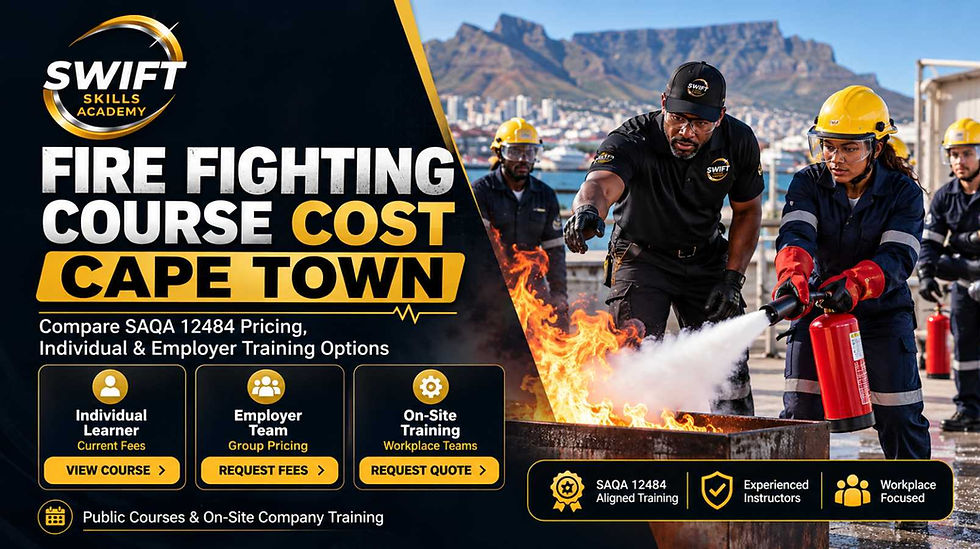
If you are comparing the cost of a fire fighting course in Cape Town, the cheapest number on a quotation is not necessarily the most important number.
Employers should understand what is included in the training, how many employees require coverage, whether practical training is included, how evidence will be issued, whether on-site delivery is appropriate and whether the training actually fits the workplace risk.
That is what determines whether fire fighting training becomes useful workplace preparation — or simply another certificate filed away.
Quick Answer: What Does a Fire Fighting Course Cost in Cape Town?
There is no single universal price for every Fire Fighting course in Cape Town.
The final cost can differ according to:
number of learners;
individual versus group booking;
public course versus on-site delivery;
practical training requirements;
venue requirements;
assessment and evidence requirements;
travel where applicable;
training materials;
certificate administration; and
whether several workplace-safety courses are being planned together.
For that reason, employers comparing quotations should ask what the quoted amount actually includes, rather than comparing only the lowest rand figure.
Swift Skills Academy provides Fire Fighting training for both individual learners and workplace teams in Cape Town.
Why Fire Fighting Training Prices Are Not Always Directly Comparable
Two providers may both advertise “basic fire fighting training”, but the quotations may represent different things.
An employer should establish whether the quotation covers:
Check | Why it matters |
Number of learners | Per-person and group economics can differ |
Practical component | Fire response cannot be treated as theory alone |
Assessment | Employers should know what evidence results from training |
Training materials | Determine whether learner material is included |
Certification | Confirm what evidence is issued |
Venue | Public and workplace delivery have different logistics |
Travel | May affect on-site quotation |
Equipment used | Practical requirements can affect delivery |
Course scope | Make sure you are comparing the same training outcome |
Administration | Important where HR or safety teams need evidence |
The question should therefore not simply be:
“Who has the cheapest Fire Fighting course?”
A more useful employer question is:
“Which quotation provides the training outcome, coverage and evidence our workplace actually needs?”
What Is SAQA Unit Standard 12484?
SAQA Unit Standard 12484 — Perform basic fire fighting is an NQF Level 2 unit standard carrying 4 credits.
Its stated purpose includes enabling qualifying learners to select and use appropriate fire-fighting equipment to extinguish or control workplace fires. The outcomes include understanding workplace fire procedures, selecting and checking appropriate equipment, assessing hazards, monitoring changes in fire conditions and retreating appropriately. SAQA
Importantly, the current SAQA record shows that the unit standard has passed its registration end date. Its registration end date was 30 June 2023, while the current record lists a last enrolment date of 30 June 2029 and a last achievement date of 30 June 2032. SAQA
That distinction matters.
An employer should not assume that seeing the number 12484 on marketing material tells them everything they need to know about the current programme, assessment route or quality-assurance arrangement.
Before booking, confirm exactly what programme is being offered and what evidence the learner will receive.
Is Fire Fighting Training Legally Required in South Africa?
There is no simple South African rule saying that every employee at every workplace must complete exactly the same Fire Fighting course.
The Occupational Health and Safety framework places broader duties on employers to provide and maintain a working environment that is safe and without risk to employees, as far as reasonably practicable.
The General Safety Regulations amended in March 2025 also include Regulation 13J dealing specifically with fire precautions and means of egress. Among other things, it addresses arrangements that support quick evacuation and requires attention to fire-fighting equipment. Government of South Africa
That does not mean every employee automatically requires SAQA 12484.
The practical employer question is:
What fire-response responsibilities exist at this workplace, and which employees need suitable information, instruction, training or competence to perform those responsibilities safely?
A Fire Extinguisher Is Not a Fire-Safety System
Employers sometimes focus heavily on buying and servicing extinguishers while giving much less attention to the people expected to respond.
A more complete system considers:
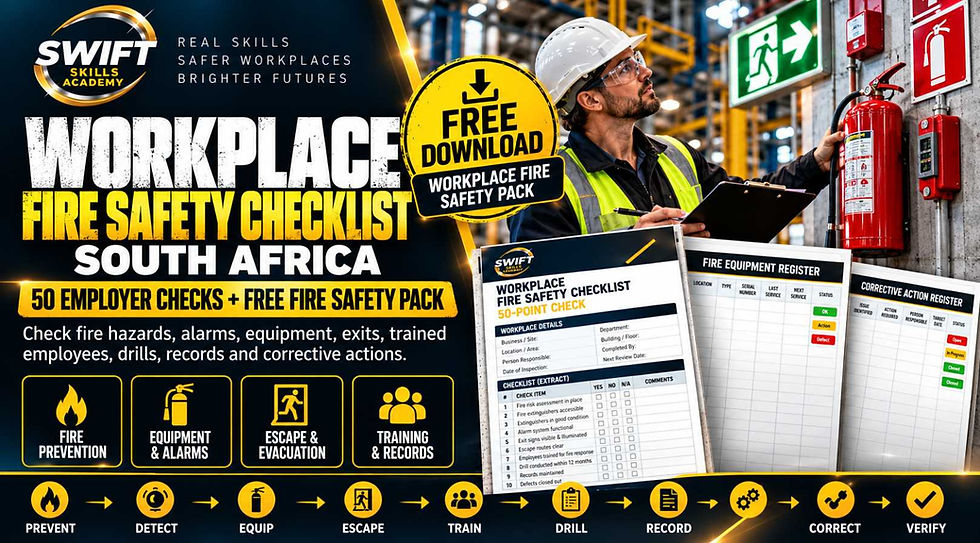
PREVENT → DETECT → EQUIP → ESCAPE → TRAIN → DRILL → RECORD → CORRECT → VERIFY
Cape Town's Fire and Rescue guidance states that commercial, industrial, healthcare and accommodation facilities must install and maintain appropriate fire-safety equipment, and it says fire equipment must be serviced at least annually. It also stresses the importance of staff being trained and equipped with knowledge to deal with a workplace fire emergency. Cape Town City Council
Routine visual workplace checks are still useful, but they do not replace professional servicing or competent technical work.
Use our Workplace Fire Safety Checklist for South African employers to review prevention, equipment, exits, training, drills, records and corrective actions.
What Are Employers Actually Paying For?
When a business buys fire fighting training, it is not merely purchasing classroom time.
A sound training decision may involve:
1. Learner preparation
Employees need to understand the basic principles behind workplace fire response.
2. Equipment awareness
Learners need to understand that different fire risks may require different equipment and different decisions.
3. Practical judgement
The most important decision may sometimes be not to fight the fire.
Smoke, heat, deteriorating visibility, an uncertain escape route or an escalating fire can turn attempted first response into a serious life-safety risk.
4. Assessment and evidence
Employers generally need proper training records for HR, SHE/OHS systems, client requirements or internal governance.
5. Operational coverage
One trained employee does not automatically create adequate workplace coverage.
Shifts, departments, buildings, leave, staff turnover and different risk areas all matter.
Individual Training vs Group Training: Which Costs Less?
There is no universal answer.
For one learner, joining a scheduled public programme may be the simplest option.
For a company training multiple employees, workplace or group delivery may become more practical because the organisation may be able to coordinate:
multiple learners;
common training dates;
departments;
shifts;
certificate administration;
travel and venue logistics; and
broader workplace-safety training.
The correct decision should be based on the total operational requirement rather than just the advertised price per person.
How Many Employees Should an Employer Train?
There is no responsible universal number.
The correct number depends on the workplace.
Consider:
number of employees;
operating hours;
number of shifts;
number of buildings or floors;
departments;
workplace layout;
fire hazards;
employee turnover;
leave and absenteeism;
assigned emergency roles; and
workplace-specific risk assessment.
Training one person simply because that employee was available on the day is poor workforce planning.
A more useful question is:
“If a fire starts on any normal shift, do we have suitable people available who understand their responsibilities?”
Public Course or On-Site Fire Fighting Training?
Public training can suit:
individuals;
small learner numbers;
employers sending one or two employees; and
organisations that can release staff individually.
On-site or team training may suit:
larger groups;
several departments;
shift-based businesses;
construction and industrial employers;
warehouses;
hospitality businesses;
manufacturing operations; and
companies trying to reduce employee travel and scheduling disruption.
The cheapest delivery method is not automatically the best one.
The best option is the one that provides appropriate training without unnecessarily disrupting operations.
Does a Fire Fighting Certificate Prove the Workplace Is Compliant?
No.
A training certificate is evidence relating to the learner's training or assessment.
It does not prove that:
the entire workplace complies with all applicable fire requirements;
extinguishers are correctly positioned or serviced;
exits are compliant;
the evacuation system is adequate;
every shift has sufficient trained coverage;
the risk assessment is complete;
fire doors or alarm systems are compliant; or
every workplace fire hazard has been controlled.
Training is one control within a larger fire-safety system.
That distinction is important for employers.
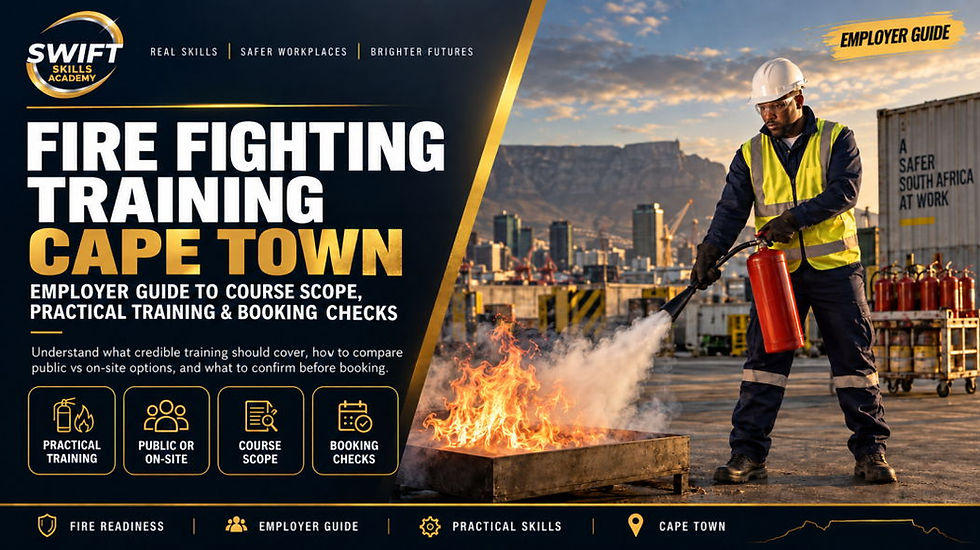
What Should Employers Check Before Accepting a Fire Fighting Training Quote?
Before approving a quotation, ask:
What exact programme is being delivered?
What learning outcomes are covered?
What practical activities are included?
What assessment is conducted?
What evidence will the learner receive?
How long does the programme run?
What is included in the quoted price?
Are there additional travel or venue charges?
Is the quotation for individual or group delivery?
Can training be delivered at the employer's workplace?
How should learner records be maintained?
How does the proposed training fit the employer's actual fire-response structure?
This gives procurement, HR and safety teams a much stronger basis for comparing providers.
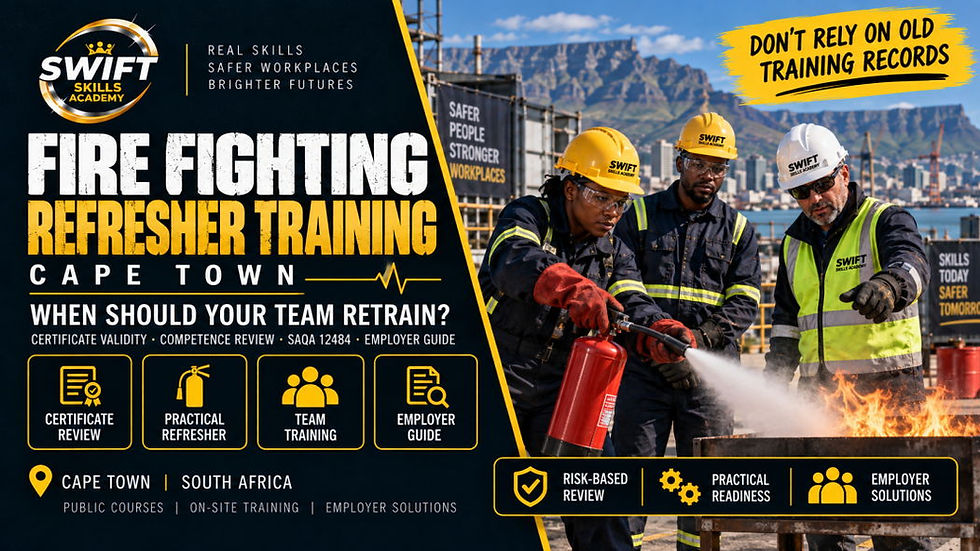
What About Fire Fighting Refresher Training?
This article should not attempt to own the refresher-training search intent anymore.
There is no sound basis for claiming that every workplace Fire Fighting certificate universally expires after one identical period.
Employers should consider competence, workplace risk, client requirements, internal procedures, changes in employees' responsibilities and any applicable programme or evidence requirements.
For the full topic, use the dedicated:
Fire Fighting Refresher Training Cape Town: When Should Your Team Retrain?
That keeps refresher intent on the article specifically engineered to own it.
Cost Mistakes Employers Commonly Make
Choosing only on price
A cheap quotation can become expensive if the employer later discovers that the training did not meet the actual requirement.
Training too few employees
Coverage fails when the only trained employee is absent.
Ignoring shifts
Day shift training does not automatically cover night operations.
Treating the certificate as the objective
The objective is safer workplace response.
Forgetting refresher planning
Training records should form part of a managed system rather than being rediscovered during an audit.
Ignoring wider fire readiness
Training cannot compensate for blocked exits, unsuitable equipment, poor housekeeping or uncontrolled fire hazards.
How Fire Fighting Training Fits Into Employer Safety Planning
Fire Fighting training may sit alongside other workplace-safety controls and training such as:
First Aid;
Basic Health and Safety;
Working at Heights;
Confined Spaces;
Scaffolding;
emergency procedures;
evacuation planning; and
workplace risk assessment.
Employers should build training around actual workplace exposures and assigned responsibilities, rather than collecting unrelated certificates.
When Should You Ask Swift Skills Academy for a Quote?
Request a current quotation when you know at least:
how many learners require training;
whether they are individuals or employees;
preferred dates;
whether you require public or workplace delivery;
where the workplace is located;
whether multiple shifts need coverage; and
whether other safety training is being planned at the same time.
Providing this information makes the quotation more useful from the start.
Frequently Asked Questions
How much does a fire fighting course cost in Cape Town?
The price depends on factors such as learner numbers, delivery format, practical requirements, venue, travel, assessment and certificate administration. Employers should request a current quotation rather than relying on an outdated advertised price.
Is SAQA 12484 still valid?
SAQA's current record lists Unit Standard 12484, Perform basic fire fighting, as having passed its registration end date of 30 June 2023. The record lists the last enrolment date as 30 June 2029 and the last achievement date as 30 June 2032. SAQA
What NQF level is SAQA 12484?
SAQA records Unit Standard 12484 at NQF Level 2 with 4 credits. SAQA
Does every employee need Fire Fighting training?
Not automatically. Employers should determine suitable fire-response responsibilities and training coverage according to workplace hazards, staffing, layout, shifts and applicable requirements.
Can an individual book Fire Fighting training?
Yes. Individual learners can review Swift Skills Academy's current Fire Fighting programme and available booking options.
Can companies book group Fire Fighting training?
Yes. Group or workplace delivery can be useful for employers training multiple employees, departments or shifts.
Is the cheapest Fire Fighting course the best option?
Price matters, but employers should compare the training scope, practical component, assessment, evidence, delivery method and whether the programme meets the workplace requirement.
Does a Fire Fighting certificate make a workplace fire compliant?
No. Training evidence relates to the learner. Overall workplace fire safety also depends on hazards, equipment, servicing, exits, emergency procedures, evacuation arrangements, drills and corrective action.
How often should Fire Fighting training be refreshed?
There is no responsible single answer for every workplace. Employers should review competence, risk changes, employee roles, internal policy, client requirements and relevant programme requirements.
Authoritative Sources & Official Guidance
Authoritative Sources & Official Guidance
Authoritative source | Why it matters |
Confirms the official unit standard title, NQF Level 2, 4 credits, purpose and current lifecycle dates, including registration end, last enrolment and last achievement dates. SAQA | |
Provides the overarching legal framework for employer duties relating to workplace health and safety in South Africa. Government of South Africa | |
Current national regulations containing Regulation 13J: Fire precaution and means of egress, including requirements relevant to evacuation, exits and workplace fire precautions. Government of South Africa | |
Provides Cape Town-specific guidance on fire equipment, workplace preparedness, staff training and servicing of fire-safety equipment. Cape Town City Council |
Recommended note directly below the table:
This article is an employer and learner information resource. Fire Fighting training is one part of a wider workplace fire-safety system and should be considered together with workplace-specific risk assessments, applicable legislation, municipal requirements, equipment servicing requirements and competent technical advice where necessary.
Read More
Recommended guide | Why read it |
Use the 50-point employer checklist to review fire prevention, equipment, exits, training, drills, records and corrective actions across the workplace. | |
Helps employers compare providers, understand training requirements, assess workplace coverage and check what evidence should be verified before booking. | |
Explains when employers should review fire-fighting competence, retraining needs, certificate age, workplace changes and refresher planning. |
Final Word
The cost of Fire Fighting training should not be reduced to a single advertised number.
For an individual, the key question may simply be whether the course delivers the training outcome required.
For an employer, the bigger questions are:
Who needs training? How many people? Which shifts? What evidence is required? What delivery method works operationally? And does the training fit into the wider workplace fire-safety system?
Compare scope, coverage and outcome first.
Then compare price.