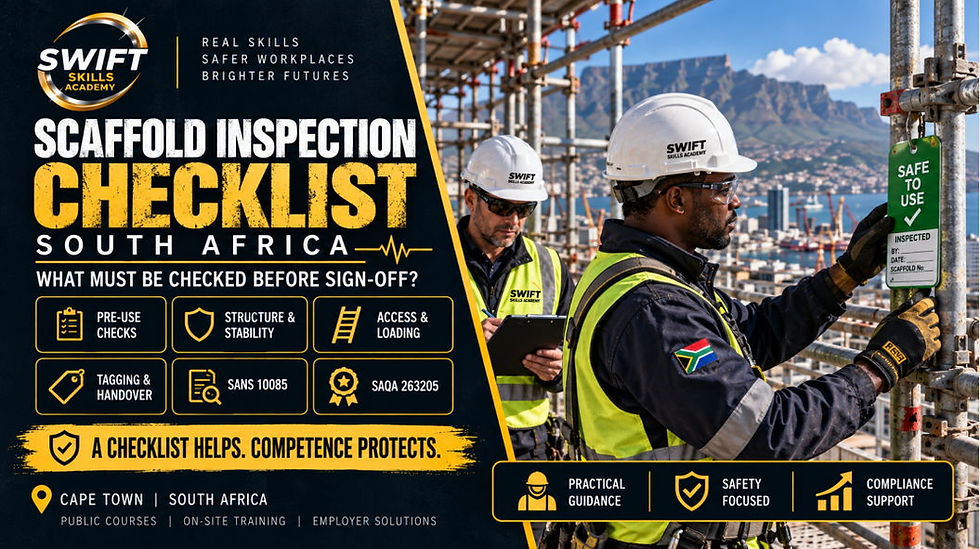
SANS 10085-1:2024 Scaffolding South Africa: Inspections, Competent Persons, Roles and Training
Updated: Sep 12

If your company uses access scaffolding, one question matters more than:
“Is the scaffold standing?”
The stronger question is:
“Can we prove that the people erecting, supervising, inspecting, handing over and using this scaffold are performing the correct roles under a controlled system?”
That is where SANS 10085-1:2024, the Occupational Health and Safety Act framework and South Africa's Construction Regulations become commercially important.
A scaffold can look complete and still leave an employer exposed if the responsibilities, competence, inspection evidence, modifications or handover process are weak.
For contractors, project managers and safety teams, this is therefore not simply a scaffolding question.
It is a people + competence + inspection + evidence + control question.
Quick Answer: What Does SANS 10085-1:2024 Mean for South African Contractors?
SANS 10085-1:2024 is the updated South African standard dealing with steel access scaffolding and working platforms across their design, erection, inspection, use, modification and dismantling lifecycle. Master Builders Association Western Cape reported that the new edition was published on 1 June 2024 to replace the previous code. (LinkedIn)
But there is an important distinction:
SANS 10085 is a national standard. The Construction Regulations are regulations under occupational health and safety legislation.
Construction Regulation 16 requires a contractor to appoint a competent person in writing to supervise scaffolding work and requires scaffold erectors, team leaders and inspectors to be competent. It also requires access scaffolding in use to comply with the safety standards incorporated for that purpose. (Acts Online)
So the practical employer question becomes:
Who is performing each scaffold role — and what evidence supports their competence?
The First Mistake: Calling SANS 10085 “Just Another Regulation”
The terminology matters.
SABS describes a South African National Standard as a published technical standard containing specifications or criteria designed for consistent use. (SABS)
Construction Regulation 16, on the other hand, is part of the regulatory framework under the Occupational Health and Safety Act.
For employers, however, the practical relationship between the two matters more than the terminology:
Regulation 16 creates scaffolding responsibilities, while the applicable incorporated safety standard informs the technical standard expected of access scaffolding.
That means a contractor should not treat SANS 10085 as a document that sits in an office while the scaffold team works from memory.
What Does Construction Regulation 16 Actually Require?
The scaffolding regulation is short — but commercially significant.
It places attention on two things:
1. Supervision and competence
A competent person must be appointed in writing to supervise scaffolding work operations, and scaffold erectors, team leaders and inspectors must be competent for their work.
2. The scaffold itself
Access scaffolding in use must comply with the safety standards incorporated for that purpose. (Acts Online)
Notice what the regulation does not say:
It does not say:
“Send everybody on the same scaffold course.”
It forces you to think about roles.
And that is exactly how employers should approach training.
What Does SANS 10085-1:2024 Cover?
At a high level, the standard addresses the lifecycle of steel access scaffolding and working platforms, including:
design;
erection;
inspection;
use;
modification;
and dismantling. (LinkedIn)
That lifecycle matters because a scaffold does not become permanently “safe” the moment erection is complete.
Conditions change.
People interfere with structures.
Components can be altered.
Work progresses.
Loads change.
Access changes.
And scaffolds may be modified.
A stronger scaffold-control system therefore asks:
Who erected it?
Who supervised the operation?
Who inspected it?
Was it handed over appropriately?
Has it subsequently been modified?
If it was modified, was the inspection status reconsidered?
That is a much stronger system than simply seeing a tag and assuming the problem is solved.
A Green Tag Is Not a Magic Shield
A green tag is useful within a properly controlled scaffold system.
But the colour of a tag does not create competence.
A form does not create competence.
A signature does not create competence.
And a checklist does not create competence.
The value comes from the person, process and evidence behind them.
Legacy SAQA Unit Standard 263205, Inspect access scaffolding, specifically includes inspecting and handing over access scaffolding. Its assessment criteria also refer to re-inspection of modified scaffolding. (SAQA)
That is why an employer should never ask only:
“Do we have a scaffold register?”
Ask:
“Who is making the judgement recorded in that register — and why are we satisfied that person is competent for that role?”
Scaffold Erector and Scaffold Inspector Are Not the Same Job
This distinction is one of the most commercially useful things an employer can understand.
Scaffold Erector
The erection role concerns the practical capability required to interpret instructions, coordinate resources and erect, use and dismantle access scaffolding.
SAQA Unit Standard 263245 — Erect, use and dismantle access scaffolding is recorded at NQF Level 3, 5 credits. The SAQA record identifies scaffold-erector functions and expressly references SANS 10085 within the learning outcomes. (SAQA)
Scaffold Inspector
The inspection role is different.
Legacy SAQA Unit Standard 263205 — Inspect access scaffolding is recorded at NQF Level 4, 6 credits. Its purpose includes understanding scaffold types, inspector responsibilities, interpreting drawings and specifications, and inspecting and handing over access scaffolding. (SAQA)
Do not send somebody on Scaffold Erector training and assume that automatically makes them a scaffold inspector.
Likewise, inspection training does not erase the competence requirements associated with the practical erection team.
Different responsibility.
Different evidence.
Different training decision.
Important 2026 Status: SAQA 263205 Has Reached Its Last Enrolment Date
This needs to be handled carefully in the redrafted article because the old wording is now too loose.
SAQA records Unit Standard 263205 as having passed its registration end date, with its last date for enrolment being 30 June 2026 and its last date for achievement being 30 June 2029. (SAQA)
Therefore, we should not advertise it casually as though new enrolment under the legacy unit standard continues indefinitely.
Swift Skills Academy should describe the course route as:
References legacy SAQA Unit Standard 263205 · NQF Level 4 · 6 Credits
and require prospective learners and employers to confirm the current training, assessment and certification pathway before enrolment.
That is stronger, safer and more credible than pretending nothing has changed.
SAQA 263245 Has a Different Transition Position
The SAQA record for 263245 — Erect, use and dismantle access scaffolding also shows that the unit standard has passed its registration end date.
However, its current SAQA record gives:
Last date for enrolment: 30 June 2029
Last date for achievement: 30 June 2032. (SAQA)
So employers should not assume that the Inspector and Erector legacy unit standards have identical transition dates.
They do not.
This is precisely why current programme confirmation matters before issuing training orders or building a company training matrix.
Which Scaffolding Training Does Each Person Need?
Use job responsibility first — not job title alone.
Actual responsibility | Training direction to investigate |
Erects, uses or dismantles access scaffolding | Scaffold Erector pathway |
Leads a scaffold erection team | Role-specific scaffold competence and employer appointment requirements |
Inspects access scaffolding | Scaffold Inspector pathway |
Supports inspection and handover | Scaffold Inspector pathway |
Works from scaffolding at height | Appropriate Working at Heights / fall-risk training according to the work performed |
Supervises contractors | Role-specific scaffold and supervisory competence |
Safety officer checks site evidence | Scaffold knowledge appropriate to their duties |
HR/SDF books training | Map actual jobs to required competence before purchasing courses |
Do not train randomly.
The commercial principle is:
Train according to role, risk and evidence — not according to whichever course name appears first on a price list.
Working at Heights Does Not Replace Scaffold Inspector Training
This mistake deserves its own section.
Someone can work at height without being responsible for inspecting a scaffold.
Someone can inspect access scaffolding without that training being identical to the practical competencies required of the erection team.
And an employee may need more than one training route because their actual duties overlap.
That is why a company training matrix should not simply contain:
“HEIGHTS — DONE.”
A stronger matrix asks:
Does this employee work at height?
Do they erect access scaffolding?
Do they lead the erection team?
Do they inspect access scaffolding?
Do they participate in handover?
Do they supervise the operation?
What evidence supports each responsibility?
That is a compliance conversation worth having before a project starts.
Need a Practical Scaffold Inspection Checklist?
Inspection systems fail when important checks live only in somebody's memory.
Swift Skills Academy has a practical Access Scaffolding Inspection Checklist that employers, supervisors and scaffold teams can use as a site-control aid.
FREE DOWNLOAD
No email gate. Print it.
Use it to strengthen conversations around scaffold condition, inspection evidence and handover.
Important: a checklist is an aid. It does not make an unqualified person competent and does not replace the applicable standard, legal duties, site-specific procedures or appropriate inspection competence.
For guidance on the inspection role:
What Should Contractors Be Able to Prove?
When a client, principal contractor, safety officer or auditor looks at scaffold controls, the strongest companies are not relying on verbal explanations.
They have a system.
Depending on the site and role, that system may include evidence such as:
Evidence area | Question the employer should be able to answer |
Appointment | Who supervises scaffolding work? |
Role allocation | Who are the erectors, team leaders and inspectors? |
Competence | What supports each person's competence for that role? |
Training records | Can certificates and training records be produced? |
Scaffold identification | Can the scaffold being discussed be clearly identified? |
Inspection | Who inspected it and what was recorded? |
Handover | How was the scaffold released into use? |
Defects | How are defects recorded and closed out? |
Modification | Who may modify the scaffold? |
Re-inspection | What happens after an alteration or modification? |
Training matrix | Does HR's training matrix match actual site responsibilities? |
The danger is not only having no paperwork.
It is having paperwork that does not match reality.
A beautiful training file is weak if the person doing the inspection is not the person whose competence the file supposedly proves.
Five Scaffold Control Failures That Should Trigger Immediate Questions
1. Nobody knows who the appointed scaffold supervisor is
If responsibility is vague, accountability is vague.
2. Erector and inspector responsibilities are treated as interchangeable
They are different functions.
3. The scaffold has changed since the last inspection
Legacy SAQA 263205 specifically recognises re-inspection of modified access scaffolding within its inspection outcomes. (SAQA)
4. The only evidence is “he has been doing scaffolding for years”
Experience can be highly valuable.
But an employer still needs to determine and document competence appropriately for the required role.
5. HR booked one scaffold course for everybody
That may be administratively convenient.
It may also be a poor competence strategy.
The Expensive Question Usually Comes After the Cheap Decision
Training decisions often look like this:
“Which scaffold course is cheapest?”
That is usually the wrong starting question.
For an employer, the real costs of the wrong training decision can include:
having the wrong person trained for the wrong role;
project delays;
repeat training;
weak client-audit evidence;
inability to substantiate competence;
inconsistent handover controls;
and unmanaged scaffold modifications.
The smarter question is:
“Which competence does this employee need for the responsibility we expect them to perform?”
Only after answering that should you compare course fees.
What Should a Safety Officer Check?
A safety officer does not need to personally perform every scaffolding function.
But they should be capable of identifying whether the scaffold-control system has obvious weaknesses.
A practical review should ask:
Who is supervising scaffolding operations?
Have scaffold responsibilities been allocated clearly?
Can competence evidence be produced?
Are inspection and handover records controlled?
How are defects dealt with?
Who may authorise modification?
What happens after modification?
Do training records match people's actual responsibilities?
Are Working at Heights and scaffold-role training being incorrectly treated as interchangeable?
That last question catches a surprising amount of weak training planning.
What Should HR and the SDF Check?
Scaffold compliance does not begin and end on the construction site.
Someone must control the competence evidence.
For HR and Skills Development Facilitators, a useful scaffold training matrix can include:
Employee
Job title
Actual scaffold responsibility
Erector / inspector / user / supervisor role
Training completed
Training route / standard reference
Certificate or assessment evidence
Date
Current pathway/status confirmation
Refresher or reassessment planning where applicable
Proof location
Responsible manager
This converts training from a pile of certificates into a workforce-control system.
What About the Draft Construction Regulations 2025?
Do not accidentally publish the draft as though it is already the operative replacement law.
The Department of Employment and Labour published Draft Construction Regulations 2025 for public comment, stating that they were intended to replace the Construction Regulations 2014. (Department of Labour)
The Department was still describing them as draft regulations undergoing public engagement in May 2025 and explicitly referred to them taking effect once promulgated. (Department of Labour)
The Department's 2025 promulgated-regulations page lists other regulations but not final Construction Regulations 2025. (Department of Labour)
Therefore, until an authoritative final promulgation is confirmed, employers should not rewrite their scaffold compliance system on the assumption that a draft has already replaced the 2014 regulations.
Always confirm the latest legal position for your specific project when compliance decisions are being made.
Contractor Scaffold Training Decision Table
If this describes your employee... | Investigate this route first |
Physically erects and dismantles access scaffolding | Scaffold Erector |
Leads erection activities | Scaffold role / team-leader competence appropriate to duties |
Inspects access scaffolding | Scaffold Inspector |
Supports inspection and handover | Scaffold Inspector |
Works from scaffolding at height | Working at Heights / fall-risk route as applicable |
Has mixed responsibilities | Conduct role assessment before booking |
Employer needs a group programme | Request company training quotation |
Unsure what certificates actually mean | Ask Swift Skills Academy to review the training requirement first |
Don't Buy Scaffold Training Until You Can Answer These Questions
Before requesting a quote, tell the training provider:
What does the employee actually do?
Do they erect?
Inspect?
Lead a scaffold team?
Work from scaffolding?
Supervise contractors?
Sign or support handover?
What training do they already hold?
What does the client or project require?
Is this for one learner or an employer group?
That information can prevent an employer from buying the wrong course.
Don't train everybody on the same course. Train the right people for the responsibilities they actually perform.
Frequently Asked Questions About SANS 10085
Scaffolding in South Africa
Is SANS 10085-1:2024 a South African scaffolding standard?
Yes. SANS are South African National Standards maintained through the national standards system, and SANS 10085-1:2024 is the updated standard relevant to steel access scaffolding and working platforms. (SABS)
What does Construction Regulation 16 say about scaffolding?
Regulation 16 requires a contractor to appoint a competent person in writing to supervise scaffolding operations, to ensure scaffold erectors, team leaders and inspectors are competent, and to ensure access scaffolding in use complies with the incorporated safety standards. (Acts Online)
Is a Scaffold Erector the same as a Scaffold Inspector?
No. SAQA 263245 addresses erection, use and dismantling responsibilities, while legacy SAQA 263205 addresses access-scaffold inspection and handover competencies. (SAQA)
Is SAQA 263205 still open for new enrolments?
The SAQA record gives 30 June 2026 as the last date for enrolment and 30 June 2029 as the last date for achievement. Prospective learners should therefore confirm the current training, assessment and certification pathway before enrolment. (SAQA)
What are the current dates for SAQA 263245?
SAQA currently records 30 June 2029 as the last date for enrolment and 30 June 2032 as the last date for achievement. (SAQA)
Does Working at Heights replace Scaffold Inspector training?
No. Working at Heights and scaffold inspection address different competencies. The correct training depends on the person's actual role and responsibilities.
Does a scaffold checklist make someone competent to inspect scaffolding?
No. A checklist can support a controlled inspection process, but the document itself does not create competence.
Must scaffolding be reconsidered after it has been modified?
Modification is important because an inspection made before a subsequent alteration cannot simply be assumed to describe the changed scaffold. Legacy SAQA 263205 specifically includes re-inspection of modified access scaffolding in its assessment criteria. (SAQA)
You May Also Want to Read Further
Resource | Why it matters |
Scaffold Inspector Course Cape Town | Inspection responsibilities, handover and current pathway guidance |
Scaffold Erector Course Cape Town | Erection, use and dismantling training route |
Working at Heights Training Cape Town | Fall-risk capability for relevant workers |
Scaffold Inspection Checklist South Africa | Practical scaffold inspection aid |
SAQA 263245 Scaffold Erector Explained | Deeper explanation of the legacy unit-standard route |
Basic Health & Safety Course Cape Town | Broader workplace safety knowledge |
OHSA Compliance Course Cape Town | Wider OHS legislative and workplace-compliance context |
Use these links:
Resource | Link |
Scaffold Inspector | |
Scaffold Erector | |
Working at Heights | |
Scaffold Inspection Checklist Guide | |
SAQA 263245 Explained | |
Basic Health & Safety | |
OHSA / SHE Compliance |
Contact Swift Skills Academy
Swift Skills Academy
6 Monaco Road, Killarney Gardens, Cape Town
Tel: 021 828 0772WhatsApp: +27 60 998 7412
Need help deciding which scaffold training applies to your employees?
Sources
Source | What It Supports |
Official qualification-record information on the scaffold inspector unit standard, including NQF level, credits, enrolment and achievement dates, and learning outcomes. | |
Official scaffold-erector unit-standard information, including current transition dates and the scope of erection, use and dismantling responsibilities. | |
Confirms that the 2025 Construction Regulations were issued as draft regulations intended to replace the Construction Regulations 2014. | |
Explains the role and nature of South African National Standards and the function of SABS within the national standards framework. | |
Industry notice identifying the June 2024 SANS 10085-1 update and its scaffold lifecycle scope, including design, erection, inspection, use, modification and dismantling. |