Welding and Fabrication Training in South Africa: Skills, Courses and Career Pathways
QUICK ANSWER: Welding And Fabrication Training In South Africa
Welding and fabrication training in South Africa should teach more than how to produce a weld. A capable fabrication worker may need to understand measurement, drawings, marking out, cutting, grinding, joint preparation, fit-up, tacking, welding, distortion control, inspection and safe workshop practices.
There is no single universal “welding and fabrication course” that provides the same outcome at every training provider. Course scope, practical hours, welding processes, assessment and certification can differ substantially.
The correct training route therefore depends on what you need to become able to do, not simply on the name printed on the course brochure.
Welding and fabrication training at a glance
Your goal | Skills likely to matter |
Start from zero | Safety, tools, measurement, cutting, joint preparation, basic welding |
Become useful in a fabrication workshop | Drawings, marking, cutting, fit-up, tacking, welding, finishing |
Improve production welding | Process control, preparation, positions, quality and repeatability |
Work with structural steel | Measurement, drawings, fit-up, welding sequence, fabrication accuracy |
Progress into pipe welding | Joint preparation, fit-up, positional welding and process control |
Develop advanced welding | MIG, TIG, SMAW, FCAW or specialist process development |
Formalise existing experience | Assessment, gap training, ARPL or applicable artisan pathway |
Train an existing workforce | Skills-gap assessment, process-specific development and workplace training |
A person can weld reasonably well and still struggle in fabrication if they cannot accurately prepare, fit and assemble the components before welding begins.
That distinction matters.
What Is Welding and Fabrication Training?
Welding is the process of joining materials using a controlled welding process.
Fabrication is broader.
Metal fabrication may involve transforming raw plate, pipe, section or other metal stock into a finished component, assembly or structure.
Depending on the job, that can involve:
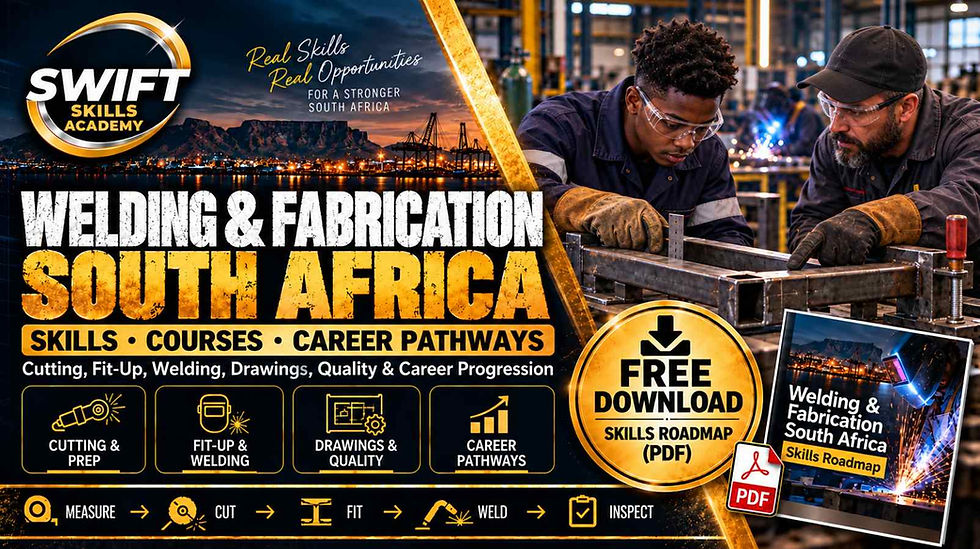
DRAWING → MEASURE → MARK → CUT → PREPARE → FIT → TACK → WELD → INSPECT → FINISH
The weld is therefore one stage inside a larger manufacturing process.
This is why practical welding training and practical fabrication training overlap so heavily.
The Southern African Institute of Welding currently describes practical welders as workers who interpret engineering drawings, select and adjust welding equipment, and use cutting and grinding techniques to prepare joints. Its 2026 practical-training material includes SMAW, GMAW, GTAW and FCAW among the commonly taught processes. SAIW
A strong training programme should therefore help the learner understand not only:
“How do I weld this joint?”
but also:
“What am I making, what dimensions must it meet, how should the pieces fit together and what must happen before and after welding?”
Welding vs Fabrication vs Boilermaking: What Is the Difference?
These terms overlap, but they are not interchangeable.
Area | Main emphasis |
Welding | Producing welded joints using defined welding processes |
Fabrication | Converting material into components or structures through measuring, cutting, shaping, fit-up, joining and finishing |
Boilermaking | An artisan trade involving fabrication and repair of structural steel, vessels, pipe systems and other metal products |
Coded welding | Demonstrating welding performance within a specific qualification/test range |
Welding inspection / quality | Evaluating whether work meets the applicable drawing, procedure, specification or acceptance requirement |
South Africa's current National Occupational Certificate: Boilermaker, SAQA ID 123381, is an NQF Level 4 qualification with 540 credits. SAQA describes the occupation as marking off and fabricating structural steel and other profiles to make or repair metal products and structures, including pipes and pressure-vessel-related work. SAQA
That does not mean an ordinary welding-and-fabrication short course automatically makes someone a qualified boilermaker.
It means fabrication skills form part of a much broader occupational landscape.
What Should a Steel Fabrication Course Actually Teach?
The phrase steel fabrication course can describe very different programmes.
A useful course should make its practical scope explicit.
Measurement, Marking and Drawing Interpretation
Before cutting steel, the learner needs to establish what must be made.
That can involve:
dimensions;
angles;
hole locations;
plate thickness;
pipe or section size;
component orientation;
drawing revision;
joint location;
fabrication tolerances;
weld-symbol information.
A fabrication worker who misreads a dimension can produce a beautifully welded component that is still unusable.
Drawing interpretation therefore belongs upstream of welding.
SAIW specifically notes that welders working with fabrication drawings must be able to interpret welding information so that they can prepare the joint and produce the required weld. SAIW
Cutting, Grinding and Joint Preparation
A welding machine cannot correct badly prepared material.
Fabrication work commonly requires skills such as:
safe use of hand and power tools;
controlled cutting;
grinding;
deburring;
removing contamination;
edge preparation;
bevel preparation;
cleaning tack areas;
dressing completed welds.
Poor preparation can affect alignment, penetration, fit-up and the quality of the finished assembly.
Fit-Up and Tacking
This is one of the biggest differences between simply practising beads and actually fabricating something.
Before final welding, components may need to be:
positioned;
aligned;
clamped;
spaced;
checked against dimensions;
tack welded;
rechecked before final welding.
A poor fit-up creates problems before the final weld begins.
Welding Process Control
The learner then needs sufficient practical development in the welding process required for the work.
That includes more than switching the machine on.
Competence develops through controlling:
arc or torch position;
travel speed;
heat;
electrode or wire manipulation;
joint angle;
bead placement;
root and fill behaviour where relevant;
welding position;
repeatability.
Inspection, Finishing and Correction
The job does not necessarily end when the arc stops.
A learner should understand the difference between:
an attractive-looking weld;
a dimensionally correct fabrication;
and work that actually satisfies the applicable requirements.
Practical development can therefore include visual checking, dimensional verification, finishing, defect awareness and knowing when work requires correction or escalation.
Which Welding Processes Are Used in Fabrication?
The correct welding process depends on the material, joint, thickness, position, production environment and required outcome.
Stick Welding / SMAW
Shielded Metal Arc Welding is widely used for practical welding development and can be useful in structural, maintenance and site-related work.
It develops fundamental skills in:
arc control;
electrode handling;
bead placement;
joint preparation;
positional technique.
MIG / GMAW
Gas Metal Arc Welding is commonly associated with production and fabrication environments where wire-fed welding can support relatively efficient deposition and repeatability.
Learners still need to understand:
machine setup;
wire selection;
shielding gas;
travel speed;
torch control;
joint preparation;
defect recognition.
“MIG is easy” is a poor training philosophy.
Making an arc is easier than consistently producing acceptable fabrication.
TIG / GTAW
TIG is commonly associated with controlled, precise welding and materials or applications where cleanliness and heat control are especially important.
It demands coordination between:
torch control;
filler addition;
heat input;
cleanliness;
joint preparation.
Flux-Cored Arc Welding / FCAW
FCAW can be relevant to structural and higher-deposition applications.
As with every process, suitability depends on the actual production requirement rather than the learner simply wanting the process that sounds most advanced.
Gas Processes and Thermal Cutting
Oxy-fuel equipment may be used for cutting, heating, joint preparation and selected welding/brazing applications.
Plasma cutting and other cutting processes can also form part of fabrication workflows.
The important principle is:
Do not choose a welding process in isolation from the fabrication job it must perform.
The Fabrication Workflow: From Drawing to Finished Component
A strong welding-and-fabrication learner should understand the workflow as a connected system.
Stage | Main question |
1. Drawing / instruction | What must be manufactured? |
2. Material identification | What am I working with? |
3. Measurement | What dimensions must be achieved? |
4. Marking out | Where must I cut, drill, form or join? |
5. Cutting | How should the material be separated safely and accurately? |
6. Edge preparation | What joint preparation is required? |
7. Fit-up | Are the parts correctly positioned and aligned? |
8. Tacking | Can the assembly be stabilised without losing alignment? |
9. Welding | Which process, sequence and technique applies? |
10. Inspection | Does the work meet the relevant visual and dimensional requirements? |
11. Finishing | What cleaning, grinding or finishing is required? |
12. Handover / next operation | Is the component ready for the next production stage? |
This is the section that separates a real fabrication-training guide from a generic welding-process article.
What Does Good Welding Skills Training Look Like in a Fabrication Workshop?
Good welding skills training should produce observable improvements.
The learner should progressively become better able to:
Competence | What improvement looks like |
Measurement | Fewer dimensional mistakes |
Marking out | Clearer, more accurate preparation |
Tool use | Safer and more controlled cutting/grinding |
Joint preparation | More consistent fit-up |
Tacking | Better alignment before final welding |
Welding | Greater repeatability |
Position control | Improved welding outside the easiest position |
Drawing interpretation | Fewer assumptions about component geometry |
Defect awareness | Earlier recognition of poor work |
Workshop discipline | Better safety, housekeeping and equipment care |
Training should not be judged only by:
“Did the learner receive a certificate?”
A better question is:
“What can the learner now perform more safely, accurately and consistently than before?”
Which Welding and Fabrication Training Route Fits Your Starting Point?
Different learners should not be placed into the same programme.
Starting point | Better route to investigate |
Never welded before | Engineering tools, cutting and foundational welding |
Basic workshop exposure | Beginner process-specific welding |
Some MIG experience | Practical assessment + targeted MIG development |
Stick welder wanting broader options | MIG, FCAW, TIG or positional progression |
Fabricator struggling with welding quality | Process-specific gap training |
Welder struggling with fit-up and prep | Tools, cutting, drawings and fabrication fundamentals |
Plate welder moving into pipe | Pipe preparation and positional welding development |
Experienced worker without formal recognition | Assessment / ARPL investigation |
Artisan candidate | Applicable trade-test pathway and preparation |
Employer with inconsistent workforce skills | Skills-gap assessment + targeted company training |
The goal is not to collect the greatest number of course certificates.
The goal is to close the actual competence gap.
How to Choose a Welding and Fabrication Course in South Africa
Do not compare providers using the course title alone.
Ask for written answers to these questions:
Question | Why it matters |
What exact skills are taught? | “Fabrication” can mean very different things |
How much practical workshop time is included? | Practical competence requires repetition |
Which welding processes are covered? | MIG, TIG, Stick and FCAW are not interchangeable |
Which materials and thicknesses are used? | Practice should match the intended work |
Does training include cutting and grinding? | Fabrication begins before welding |
Does it include drawings and measurement? | Accuracy depends on more than welding technique |
Is fit-up and tacking practised? | Assembly quality affects final welding |
How is practical competence assessed? | Completion alone does not prove the same thing as assessment |
What certificate or record is issued? | Different documents represent different outcomes |
What does the full fee include? | Materials, gas, consumables and assessment can change total cost |
What progression route follows? | Training should connect logically to the learner's goal |
The cheapest programme can become expensive if the learner later discovers that the course did not include the practical skills they assumed it did.
Likewise, a longer course is not automatically better.
The correct question is:
Does the training content match the capability I need to build?
Short Course, Occupational Qualification, Coded Welding or Red Seal?
These pathways should never be collapsed into the word “certificate.”
Route | Main purpose |
Practical short course | Develop defined skills |
Competency assessment | Establish what the learner can currently do |
Occupational qualification | Complete a formally registered occupational programme |
Coded-welder qualification/testing | Demonstrate welding performance within a defined test scope |
ARPL | Seek recognition of existing occupational competence |
Trade test / Red Seal | Formal artisan-recognition pathway |
Occupational Certificate: Welder — SAQA ID 94100
SAQA records the Occupational Certificate: Welder as an NQF Level 4 qualification worth 373 credits.
There is an important 2026 transition issue.
SAQA shows:
registration end date: 30 December 2025;
last date for enrolment: 30 December 2026;
last date for achievement: 30 December 2029. SAQA
That means somebody looking for formal occupational-welder training in late 2026 should verify the exact qualification, provider scope, learner-registration route and current availability before paying.
Do not rely on an old website simply because it still displays the qualification name.
National Occupational Certificate: Boilermaker — SAQA ID 123381
SAQA currently records the newer National Occupational Certificate: Boilermaker, SAQA ID 123381 at NQF Level 4 with 540 credits. It replaced the earlier Occupational Certificate: Boilermaker 93626. SAQA
This distinction is particularly important for people searching terms such as:
steel fabrication course, boilermaker course, metal work course or welding and fabrication course.
Those searches do not necessarily describe the same qualification or career outcome.
A short fabrication programme must not be marketed as though it automatically equals a full boilermaker artisan pathway.
Does a Welding and Fabrication Course Make You a Qualified Boilermaker?
No.
A short welding and fabrication course can develop useful skills used in fabrication and boilermaking environments.
It does not automatically confer artisan status.
Likewise:
welding training does not automatically make someone Red Seal;
a fabrication certificate does not automatically make someone a boilermaker;
coded-welder testing does not automatically create artisan status;
years of experience do not automatically create formal recognition.
Always ask:
What is the exact outcome of this programme?
Welding and Fabrication Career Pathways in South Africa
The combination of welding and fabrication skills can support progression into several types of work.
Possible directions include:
assistant welder;
fabrication assistant;
production welder;
structural welder;
maintenance welder;
MIG or FCAW production welding;
TIG welding;
pipe welding;
coded welding;
boilermaker-development pathways;
workshop fabrication;
quality and inspection progression;
supervisory or coordination roles after sufficient experience.
Training does not guarantee employment.
Employers can require different levels of competence, experience, qualifications, medical fitness, site access, welding tests or project-specific certification depending on the work.
The useful question is therefore not:
“Which welding course guarantees a job?”
It is:
“Which measurable skills does the type of employer I am targeting actually need?”
What Employers Should Look for in Welding and Fabrication Training
Employer training should begin with the production problem.
For example:
Problem: poor fit-up Training need: measurement, preparation, clamping and tacking
Problem: excessive rework Training need: process control, preparation and defect awareness
Problem: employees cannot follow drawings Training need: drawing interpretation and fabrication workflow
Problem: inconsistent MIG welding Training need: process-specific practical development
Problem: experienced workers have unknown skill levels Training need: competency assessment before training
Problem: unsafe grinder or cutting practices Training need: tools, cutting and workshop-safety development
The best employer programme is not necessarily the longest programme.
It is the one that closes the verified skills gap.
Seven Welding and Fabrication Training Mistakes That Waste Time and Money
1. Choosing the Course by Name
“Advanced fabrication” can sound impressive while saying almost nothing about what will actually be practised.
2. Treating Welding and Fabrication as the Same Skill
Welding is crucial, but preparation, measurement and fit-up can determine whether the final component is usable.
3. Skipping Cutting and Grinding Fundamentals
A learner who cannot prepare a joint consistently will struggle to produce consistent fabrication.
4. Starting With an Advanced Welding Process Too Soon
Pipe, positional or specialist welding does not replace fundamental control.
5. Ignoring Drawings
A good weld in the wrong location is still wrong.
6. Assuming Every Certificate Has the Same Status
Short-course completion, occupational qualifications, trade certificates and coded-welder qualification are different outcomes.
7. Choosing Training Only by Price
The correct comparison is:
TOTAL COST + PRACTICAL SCOPE + ASSESSMENT + OUTCOME + PROGRESSION
not:
CHEAPEST ADVERTISED FEE
Frequently Asked Questions
What is welding and fabrication training?
Welding and fabrication training develops the skills used to prepare, assemble and join metal components. Depending on the programme, this can include measurement, drawing interpretation, cutting, grinding, joint preparation, fit-up, tacking, welding, inspection and finishing.
Is welding the same as fabrication?
No. Welding is one joining process used within fabrication. Fabrication can also include measuring, marking out, cutting, shaping, drilling, fit-up, assembly and finishing.
What does a welding and fabrication course include?
There is no universal course syllabus. Ask the provider exactly which tools, processes, materials, welding positions, fabrication tasks, assessments and certification outcomes are included.
What should a steel fabrication course teach?
A useful steel fabrication course may cover drawing interpretation, measurement, marking out, cutting, grinding, preparation, fit-up, tacking, welding, dimensional checking and safe workshop practices. The exact scope should be confirmed before enrolment.
Do I need Matric for welding and fabrication training?
Not every practical short course requires Matric. Formal occupational qualifications have their own entry requirements. Always check the exact programme rather than assuming one admission rule applies to all welding and fabrication training.
Which welding process is best for fabrication?
There is no universally best process. SMAW, MIG/GMAW, TIG/GTAW and FCAW serve different applications. Process selection depends on material, thickness, joint, position, production environment and the required outcome.
Is MIG good for fabrication work?
MIG/GMAW is widely used in production and fabrication environments, but the learner still needs correct setup, preparation, torch control, travel speed, shielding and defect awareness.
Do fabricators need to read drawings?
Drawing interpretation is highly relevant because fabrication depends on correct dimensions, component orientation, joints, material information and welding instructions. SAIW specifically identifies engineering-drawing interpretation as a relevant practical welding skill. SAIW
Is a metal work course the same as welding and fabrication training?
Not necessarily. “Metal work” is a broad description that can include cutting, shaping, assembly, forming, welding or other workshop skills. Compare the actual practical syllabus rather than relying on the course title.
Does a welding and fabrication course make me a boilermaker?
No. Practical fabrication training can develop skills relevant to boilermaking, but a short course does not automatically provide a full occupational qualification or artisan status.
Does welding and fabrication training make me Red Seal?
No. Red Seal artisan recognition involves the applicable trade pathway and successful trade test. Ordinary short-course completion is not the same outcome.
Can an experienced welder skip beginner training?
Possibly. An experienced welder may benefit from a competency assessment before being placed into additional training. The purpose is to identify genuine skills gaps rather than automatically repeating content already mastered.
Can companies arrange welding and fabrication training for employees?
Yes, depending on the programme, workforce needs, equipment, facilities and training objective. Employer training should ideally begin with a skills-gap assessment so that training addresses the actual production or competence problem.
Authoritative Sources & Regulatory References
Authoritative Source | What It Supports |
Occupational-welder qualification purpose, NQF level, credits and current registration/enrolment transition dates | |
Current boilermaker qualification, purpose, NQF level, credits and replacement status | |
Practical welding processes, training context and welder-performance development | |
Fabrication drawings, welding symbols and joint-information interpretation | |
General South African workplace health-and-safety legislative framework |
The OHS Act's stated purpose includes protection of people at work in connection with plant and machinery, which is directly relevant to the workshop environment in which fabrication training takes place. Government of South Africa
Read More
Read More | Why Read It |
Learn how drawings, dimensions, weld symbols, revisions and WPS requirements connect to fabrication work | |
Understand cutting, grinding, joint preparation and tool skills used before welding | |
Check entry requirements, practical readiness and the differences between beginner, advanced and formal pathways |
Final Word
Strong fabrication starts before the welding arc is struck.
The worker first needs to understand the job, measure correctly, prepare the material, control the fit-up and select the correct process.
Then the welding must be repeatable.
Then the finished fabrication must be checked.
That is why the strongest welding and fabrication training does not treat welding as an isolated skill.
It develops a connected pathway:
UNDERSTAND → PREPARE → FIT → WELD → CHECK → IMPROVE
The right programme is the one that closes the gap between what you can do today and what the workshop, employer, assessment or career pathway requires you to do next.