Fire Drill Checklist South Africa: Workplace Evacuation Drill Guide + Free PDF
This is the format I’d use consistently for the entire Fire Safety cluster going forward.
A workplace fire drill should answer a much more important question than:
“Did everybody leave the building?”
It should tell the employer whether the emergency system actually works.
Could employees hear or recognise the alarm?
Did people know which route to use?
Were exits clear?
Did Fire Wardens understand their responsibilities?
Were visitors and contractors considered?
Could everybody be accounted for at the assembly point?
Were problems recorded?
And most importantly:
Were those problems actually corrected afterwards?
That is what turns a fire drill checklist South Africa from a calendar exercise into a meaningful workplace safety test.
Quick Answer: What Should a Workplace Fire Drill Check?
A useful workplace fire drill should test at least six things:
Alarm and communication
Evacuation behaviour
Escape routes and exits
Fire Warden or emergency-role performance
Assembly-point accountability
Corrective action after the drill
A strong drill process therefore looks like:
PLAN → ACTIVATE → EVACUATE → ACCOUNT → OBSERVE → CORRECT → VERIFY
South Africa's General Safety Regulations address fire precautions and means of egress, including workplace evacuation considerations, escape routes and firefighting equipment.
The purpose of a drill should therefore go beyond simply getting employees outside.
It should test whether the workplace can evacuate quickly, safely and in an organised manner.
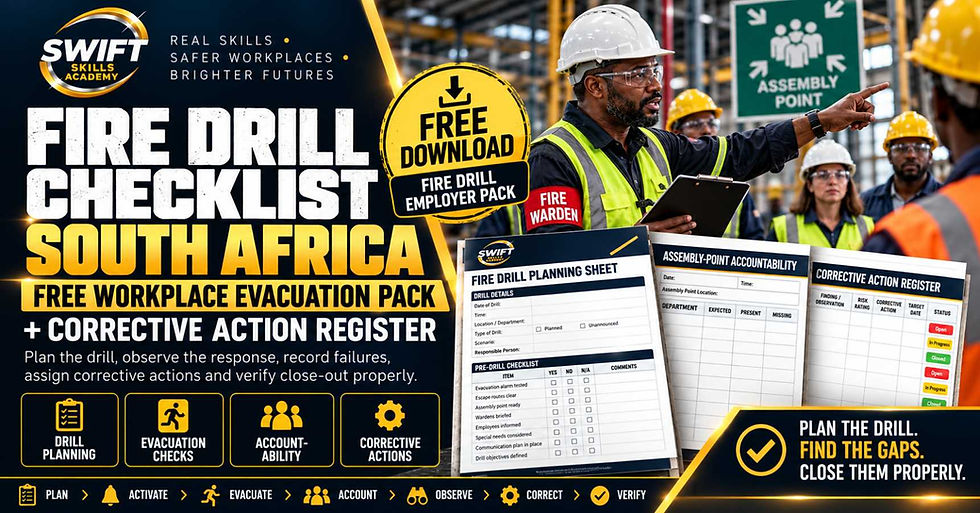
Free Fire Drill Checklist PDF for South African Employers
Swift Skills Academy has created a practical:
Workplace Fire Drill Planning, Observation & Corrective Action Pack
The downloadable employer pack can be used to help plan, observe and review a workplace fire drill.
It includes:
fire drill planning sheet;
pre-drill readiness checklist;
Fire Warden and emergency-role coverage;
observer allocation sheet;
alarm and communication check;
evacuation observation checklist;
escape route and exit review;
assembly-point accountability;
visitor and contractor considerations;
evacuation timing;
Fire Warden performance review;
fire drill report template;
corrective-action register;
training-gap assessment;
management verification;
and follow-up drill records.
The most important question comes after the drill:
What did the drill reveal that the employer now needs to fix?
Why Should Employers Conduct Fire Drills?
A written emergency plan is useful.
But a document cannot tell an employer whether people will respond correctly when the alarm actually sounds.
A drill tests the difference between:
WHAT THE PROCEDURE SAYS
and
WHAT PEOPLE ACTUALLY DO
That difference can be significant.
A drill may reveal:
employees who do not recognise the alarm;
people attempting to collect personal belongings;
uncertainty over assembly points;
blocked escape routes;
incorrect route selection;
Fire Wardens who do not know their assigned area;
visitors being forgotten;
poor accountability;
communication failures;
people attempting to re-enter;
and managers assuming somebody else is responsible.
Those failures are valuable information — provided they are acted on.
Are Fire Drills Required in South Africa?
Employers should be careful with blanket statements such as:
“Every South African workplace must perform exactly X fire drills every year.”
Fire-safety requirements can arise from several sources, including:
occupational health and safety requirements;
building requirements;
municipal fire-safety provisions;
industry requirements;
client requirements;
site rules;
workplace risks;
and emergency procedures.
At national level, the General Safety Regulations address fire precautions and means of egress.
Municipal requirements can also apply.
For example, Cape Town has provisions dealing with emergency evacuation planning and drills.
Those local requirements should not automatically be presented as a universal national frequency for every South African workplace.
Employers should determine what applies to their particular:
municipality;
building;
occupancy;
sector;
site;
client;
insurer;
and workplace risk profile.
How Often Should a Workplace Conduct a Fire Drill?
The appropriate frequency may depend on the workplace and the requirements that apply to it.
Factors that may justify more frequent drills include:
high staff turnover;
shift work;
large or complex premises;
hazardous processes;
previous poor drill performance;
changed layouts;
new employees;
contractors or public visitors;
employees needing evacuation assistance;
emergency-role changes;
new alarm systems;
and significant workplace changes.
A drill calendar should not be treated as:
“We did one, therefore we are finished.”
The objective is emergency readiness.
Fire Drill Checklist: Before the Drill
Good drills begin before the alarm is activated.
1. Define the Purpose of the Drill
Decide what the employer is actually testing.
Possible objectives include:
overall evacuation;
a new assembly point;
a changed emergency route;
night-shift response;
Fire Warden performance;
accountability;
emergency communications;
or response from a specific department.
Without an objective, the employer may have no meaningful standard against which to evaluate the result.
2. Confirm the Emergency Procedure
Before running a drill, verify that the procedure reflects the current workplace.
Check:
☐ Emergency routes are current
☐ Assembly points are current
☐ Responsible people are still employed
☐ Work areas have not changed
☐ New hazards have been considered
☐ Emergency contact details are current
☐ Shift arrangements are reflected
☐ Visitors and contractors are considered
3. Confirm Fire Warden Coverage
A Fire Warden list does not necessarily mean the workplace has effective coverage.
Ask:
Which department is each person responsible for?
Which floor or work area?
Which shift?
Who covers annual leave?
Who covers sickness?
Who covers nights or weekends?
Who performs accountability?
Who communicates with emergency services?
This is why employers should review actual coverage, not merely appointment letters.
4. Identify People Who May Need Assistance
Evacuation planning should account for people who may require additional support.
This could include:
employees with mobility limitations;
temporary injuries;
visitors unfamiliar with the premises;
elderly occupants;
learners;
or anyone requiring assistance under the workplace emergency arrangements.
The objective is to plan assistance before an emergency rather than improvising during one.
5. Check Escape Routes Before Starting
A drill should never knowingly create an unsafe evacuation.
Check:
☐ Passages are unobstructed
☐ Exit doors are usable
☐ Stairways are clear
☐ Escape routes do not terminate in unsafe areas
☐ Emergency exits are accessible
☐ Assembly point is usable
☐ Dangerous work activities have been considered
Should Employees Be Told About a Fire Drill in Advance?
A drill does not necessarily have to be a surprise to be useful.
The objective is to develop and evaluate correct behaviour — not to frighten people.
There can be value in progressing through stages:
ANNOUNCED PRACTICE
↓
OBSERVED DRILL
↓
MORE REALISTIC SCENARIO
Realism should never create avoidable danger.
What Should Happen When the Fire Alarm Sounds?
Once the drill begins, observers should assess behaviour rather than simply timing the exercise.
Look for:
☐ Did employees recognise the alarm?
☐ Did work stop promptly?
☐ Did people move towards designated exits?
☐ Did anyone run or behave dangerously?
☐ Did employees collect bags or belongings?
☐ Were lifts avoided where required?
☐ Did employees follow evacuation instructions?
☐ Were visitors supported?
☐ Did people report to the assembly point?
☐ Did anyone attempt to re-enter?
What Should Fire Wardens Do During a Drill?
The drill should test the Fire Warden system itself.
Depending on the workplace procedure, observers may assess whether Fire Wardens:
recognised the alarm;
knew their assigned area;
directed people towards escape routes;
communicated clearly;
assisted with evacuation;
reported problems;
moved to the correct assembly area;
assisted with accountability;
knew who they reported to;
prevented unnecessary re-entry;
and stayed within the limits of their assigned duties.
A drill is an effective way to discover whether a Fire Warden appointment exists only on paper.
Fire Warden vs Fire Fighter During a Drill
A Fire Warden drill should not create the impression that every appointed person is automatically expected to fight a fire.
Evacuation duties and firefighting duties are not identical.
If employees are expected to undertake basic workplace fire response, employers should separately determine whether they have suitable training for that role.
SAQA Unit Standard 12484 — Perform Basic Fire Fighting — addresses workplace fire response including identifying fire conditions, selecting equipment, monitoring changing conditions, retreat, handover and reporting.
The important distinction is:
DRILLING EVACUATION ≠ PROVING FIRE-FIGHTING COMPETENCE
What Should Observers Watch During the Evacuation?
Observers should be positioned where they can see how the procedure performs.
Alarm Response
Was the alarm audible?
Did employees know what it meant?
Were there areas where it could not be heard?
Evacuation Behaviour
Did people stop working?
Did they evacuate promptly?
Did anyone delay?
Did people use the correct route?
Escape Routes
Was congestion created?
Were doors obstructed?
Were routes suitable for the number of occupants?
Were alternative exits understood?
Fire Warden Performance
Did they know what to do?
Did multiple people give conflicting instructions?
Were areas overlooked?
Assembly Point
Did everybody know where to go?
Was the location safe?
Was accountability possible?
Communication
Could Fire Wardens communicate with the coordinator?
Could missing people be escalated quickly?
Should You Time a Fire Drill?
Recording evacuation time can be useful.
But it should not become the only performance measure.
A fast evacuation can still be poor if:
people ran;
a department was forgotten;
visitors were missing;
the wrong exit was used;
somebody re-entered;
a Fire Warden abandoned their role;
or nobody knew whether every person was accounted for.
Therefore record:
TIME + BEHAVIOUR + ACCOUNTABILITY + FAILURES
not simply:
TIME
What Happens at the Assembly Point?
The assembly point is where one of the most important parts of the drill occurs:
ACCOUNTABILITY
The workplace needs a method for determining whether people who should have evacuated are accounted for.
Depending on the workplace, this could include:
employees;
contractors;
visitors;
learners;
customers;
temporary workers;
and emergency-role personnel.
The process should answer:
Who should be here?
Who is here?
Who cannot be confirmed?
Who is responsible for escalating that information?
What If Someone Is Missing at the Assembly Point?
A missing-person report should immediately be escalated according to the workplace emergency procedure.
Employees should not improvise dangerous rescue attempts or re-enter a fire-affected building simply because somebody cannot be accounted for.
Relevant information should be given promptly to the responsible people, which may include:
the emergency coordinator;
management;
security;
and emergency services.
The drill should test whether that communication chain actually works.
Should People Re-Enter the Building During a Fire Drill?
People should not simply decide for themselves that it is safe to return.
The workplace should have a defined all-clear and re-entry process.
Observers should note:
☐ Who gives the all-clear?
☐ Do employees wait for it?
☐ Does anybody re-enter early?
☐ Is the process communicated clearly?
Fire Drill Checklist: After the Drill
A drill is not complete when everyone returns to work.
The most valuable stage often starts afterwards.
Hold a structured debrief and ask:
What went well?
What failed?
Which areas were slow?
Could everybody hear the alarm?
Were exits usable?
Did Fire Wardens understand their roles?
Were visitors accounted for?
Did anybody behave unsafely?
Was communication effective?
Could management account for everybody?
Was practical training inadequate?
What needs to change?
Then convert those findings into corrective actions.
Fire Drill Corrective Action Register
Every meaningful failure should have:
Field | What to Record |
Finding | What failed or could be improved |
Risk / Priority | Importance of the problem |
Corrective Action | What must change |
Responsible Person | Who owns the action |
Due Date | When it must be completed |
Evidence | What proves completion |
Verified By | Who confirmed that the fix works |
This is where many workplace drills lose their value.
They identify problems.
Then nothing happens.
A better principle is:
FIND → ASSIGN → FIX → VERIFY
What Problems Commonly Appear During Fire Drills?
Typical observations may include:
alarm not heard everywhere;
employees not knowing the assembly point;
blocked exits;
confusion between Fire Wardens and managers;
missing shift coverage;
visitors forgotten;
contractors not briefed;
employees attempting to collect possessions;
people using the wrong route;
doors difficult to open;
poor assembly-point discipline;
inaccurate attendance information;
employees returning too early;
Fire Wardens unclear about their role;
and employees expected to use fire equipment without sufficient training.
The objective is not to produce a perfect-looking drill report.
It is to expose weaknesses before a real emergency exposes them for you.
Fire Drills for Offices
Office drills should consider:
multiple floors;
reception visitors;
meeting rooms;
kitchens;
staircases;
lifts;
fire doors;
employees working flexibly;
contractors;
and persons requiring assistance.
One common mistake is assuming everybody knows the building simply because they work there every day.
Routine can create complacency.
Fire Drills for Warehouses and Logistics Operations
Warehouse drills can be more complex because of:
large floor areas;
high-rack storage;
forklifts;
loading areas;
drivers;
contractors;
battery-charging areas;
night shifts;
multiple access points;
and industrial noise.
A drill should test whether all operating areas are actually covered — not just the administration office.
Fire Drills for Factories and Manufacturing Sites
Manufacturing sites may need to account for:
machinery shutdown;
process hazards;
hot work;
gases;
flammable materials;
restricted areas;
maintenance contractors;
hearing protection;
high-noise environments;
and multiple shifts.
The alarm may work perfectly in an office while being difficult to hear in production.
A drill is how the employer discovers that.
Fire Drills for Construction Sites
Construction environments change continuously.
Routes that existed last month may no longer exist.
A drill should therefore consider:
changing access routes;
temporary structures;
contractors;
subcontractors;
hot work;
temporary electrical systems;
storage;
gas cylinders;
changing headcount;
and multiple employers working simultaneously.
Static emergency procedures should not be assumed to remain appropriate as the site changes.
Fire Drills for Hotels, Hospitality and Public Buildings
These workplaces create a different problem:
many occupants may not know the building at all.
That means the emergency system may depend more heavily on:
staff communication;
clear signage;
escape-route visibility;
emergency lighting;
guest management;
accountability arrangements;
and trained emergency personnel.
Should Contractors and Visitors Be Included in a Fire Drill?
They should at least be considered in the emergency procedure.
An evacuation system that works only for permanent employees may fail when:
contractors are in plant rooms;
visitors are in meeting rooms;
delivery drivers are on site;
temporary workers are present;
or customers occupy public areas.
The employer should determine:
WHO IS ON SITE → WHO KNOWS THEY ARE THERE → WHO ACCOUNTS FOR THEM
Should Fire Extinguishers Be Used During a Fire Drill?
An evacuation drill and practical Fire Fighting exercise are different activities.
Employers should not casually discharge extinguishers or simulate unsafe firefighting conditions merely to make an evacuation drill appear more realistic.
If practical extinguisher training is required, it should be appropriately planned and controlled.
That is where dedicated Fire Fighting training becomes relevant.
What Records Should Be Kept After a Fire Drill?
Useful employer evidence may include:
date and time;
workplace or building;
drill objective;
scenario;
Fire Wardens present;
observers;
attendance or evacuation record;
evacuation duration;
assembly-point record;
problems identified;
corrective actions;
responsible persons;
due dates;
evidence of completion;
management review;
and next scheduled review or drill.
Fire Drill Report Template: What Should It Contain?
A good report should answer:
What Was Tested?
State the drill objective.
What Happened?
Record the sequence of events.
How Did People Respond?
Document observed behaviour.
What Failed?
Record weaknesses objectively.
What Must Change?
Assign corrective action.
Who Owns It?
Name the responsible person.
When Must It Be Fixed?
Set a realistic deadline.
Was It Verified?
Record evidence after close-out.
The report is valuable because it creates a bridge between:
DRILL → MANAGEMENT ACTION
Download the Free Workplace Fire Drill Pack
The Swift Skills Academy download contains:
Fire Drill Planning Sheet
Pre-Drill Readiness Checklist
Fire Warden Coverage Record
Observer Allocation Sheet
Alarm & Communication Check
Evacuation Observation Checklist
Escape Route & Exit Review
Assembly-Point Accountability Sheet
Evacuation Timing Record
Visitor / Contractor Check
Fire Warden Performance Review
Fire Drill Report Template
Corrective Action Register
Training Gap Assessment
Management Verification
Follow-Up Drill Record
This gives employers a way to manage the entire drill lifecycle, rather than simply completing a one-page checklist.
What If the Drill Shows Employees Are Not Properly Trained?
That is exactly what a drill is supposed to reveal.
Possible corrective actions could include:
emergency-procedure briefing;
Fire Warden role clarification;
additional Fire Wardens;
improved shift coverage;
changes to signage;
alarm improvements;
evacuation assistance arrangements;
corrective maintenance;
revised assembly procedures;
or practical Fire Fighting training.
Training is only one possible corrective action.
Physical or technical defects may require:
maintenance;
engineering;
building work;
alarm-system intervention;
fire-protection work;
or other technical controls.
When Does Fire Fighting Training Become Relevant?
A fire drill may reveal that certain employees are expected to do more than direct evacuation.
If employees may be expected to:
assess an early-stage fire;
select firefighting equipment;
use an extinguisher;
isolate hazards;
undertake limited initial response;
or form part of a workplace fire-response team,
the employer should examine whether those employees have suitable training for those assigned duties.
This creates a natural link between workplace readiness and practical Fire Fighting training without confusing an evacuation drill with firefighting competence.
Frequently Asked Questions
What Is a Workplace Fire Drill?
A workplace fire drill is a planned exercise used to practise and evaluate emergency evacuation arrangements, employee behaviour, emergency roles, escape routes, accountability and related workplace procedures.
Are Fire Drills Compulsory in South Africa?
Applicable requirements can depend on national occupational safety provisions, municipal rules, building requirements and workplace-specific conditions. Employers should determine which requirements apply to their particular premises and operations.
How Often Should a Fire Drill Be Conducted?
There is no responsible single frequency that should automatically be presented as universal to every South African workplace. Employers should consider applicable national, municipal, building, industry, client and workplace-specific requirements.
Should Employees Know About the Drill Beforehand?
A drill may be announced. The objective is to practise and evaluate correct behaviour, not to frighten employees.
Who Should Organise a Workplace Fire Drill?
The responsible person depends on the workplace structure and emergency arrangements. Participants may include management, H&S personnel, facilities personnel, emergency coordinators and Fire Wardens.
Should Fire Wardens Participate?
Yes. Where Fire Wardens form part of the workplace emergency system, the drill provides an opportunity to test whether they understand and can perform their assigned responsibilities.
Should a Fire Drill Be Timed?
Timing can be useful, but it should not be the only measure. Employers should also evaluate behaviour, routes, communication, Fire Warden performance and accountability.
What Should Observers Record?
Observers should record matters such as alarm response, evacuation behaviour, congestion, route use, Fire Warden performance, assembly-point activity, accountability, communication failures and corrective-action needs.
What Happens If Somebody Is Missing?
The missing-person information should be escalated according to the workplace emergency procedure. Employees should not improvise unsafe re-entry.
Should Visitors and Contractors Be Included?
They should be considered in the emergency arrangements because they may not know the workplace or evacuation procedure.
Does Completing a Fire Drill Prove Legal Compliance?
No. A completed drill alone does not prove that every applicable fire, building, occupational safety, equipment, training or municipal requirement has been satisfied.
Does a Successful Drill Prove Fire Fighting Competence?
No. Evacuation performance and practical Fire Fighting competence are different matters.
Can Swift Skills Academy Provide Fire Fighting Training After a Drill?
Swift Skills Academy provides Fire Fighting training in Cape Town and supports enquiries for employer groups and on-site training requirements.
Authoritative Sources
Source | Relevance |
South African Government / Department of Employment and Labour — General Safety Regulations | Fire precautions, means of egress, escape arrangements and workplace fire safety requirements. |
City of Cape Town — Fire Safety Guidance | Local fire-safety, evacuation and building preparedness guidance. |
South African Qualifications Authority — SAQA Unit Standard 12484 | Workplace basic Fire Fighting competence, equipment selection, changing conditions, retreat, handover and reporting. |
Western Cape Government Fire Safety Guidance | Practical evacuation, drill and emergency-readiness guidance. |
Read More
Fire Warden South Africa: Fire Warden vs Fire Marshal vs Fire Fighter https://www.swiftskillsacademy.com/post/fire-warden-south-africa-fire-marshal-fire-fighter
Workplace Fire Safety Checklist South Africa: 50 Employer Checks + Free PDF https://www.swiftskillsacademy.com/post/workplace-fire-safety-checklist-south-africa
Workplace Fire Smoke Safety South Africa: When to Stop Fighting and Evacuate https://www.swiftskillsacademy.com/post/workplace-fire-smoke-safety-visibility-retreat-evacuation
Final Word
A fire drill should not be treated as:
alarm rings → everybody walks outside → form gets signed → finished
Its real purpose is to discover whether the workplace emergency system works when people actually have to use it.
A strong employer process is:
PLAN → ACTIVATE → EVACUATE → ACCOUNT → OBSERVE → CORRECT → VERIFY
And if the drill exposes uncertainty around employees who may be expected to undertake basic workplace fire response, that is the point at which employers should examine whether the right people have the right Fire Fighting training.