Fire Warden South Africa: Fire Warden vs Fire Marshal vs Fire Fighter — Duties, Training & Employer Guide
A workplace may have fire extinguishers, exit signs and an emergency plan — but one question often remains unanswered:
Who is actually expected to act if a fire starts?
Is that person a Fire Warden?
A Fire Marshal?
A trained workplace fire responder?
Or a professional Fire Fighter?
Those terms are sometimes used loosely, but the roles are not automatically the same.
For South African employers, the more useful question is not simply what somebody is called.
It is:
What fire-related duties has the employer assigned, what hazards exist, what competence is required, and are enough suitably trained people available when the workplace is operating?
That distinction matters because appointing someone as a Fire Warden does not by itself make that person competent to use firefighting equipment, enter hazardous conditions or act as a professional emergency responder.
Quick Answer: What Is a Fire Warden in South Africa?
A Fire Warden is generally a workplace employee assigned fire-safety and emergency-response responsibilities in addition to their normal job.
Depending on the workplace and its emergency arrangements, these responsibilities may include:
recognising fire hazards;
raising or communicating an alarm;
assisting employees to evacuate;
checking an assigned area or zone where this is part of the procedure;
directing people towards safe escape routes;
assisting with assembly-point accountability;
knowing where fire equipment is located;
reporting fire-safety defects;
participating in drills;
and, where appropriately trained and authorised, taking limited initial action against a small workplace fire.
A Fire Warden is not automatically a professional Fire Fighter.
Professional firefighters operate as emergency-service personnel and may deal with larger, developed and complex fires, rescue situations and dangerous environments requiring specialist equipment and training. Absolute Health makes the same broad distinction in its competitor article between professional firefighters and workplace Fire Wardens. Absolute Health Services
For employers, the critical issue is therefore:
TITLE → DUTIES → HAZARDS → TRAINING → COMPETENCE → COVERAGE
Fire Warden vs Fire Marshal vs Fire Fighter: What Is the Difference?
Role | Typical workplace function | Evacuation involvement | Basic fire response | Professional firefighter? |
Fire Warden | Workplace emergency/fire-safety role | Commonly yes | Only where appropriately trained, authorised and conditions permit | No |
Fire Marshal | Often used for a coordinating or similar workplace fire role | Commonly yes | Depends on workplace procedure and training | No |
Workplace Fire Responder | Employee trained for initial workplace response | May be | Yes, within training and safe operating limits | No |
Professional Fire Fighter | Emergency-service fire suppression and rescue | Yes | Advanced professional response | Yes |
The important point is that job titles are not enough.
Different organisations may use “Fire Warden”, “Fire Marshal”, “Emergency Warden” or similar terminology differently.
An employer should therefore document:
WHO → DOES WHAT → WHERE → WHEN → WITH WHAT TRAINING → UNDER WHAT LIMITS
Is a Fire Warden the Same as a Fire Fighter?
No.
A workplace Fire Warden is ordinarily an employee given emergency-related responsibilities within the workplace.
A professional Fire Fighter is trained and equipped for a much wider level of emergency intervention.
This distinction becomes particularly important when employers send employees for basic Fire Fighting training.
SAQA Unit Standard 12484, Perform Basic Fire Fighting, is aimed at workplace fire response.
Its stated purpose includes the ability to select and use appropriate firefighting equipment to extinguish or control workplace fires. Its assessment criteria include identifying the nature and context of a fire, selecting suitable equipment, isolating hazards, monitoring changing conditions, retreating appropriately, handing over the scene and reporting the incident. SAQA
That is very different from qualifying someone as a professional municipal firefighter.
Does a Fire Warden Need Fire Fighting Training?
Not every duty performed by a Fire Warden involves fighting a fire.
A person may have evacuation, alarm, communication or accountability responsibilities without being expected to use an extinguisher.
But if your emergency arrangements expect an employee to identify a fire, select firefighting equipment and attempt initial fire control, the employer should determine whether that person has the appropriate knowledge, training and competence for that assigned task.
This is where employers frequently make a serious management mistake:
Appointment is not competence.
Putting “Fire Warden” on an appointment letter does not teach someone how to identify a fire, choose an extinguisher, recognise changing fire conditions or know when to retreat.
What Does a Fire Warden Actually Do?
A useful Fire Warden role should be defined around the organisation's emergency arrangements rather than copied from a generic appointment template.
Typical responsibilities may be divided into three stages.
Before an Emergency
A Fire Warden may help identify or report matters such as:
obstructed escape routes;
inaccessible extinguishers;
damaged or missing signage;
combustible material accumulating where it should not;
fire doors being obstructed or held open improperly;
unsafe storage;
changes to layout affecting evacuation;
employees who do not know the emergency procedure;
and other visible fire-readiness problems.
The 2025 General Safety Regulations require employers to keep relevant escape routes and exits clear and capable of enabling quick evacuation, and require suitable firefighting equipment to be provided and maintained having regard to the workplace and flammable materials present. Government of South Africa
During a Fire Emergency
Depending on the workplace procedure, a Fire Warden may:
raise or communicate the alarm;
begin evacuation of an assigned area;
direct employees towards designated exits;
discourage re-entry;
report conditions to the responsible emergency coordinator;
assist with accountability at the assembly point;
summon or help summon emergency services;
and, where specifically trained and safe to do so, undertake limited initial fire response.
But there is an important qualification:
Evacuation must not be delayed merely because somebody has access to an extinguisher.
Life safety comes first.
After the Emergency or Drill
The role may also include helping identify:
evacuation delays;
employees who did not respond;
blocked routes;
doors that failed;
poor alarm audibility;
missing personnel information;
equipment problems;
confusion over responsibilities;
and corrective actions requiring follow-up.
That turns a Fire Warden from a name on a form into part of a functioning emergency system.
When Should a Fire Warden Use a Fire Extinguisher?
Only within the person's training, the workplace emergency procedure and conditions that remain suitable for basic workplace response.
SAQA 12484 specifically requires learners to understand fire context, choose appropriate equipment, monitor changing conditions and undertake suitable retreat procedures. SAQA
A simple employer decision gate is:
ALARM RAISED?
↓
PERSON TRAINED?
↓
FIRE SMALL AND CONTAINABLE?
↓
CORRECT EQUIPMENT AVAILABLE?
↓
SAFE ESCAPE ROUTE BEHIND PERSON?
↓
NO DANGEROUS SMOKE / HEAT / RAPID SPREAD?
↓
ONLY THEN CONSIDER BASIC RESPONSE
If any critical condition fails:
RETREAT AND EVACUATE
When Should a Fire Warden Stop Fighting a Fire?
A trained employee should not keep trying simply because an extinguisher has already been discharged.
Retreat may be necessary when:
smoke increases rapidly;
visibility deteriorates;
heat becomes significant;
fire spreads beyond the original area;
the selected extinguisher is ineffective;
multiple materials become involved;
hazardous substances, gas cylinders or battery systems become involved;
the person's escape route becomes uncertain;
or conditions move beyond the employee's training and workplace procedure.
This is why knowing when not to fight is part of genuine competence.
Read SSA's dedicated guide:
Is There a Legal Requirement to Appoint a Fire Warden in South Africa?
Employers should be careful with blanket internet statements such as:
“Every company must appoint one Fire Warden for every X employees.”
South African fire-safety duties arise through several overlapping layers including occupational health and safety requirements, building/fire requirements, municipal rules, workplace risk and specific industry or site requirements.
The current General Safety Regulations contain requirements dealing with fire precautions, means of egress and suitable firefighting equipment. They require employers to consider matters including workplace size, construction, location, number of people, activities and flammable materials. Government of South Africa
That supports a risk- and workplace-based approach, rather than inventing one universal Fire Warden ratio for every South African employer.
Local fire-safety requirements can also matter. The City of Cape Town, for example, sets out requirements relating to evacuation, emergency escapes, fire equipment and staff preparedness for buildings and businesses within its jurisdiction. Cape Town City Council
How Many Fire Wardens Should a Workplace Have?
Instead of beginning with an arbitrary number, employers should consider:
1. Workplace size
A single small office and a multi-building industrial operation do not have equivalent emergency needs.
2. Layout
Separate floors, departments, warehouses, workshops and isolated work areas can affect coverage.
3. Number of occupants
Employees are not the only people to consider. Visitors, contractors, customers and persons requiring evacuation assistance may also be present.
4. Fire risk
Offices, fabrication shops, fuel-handling operations, warehouses and commercial kitchens have different exposures.
5. Operating hours
A person available at 10:00 does not provide coverage for a 22:00 shift.
6. Leave and absence
Your emergency system should not collapse because one person is sick or on annual leave.
7. Assigned responsibilities
Evacuation coordination and actual initial firefighting are different duties and may require different competence.
A useful planning model is:
AREA → PEOPLE → HAZARDS → SHIFT → ABSENCE COVER → ROLE → TRAINING
Does Every Shift Need Fire-Response Coverage?
This is one of the questions employers should ask before booking training.
Imagine a warehouse operates:
06:00–14:0014:00–22:0022:00–06:00
Training four people is not necessarily meaningful if all four work the morning shift.
The better question is:
When the workplace is operating, are the people needed to perform the emergency roles actually present?
This is why employer bookings should be based on coverage, not merely certificate count.
Who Should an Employer Consider for Fire Warden Duties?
Potential candidates generally need to be:
regularly present in the work area;
familiar with the premises;
familiar with escape routes;
able to understand the site's emergency procedure;
willing to accept the responsibility;
capable of communicating clearly;
able to recognise when conditions are deteriorating;
and suitably trained for any technical response duties assigned to them.
Selecting the nearest available employee and handing them an appointment form is not an emergency-management strategy.
Can the Same Employee Be a Fire Warden, First Aider and Health & Safety Representative?
Possibly, depending on the workplace, applicable requirements and whether the person can realistically fulfil each responsibility.
But employers should consider role conflict during an actual emergency.
For example, if the same person is simultaneously expected to:
direct an evacuation;
use an extinguisher;
account for employees;
and administer first aid,
those duties may compete at exactly the moment they are all required.
The correct structure should therefore be based on actual emergency needs rather than simply minimising the number of appointments.
Fire Warden Requirements for Offices
Office environments may appear low-risk, but fire planning still needs to consider:
electrical equipment;
kitchens;
overloaded or damaged electrical systems;
storage;
people unfamiliar with the building;
mobility limitations;
blocked passages;
fire doors;
evacuation routes;
alarm arrangements;
and assembly-point accountability.
The City of Cape Town specifically highlights safe evacuation, emergency escapes and appropriate fire equipment as important building fire-safety considerations. Cape Town City Council
Fire Warden Requirements for Warehouses and Logistics Operations
Warehouses can introduce additional factors such as:
high combustible loads;
stacked materials;
packaging;
forklifts;
battery charging;
large floor areas;
night shifts;
contractors;
loading zones;
and long travel distances to exits.
This is exactly why a generic “we have two trained people” answer can be inadequate.
Coverage needs to reflect the actual workplace.
Fire Warden Requirements for Workshops and Manufacturing
Engineering, fabrication and manufacturing operations may also involve:
welding;
grinding;
hot work;
gases;
electrical equipment;
oils;
solvents;
compressed cylinders;
maintenance activities;
and changing production layouts.
In these workplaces, fire-response training should sit alongside prevention, equipment, permit systems, housekeeping and emergency planning rather than being treated as a standalone certificate.
What Training Should a Workplace Fire Responder Receive?
Where an employee will be expected to perform basic workplace fire response, training should develop genuine decision-making capability.
SAQA Unit Standard 12484 — Perform Basic Fire Fighting includes knowledge and assessment around:
identifying the nature and context of fire;
selecting appropriate firefighting and safety equipment;
isolating hazards;
approaching a fire according to procedure;
monitoring changes;
retreat procedures;
handover;
reporting;
and recording. SAQA
The official SAQA record currently shows:
NQF Level: 2
Credits: 4
Registration end date: 30 June 2023
Last enrolment date: 30 June 2029
Last achievement date: 30 June 2032. SAQA
Those dates matter because many websites still describe older unit standards without explaining their current registration status.
Does Basic Fire Fighting Training Make Someone a Professional Fire Fighter?
No.
This distinction should be made explicit.
Basic workplace Fire Fighting training can develop competence relevant to controlled workplace fire-response situations.
It does not turn a learner into a professional emergency-service firefighter.
SAQA 12484 itself is framed around controlling or extinguishing fires in the workplace, including equipment selection, monitoring, retreat, handover and reporting. SAQA
Employers should therefore avoid creating dangerous expectations such as:
“You have a Fire Fighting certificate, therefore you must fight any fire.”
That is not what responsible workplace emergency planning looks like.
Fire Warden vs Fire Marshal: Are They the Same?
The terms may overlap in workplace use.
Some organisations use Fire Marshal for a more senior coordinating role and Fire Warden for a particular floor, zone or department.
Others use them interchangeably.
The title alone is therefore less important than documented responsibility.
SSA recommends that employers define:
assigned area;
alarm responsibilities;
evacuation responsibilities;
accountability responsibilities;
fire-equipment responsibilities;
communication chain;
limits of authority;
required training;
and backup arrangements.
What Records Should Employers Keep?
Depending on the organisation and its systems, useful evidence may include:
role or appointment records;
training records;
certificates where applicable;
workplace emergency procedures;
fire-equipment records;
evacuation plans;
drill records;
attendance or accountability records;
corrective-action registers;
refresher reviews;
and evidence that identified failures were actually corrected.
A signature proves that something was signed.
It does not automatically prove competence or that the emergency system works.
How Often Should Fire Warden or Fire Fighting Training Be Refreshed?
Employers should be cautious with claims that every Fire Fighting certificate universally expires after exactly one fixed period because of one blanket national rule.
A more defensible approach is to review competence and refresher needs when circumstances change, including:
employees changing role;
emergency procedures changing;
workplace layout changing;
new hazards or equipment being introduced;
poor drill performance;
long periods without practical use;
employer or client requirements;
site requirements;
or evidence that competence needs reinforcement.
SSA already has a dedicated refresher guide, so this article should link rather than cannibalise it.
Fire Warden Checklist for Employers
Before deciding that your workplace fire-response system is ready, ask:
PEOPLE
☐ Have fire-related roles been clearly allocated?
☐ Does each person know what their role actually requires?
☐ Are backups available for leave and absence?
☐ Are operating shifts appropriately covered?
TRAINING
☐ Have employees expected to use firefighting equipment received suitable training?
☐ Can they identify when not to attempt fire control?☐ Can they select appropriate equipment?☐ Do they understand retreat conditions?
EVACUATION
☐ Are exit routes known?
☐ Are routes clear?
☐ Can doors be opened rapidly from inside?
☐ Is the assembly process understood?
☐ Are persons needing assistance accounted for?
The current General Safety Regulations require relevant exit doors and escape routes to support quick evacuation and set requirements concerning means of egress. Government of South Africa
EQUIPMENT
☐ Is suitable firefighting equipment provided?
☐ Is it accessible?☐ Is it maintained?
☐ Do relevant employees know its location and limitations?
DRILLS
☐ Has the procedure actually been tested?
☐ Were failures recorded?
☐ Were corrective actions assigned?
☐ Was closure verified?
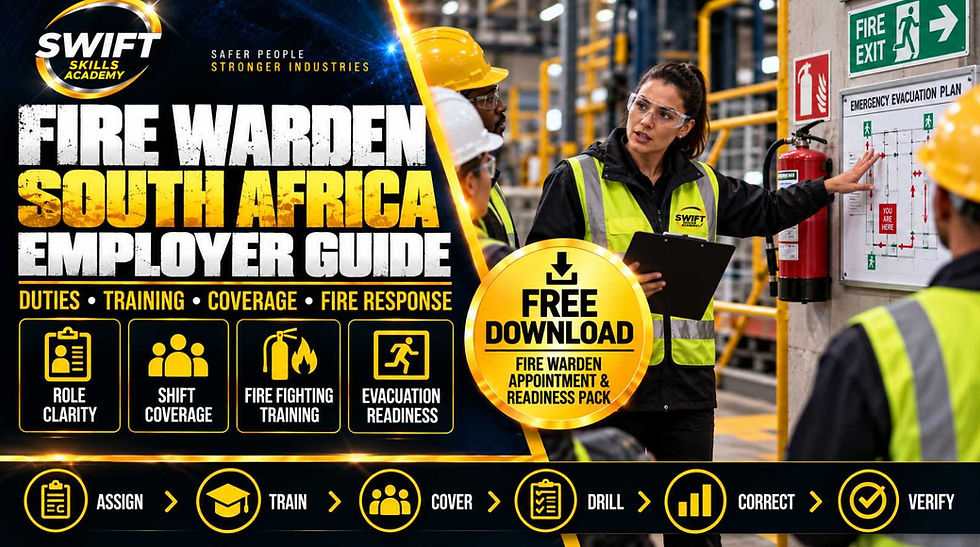
Download: Fire Warden Appointment & Readiness Pack
This is where I would add the lead magnet that Absolute Health does not have on this exact topic.
The SSA pack should contain:
Fire Warden Role & Responsibility Checklist
Fire Warden Appointment Record
Work Area / Zone Allocation Sheet
Shift Coverage Matrix
Fire Fighting Training Register
Emergency Contact Record
Equipment Awareness Checklist
Fire Drill Observer Sheet
Assembly-Point Accountability Sheet
Corrective Action Register
Competence / Refresher Review Record
Management Verification Page
This PDF should be designed around:
ASSIGN → TRAIN → COVER → DRILL → CORRECT → VERIFY
That downloadable asset could become one of the strongest conversion mechanisms on the page because the employer will effectively diagnose their own training gap while completing it.
When Should an Employer Book Fire Fighting Training?
Training becomes especially relevant when an employer identifies employees who are expected to:
respond to early-stage workplace fires;
select or use extinguishers;
form part of a workplace fire-response team;
provide emergency coverage across departments or shifts;
or strengthen an identified gap following a drill, risk review or incident.
The booking decision should not begin with:
“How many certificates can we buy?”
It should begin with:
“Who needs to be able to do what when a fire starts?”
Then train around that requirement.
REVIEW → IDENTIFY → TRAIN → DRILL → RECORD → VERIFY
Frequently Asked Questions
What is a Fire Warden in South Africa?
A Fire Warden is generally an employee assigned workplace fire-safety or emergency-response responsibilities. Those responsibilities should be defined by the employer's actual emergency arrangements rather than assumed from the title alone.
Is a Fire Warden the same as a Fire Fighter?
No. A workplace Fire Warden is not automatically a professional firefighter. Workplace Fire Fighting training such as SAQA 12484 deals with basic workplace fire response, including equipment selection, monitoring, retreat, handover and reporting. SAQA
What is the difference between a Fire Warden and Fire Marshal?
Employers may use the terms differently. In some organisations a Fire Marshal coordinates multiple wardens; elsewhere the terms are used interchangeably. The employer should document the actual duties rather than rely on the title.
Does a Fire Warden need Fire Fighting training?
If the employee is expected to use firefighting equipment or perform basic fire suppression, the employer should ensure that the person has suitable knowledge, training and competence for that task.
Is Fire Warden training mandatory in South Africa?
Employers should not reduce the issue to a blanket statement based only on job title. Fire precautions, evacuation arrangements, suitable equipment and workplace emergency capability must be considered against applicable OHS, fire, building, municipal and workplace-specific requirements. Government of South Africa
How many Fire Wardens should a company have?
There is no responsible universal number that should simply be copied onto every workplace. Consider layout, occupancy, hazards, operating shifts, absence coverage and the emergency roles that need to be performed.
Does every shift need trained people?
If emergency-response capability is expected while the workplace operates, employers should consider whether adequate competent coverage exists on every relevant operating shift.
Can a Fire Warden fight a fire?
An employee who has appropriate training and authority may be able to undertake limited basic fire response where conditions remain within the person's training and workplace procedure. If conditions become unsafe, retreat and evacuation take priority.
When should a Fire Warden stop using an extinguisher?
When smoke, heat, spread, hazardous materials, equipment failure or loss of a safe escape route make continued intervention unsafe.
Can a Fire Warden also be a First Aider?
Possibly, but employers should consider whether simultaneous emergency duties could conflict.
Does Fire Fighting training make someone a professional firefighter?
No. Basic workplace Fire Fighting training does not confer professional emergency-service firefighter status.
What is SAQA Unit Standard 12484?
It is Perform Basic Fire Fighting, NQF Level 2, 4 credits. Its registration end date was 30 June 2023, with last enrolment currently listed as 30 June 2029 and last achievement as 30 June 2032. SAQA
Can Fire Fighting training be done on-site?
Employer-team delivery can be appropriate where the provider, facilities, training conditions and programme requirements support it. SSA provides an on-site enquiry route for employer groups.
Authoritative Sources
Authoritative Source | What It Supports |
Workplace basic fire-fighting competence, equipment selection, changing fire conditions, retreat, handover and reporting. Also confirms NQF Level 2, 4 credits and the published transition dates. | |
Fire precautions, means of egress, emergency escape routes, evacuation considerations and suitable firefighting equipment in the workplace. | |
Employer fire-safety responsibilities and the current regulatory framework for workplace fire precautions and emergency arrangements. | |
Local fire-safety guidance relating to emergency escapes, fire doors, firefighting equipment, evacuation and building fire preparedness. |
Read More
Exactly these three:
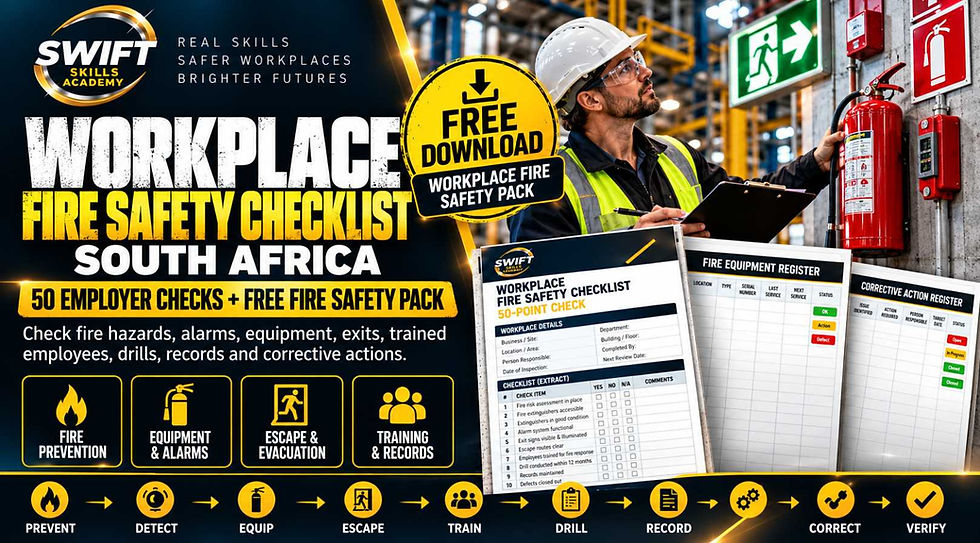
Workplace Fire Safety Checklist South Africa: 50 Employer Checks + Free PDF https://www.swiftskillsacademy.com/post/workplace-fire-safety-checklist-south-africa
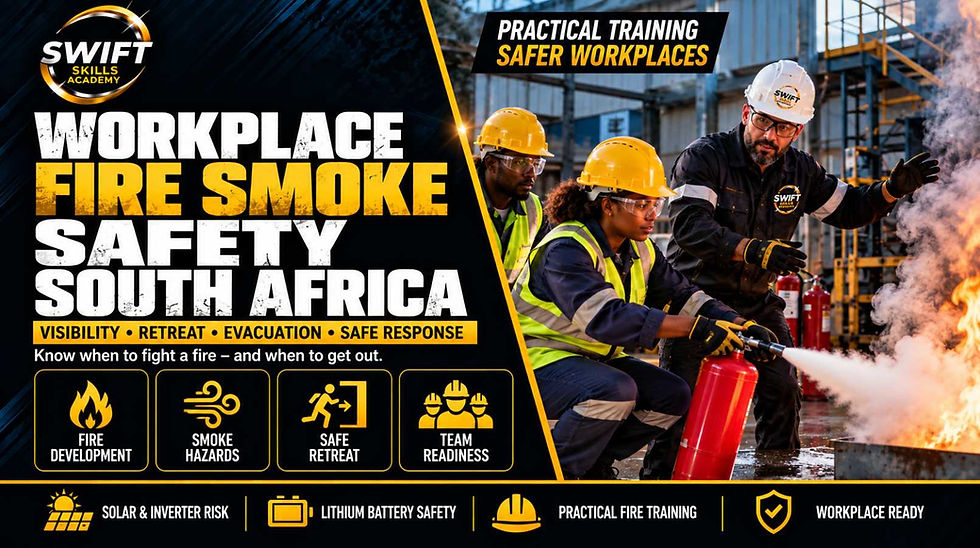
Workplace Fire Smoke Safety South Africa: When to Stop Fighting a Fire and Evacuate https://www.swiftskillsacademy.com/post/workplace-fire-smoke-safety-visibility-retreat-evacuation
Fire Fighting Training Requirements South Africa: Employer Booking & Provider Guide https://www.swiftskillsacademy.com/post/fire-fighting-course-cape-town-guide
Final Word
A workplace does not become fire-ready because somebody has been given the title Fire Warden.
A functioning system requires the employer to know:
who is responsible → what they are expected to do → whether they are trained → whether every operating period is covered → whether they know when to act → whether they know when to retreat → whether the system has been tested.
That is the gap employers should close.
And where employees are expected to perform basic workplace fire response, practical Fire Fighting training should form part of that system — not merely another certificate in the safety file.