How to Become a Welder in South Africa (2026 Salary, Courses & Jobs)
- Apr 13
- 3 min read
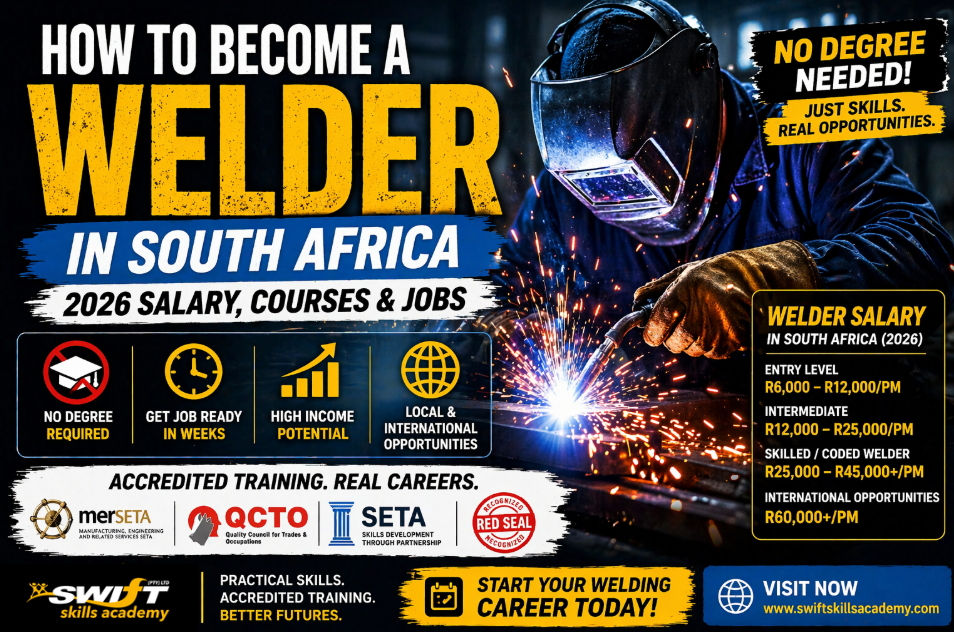
South Africa doesn’t have a job shortage.
It has a skills shortage.
While thousands of graduates struggle to find work, industries like construction, mining, and manufacturing are desperate for skilled welders.
This is where opportunity lives.
If you’re ready to learn a high-income, practical skill, welding can take you from unemployed → employable in months — not years.
And the best part?
👉 You don’t need a degree.
You need the right training, the right certification, and the right pathway.
How to Become a Welder in South Africa: What Does a Welder Do?
Welders are the backbone of industry.
They:
Join metal structures
Repair machinery
Build pipelines, buildings, and infrastructure
Work in construction, shipbuilding, mining, and manufacturing
👉 Without welders, nothing gets built
💰 Welder Salary in South Africa (2026)
Your earning potential depends on your skill level:
Entry-Level Welder
R6,000 – R12,000/month
Intermediate Welder
R12,000 – R25,000/month
Skilled / Coded Welder
R25,000 – R45,000+/month
International Opportunities
Can exceed R60,000+/month depending on contracts
👉 Welding is one of the few skills where income scales fast with experience
🎓 Step-by-Step: How to Become a Welder South Africa
🔧 Step 1: Start with Accredited Welding Training
To get hired, you need practical, hands-on training — not theory.
At Swift Skills Academy, you can train in:
Core Welding Courses
Carbon Steel Arc Welding
Gas Metal Arc Welding (MIG)
Gas Tungsten Arc Welding (TIG)
Assistant Welder Program
🏅 Step 2: Understand Accreditation (CRITICAL)
To stand out, your training must align with:
MERSETA
QCTO
SETA
Red Seal Certification (for qualified artisans)
👉 These certifications signal credibility + employability
🛠️ Step 3: Gain Practical Experience
Employers don’t hire certificates.
They hire skills.
You need:
Hands-on welding practice
Workshop exposure
Real-world projects
👉 The more you practice, the faster you get hired
📈 Step 4: Specialize & Increase Your Income
Once you’re trained, you can specialize in:
Pipe Welding
Structural Welding
Coded Welding (high-paying)
👉 Specialization = higher income
🌍 Step 5: Explore Job Opportunities
Welders are needed in:
Construction companies
Mining operations
Manufacturing plants
Engineering firms
👉 Skilled welders are also in demand internationally
🚀 Why Welding is One of the Best Careers Right Now
No degree required
Fast entry into the workforce
High demand across industries
Strong earning potential
Opportunity to work locally or abroad
👉 It’s one of the most practical and future-proof careers in South Africa
⚠️ The Biggest Mistake People Make
Most people:
Choose theory over skills
Wait years for jobs
Ignore high-demand trades
Meanwhile…
👉 Skilled welders are getting hired faster than graduates
🎯 How to Choose the Right Welding Course
Ask yourself:
Do I want quick employment? → Start with Arc Welding
Do I want higher income? → Add MIG/TIG
Do I want long-term career growth? → Work toward Red Seal
👉 The right path depends on your goal
💣 Final Word
You don’t need a degree to build a successful career.
You need a skill that the market is desperate for.
Welding is that skill.
And the people who act now?
👉 They get ahead first.
🔥 Call to Action
Ready to become a certified welder and get hired faster?: How to Become a Welder in South Africa
Explore accredited welding courses here:👉 Start Your Welding Career
FAQ: Frequently Asked Questions
Which welding course is best for beginners in South Africa?
Arc welding is the best starting point. It builds foundational skills and leads to advanced welding techniques.
Do I need a degree to become a welder?
No. Welding is a skills-based career that requires practical training, not a university degree.
What is MERSETA accreditation?
MERSETA ensures training meets industry standards in manufacturing and engineering sectors.
How long does it take to become a welder?
You can become job-ready in a few weeks to months depending on your training intensity.


