Office First Aid Requirements South Africa: First Aiders, Boxes, Ratios & Employer Checklist

Your office has 73 employees.
One trained First Aider works at reception.
Everything looks fine.
Then she takes annual leave.
Or works from home.
Or moves to another floor.
Or leaves the company.
Does the office still have a functioning First Aid system?
That is the weakness in treating office First Aid as nothing more than a certificate-counting exercise.
South African office employers need to think about headcount, trained First Aiders, actual availability, First Aid boxes, office layout, working hours, hybrid work, emergency information and employer records together.
The legal ratio is only the starting point.
Quick Answer: What Are the Office First Aid Requirements in South Africa?
For an office workplace, the General Safety Regulations create several important First Aid duties.
Where more than five employees are employed at a workplace, the employer must provide a First Aid box or boxes at or near the workplace that are available and accessible for treatment. AWT Environment
Where more than 10 employees are employed, current Regulation 3(4) requires at least one appropriately certificated First Aider to be readily available during normal working hours for every group of up to 100 employees in an office or shop. The December 2025 amendment also requires the person to hold a valid certificate of competency in First Aid issued by an organisation approved by the Chief Inspector. South African Government
In practical terms:
1–5 office employeesThe specific First Aid-box threshold in Regulation 3(2) is not triggered, but the employer's broader duty to ensure prompt First Aid treatment still matters.
6–10 office employeesA First Aid box or boxes are required.
11–100 office employeesAt least one qualifying First Aider must be readily available during normal working hours.
101–200 office employeesPlan for at least two under the office ratio.
201–300 office employeesPlan for at least three.
And so on.
But simply reaching the mathematical minimum does not guarantee practical coverage.
Why Offices Need a Different First Aid Compliance Approach
An office is usually lower risk than a fabrication workshop, warehouse or construction site.
That does not mean the First Aid system can be casual.
Office emergencies can include:
slips and falls;
cuts;
burns from kitchens or hot liquids;
choking;
allergic reactions;
asthma attacks;
seizures;
diabetic emergencies;
fainting;
chest pain;
cardiac arrest;
workplace violence;
injuries involving stairs or lifts.
The office also creates its own operational problems.
People may work:
from home;
across several floors;
from satellite offices;
on flexible schedules;
after normal office hours;
in client-facing areas;
in meeting rooms far from the main reception.
So the right question is not only:
“How many employees do we have?”
It is:
“If someone needs First Aid right now, who is actually here, where are they, and can they reach the person quickly?”
How Many First Aiders Does an Office Need in South Africa?
The specific office/shop ratio in Regulation 3(4) is one First Aider for every group of up to 100 employees, once the workplace employs more than 10 people. South African Government
That is materially different from the general workplace ratio of one for every group of up to 50 employees.
Office with 18 employees
At least one person meeting the Regulation 3(4) requirements should be readily available during normal working hours.
Office with 94 employees
The statutory ratio still points to at least one.
Operationally, relying on exactly one person may be fragile.
Office with 145 employees
The office moves into a second group of up to 100 employees.
Plan for at least two.
Office with 265 employees
Plan for at least three under the office ratio.
The important words are not only:
“one per 100.”
They are also:
“readily available during normal working hours.” South African Government
Why “Readily Available” Matters More Than the Spreadsheet
Imagine an office with 82 employees and one qualified First Aider.
On paper:
82 employees → one First Aider → ratio met.
But today the First Aider is:
working remotely;
attending a client meeting;
on sick leave;
on annual leave;
attending training;
based on another floor;
no longer employed.
The spreadsheet still says:
1 First Aider.
The workplace may effectively have:
0 readily available First Aiders.
That is why employers should maintain backup capability, even where the minimum arithmetic appears satisfied.
Should an Office Have More First Aiders Than the Legal Minimum?
Often, yes.
Not because every office automatically has a legal duty to exceed the ratio.
Because practical resilience matters.
Consider training additional employees where the office has:
several floors;
multiple buildings;
flexible working arrangements;
hybrid employees;
employees frequently away from their desks;
reception and back-office areas separated physically;
long operating hours;
evening work;
weekend teams;
high visitor numbers;
employees with significant known workplace health risks;
a large workforce concentrated in different zones.
The statutory minimum should not become a ceiling.
Do Hybrid Employees Count When Planning Office First Aid?
Hybrid working makes First Aid planning more complicated.
The employer should distinguish between:
total employees attached to the business
and
employees actually present at the workplace when First Aid coverage is required.
For operational planning, the key issue is whether the appropriately certificated person is readily available at the workplace during the relevant working period.
A First Aider working from home cannot provide immediate First Aid to someone who collapses at the office.
So an office coverage planner should record:
employee;
First Aid status;
normal working days;
office days;
floor;
department;
backup person;
planned absences.
Do not rely solely on total certificate numbers.
What If Your Office Has Several Floors?
The regulations give employers a ratio.
They do not magically solve geography.
Suppose a business occupies four floors in a large office building.
The only First Aider is on Floor 1.
An employee collapses on Floor 4.
There may be:
locked access doors;
security-controlled lifts;
stair delays;
poor internal communication;
no one nearby who knows who the First Aider is.
This is why multi-floor employers should map:
Floor → employees → First Aider → backup → First Aid box → emergency contact → access route
A floor map can be more useful in a real emergency than a spreadsheet stored in HR.
Does Every Floor Need Its Own First Aid Box?
Do not invent a universal “one box per floor” legal rule.
Regulation 3 requires the employer to provide a First Aid box or boxes where more than five employees are employed and requires them to be at or near the workplace, available and accessible. The number and placement should also reflect the workplace circumstances and likely injuries. AWT Environment
For a small single-floor office, one properly located box may be practical.
For a large multi-floor office, several boxes may make far more operational sense.
Ask:
How long does it take to reach the box?
Is it behind a locked door?
Is it accessible after reception closes?
Can employees find it?
Does everyone know its location?
Is the route obstructed?
Is a second box appropriate for another floor or wing?
Accessibility should drive the decision.
Where Should an Office First Aid Box Be Located?
A First Aid box should be:
easy to reach;
clearly identifiable;
accessible during working hours;
known to employees;
protected from inappropriate use;
regularly checked.
Common office locations include:
reception;
security;
kitchen or central common area;
HR;
facilities office;
designated emergency station;
central floor lobby.
But reception is not automatically the best location.
If reception is locked after 17:00 and employees work until 21:00, the box may no longer be practically accessible.
Location should follow the workplace.
Not convenience for the person who purchased the box.
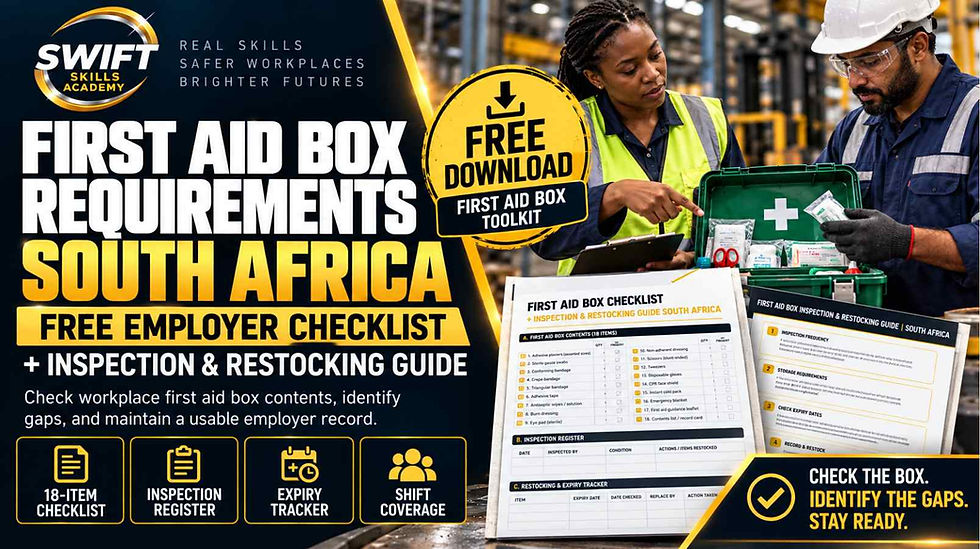
What Must Be Inside an Office First Aid Box?
The General Safety Regulations provide minimum First Aid-box contents.
The regulations also specifically recognise shops and offices by allowing reduced quantities for certain listed items in the prescribed minimum-content annexure. eTenders Portal
The prescribed list includes items such as:
wound cleaner or antiseptic;
wound-cleaning swabs;
padding material;
sterile gauze;
forceps;
scissors;
safety pins;
triangular bandages;
roller bandages;
adhesive products;
dressings;
splints;
disposable gloves;
CPR mouthpieces or similar devices;
absorbent material for blood or body-fluid spills;
disinfectant;
household-type protective gloves;
an impervious disposal bag. eTenders Portal
This section should remain concise because your dedicated First Aid Box Requirements South Africa article owns the complete box-content search intent.
What Should Not Happen to the Office First Aid Box?
Do not let the First Aid box become:
the office medicine cabinet;
the kitchen cupboard;
a stationery container;
permanently locked;
empty after one incident;
filled with expired products;
impossible to locate;
managed by someone who has left the company.
The employer needs a simple inspection process.
How Often Should an Office First Aid Box Be Checked?
Avoid inventing a statutory monthly inspection interval where the regulation does not prescribe one.
Instead, create an employer inspection frequency appropriate to the workplace.
Also trigger an inspection:
after an item is used;
after an incident;
when an employee reports missing stock;
when the box is moved;
before an important client or compliance audit;
where products approach expiry;
after changes to workplace risk.
A simple controlled register should record:
Date → box location → checked by → missing/expired items → corrective action → close-out
Does the Office Need a Sign Showing Where First Aid Is Located?
Employees should not need to search for First Aid during an emergency.
Clear identification of First Aid facilities, responsible persons and emergency arrangements is strong workplace practice.
For a larger office, consider visible information showing:
First Aid box location;
First Aider names;
floor or department;
internal emergency number;
security number;
emergency medical number;
assembly point where relevant.
Do not bury emergency information in the employee handbook.
Does Reception Have to Be the First Aider?
No general rule says the receptionist automatically has to be the First Aider.
Reception can be a logical choice because the employee is often:
centrally located;
visible;
aware of visitors;
connected to security.
But there are weaknesses.
A receptionist may:
leave the desk;
work different shifts;
take lunch;
work remotely;
have annual leave;
be overloaded with emergency calling, access control and First Aid responsibilities simultaneously.
Select First Aiders based on the response role, not their job title.
Who Should an Office Train as First Aiders?
Look for employees who are:
regularly present;
willing to perform the role;
calm under pressure;
reasonably accessible to other staff;
spread across important office areas;
likely to remain employed;
available across normal working hours;
able to attend practical training.
For a multi-floor workplace, do not put every trained person on the same floor.
For a hybrid workforce, do not train three people who all work from home on Fridays.
Training decisions need to solve the coverage problem.
Office First Aid Coverage Example
Imagine a company with:
Headcount: 178 employees
Building: three floors
Working pattern: hybrid
Operating hours: 07:30–18:00
Current First Aiders: two
On the surface, two First Aiders align with the one-per-100 office ratio.
Now look deeper.
First Aider 1 Floor 2 Works from home Monday and Friday
First Aider 2 Floor 2 Works 08:30–16:30
The problem becomes obvious.
Both are on the same floor.
Early and late coverage may be weak.
Mondays and Fridays may be weak.
Floors 1 and 3 depend on response from another area.
The ratio is only one layer of the system.
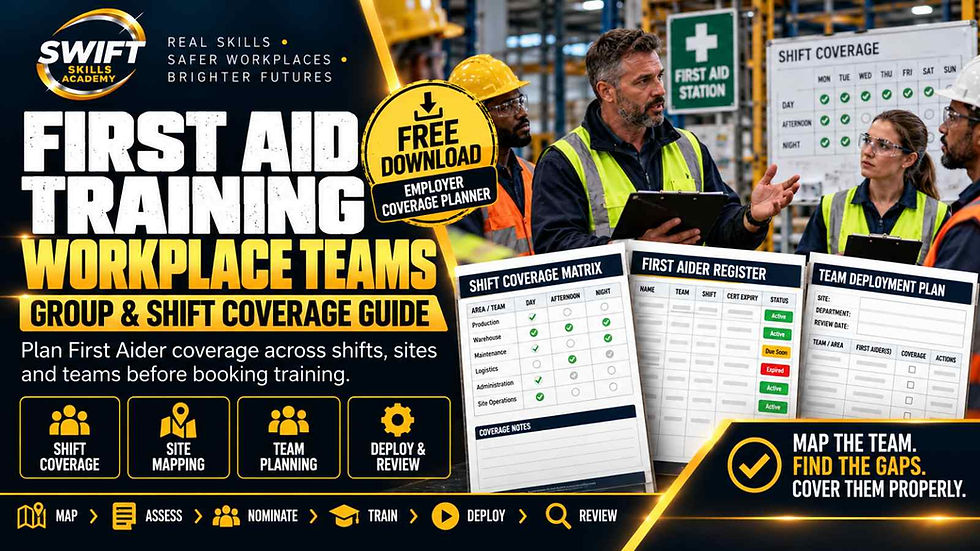
What Office First Aid Records Should HR Keep?
At minimum, a controlled employer system should make it easy to produce:
current First Aider register;
certificate copies;
certificate validity dates;
programme/provider information;
First Aider site/floor;
working hours or shift where relevant;
backup coverage;
First Aid box locations;
inspection records;
emergency contact information;
training dates;
upcoming renewal or review dates;
incident-related First Aid records where applicable.
Your Workplace First Aid Records: Employer Evidence Guide South Africa article should own the deeper evidence-file topic.
Here, the message is simpler:
An office should be able to show who is trained, where they are, whether their evidence is current and whether First Aid equipment is ready.
Office First Aid and Remote Employees
Employees working permanently from home are not physically available to respond to emergencies at the office.
That sounds obvious.
Yet training registers can make organisations look far better covered than they actually are.
Separate:
trained employee
from
available office responder
Your First Aider register should therefore include an operational status such as:
office-based;
hybrid;
remote;
transferred;
on leave;
expired;
current;
backup.
Office First Aid for Visitors and Contractors
Offices are not occupied only by employees.
They may also receive:
clients;
delivery drivers;
cleaners;
security personnel;
contractors;
job applicants;
consultants;
members of the public.
The employer's emergency arrangements should account for people who may be present at the workplace.
Reception, security and nominated First Aiders should know how to:
call for help;
identify the location;
guide emergency services;
access the First Aid box;
alert internal responders.
What If the Office Is Inside a Warehouse or Factory?
This is where the “office = one per 100” assumption needs careful handling.
A small administrative office may sit inside a broader industrial workplace.
Do not automatically isolate the office from the real workplace risk simply because employees sit at desks.
Ask:
Is it genuinely a separate workplace?
Do office employees enter operational areas?
Are there shared evacuation routes?
Are First Aiders deployed across the whole site?
Does the employer's risk assessment identify industrial hazards affecting office employees?
Are emergency services likely to access the site through the operational area?
Use the real workplace context.
Do not use “office” as a shortcut to weaker safety planning.
Does a Low-Risk Office Only Need Basic First Aid?
Often, foundational workplace First Aid capability may be the logical route to investigate.
But do not select training solely because the workplace looks low risk.
Consider:
employee numbers;
medical response time;
workforce age/profile;
responder responsibilities;
shared building risks;
neighbouring industrial activities;
emergency plan;
existing capability.
The course should match the required competence.
Not simply the room type.
What First Aid Course Should Office First Aiders Take?
Employers should verify the exact current training programme being purchased rather than relying only on old labels such as “First Aid Level 1.”
Swift Skills Academy's current foundational route is Basic Emergency First Aid Responder SP-230801.
For employers, the better procurement questions are:
What is the programme title?
What is the programme ID?
What competence does it develop?
What assessment applies?
What certificate is issued?
What provider/approval evidence applies?
Does it fit the responder's role?
Your separate First Aid Level 1, Level 2 & Level 3 South Africa article owns the detailed course-selection comparison.
Public Training or On-Site First Aid Training for Offices?
Public training may work well when:
one or two employees need training;
scheduled dates suit the employer;
learners come from different departments;
operational disruption is small.
On-site training may make more sense when:
multiple employees need training;
several floors need coverage;
a large office needs backup responders;
the employer needs coordinated rollout;
departments need to maintain operational cover during training.
For a company with 150 employees and multiple coverage gaps, the best answer may not be sending one person at a time to public courses.
Plan the system.
Then train the people.
10 Questions Every Office Manager Should Be Able to Answer
Ask management:
1. How many employees are normally at this workplace?
2. How many current First Aiders do we have?
3. Where are they located?
4. Are they actually available throughout normal working hours?
5. Who covers annual leave and sickness?
6. Where are our First Aid boxes?
7. When were the boxes last checked?
8. Can we produce the First Aiders' current certificates?
9. Do employees know who to call?
10. What happens if our main First Aider is absent today?
If several answers require someone to “check and get back to you,” the office First Aid system deserves attention.
The 15-Minute Office First Aid Test
Give HR, Facilities or SHEQ fifteen minutes.
Can they produce:
office headcount;
current First Aider register;
certificate evidence;
First Aid box locations;
most recent box inspections;
emergency contact information;
backup First Aider arrangements;
upcoming certificate review dates?
If they cannot, the problem may not be the number of courses purchased.
It may be the management system.
Office First Aid Compliance Checklist
Before closing your review, check:
People
Current First Aiders identified
Certificate status checked
Backup coverage identified
Hybrid working considered
Floor/site deployment mapped
Equipment
First Aid box provided where required
Box accessible
Contents checked
Missing items replaced
Location known to employees
Emergency Response
Internal emergency number known
Security/reception role clear
Ambulance access considered
First Aiders identifiable
Employees know how to summon help
Records
First Aider register current
Certificate copies filed
Expiry/review dates tracked
Box inspection records available
Open corrective actions assigned
Management
One person owns the system
Coverage reviewed when people leave
Changes to floors/sites trigger review
Training gaps lead to action
Next review date recorded
Common Office First Aid Compliance Failures
One First Aider and No Backup
The ratio may look adequate until that employee is absent.
Expired Certificate Still on the Register
The spreadsheet was never updated.
First Aid Box Locked in HR
Accessible during HR hours is not necessarily accessible during office operating hours.
No One Knows Where the Box Is
A stocked box that cannot be found quickly has reduced practical value.
First Aider Works Hybrid
The certificate exists.
The person is not physically there.
All First Aiders Sit Together
Excellent coverage for one department.
Weak coverage elsewhere.
Old Employees Still Appear on the Register
Turnover silently destroys emergency plans.
No Box Inspection Record
No one can say when the contents were last checked.
Training Was Bought Without a Coverage Plan
Certificates were created.
The operational gap remained.
What Should an Office Employer Do Next?
Step 1: Confirm the Office Headcount
Work from the actual workplace arrangement, not an outdated HR total.
Step 2: Apply the Correct First Aider Threshold
For an office with more than 10 employees, assess the one-per-up-to-100 requirement. South African Government
Step 3: Check Actual Availability
Review floors, hybrid days, operating hours and absence.
Step 4: Check the First Aid Box
Confirm location, accessibility and contents.
Step 5: Verify Certificates
Make sure current First Aiders have valid, traceable competency evidence.
Step 6: Identify Backup Coverage
Do not build the emergency plan around one person.
Step 7: Map Floors or Areas
Make sure responders and equipment can actually reach employees.
Step 8: Update the Employer Evidence File
Keep the register, certificates and box inspections controlled.
Step 9: Train Genuine Gaps
Do not randomly nominate staff.
Select people who solve the operational coverage problem.
Step 10: Set the Next Review Trigger
Review again when:
employee numbers change;
a First Aider resigns;
certificates expire;
people move floors;
hybrid patterns change;
office premises change.
Frequently Asked Questions
How many First Aiders does an office need in South Africa?
Where more than 10 employees are employed at an office workplace, Regulation 3(4) provides for at least one qualifying First Aider for every group of up to 100 employees, readily available during normal working hours. South African Government
Does an office with 10 employees need a First Aider?
The specific Regulation 3(4) First Aider threshold applies where more than 10 employees are employed.
That does not remove the employer's broader duty to ensure prompt First Aid treatment.
Does an office with six employees need a First Aid box?
Yes. Regulation 3(2) applies where more than five employees are employed at the workplace. AWT Environment
Does an office with 100 employees need one or two First Aiders?
Under the office ratio, one group of up to 100 employees points to at least one qualifying First Aider, provided the threshold of more than 10 employees is met and the person is readily available during normal working hours. South African Government
Does an office with 101 employees need two First Aiders?
The regulation works in groups of up to 100 office employees, so 101 employees moves into a second group.
Do offices need a First Aid box?
Where more than five employees are employed at the workplace, a First Aid box or boxes must be provided at or near the workplace and be available and accessible. AWT Environment
Does every office floor need a First Aid box?
There is no simple universal rule saying every floor must have one.
The employer should provide sufficient accessible First Aid equipment for the workplace circumstances. A large or multi-floor office may reasonably need several boxes.
Does the receptionist have to be the office First Aider?
No general rule makes reception the compulsory First Aider.
Choose people based on availability, suitability and workplace coverage.
Does a hybrid First Aider count if they are working from home?
A person working from home cannot be physically readily available to provide immediate First Aid at the office that day.
Employers should plan operational coverage accordingly.
What certificate should an office First Aider have?
Current Regulation 3(4) refers to a valid certificate of competency in First Aid issued by an organisation approved by the Chief Inspector. South African Government
How often should an office review its First Aid arrangements?
Use periodic reviews plus trigger events such as employee turnover, certificate expiry, floor moves, office relocation, hybrid-working changes and incidents.
Authoritative Sources & Regulatory References
South African Government — General Safety Regulations and December 2025 Amendment
Supports the current office/shop First Aider ratio, employee threshold, readiness requirement and certificate wording. South African Government
General Safety Regulations — First Aid, Emergency Equipment and Procedures
Supports the duty to ensure prompt First Aid treatment, First Aid-box threshold and workplace-box requirements. AWT Environment
General Safety Regulations — Minimum Contents of a First Aid Box
Supports the prescribed minimum First Aid-box equipment and the specific reduced quantities permitted for shops and offices for certain items. eTenders Portal
Department of Employment and Labour — Promulgated Regulations 2025
Confirms the 2025 General Safety Regulations amendment as promulgated regulatory material. Labour.gov.za
Read More
Final Word
Office First Aid requirements South Africa - compliance is easy to underestimate.
The workplace may look low risk.
The employee numbers may look simple.
The certificate spreadsheet may look complete.
But the real test is much more practical:
Is someone trained?
Are they here?
Can employees reach them?
Can they reach the casualty?
Is the First Aid box accessible?
Is the evidence current?
Is there backup when somebody is absent?
For South African offices, the one-per-100 ratio is an important legal starting point.
It should not become the entire First Aid strategy.
A strong office First Aid system connects:
HEADCOUNT → TRAINED PEOPLE → REAL AVAILABILITY → EQUIPMENT → LOCATION → RECORDS → BACKUP → REVIEW