
OHS Act Compliance South Africa: 2026 Employer Guide to Duties, Risk Control and Workplace Training
Updated: Sep 17
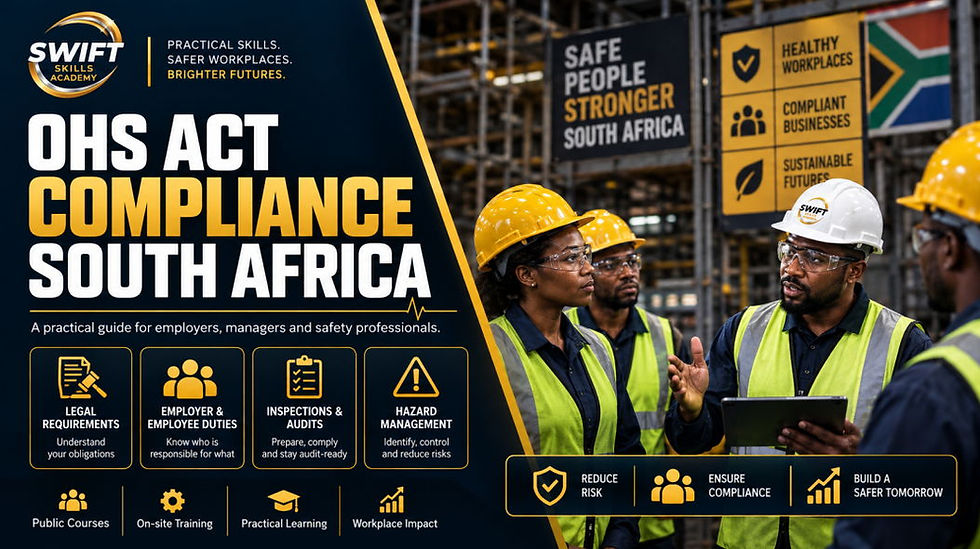
OHS Act compliance in South Africa is not achieved by owning a safety file, issuing PPE or sending employees on one training course.
It is a working system of prevention.
South Africa’s Occupational Health and Safety Act 85 of 1993 requires employers to provide and maintain, as far as reasonably practicable, a working environment that is safe and without risk to employees’ health. The Act also protects people who may be affected by workplace activities even though they are not employees. (Government of South Africa)
For an employer, that means asking practical questions:
What hazards exist in our workplace?
Who can be exposed?
What controls are reasonably practicable?
Have employees received the information, instruction, training and supervision they need?
Are safety measures actually being enforced?
Do employees understand their own legal responsibilities?
Are emergency arrangements appropriate to the risks?
Can we demonstrate what we have done if an inspector, client or investigator asks?
That is the real meaning of OHS Act compliance South Africa.
It is not a certificate on a wall.
It is the ability to show that workplace risks are being identified, controlled, communicated, supervised and reviewed.
Quick Answer: What Is OHS Act Compliance in South Africa?
OHS Act compliance means applying the Occupational Health and Safety Act 85 of 1993 together with the regulations and requirements that apply to the hazards and activities of a particular workplace.
The Act creates broad duties. Specific regulations can then impose additional requirements for matters such as machinery, construction work, ergonomics, hazardous substances, noise, physical agents, first aid, confined spaces or other occupational risks.
This distinction matters.
There is no single universal checklist that makes every South African workplace compliant.
A small office, fabrication workshop, warehouse, construction site and chemical plant may all fall within the occupational health and safety framework, but their actual control measures can be very different.
Important 2026 Legal Position: Do Not Confuse Proposed Changes With Current Law
South Africa’s occupational health and safety framework continues to develop.
The Department of Employment and Labour has been working on reform of the OHS Act, and Department communications continue to refer to an Occupational Health and Safety Amendment Bill and proposed stronger duties and enforcement measures. Proposed provisions should not be presented as current law until the legislative process has been completed and the relevant provisions have been formally brought into force. (Department of Labour)
At the same time, regulations under the existing Act have continued to change. Government published new General Safety, Noise Exposure and Physical Agents regulations during 2025, further General Safety and workplace-environment amendments in December 2025, and amendments to the Physical Agents Regulations in February 2026. (Department of Labour)
So an employer should not rely on a safety manual written several years ago and assume nothing has changed.
The Act, applicable regulations and workplace risk profile must be considered together.
What Does Section 8 of the OHS Act Require From Employers?
Section 8 contains one of the central employer duties in South African occupational health and safety law.
The Department of Employment and Labour describes Section 8 as placing a duty on employers to provide and maintain, as far as reasonably practicable, a safe working environment without risk to employees’ health. (Department of Labour)
In practical terms, an employer’s safety system should address matters such as:
workplace hazards;
plant, machinery and equipment;
safe systems of work;
appropriate precautionary measures;
information and instruction;
employee training;
adequate supervision;
enforcement of safety measures;
emergency arrangements;
and the risks created by the activities being performed.
The legal duty is active.
An employer cannot simply write a procedure and assume the problem has been solved.
A procedure must be relevant to the work, communicated to the people affected and supported by appropriate controls.
PPE Is Not the Starting Point of Risk Control
One of the most important principles for employers is that PPE should not automatically be the first or only answer to a hazard.
The Department has specifically referred to section 8(2)(b) when explaining that employers should take reasonably practicable steps to eliminate or mitigate hazards before relying on personal protective equipment. (Department of Labour)
For example, if a worker is exposed to a dangerous machine, excessive noise, hazardous substance or fall risk, simply handing over PPE does not necessarily address the full duty.
The employer should ask:
Can the hazard be eliminated?
Can the exposure be prevented or reduced?
Can engineering or physical controls be introduced?
Can the way the work is organised be changed?
What training, supervision and procedures are necessary?
What PPE is still needed after those controls?
This is why PPE rules form only one part of a functioning OHS system.
For a deeper practical guide, see PPE Rules South Africa: Employer Guide.
Employee Duties Matter Too
OHS compliance is not exclusively an employer issue.
Employees also have duties under the Act.
The Department of Employment and Labour continues to refer to section 14 as dealing with the general duties of employees at work. (Department of Labour)
In practical terms, employees should understand that workplace safety includes responsibilities such as:
taking reasonable care for their own health and safety;
taking reasonable care for people who may be affected by their acts or omissions;
cooperating with lawful workplace safety requirements;
following appropriate procedures;
using prescribed safety equipment correctly;
reporting unsafe or unhealthy conditions through the workplace system;
and reporting incidents where required.
This does not transfer the employer’s legal responsibility onto employees.
A better way to understand the relationship is:
The employer must create and maintain the safety system.Employees must cooperate with and participate in that system.
Both sides matter.
Does Every Workplace Need a Risk Assessment?
Risk assessment is fundamental to effective occupational health and safety management, but employers should be careful with oversimplified statements such as:
“Every employer must complete exactly the same risk-assessment document.”
The actual risk-assessment duties can arise from the general employer duties in the Act and from specific regulations that apply to particular hazards or activities.
The Department has itself issued enforcement action where an employer failed to conduct workplace hazard identification and risk assessment in relation to section 8(2)(d). (Department of Labour)
A useful workplace risk process should determine:
what can cause harm;
who may be exposed;
how exposure can occur;
the likely consequences;
what controls already exist;
what additional controls are required;
who is responsible;
and when the assessment should be reviewed.
A risk assessment should reflect the real workplace, not a generic template downloaded from the internet.
If the process, equipment, workforce, substances or work environment changes, the assessment may also need to change.
Information, Instruction, Training and Supervision Are Different Things
One of the weaknesses in many workplace safety systems is that four different responsibilities are treated as though they mean the same thing.
They do not.
Information
Employees need relevant information about hazards and precautions.
Instruction
They need to know what they are expected to do.
Training
Where knowledge or competence is needed, employees need appropriate training for the work and risks involved.
Supervision
The employer still needs to make sure work is carried out under suitable supervision and that required controls are followed.
A training certificate therefore does not automatically prove that every workplace duty has been satisfied.
Likewise, a toolbox talk is not automatically a substitute for formal or task-specific training where greater competence is required.
The correct question is:
What knowledge, skill, instruction and supervision does this employee need to perform this particular work safely?
Safety Training Does Not Make a Workplace “Compliant” by Itself
This is an important correction to the previous version of this article.
Training can form a critical part of an employer’s OHS system.
But no legitimate training provider should imply:
“Take this one course and your company is now OHS Act compliant.”
Compliance depends on the workplace.
A company may also need:
risk assessments;
safe work procedures;
appropriate appointments;
machinery controls;
occupational hygiene measures;
emergency arrangements;
inspections;
medical surveillance where applicable;
PPE systems;
contractor controls;
reporting procedures;
specialist competence;
and records.
Training is one control within that broader system.
Basic Health & Safety vs OHSA/SHE Training: Which One Do You Need?
These two learning routes solve different problems.
Basic Health & Safety
A foundational programme is useful where employees need practical understanding of:
employer and employee duties;
general workplace safety rules;
hazard awareness;
PPE;
housekeeping;
emergency procedures;
and basic reporting responsibilities.
Swift Skills Academy’s Basic Health & Safety Course in Cape Town is the relevant starting point for this type of learner.
OHSA/SHE Compliance Training
A broader OHSA/SHE route is more appropriate where supervisors, representatives or workplace teams need a deeper understanding of occupational health and safety responsibilities and how workplace safety systems operate.
Specialist Training
Neither of those courses automatically replaces specialist training where employees face specific risks.
Depending on the work, an employer may need to consider separate training or competence for areas such as:
The training matrix should follow the hazards and roles — not the other way around.
Important SAQA 259639 Status Note for Employers
This article should no longer describe SAQA Unit Standard 259639 simply as a currently registered “accredited course” without qualification.
SAQA currently records Unit Standard 259639, Explain basic health and safety principles in and around the workplace, as having passed its registration end date.
The SAQA record nevertheless shows:
NQF Level 2;
4 credits;
registration end date: 30 June 2023;
last date for enrolment: 30 June 2029;
last date for achievement: 30 June 2032. (regqs.saqa.org.za)
The unit standard covers employer and employee duties, workplace safety rules, PPE, housekeeping and emergency procedures. (regqs.saqa.org.za)
The correct commercial approach is therefore:
Before enrolment, confirm the current programme, provider scope, learner registration route, assessment arrangements and certificate or statement to be issued in writing.
That wording is much safer than casually calling every programme “SAQA accredited.”
When Do You Need a Health and Safety Representative?
A common employer question is:
“At what point do I need a health and safety representative?”
Section 17 becomes particularly important once a workplace has more than 20 employees.
Government guidance summarising the Act states that where there are more than 20 employees, an employer must designate health and safety representatives in writing. (awt.dffe.gov.za)
The representative does not take over the employer’s legal duties.
Instead, the role forms part of worker participation in the workplace safety system.
If this applies to your organisation, read Do I Need a Health and Safety Representative in South Africa?.
Where two or more health and safety representatives have been designated, section 19 deals with the establishment of a health and safety committee. (awt.dffe.gov.za)
What Records Should an Employer Keep?
There is no single universal folder called “the OHS compliance file” that automatically applies in exactly the same way to every workplace.
That distinction is important.
For example, formal construction safety-file requirements arise in construction contexts and should not casually be presented as a universal requirement for every office or small business.
However, employers should be able to demonstrate the safety arrangements that apply to their workplace.
Depending on the operation, useful evidence may include:
risk assessments;
induction records;
training records;
competence records;
PPE issue and inspection records;
equipment inspections;
statutory appointments;
health and safety representative records;
committee minutes;
toolbox talks;
safe work procedures;
emergency plans;
drill records;
incident reports;
corrective-action records;
maintenance records;
medical-surveillance records where applicable;
and contractor safety documentation.
The objective is not to create paperwork for its own sake.
The objective is to create traceable evidence of a functioning control system.
Emergency Preparedness Is Part of OHS — But the Requirement Depends on the Risk
Employers need to consider credible workplace emergencies.
Those emergencies may include:
fire;
serious injury;
medical emergency;
chemical release;
machinery incident;
electrical incident;
evacuation;
confined-space emergency;
fall-from-height rescue;
or another site-specific event.
The correct emergency arrangements depend on the workplace.
For broader guidance, see Workplace Emergency Procedures South Africa.
Where fire risk is relevant, see Fire Fighting Training Cape Town: Employer Guide.
For current First Aid requirements, use Legal Requirements for First Aid Training in South Africa.
Incident Reporting: Not Every Event Is Treated the Same Way
Employers should have an internal system for reporting, investigating and correcting unsafe events.
But legal reporting to the Department should not be described as though every minor incident follows the same statutory procedure.
Section 24 of the OHS Act addresses incidents that must be reported, while the General Administrative Regulations prescribe additional reporting requirements and procedures. (awt.dffe.gov.za)
A sound workplace system should distinguish between:
unsafe conditions;
near misses;
internal incidents;
injuries;
occupational illness concerns;
and events that trigger formal statutory reporting.
When serious incidents occur, employers should verify the applicable reporting requirement rather than relying on a generic blog checklist.
What Can Labour Inspectors Do?
The Department of Employment and Labour actively conducts OHS inspections and enforcement.
Recent Department reports show that inspections can result in:
contravention notices;
enforcement notices;
prohibition of dangerous work or areas;
follow-up inspections;
and referral for prosecution where non-compliance persists. (Department of Labour)
This is why OHS preparation should happen before an inspection.
A workplace should not have to reconstruct its safety system after an inspector arrives.
The 10-Point OHS Act Compliance Check for Employers
Use this as a management-level gap check.
1. Have we identified our real workplace hazards?
Not generic hazards copied from another company.
2. Have we assessed the risks and selected appropriate controls?
Including controls beyond PPE.
3. Do employees understand the risks relevant to their jobs?
Information must reach the people exposed.
4. Have employees received appropriate training?
Training should match roles and hazards.
5. Is work adequately supervised?
A certificate does not replace supervision.
6. Are required safety measures actually enforced?
Rules that nobody follows are weak controls.
7. Do we have appropriate emergency arrangements?
They should reflect credible emergencies.
8. Do we have the required appointments and representation structures?
Including health and safety representatives where section 17 applies.
9. Are incidents, hazards and corrective actions properly managed?
Problems should lead to action.
10. Can we demonstrate what we have done?
Records should support the real safety system.
If several of these answers are no, the next step is not simply “buy a course.”
The next step is to identify the gaps and decide which require training, engineering controls, procedures, appointments, specialist advice or another intervention.
Where Employers Commonly Go Wrong
The most common OHS mistake is not complete inaction.
It is partial compliance being mistaken for complete compliance.
Examples include:
“We issued PPE, so we're compliant.”
Not necessarily.
“Everyone signed the induction register.”
That proves attendance, not necessarily understanding or competence.
“We appointed a safety representative.”
The appointment does not remove the employer’s duties.
“We have a risk assessment.”
It may be irrelevant if the workplace or process has changed.
“We sent the team on a safety course.”
Training does not fix defective machinery, an uncontrolled hazard or an unsafe work system.
“The contractor handles safety.”
Contractor involvement does not justify ignoring the legal responsibilities that remain applicable to the parties involved.
The strongest OHS systems recognise that compliance is layered.
A Better Way to Build Workplace Safety
Employers should think in this order:
1. Understand the work.
What activities actually take place?
2. Identify the hazards.
What can harm employees or other people?
3. Assess the risk.
How could harm occur and how severe could it be?
4. Select controls.
Eliminate or reduce risks as far as reasonably practicable.
5. Define responsibilities.
Who is accountable for what?
6. Inform and train people.
Give employees the knowledge relevant to their work.
7. Supervise and enforce.
Make sure controls are actually implemented.
8. Prepare for emergencies.
Plan for credible failures.
9. Record and review.
Keep evidence and improve the system when conditions change.
That is a far better model than treating OHS compliance as a collection of certificates.
FAQ: OHS Act Compliance South Africa
What is OHS Act compliance in South Africa?
OHS Act compliance means applying the Occupational Health and Safety Act 85 of 1993 and the regulations relevant to the workplace. It includes identifying hazards, controlling risks, providing appropriate information, instruction, training and supervision, maintaining safe systems of work and fulfilling other duties that apply to the employer’s activities. (Government of South Africa)
What is the main employer duty under the OHS Act?
Section 8 requires employers to provide and maintain, as far as reasonably practicable, a working environment that is safe and without risk to employees’ health. (Department of Labour)
Do employees also have OHS duties?
Yes. Section 14 deals with general employee duties, including taking reasonable care and cooperating with workplace safety requirements. (Department of Labour)
Is issuing PPE enough for OHS compliance?
No. Employers should first consider reasonably practicable steps to eliminate or mitigate hazards before relying on PPE as the primary control. (Department of Labour)
Does every employer need a health and safety representative?
Section 17 becomes applicable where an employer has more than 20 employees at a workplace. The required representation structure should then be determined from the Act and the circumstances of that workplace. (awt.dffe.gov.za)
Does completing a safety course make a company OHS compliant?
No. Training may be an important part of compliance, but it does not replace risk controls, safe systems of work, supervision, statutory appointments, emergency arrangements or other legal requirements applicable to the workplace.
Is SAQA Unit Standard 259639 still current?
SAQA records Unit Standard 259639 as having passed its registration end date, with a last date for enrolment of 30 June 2029 and last date for achievement of 30 June 2032. Current provider scope, learner registration, assessment and certification arrangements should therefore be confirmed before enrolment. (regqs.saqa.org.za)
Has a new OHS Act replaced Act 85 of 1993 in 2026?
The Department continues to discuss proposed reform through an Occupational Health and Safety Amendment Bill. Proposed provisions should not be treated as enacted law unless and until they are formally brought into force. The existing Act and currently promulgated regulations remain the starting point for this guide. (Department of Labour)
OHS Compliance Starts With the Workplace — Not With the Certificate
The Occupational Health and Safety Act is fundamentally about prevention.
A safer workplace is built by understanding hazards, choosing appropriate controls, giving people the information and competence they need, supervising the work and correcting weaknesses before they become incidents.
Training can make an important contribution.
But good employers do not ask:
“What certificate can I buy so that we are compliant?”
They ask:
“What risks do our people face, what does the law require for those risks, and what do we need to do to control them properly?”
That is the question that builds a real occupational health and safety system.
Swift Skills Academy provides workplace safety training in Cape Town for individuals and employers who need a practical training pathway across basic workplace safety, OHSA/SHE awareness and specialist risk areas.
Swift Skills Academy
6 Monaco Road, Killarney Gardens, Cape Town
Tel: 021 828 0772WhatsApp: +27 60 998 7412
You May Also Want to Read Further
Guide | Why Read It |
Understand why PPE is only one part of risk control. | |
Understand the section 17 more-than-20-employees trigger. | |
Build a better new-employee safety induction system. | |
Plan workplace evacuation, emergency roles and response. | |
Understand public and on-site workplace fire training routes. | |
Understand the risk-based approach to work at height. | |
Understand employer first-aid duties and training requirements. |
Sources
South African Government — Occupational Health and Safety Act 85 of 1993. The official government page confirms the purpose, commencement and statutory basis of the Act. (Government of South Africa)
Department of Employment and Labour — World OHS Day 2026 address. Confirms the Department’s current interpretation of section 8 and its continued focus on prevention and risk control. (Department of Labour)
Department of Employment and Labour — OHS risk-control guidance. Explains the section 8 hierarchy principle of eliminating or mitigating hazards before relying on PPE. (Department of Labour)
South African Government — General Safety Regulations, 2025. Confirms recent regulatory activity under the OHS Act. (Government of South Africa)
South African Government — General Safety and Environment for Workplaces Amendment, December 2025. (Government of South Africa)
South African Government — Physical Agents Regulations amendments, February 2026. (Government of South Africa)
South African Qualifications Authority — Unit Standard 259639. Confirms the unit-standard outcomes, status, NQF level, credits and transitional enrolment/achievement dates. (regqs.saqa.org.za)


