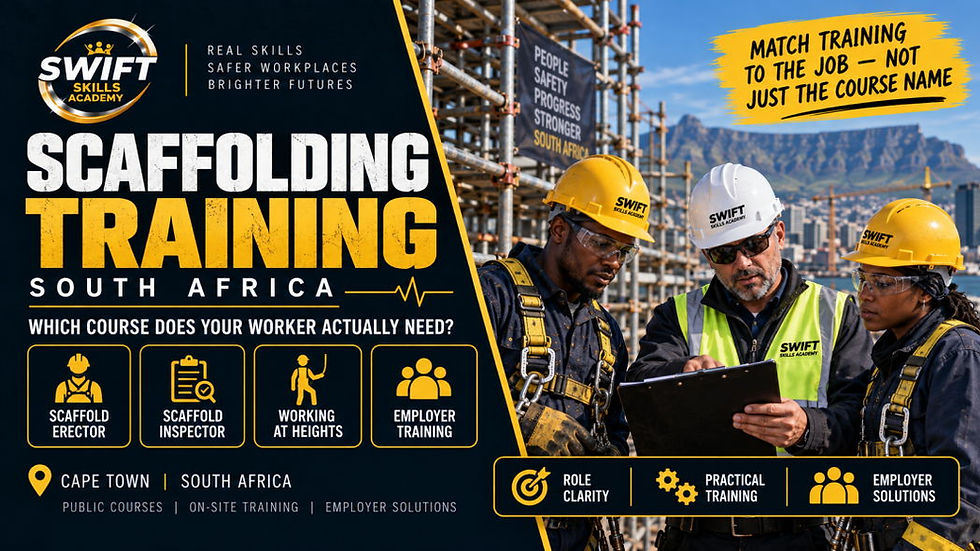
Scaffold Erector Requirements South Africa: ID, Literacy, Fitness, Medical Readiness and Training Checklist

Scaffold Erector Requirements South Africa: Full Checklist Before You Enrol
Quick Answer: What Are the Scaffold Erector Requirements in South Africa?
The Basic Requirements Before You Book
The typical scaffold erector requirements South Africa learners should prepare for include:
certified copy of ID
basic communication ability
basic mathematical literacy
physical readiness for site work
comfort working around height-risk environments
PPE readiness
medical fitness where required by the provider, employer or site
willingness to follow safety instructions
ability to participate in practical scaffold training
correct course selection aligned to the scaffold role
For scaffold erector training, the key South African unit standard is SAQA 263245: Erect, use and dismantle access scaffolding. This unit standard is listed at NQF Level 3 with 5 credits and assumes Communication at NQF Level 2 and Mathematical Literacy at NQF Level 2.
👉 Ready to book the Cape Town course?
Explore Here: 👉Scaffold Erector Course Cape Town SAQA 263245
💬 WhatsApp Swift Skills Academy: +27 60 998 7412
Why Scaffold Erector Requirements Matter
These Requirements Are Not Bureaucracy. They Are Safety Filters.
Many people think scaffold course requirements are just admin.
They are not.
Scaffold erector training prepares learners for work linked to access scaffolding — a safety-critical environment where mistakes can affect the learner, the scaffold team, workers below, supervisors, contractors and the employer.
A scaffold erector may need to:
understand instructions
identify hazards
work safely around heights
handle scaffold components
follow erection sequence
communicate with a team
use PPE correctly
understand safe access
assist with dismantling
respect site procedures
That is why requirements exist.
They help confirm that the learner is ready to participate safely and meaningfully.
A course provider should not only ask:
“Can this person pay?”
The better question is:
“Is this person ready for the training and the risk environment?”
The Enrolment Block Nobody Talks About
Most Learners Do Not Fail Because They Lack Interest
There are two types of people trying to book scaffold erector training.
1. The Learner Who Waits Until the Last Minute
They want to enrol.
They ask for the course date.
They are excited.
But then the requirements appear:
“Do you have your ID?”
“Can you attend practical training?”
“Are you medically fit?”
“Do you have PPE?”
“Can you work around heights?”
“Do you understand basic instructions?”
“Are you booking the correct scaffold course?”
Suddenly, the booking slows down.
Not because the learner is not serious.
Because the learner was not prepared.
2. The Learner Who Arrives Ready
They have their ID.
They understand the course.
They know the physical expectations.
They check medical fitness where needed.
They understand PPE.
They ask the right questions.
They book with confidence.
Same course.
Completely different experience.
That is the purpose of this guide.
It removes friction before enrolment.
Scaffold Erector Requirements Checklist
Download-Style Checklist Before You Book
Use this checklist before contacting the training provider.
Requirement | What to Prepare | Why It Matters |
ID copy | Certified or clear copy of your South African ID or valid identification | Needed for learner records and certificate details |
Contact details | Correct phone number, WhatsApp and email | Helps with course communication and confirmations |
Basic communication | Ability to understand instructions and ask questions | Scaffold work depends on clear communication |
Mathematical literacy | Basic ability with measurements, quantities and practical site logic | Scaffold layout and resource planning require basic numeracy |
Physical readiness | Ability to stand, move, lift, climb and participate in practical work | Scaffold training is practical and site-related |
Medical fitness | Medical certificate where required by employer, provider or site | Height-risk and physical work may require fitness confirmation |
PPE readiness | Safety boots, suitable workwear and other PPE where required | Practical training must be done safely |
Height-risk comfort | Willingness to work around scaffold and height-risk environments | Scaffold work may involve elevated structures |
Course choice | Confirm SAQA 263245 for scaffold erector training | Avoid booking the wrong scaffold course |
Employer approval | If sponsored, confirm company approval and learner details | Prevents admin delays |
Next-step plan | Consider Working at Heights and Scaffold Inspector progression | Helps build a stronger safety career pathway |
Requirement 1: ID Copy and Learner Details
Why Your ID Matters Before Training
The first requirement is simple but important.
You should prepare:
copy of your ID
correct full names
correct surname
ID number
contact number
WhatsApp number
email address
employer details if booked by a company
This matters because your learner record and certificate details must be correct.
A spelling mistake on a certificate can create problems later when you need to submit it to an employer, safety officer, HR department or client site.
Before training, check your details carefully.
Requirement 2: Basic Communication Ability
Scaffold Work Depends on Instructions
SAQA 263245 assumes Communication at NQF Level 2.
In practical terms, you should be able to:
understand basic instructions
listen to safety briefings
ask questions
report unsafe conditions
understand warnings
communicate with team members
follow a sequence
understand what the facilitator is explaining
Scaffold work is team work.
If one person does not understand instructions, the whole team can be affected.
That is why communication is not “school stuff.”
It is a safety requirement.
Requirement 3: Mathematical Literacy
Why Maths Matters in Scaffold Training
SAQA 263245 assumes Mathematical Literacy at NQF Level 2.
This does not mean you need to be a mathematician.
But you should be comfortable with basic practical maths such as:
counting components
understanding measurements
recognising quantities
understanding spacing
following layout logic
checking basic dimensions
understanding load and platform awareness at a basic level
working with simple site instructions
Scaffolding is physical work, but it is not mindless work.
Workers must think, measure, count, check and communicate.
That is why mathematical literacy matters.
Requirement 4: Physical Readiness
Scaffold Erector Training Is Practical
Scaffold erector training is not only sitting in a classroom.
Learners may need to participate in practical activities linked to:
scaffold components
PPE use
safe handling
movement around scaffold structures
team coordination
erection sequence
dismantling sequence
housekeeping
site safety behaviour
Physical readiness matters because scaffold work can involve:
standing for long periods
walking on uneven surfaces
carrying equipment
bending
climbing
lifting
balancing
wearing PPE
working in outdoor conditions
You do not need to be a professional athlete.
But you must be physically capable of participating safely.
Requirement 5: Medical Fitness
When a Medical Certificate May Be Needed
A medical certificate for scaffold training may be required depending on the provider, employer, client site, work environment or internal safety policy.
Medical fitness is often relevant because scaffold work can involve:
working at height
climbing
physical exertion
use of harnesses
elevated work platforms
construction site exposure
heat, dust or outdoor conditions
safety-critical activities
Before booking, ask:
Do I need a medical certificate for this course?
Does my employer require medical fitness?
Does the site require a fitness-to-work certificate?
Is Working at Heights medical fitness required?
Must the medical be done before training?
Do not leave this until the day of training.
If medical fitness is required and you do not have it, your enrolment or practical participation may be delayed.
Requirement 6: PPE Readiness
What PPE Might Be Required?
PPE requirements can vary by provider and training environment, but scaffold learners should generally be ready for site-style safety expectations.
You may be asked to bring or wear:
safety boots
hard hat
reflective vest
gloves
suitable workwear
safety glasses where required
harness where required or supplied
other site-specific PPE
PPE is not for appearance.
It protects the learner during practical work.
It also builds the correct habits for real site environments.
A learner who refuses PPE is not ready for scaffold work.
Requirement 7: Comfort Around Height-Risk Environments
Scaffold Work Is Linked to Height Risk
Scaffold erector training may involve structures, platforms, climbing and working around elevated areas.
Even when training is controlled, the learner must take height risk seriously.
Ask yourself:
Am I comfortable following height safety instructions?
Can I wear a harness correctly if required?
Can I follow controlled access rules?
Can I avoid shortcuts?
Can I tell the facilitator if I feel unsafe?
Am I willing to work slowly and safely rather than rush?
Fear is not the problem.
Ignoring safety is the problem.
Good scaffold workers respect height risk.
They do not act careless around it.
Requirement 8: Choosing the Correct Scaffold Course
Scaffold Erector Is Not the Same as Scaffold Inspector
One of the biggest mistakes learners make is booking the wrong course.
Scaffold-related courses can include:
scaffold awareness
Working at Heights
scaffold erector training
scaffold inspector training
scaffold supervisor training
basic health and safety
They are not the same.
If your goal is to assist with access scaffolding erection, use and dismantling, the key course is linked to:
SAQA 263245: Erect, use and dismantle access scaffolding
If your goal is to inspect access scaffolding, the pathway may involve:
SAQA 263205: Inspect access scaffolding
A worker may need both over time, but they serve different purposes.
Requirement 9: Employer Approval for Company Bookings
Companies Should Prepare Learner Information Early
If a company is booking scaffold training for employees, the employer should prepare:
learner names
ID numbers
contact details
job roles
training date preferences
site location if on-site training is requested
PPE availability
medical fitness status where required
current training records
whether learners need Working at Heights as well
whether scaffold inspector training is a future requirement
Company training becomes smoother when HR, safety and operations coordinate before the booking.
Last-minute training creates confusion.
A clear training list creates confidence.
Requirement 10: The Right Mindset
Scaffold Erector Training Requires Safety Discipline
A strong scaffold learner should arrive with the right mindset.
That means:
listen carefully
follow instructions
ask questions
respect the facilitator
respect PPE rules
do not rush practical work
report unsafe conditions
help team members
avoid horseplay
treat scaffolding as safety-critical
This matters because scaffold work is not about ego.
It is about discipline.
The best scaffold workers are not the ones who try to look brave.
They are the ones who work safely, follow sequence and respect the system.
Why These Requirements Exist From a Compliance Perspective
Employers Need Training That Matches the Work
Employers and safety officers need to show that workers were prepared for the work they are expected to do.
This matters for:
training registers
site files
contractor packs
client audits
workplace safety
OHS compliance
incident investigations
insurance questions
worker deployment
risk management
A worker who does not meet basic requirements may not be ready for scaffold-related responsibilities.
A worker who completes the correct training with proper records becomes easier to verify and deploy.
That is why requirements are not just admin.
They are part of risk control.
What SAQA 263245 Says About Learning Readiness
Communication and Maths Are Not Optional Details
SAQA 263245 lists assumed learning in place as:
Communication at NQF Level 2
Mathematical Literacy at NQF Level 2
The qualifying learner should be capable of:
interpreting basic drawings and instructions
coordinating resources
erecting and using access scaffolding
dismantling access scaffolding
This shows why readiness matters.
A learner must be able to understand instructions, communicate and apply practical site logic.
Scaffold work is not just physical.
It is technical, controlled and safety-driven.
Public Class Requirements vs On-Site Company Training Requirements
Individuals and Companies Prepare Differently
Requirement Area | Individual Booking | Company / On-Site Training |
ID copy | Learner must provide own ID | Employer collects learner IDs |
Course date | Learner chooses available date | Company coordinates group schedule |
PPE | Learner confirms what to bring | Employer may provide PPE |
Medical fitness | Learner checks if required | Employer checks workers’ fitness status |
Transport | Learner travels to venue | Training may happen on-site |
Training records | Learner keeps certificate | Employer updates training matrix |
Next step | Learner asks about progression | Company plans team compliance pathway |
The requirement is the same in principle:
Be ready.
The preparation method depends on who is booking.
Download-Style Checklist: Are You Ready to Book?
Scaffold Erector Requirements South Africa Checklist
Before you book, confirm:
I have a copy of my ID.
My full names and ID number are correct.
I can understand basic training instructions.
I am comfortable with basic practical maths.
I am physically able to participate in practical training.
I have asked whether medical fitness is required.
I have safety boots or know what PPE is required.
I understand that scaffold training may involve height-risk environments.
I know this is scaffold erector training, not only awareness.
I have checked whether the course is linked to SAQA 263245.
I know the training is NQF Level 3 and 5 credits.
I have saved the course link.
I have WhatsApped Swift Skills Academy if unsure.
👉 Ready to book? View the Cape Town course:
Explore Here: 👉Scaffold Erector Course Cape Town SAQA 263245
💬 WhatsApp: +27 60 998 7412
What Happens After You Meet the Requirements?
The Training Pathway
Once you meet the basic scaffold course requirements, your pathway may look like this:
Submit learner details.
Confirm course date.
Confirm PPE and medical requirements.
Attend scaffold erector training.
Complete theory and practical learning.
Complete assessment where applicable.
Receive your scaffold erector certificate.
Keep your certificate for site and employer records.
Build experience on site.
Progress to Working at Heights, Scaffold Inspector or broader OHS training.
The certificate is not the end.
It is the start of stronger site credibility.
Common Mistakes That Delay Scaffold Course Enrolment
Avoid These Before You Book
Common enrolment delays include:
no ID copy
incorrect spelling of learner names
no contact number
no employer approval
not knowing whether medical fitness is required
arriving without required PPE
booking the wrong scaffold course
confusing Working at Heights with scaffold erector training
assuming all scaffold certificates are the same
not checking SAQA 263245
leaving everything until the last minute
Most delays are avoidable.
Prepare the checklist first.
Then book with confidence.
Why Swift Skills Academy Is the Practical Cape Town Choice
Clear Requirements. Clear Course. Clear Next Step.
Swift Skills Academy’s Scaffold Erector course pathway is built around the course details that matter:
SAQA 263245
NQF Level 3
5 credits
access scaffolding
erection, use and dismantling
practical scaffold training
Cape Town enrolment
public and company training enquiries
SANS 10085 relevance
Working at Heights and Scaffold Inspector progression
This gives learners and employers clarity before booking.
No confusion.
No guessing.
No vague scaffold training promises.
Just a clear route into scaffold erector training in Cape Town.
👉 View the SAQA 263245 Scaffold Erector Course in Cape Town:
Explore Here: 👉Scaffold Erector Course Cape Town SAQA 263245
💬 Ask about requirements on WhatsApp: +27 60 998 7412
FAQ: Scaffold Erector Requirements South Africa
What are the requirements for scaffold erector training in South Africa?
Typical requirements include a valid ID, basic communication ability, basic mathematical literacy, physical readiness, PPE readiness and medical fitness where required by the provider, employer or site. Learners should also confirm that the course is linked to SAQA 263245.
Do I need maths for scaffold erector training?
Yes, basic mathematical literacy is important. SAQA 263245 assumes Mathematical Literacy at NQF Level 2 because scaffold work may involve measurements, quantities, layout logic and practical site calculations.
Do I need a medical certificate for scaffold training?
A medical certificate may be required depending on the training provider, employer, client site or work environment. Because scaffold work can involve height-risk and physical activity, learners should ask before booking.
Is Working at Heights required before scaffold erector training?
Working at Heights is not the same as scaffold erector training, but it is highly relevant because scaffold work is linked to height-risk environments. Some employers or sites may require Working at Heights in addition to scaffold erector training.
Where can I book scaffold erector training in Cape Town?
Swift Skills Academy offers Scaffold Erector training in Cape Town linked to SAQA 263245, NQF Level 3 and 5 credits.
Explore Here: 👉Scaffold Erector Course Cape Town SAQA 263245
or WhatsApp +27 60 998 7412.
Final Word: Requirements Are Not Roadblocks. They Are Readiness Checks.
The best learners do not wait until the training day to prepare.
They check the requirements first.
They confirm their ID.
They understand the course.
They ask about PPE.
They check medical fitness where needed.
They know the difference between scaffold awareness, Working at Heights, scaffold erector training and scaffold inspector training.
They do not guess.
They prepare.
That is how scaffold training becomes smoother, safer and more valuable.
If you are serious about scaffold erector training in South Africa, start with the checklist.
Then choose the route that matters:
SAQA 263245. NQF Level 3. 5 credits. Erect, use and dismantle access scaffolding. Cape Town enrolment. Swift Skills Academy.
Contact Swift Skills Academy
Ready to check your scaffold erector requirements or book training in Cape Town?
📞 021 828 0772📧 info@swiftskillsacademy.co.za💬 WhatsApp: +27 60 998 7412📍 6 Monaco Rd, Killarney Gardens, Cape Town🌍 www.swiftskillsacademy.com
Swift Skills Academy — Cape Town’s authority in scaffold erector training, scaffold course requirements, access scaffolding, Working at Heights and workplace safety compliance.
Explore Here: 👉Scaffold Erector Course Cape Town SAQA 263245
Sources
Source | Type | Why It Matters for Readers |
National unit standard | Confirms SAQA 263245 outcomes and assumed learning, including Communication and Mathematical Literacy at NQF Level 2. | |
National unit standard | Confirms the official unit standard context for erecting, using and dismantling access scaffolding. | |
National unit standard | Supports the distinction between scaffold erector training and scaffold inspector progression. | |
Industry body reference | Supports the relevance of SANS 10085-1 for steel access scaffolding design, erection, use and inspection. | |
Standards reference | Confirms that SANS 10085-1 relates to the design, erection, use and inspection of steel access scaffolding. | |
Course landing page | Provides the Cape Town enrolment destination for learners ready to book SAQA 263245 scaffold erector training. |