
Scaffolding Training in South Africa: Which Course Does Your Worker Actually Need?
Updated: Sep 12
Quick Answer
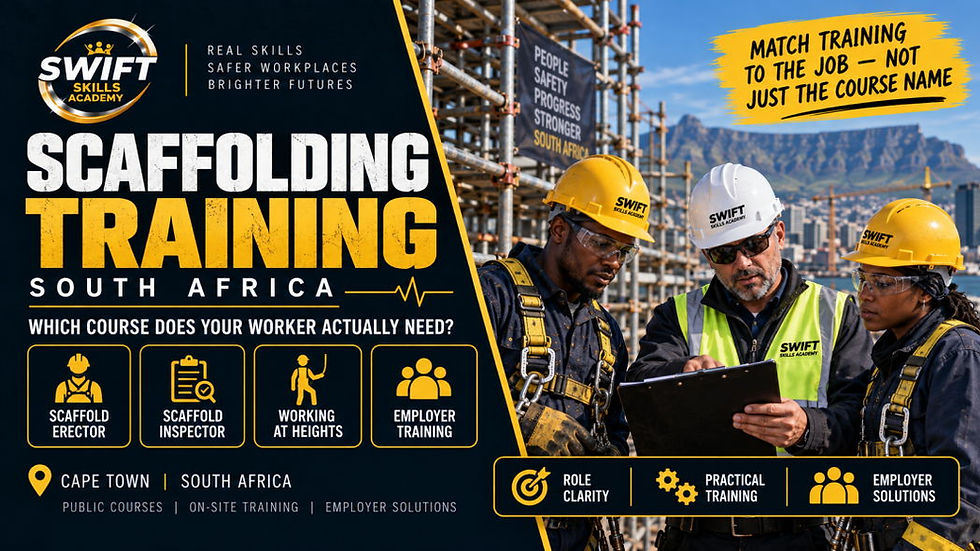
Scaffolding training in South Africa should be chosen according to the work the person actually performs — not simply because a course contains the word “scaffolding.”
A worker who erects, uses or dismantles access scaffolding has a different competence requirement from a person who inspects and hands over scaffolding, a worker exposed to fall risk, or a supervisor who manages scaffold contractors.
South Africa's Construction Regulations require scaffolding operations to be supervised by a competent person and require scaffold erectors, team leaders and inspectors to be competent for their work. SAQA Unit Standard 263245 — Erect, use and dismantle access scaffolding is recorded at NQF Level 3 with 5 credits, with last enrolment currently recorded as 30 June 2029 and last achievement as 30 June 2032. (Department of Labour)
The quickest way to choose correctly is to start with one question:
What will this employee actually be responsible for on site?
Scaffolding Training Role Selector
What the person actually does | Training direction to investigate | Why |
Works near scaffolding or uses an already-controlled access scaffold | Site induction / scaffold awareness appropriate to the role | Hazard recognition and safe-use expectations |
Erects, uses or dismantles access scaffolding | Scaffold Erector pathway | Role-specific practical erection and dismantling competence |
Leads members of a scaffold erection team | Scaffold Erector competence plus employer/site role requirements | Greater control responsibility |
Inspects or supports scaffold handover | Scaffold Inspector pathway | Inspection judgement, documentation and handover |
Performs work where there is fall risk | Appropriate Working at Heights / fall-protection training | Fall-risk control is a different competence issue |
Supervises scaffold contractors or site controls | Role-appropriate supervisory / scaffold-safety competence | Oversight, appointments, records and control |
HR/SDF books training for several job roles | Map duties before purchasing courses | Prevents expensive role-to-course mismatch |
How to Choose Scaffolding Training in South Africa by Job Role
The biggest purchasing mistake is asking:
“Which scaffolding course do you offer?”
before asking:
“What will this person actually do?”
The same scaffold may involve several people with completely different responsibilities.
Worker Uses or Works Around Scaffolding
A worker may need to understand safe access, visible hazards, restrictions, tags, housekeeping and when to report an unsafe condition without ever being responsible for erecting or inspecting the structure.
That is not automatically the same role as a scaffold erector.
Awareness can be valuable.
It does not make someone competent to perform a different scaffold role.
Worker Erects, Uses or Dismantles Scaffolding
This is where the Scaffold Erector pathway becomes relevant.
SAQA Unit Standard 263245 is specifically titled:
Erect, use and dismantle access scaffolding.
Its stated outcomes include interpreting basic drawings and instructions, coordinating resources, erecting and using access scaffolding, and dismantling access scaffolding. (SAQA)
That is a clearly different scope from general scaffold awareness.
If the employee physically participates in the controlled erection and dismantling process, the training decision should reflect that responsibility.
Worker Inspects or Hands Over Scaffolding
Inspection is a different role again.
Legacy SAQA Unit Standard 263205 — Inspect access scaffolding covered understanding scaffold types, inspector responsibilities, interpreting drawings and specifications, inspecting scaffolding and handing it over.
SAQA records 263205 at NQF Level 4 with 6 credits. Its last enrolment date was 30 June 2026, while its last achievement date is 30 June 2029. (SAQA)
Because that last-enrolment date has now passed, employers should not assume that a new course booking in late 2026 can simply be enrolled against legacy 263205.
The current training, assessment and certification pathway should be confirmed before booking.
Worker Performs Work at Height
Working at Heights and Scaffold Erector training solve different problems.
A scaffold erector learns about scaffold erection, use and dismantling.
Fall-risk training addresses the hazards and controls associated with performing work where a fall could occur.
One certificate should not automatically be treated as a replacement for the other.
A worker may require more than one competence route because their job contains more than one risk.
Supervisor, Safety Officer or Site Manager Controls Scaffold Work
A supervisor may never physically erect a scaffold.
But they may still have to understand:
who is responsible for scaffold work;
who may inspect;
what evidence belongs in the safety file;
how modifications are controlled;
when a scaffold should not be used;
and whether the employees' training matches their duties.
The training decision should therefore follow the actual responsibility, not merely the job title.
What Does South African Law Actually Require?
Construction Regulation 16 is short but commercially important.
It requires a contractor to appoint a competent person in writing to ensure scaffolding operations are carried out under supervision and that scaffold erectors, team leaders and inspectors are competent to carry out their work.
It also requires access scaffolding in use to comply with the applicable incorporated safety standards. (Department of Labour)
Notice what the Regulation does not say:
It does not say:
“Buy any course called scaffolding training and the employer is compliant.”
Competence Comes Before the Certificate
Training evidence can support competence.
But competence involves more than possessing a piece of paper.
An employer should be able to connect:
person → role → training → knowledge → experience → assessment/evidence → actual responsibility
That is much stronger than:
employee → certificate
A Training Certificate Does Not Automatically Grant Site Authority
A training certificate does not automatically:
appoint someone as the scaffold supervisor;
make someone competent for every scaffold system;
convert an erector into an inspector;
guarantee site access;
guarantee legal compliance;
or eliminate the employer's responsibility to assess competence.
This distinction is important both legally and commercially.
You are not buying paper.
You are trying to close a competence gap.
What Does SAQA 263245 Actually Cover?
For Scaffold Erector training, the most important official reference is SAQA Unit Standard 263245.
SAQA records:
Item | Current SAQA record |
Unit Standard | 263245 |
Title | Erect, use and dismantle access scaffolding |
NQF Level | 3 |
Credits | 5 |
Registration end date | 30 June 2023 |
Status | Passed the End Date |
Last enrolment | 30 June 2029 |
Last achievement | 30 June 2032 |
(SAQA)
The phrase “Passed the End Date” should therefore not be simplified into:
“This standard is dead.”
SAQA still records specific transition dates for enrolment and achievement.
What the Unit Standard Expects Learners to Be Able to Do
The four core outcomes are particularly useful when an employer evaluates a training programme:
Interpret instructions → Coordinate resources → Erect and use access scaffolding → Dismantle access scaffolding.
The official assessment criteria also refer to SANS 10085, ground conditions, bracing, ties, PPE, signage, barricading, hazards, erection sequence and safe dismantling. (SAQA)
That gives employers something concrete against which to evaluate course content.
Do not ask only:
“Is there a certificate?”
Ask:
“What was the person trained and assessed to do?”
Prior Learning Matters
SAQA also records assumed learning for 263245, including Communication and Mathematical Literacy at NQF Level 2 and prior competence in assisting to erect, use and dismantle access scaffolding at NQF Level 3. (SAQA)
That is another reason employers should not treat every applicant as interchangeable.
The correct pathway can depend on where the learner is starting.
Scaffold Erector vs Scaffold Inspector vs Working at Heights
This is the section I expect to generate some of the strongest conversions because it resolves the buying confusion directly.
Responsibility | Primary training direction | Do not confuse it with |
Erects and dismantles access scaffolding | Scaffold Erector | General awareness |
Leads scaffold erection activities | Scaffold Erector + employer/site role requirements | Inspector qualification alone |
Inspects and supports handover | Scaffold Inspector pathway | Scaffold Erector alone |
Works exposed to fall risk | Working at Heights / fall-protection route appropriate to task | Scaffold Erector |
Controls contractors / scaffold evidence | Supervisory/site safety competence | Automatically being the inspector |
Works near an existing scaffold | Appropriate awareness / induction | Permission to erect or modify |
SAQA 263205's purpose was specifically to develop inspection competence and included inspection, reinspection after modification, registers and handover documentation. (SAQA)
SAQA 263245 is the erection/use/dismantling standard. (SAQA)
Different role.
Different judgement.
Different evidence.
How Much Does Scaffolding Training Cost and How Long Does It Take?
There is no useful universal answer to either question without first identifying the course.
Google users searching:
“How much is a scaffolding course?”
or
“How long does a scaffolding course take?”
are often comparing programmes that do not teach the same thing.
Duration and pricing can change according to:
Factor | Why it changes the course |
Role | Awareness, erection and inspection are different scopes |
Learner starting point | Prior learning and experience may differ |
Practical component | Hands-on training takes different resources from classroom-only awareness |
Assessment | Formal assessment adds requirements |
Public vs on-site delivery | Logistics and group size differ |
Number of learners | Employer groups may require different delivery arrangements |
Equipment/site conditions | Practical scaffold work requires suitable infrastructure |
Current certification pathway | Legacy unit-standard transitions must be checked |
So the cheapest quote is not automatically the cheapest decision.
Paying less for the wrong training is still wasted money.
For current Swift Skills Academy pricing, dates and delivery options, use the dedicated fees or booking routes in the conversion sections rather than relying on generic online estimates.
What Should an Employer Check Before Booking Scaffolding Training?
Before issuing a purchase order, build a short training specification.
Ask the provider to make clear:
What role is being trained?
What exact learning outcomes are covered?
What unit-standard or programme reference is being used, where applicable?
What is the current status of that programme?
What prior learning is expected?
How much is practical versus theoretical?
What assessment is performed?
What training or completion evidence will the learner receive?
Can employer groups be trained on site?
Does the programme fit the actual scaffold system and duties used by the company?
That last question matters enormously.
A certificate titled “Scaffolding Training” tells an employer almost nothing if nobody can explain what the learner was trained to do.
Public Course vs On-Site Scaffolding Training
Neither delivery method is automatically better.
The correct option depends on who is being trained.
Public Training
Public classes often suit:
individual learners;
small numbers of employees;
companies with one or two new workers;
learners who can attend the provider's training venue.
On-Site Company Training
On-site delivery may make more sense where an employer has:
a larger team;
multiple scaffold-related roles;
operational constraints;
site-specific procedures;
several learners who would otherwise travel individually.
The important point is not merely location.
It is whether the training route matches the role, risk, equipment, employer expectations and current assessment pathway.
What Training Evidence Should an Employer Keep?
A training file should make the competence story easy to understand.
Depending on the role and programme, useful records can include:
Evidence | What it helps prove |
Employee identity | Who received the training |
Training record/certificate | What programme was completed |
Unit-standard/programme reference | What outcomes the record relates to |
Attendance record | Participation |
Assessment evidence where applicable | Whether competence was assessed |
Provider details | Traceability |
Training dates | When the training occurred |
Employer appointment | What responsibility the worker was given |
Training matrix | Whether training corresponds to the worker's job |
Site induction / procedures | How competence is applied locally |
The strongest training file therefore connects:
certificate + role + appointment + workplace controls
rather than keeping each document in isolation.
What Does SANS 10085-1:2024 Have to Do With Training?
SANS 10085-1:2024 is titled:
The design, erection, inspection, use, modification and dismantling of steel access scaffolding and working platforms — Part 1: General.
The Government Gazette confirms that its scope covers minimum specifications, minimum design requirements and guidance for safe erection, inspection, use, modification and dismantling of scaffold components for relevant scaffold types. (Government of South Africa)
That is why SANS 10085 repeatedly appears in serious scaffold-training discussions.
SAQA 263245 itself refers to SANS 10085 in areas including scaffold types, platform classes, stabilisation, PPE and erection. (SAQA)
The full SANS standard is copyrighted and should be obtained through an authorised standards channel.
60-Second Scaffold Training Decision Check
Before buying a course, answer these questions:
Question | If YES | Training direction |
Will the worker physically erect scaffolding? | Yes | Investigate Scaffold Erector training |
Will the worker dismantle scaffolding? | Yes | Investigate Scaffold Erector training |
Will the worker coordinate scaffold erection resources/team activities? | Yes | Scaffold Erector competence becomes highly relevant |
Will the worker inspect or hand over scaffolding? | Yes | Investigate current Scaffold Inspector pathway |
Will the worker perform work exposed to fall risk? | Yes | Assess Working at Heights / fall-protection needs |
Is the person only using or working near completed scaffolding? | Yes | Role-appropriate induction / awareness may be relevant |
Is the person supervising contractors? | Yes | Assess supervisory/site-control competence |
Are you booking for several employees? | Yes | Consider role mapping before arranging group/on-site training |
Are you unsure which role applies? | Yes | Do not guess — obtain training-pathway guidance first |
If you cannot answer these questions, you are not yet ready to choose the course.
That is the point at which a training consultation can save an employer from buying the wrong programme.
Frequently Asked Questions
What is scaffolding training in South Africa?
It is a broad term covering different types of learning related to scaffold use, hazards, erection, dismantling, inspection, supervision and associated fall risks. The correct training depends on the learner's actual responsibilities.
Which training does a scaffold erector need?
For workers whose duties involve erecting, using and dismantling access scaffolding, SAQA Unit Standard 263245 is an important South African scaffold-erector reference. It is NQF Level 3, 5 credits, with last enrolment currently recorded as 30 June 2029 and last achievement as 30 June 2032. (SAQA)
Is SAQA 263245 still relevant in 2026?
Yes, but use precise terminology. The unit standard has passed its registration end date, while SAQA still records transition dates allowing enrolment until 30 June 2029 and achievement until 30 June 2032. (SAQA)
Is Scaffold Erector the same as Scaffold Inspector?
No. Erector competence concerns erection, use and dismantling. Inspection concerns evaluation, documentation and handover. Legacy SAQA 263205 specifically addressed scaffold inspection and handover. (SAQA)
Can someone still enrol against SAQA 263205 in September 2026?
SAQA lists 30 June 2026 as the last enrolment date for 263205. Do not assume a new course can still be newly enrolled against that legacy unit standard. Confirm the current approved training, assessment and certification pathway before booking. (SAQA)
Is Working at Heights the same as Scaffold Erector training?
No. Scaffold Erector training addresses scaffold erection/use/dismantling competence. Working at Heights addresses fall-risk work and associated controls. Some workers may need both depending on their duties.
How long does a scaffolding course take?
There is no universal duration because different programmes have different purposes, practical components and assessment requirements. Confirm the exact course scope and current duration with the provider before comparing quotations.
How much does scaffolding training cost?
Costs depend on the type of training, practical component, assessment route, number of learners and whether the training is public or delivered on site. Compare like with like, not merely the cheapest headline price..
Does a scaffolding certificate automatically prove competence?
No. A certificate can support evidence of training, but an employer still needs to consider the person's actual knowledge, training, experience, role and workplace competence.
Does a scaffolding certificate guarantee site access?
No. Site access may depend on employer, client and principal-contractor requirements, appointments, induction, competence checks and other controls.
Can Swift Skills Academy train company scaffold teams on site?
Swift Skills Academy provides public and on-site company training options for Scaffold Erector training. Current suitability, dates and logistical requirements should be confirmed before booking. (Swift Skills Academy)
Final Word
“Scaffolding training” is too broad a phrase to base a purchasing decision on.
Start with the worker.
What do they actually do?
Do they use the scaffold?
Erect it?
Dismantle it?
Inspect it?
Work at height from it?
Supervise the people doing those jobs?
Once that responsibility is clear, the training decision becomes much easier.
For employers, that means a training matrix that better reflects the work happening on site.
For learners, it means choosing training that actually matches the role they want to perform.
And for both, it means moving away from buying certificates by title and toward building role-specific competence and defensible training evidence.


