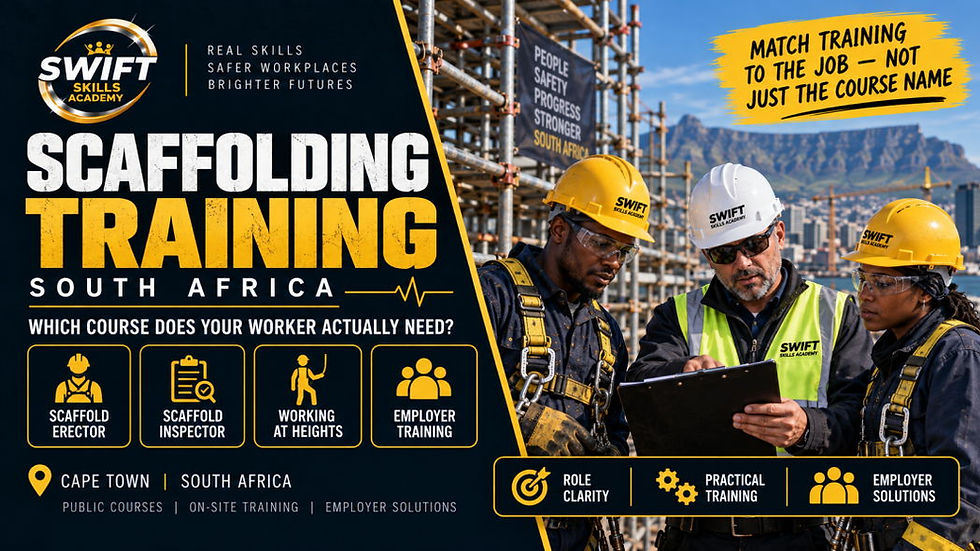
Scaffolding Training Cape Town: Should You Book a Public Class or On-Site Company Training?
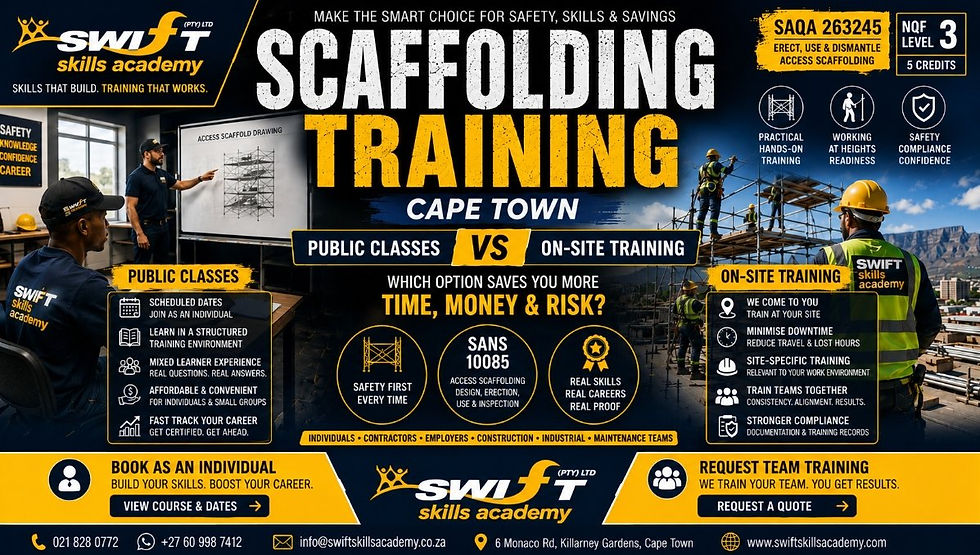
Quick Answer: Should You Choose Public Scaffold Classes or On-Site Scaffold Training?
The Best Option Depends on Who Is Booking
If you are an individual learner, a public scaffold class is usually the best option because it gives you access to scheduled training, a structured learning environment, practical exposure and a certificate pathway without needing to arrange a whole group.
If you are an employer, on-site scaffold training may be more efficient when you have a team to train, want to reduce travel time, need training around your site context, or want to align training with your company’s working environment and compliance documentation.
The most important point is this:
Do not choose scaffolding training only because it is cheap or available.
Choose the option that gives the right outcome.
For scaffold erector training, the key unit standard is SAQA 263245: Erect, use and dismantle access scaffolding, listed at NQF Level 3 with 5 credits. The official SAQA outcomes include interpreting basic drawings and instructions, coordinating resources, erecting and using access scaffolding, and dismantling access scaffolding.
Book as an individual: 👉Scaffold Erector Course Cape Town SAQA 263245
Request team training: 👉Scaffold Erector Course Cape Town SAQA 263245
The Real Scaffolding Training Question Most People Ask Too Late
Public Class or On-Site Training Is Not Just a Convenience Decision
There are two types of people searching scaffolding training Cape Town right now.
1. The Individual Who Needs a Certificate to Move Forward
They want to work on site.
They want to become more employable.
They want proof of training.
They may already be working as a labourer, contractor, maintenance worker or scaffold assistant.
They are asking:
“Where can I do scaffolding training in Cape Town?”
“Can I book as one person?”“What certificate will I get?”
“Is this linked to SAQA 263245?”“Will this help me get site-ready?”
For them, a public class may be the fastest route.
2. The Employer Who Needs a Team Trained Without Killing Productivity
They have multiple workers.
They have site deadlines.
They have client pressure.
They have contractor packs.
They have safety file expectations.
They have workers travelling from different areas.
They are asking:
“Can training happen on-site?”
“How many workers can we train together?”
“Will this reduce downtime?”“Can we align training with our site context?”
“Will this support compliance evidence?”
For them, on-site company training may be the smarter option.
Same keyword.
Two completely different buyers.
That is why this guide matters.
What Is Scaffolding Training Cape Town?
The Plain-English Definition
Scaffolding training Cape Town refers to training that helps workers and companies understand scaffold safety, access scaffolding, scaffold erection, scaffold use, scaffold dismantling or scaffold inspection depending on the course selected.
But the phrase “scaffolding training” can mean different things.
It may refer to:
scaffold awareness
scaffold user training
scaffold erector training
scaffold inspector training
Working at Heights
scaffold supervisor training
company site-specific scaffold training
public scaffold classes
on-site scaffold training
This is where buyers get confused.
Not every scaffolding course is the same.
If a worker is expected to erect, use or dismantle access scaffolding, the training should connect clearly to SAQA 263245.
If a worker needs to inspect scaffolding, the pathway may be different and may connect to SAQA 263205.
If a worker only needs to understand height risk, Working at Heights may support the scaffold pathway but does not replace scaffold erector training.
Public Scaffold Classes in Cape Town
What Is a Public Scaffold Class?
A public scaffold class is a scheduled training session where individual learners or smaller groups join a course at the provider’s training venue.
This option is ideal when:
you are booking for yourself
you do not have a full company group
you need a scheduled training date
you want a structured learning environment
you want to attend with other learners
your employer is sending one or two workers
you need a certificate pathway without arranging a custom session
Public classes work well for individual career growth.
They also help companies that only need to train a small number of workers.
When Public Scaffold Classes Make Sense
Best for Individuals, Small Teams and Fast Enrolment
A public class is usually the better option when:
you are an individual learner
you are unemployed and trying to improve your site readiness
you are a labourer wanting to move into scaffold work
you are a contractor needing proof of training
your company only has one or two learners
you cannot wait for a company group to be formed
you want a fixed location and training date
you need a more affordable per-person option
Public classes can also create strong learning value because learners hear questions from other people in the room.
A learner may arrive thinking only about a certificate.
They may leave understanding scaffold risk, practical responsibilities and career direction more clearly.
Benefits of Public Scaffold Classes
Why Individuals Often Choose This Route
Benefit | Why It Matters |
Easier to book as one person | You do not need a company group |
Scheduled dates | Helps learners plan transport and availability |
Structured classroom setting | Good for theory, discussion and assessment |
Mixed learner environment | Learners hear different site examples |
Career-focused | Useful for workers trying to upgrade employability |
Clear route to course page | Easy enrolment for individuals |
For individual learners, public classes are often the simplest entry point into scaffold training.
They help you stop waiting for an employer to organise training and start building proof for yourself.
Limits of Public Scaffold Classes
Why Public Classes Are Not Always Best for Companies
Public classes are useful, but they may not always suit company teams.
Possible limitations include:
workers must travel to the training venue
shifts may be disrupted
teams may attend on different dates
training examples may be general rather than site-specific
the employer has less control over timing
transport costs may add up
production time may be affected
If a company has multiple workers, the “cheap per-person” option may not be the cheapest overall option once travel, downtime and scheduling are included.
That is where on-site training becomes powerful.
On-Site Scaffold Training in Cape Town
What Is On-Site Scaffold Training?
On-site scaffold training means the provider comes to the company’s premises, construction site, facility, workshop or selected training location to train a group of workers.
This option is useful when employers need training for:
scaffold teams
construction crews
maintenance teams
contractors
facilities teams
industrial workers
shutdown workers
company groups
multiple departments
site-specific risk environments
On-site training is not only about convenience.
It can help connect training to the real work environment.
When On-Site Scaffold Training Makes Sense
Best for Employers, Contractors and Company Teams
On-site scaffold training usually makes sense when:
you have several employees to train
workers are based at one site
travel time would reduce productivity
the company wants training aligned to its work environment
you need to train teams together
you want less disruption to operations
you need training evidence for compliance files
you want to coordinate training around shifts
you have a site-specific scaffold risk profile
you want a consistent message across the team
For employers, the key question is not only:
“How much is the course?”
The stronger question is:
Which option gives us the best training outcome with the least operational disruption?
Benefits of On-Site Scaffold Training
Why Companies Often Prefer This Route
Benefit | Why It Matters |
Reduced travel time | Workers do not need to travel across Cape Town |
Team consistency | The whole team receives the same message |
Better scheduling control | Training can be planned around operations |
Site relevance | Examples can connect to real workplace conditions |
Stronger compliance evidence | Easier to align with site files and training registers |
Group value | Cost per learner may improve for larger groups |
Employer convenience | HR, safety and operations can coordinate in one session |
On-site training is often the stronger choice when scaffold training is part of a broader company compliance or workforce development plan.
Limits of On-Site Scaffold Training
What Employers Must Prepare
On-site scaffold training can be powerful, but companies must prepare properly.
Before booking, ask:
Do we have enough learners?
Is there a suitable training area?
Is there access to scaffold equipment if required?
Can workers be released from operations?
Is the site safe for practical training?
Do learners have PPE?
Do we need medical fitness checks?
Will training happen during normal hours?
Is transport still needed for some workers?
What documentation do we need after training?
On-site training works best when the employer is organised.
A strong provider can guide the process, but the company must make the site ready.
Public Classes vs On-Site Training: Quick Comparison
Which Scaffolding Training Option Is Better?
Factor | Public Scaffold Class | On-Site Company Training |
Best for | Individuals and small groups | Employers and larger teams |
Location | Provider training venue | Company site or selected location |
Scheduling | Fixed public dates | More flexible by arrangement |
Cost structure | Per learner | Often quoted per group or per learner |
Travel | Learner travels | Provider may travel to company |
Site relevance | General examples | Can connect to company environment |
Team consistency | Learners may attend separately | Whole team can train together |
Compliance evidence | Individual certificate records | Strong for company training files |
Operational impact | Workers leave site | Can reduce travel and downtime |
Best CTA | Book as an individual | Request team training |
The best choice depends on your situation.
Individuals usually need a public class.
Companies with teams should ask about on-site training.
Group Size: The Hidden Factor That Changes the Best Option
One Learner vs Ten Learners Is a Different Decision
If you are booking for one learner, public class is usually simple.
If you are booking for ten or more workers, on-site training may be more efficient.
Why?
Because group training changes the cost equation.
You must consider:
transport costs
time away from site
shift disruption
admin time
coordination
productivity loss
supervisor availability
training records
certificate collection
site compliance needs
The lowest course price is not always the lowest total cost.
For employers, the real cost is:
course fee +
travel +
downtime +
admin +
disruption +
compliance risk
That is why on-site training often becomes the smarter business decision.
Travel Time in Cape Town: Why Location Matters
Training Logistics Can Kill Productivity
Cape Town traffic is not a small issue.
If workers must travel from:
Killarney Gardens
Montague Gardens
Bellville
Brackenfell
Parow
Epping
Cape Town CBD
Somerset West
Stellenbosch
Paarl
Atlantis
Worcester
then travel time can become a real cost.
For individuals, travelling to a public class may be manageable.
For employers sending a whole team, travel may create:
late arrivals
overtime complications
lost production time
transport coordination issues
fatigue
scheduling headaches
On-site scaffold training can reduce this friction when the group size justifies it.
Practical Context: Why Training Near the Work Environment Can Help
Scaffold Training Is More Powerful When Workers Recognise the Risk
On-site training can be useful because workers may relate the training to their actual environment.
For example, a company may use scaffolding in:
warehouse maintenance
construction access
factory repairs
shutdown projects
painting and plastering
roof access
plant maintenance
signage installation
industrial cleaning
facilities work
When training examples match the real work environment, learners often understand risk faster.
This does not mean public classes are weak.
It means on-site training can create stronger context for company teams.
Compliance Outcomes: What Employers Should Really Want
The Goal Is Not Only Attendance
The goal of scaffolding training is not simply to say:
“Our staff attended.”
The stronger outcome is:
“Our staff received relevant training linked to their scaffold-related responsibilities, and we have evidence to support our site compliance.”
Employers should want:
attendance registers
learner details
certificate records
course outcomes
unit standard references where applicable
training dates
provider details
site training records
updated training matrix
PPE and medical fitness alignment where needed
follow-up training plan where gaps exist
A certificate is useful.
A documented training system is stronger.
Why SAQA 263245 Should Be the Core Course Reference
Public or On-Site, the Standard Still Matters
Whether you choose a public class or on-site company training, the course outcome must still be clear.
For scaffold erector training, the central reference is:
SAQA 263245: Erect, use and dismantle access scaffolding
This unit standard is listed at NQF Level 3 with 5 credits.
The official outcomes include:
interpreting basic drawings and instructions
coordinating resources
erecting and using access scaffolding
dismantling access scaffolding
This is what separates scaffold erector training from vague scaffold awareness.
If workers are expected to assist with access scaffold erection, use or dismantling, the training should clearly match that work.
What About Scaffold Inspector Training?
The Next Step After Erector Training
Scaffold erector training and scaffold inspector training are different.
SAQA 263245 focuses on erecting, using and dismantling access scaffolding.
Scaffold inspector training is linked to SAQA 263205, which focuses on inspecting access scaffolding.
For companies, this matters because one worker may not need only one course.
A proper scaffold training plan may include:
Working at Heights
Scaffold Erector training
Scaffold Inspector training
Basic Health & Safety
OHSA / SHE compliance training
This creates a stronger safety and compliance pathway.
What Individuals Should Ask Before Booking a Public Class
Individual Learner Checklist
Before booking public scaffolding training Cape Town, ask:
Is this course right for scaffold erector work?
Is it linked to SAQA 263245?
Is it NQF Level 3?
What certificate will I receive?
What must I bring?
Do I need PPE?
What time does training start?
Is assessment included?
Can this help me move toward site work?
What course should I do next?
A good learner does not only chase a certificate.
A good learner builds a pathway.
What Employers Should Ask Before Booking On-Site Training
Company Training Checklist
Before booking on-site scaffold training, ask:
How many workers need training?
Are they scaffold users, erectors or inspectors?
Do they also need Working at Heights?
Is the training linked to SAQA 263245?
Can the provider train on-site?
What space is required?
What PPE must workers bring?
Is practical training included?
What evidence will we receive?
Can we align training with shift schedules?
Can certificates be issued per learner?
Can training records support our site file?
Companies should not book training randomly.
They should build a training matrix that matches job duties.
Choose the Right Scaffolding Training Option
For Individuals
If you are a worker, contractor, learner or job seeker who wants scaffold training in Cape Town, start with the public class route.
👉 Book as an individual: 👉Scaffold Erector Course Cape Town SAQA 263245
For Companies
If you are an employer, HR manager, SDF, safety officer, construction company or contractor with a team to train, ask about company and on-site training options.
👉 Request team training: 👉Scaffold Erector Course Cape Town SAQA 263245
Why Swift Skills Academy Is the Practical Cape Town Choice
Public Classes and Company Training Flexibility
Swift Skills Academy is positioned to support both kinds of buyer.
For individuals, the course page gives a clear route into scaffold erector training in Cape Town.
For employers, the same training pathway can support company groups and on-site training conversations.
Swift Skills Academy’s Scaffold Erector course page positions the course around:
SAQA 263245
NQF Level 3
5 credits
practical scaffold training
access scaffolding erection, use and dismantling
SANS 10085 relevance
Cape Town training access
individual and company booking potential
That clarity matters because the buyer should know what they are booking before they pay.
Explore Here: 👉Scaffold Erector Course Cape Town SAQA 263245
Explore Here: 👉 Basic Health and Safety Course Cape Town – SAQA 259639
Explore Here: 👉 Introduction to OHSA course page
Explore Here: 👉Basic First Aid Course Cape Town – SAQA 12483
Explore Here: 👉Fire Fighting Course Cape Town – SAQA 12484
Explore Here: 👉Basic Health & Safety SAQA 259639
Explore Here: 👉Scaffold Inspector Course Cape Town SAQA 263205
Explore Here: 👉Working at Heights Course Cape Town SAQA 229998
Explore Here: 👉OHS Act Compliance South Africa 2026 Guide
Explore Here: 👉Health and Safety Induction South Africa
FAQ: Scaffolding Training Cape Town
What is the best scaffolding training option in Cape Town?
The best option depends on who is booking. Individuals usually benefit from public scaffold classes because they can join scheduled dates. Employers with multiple workers may benefit from on-site scaffold training because it can reduce travel time, improve scheduling and align training with site needs.
Is public scaffold training better than on-site training?
Public scaffold training is better for individuals and small groups. On-site scaffold training is often better for companies with larger teams, site-specific risks, operational constraints or compliance documentation needs.
What unit standard should scaffold erector training use?
For scaffold erector training, the key unit standard is SAQA 263245: Erect, use and dismantle access scaffolding, listed at NQF Level 3 with 5 credits.
Can companies book on-site scaffold training in Cape Town?
Yes. Companies can request team training where group size, site suitability, scheduling and practical requirements make on-site delivery appropriate.
Where can I book scaffolding training in Cape Town?
Swift Skills Academy offers scaffold erector training in Cape Town linked to SAQA 263245, NQF Level 3 and 5 credits. Individuals can book public training, while companies can enquire about team training options.
Final Word: The Best Scaffolding Training Option Is the One That Matches the Buyer
If you are an individual, do not wait for a company to develop your career.
Book a public scaffold class and start building proof.
If you are an employer, do not treat scaffold training as random admin.
Choose the option that reduces downtime, supports compliance evidence and trains the team properly.
Public classes and on-site company training both have value.
The mistake is choosing blindly.
The smart move is to match the training method to the actual need:
Individual learner? Book public training.
Company team? Request on-site training.
Scaffold erector work? Check SAQA 263245.
Site compliance? Keep proper training evidence.
Career growth? Build the pathway.
That is how scaffold training becomes more than a certificate.
It becomes proof, protection and progress.
Contact Swift Skills Academy
Book scaffolding training in Cape Town for individuals or company teams.
📞 021 828 0772📧 info@swiftskillsacademy.co.za💬 WhatsApp: +27 60 998 7412📍 6 Monaco Rd, Killarney Gardens, Cape Town🌍 www.swiftskillsacademy.com
Swift Skills Academy — Cape Town’s authority in scaffolding training, scaffold erector training, access scaffolding, Working at Heights and workplace safety compliance.
Explore Here: 👉Scaffold Erector Course Cape Town SAQA 263245
Sources
Source | Type | Why It Matters for Readers |
National unit standard | Confirms SAQA 263245 as “Erect, use and dismantle access scaffolding,” NQF Level 3, 5 credits, and the core scaffold erector outcomes. | |
National unit standard | Supports the distinction between scaffold erector training and scaffold inspector training. | |
Industry body reference | Supports SANS 10085-1 relevance for steel access scaffolding design, erection, use and inspection. | |
Standards reference | Confirms that SANS 10085-1 relates to the design, erection, use and inspection of steel access scaffolding. | |
Course landing page | Confirms Swift Skills Academy’s Cape Town scaffold erector training pathway, SAQA 263245, NQF Level 3, 5 credits and public/company training direction. |