
Scaffold Inspection Checklist South Africa: Sign-Off, Green Tag & Handover Guide
Updated: Sep 12
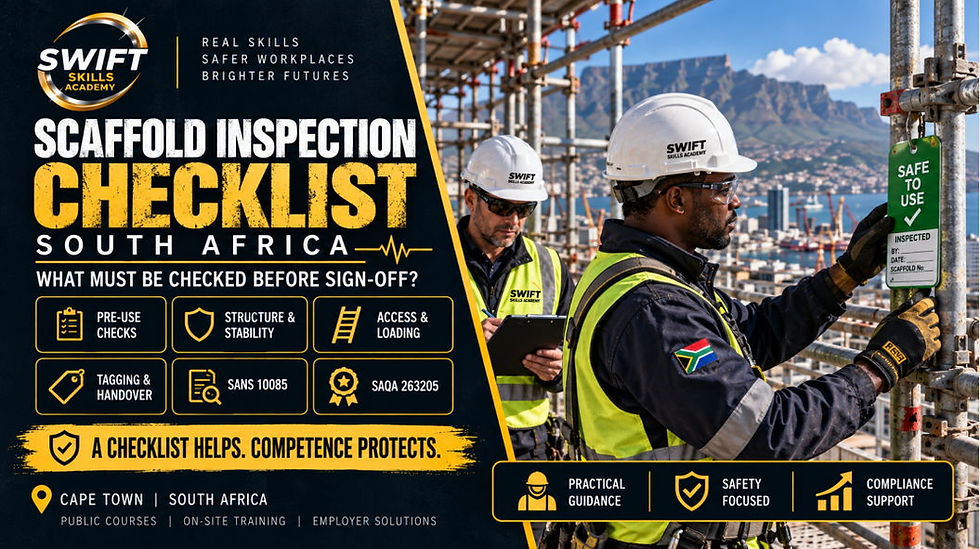
Quick Answer: A scaffold inspection checklist South Africa should help a competent person systematically check the scaffold's identity, surroundings, foundations, structure, bracing, ties, platforms, edge protection, access, loading, visible defects, modifications, tagging, inspection records and handover status before the scaffold is released for use.
But the checklist is only the inspection aid.
It is not the competence itself.
South Africa's Construction Regulation 16 requires a contractor to appoint a competent person in writing to supervise scaffolding operations and requires scaffold erectors, team leaders and inspectors to be competent for their work. Access scaffolding in use must comply with the applicable incorporated safety standards.
Scaffold Inspection at a Glance
Inspection area | Core question before sign-off |
Scaffold identity | Are we inspecting the correct scaffold for the correct intended use? |
Site surroundings | Are nearby excavations, traffic, overhead hazards or other site conditions affecting it? |
Foundations | Is the scaffold properly supported, stable and free from visible settlement? |
Structure | Are standards, ledgers, transoms, connections, bracing and ties satisfactory? |
Platforms | Are working platforms secure and suitable? |
Edge protection | Are guardrails, midrails and toe boards present where required? |
Access | Can workers enter and leave safely? |
Loading | Is the scaffold being used within its intended loading and purpose? |
Alterations | Has anything changed since the previous inspection? |
Defects | Is any condition serious enough to prevent use? |
Tag/status | Does the displayed status agree with the actual inspection decision? |
Register | Is the inspection result traceable? |
Handover | Is the scaffold genuinely ready to be released for its intended use? |
Who Is Responsible for Scaffold Inspection in South Africa?
Scaffold inspection should not be assigned simply to the most senior employee standing nearby.
Construction Regulation 16 requires competent people to be involved in scaffold operations. The Construction Regulations define competence through appropriate knowledge, training and experience and, where applicable, qualifications specific to the work or task.
Historically, SAQA Unit Standard 263205 was specifically titled “Inspect access scaffolding.” Its outcomes included understanding scaffold types and compliance, explaining inspector responsibilities, interpreting drawings and specifications, inspecting access scaffolding, completing inspection registers and handover documentation, and reinspecting modified systems. (SAQA)
That provides an excellent description of what competent scaffold inspection actually involves.
It is considerably more than:
“Look at it and tick the boxes.”
Scaffold Inspection Checklist South Africa: The 8 Inspection Areas That Matter
1. Scaffold Identity, Scope and Intended Use
Before inspecting components, establish what you are actually inspecting.
Record or confirm the scaffold identifier, location, intended purpose and the work it must support.
Ask whether the scaffold being inspected is the scaffold shown in the relevant drawing, instruction, handover record or workplace documentation where those documents apply.
A technically sound scaffold used for a different purpose from the one for which it was planned can still create risk.
2. Surrounding Site and Interface Hazards
This is one area I would add because many checklist articles focus only on the steel structure.
Look around the scaffold as well as at it.
Consider nearby excavations or undermining, moving vehicles or plant, overhead work, electrical hazards, falling-object exposure, adjacent structures, public access and any change to the surrounding work area that could affect safe use.
An inspection should consider the scaffold in its actual operating environment, not as an isolated structure.
3. Foundations, Base Support and Stability
Check whether the supporting surface appears suitable and stable.
Look for visible sinking, settlement, movement or undermining.
Confirm base plates and sole boards where required, check whether standards appear properly supported and identify anything suggesting the scaffold has shifted.
Do not green-tag an unstable scaffold because every component above ground looks tidy.
The foundation supports every decision above it.
4. Standards, Ledgers, Transoms, Bracing, Ties and Connections
Inspect the main structural elements systematically.
Look for missing or loose members, damaged components, displaced connections, visibly bent or badly corroded parts, missing bracing, altered ties and unauthorised changes.
Do not assume that because a scaffold was erected correctly it remains unchanged.
Workers, other contractors and site activity can alter scaffold conditions after handover.
5. Platforms, Guardrails and Edge Protection
Working platforms should be examined for condition, security, dangerous gaps, displaced or damaged boards and obvious trip hazards.
Where the work requires edge protection, examine guardrails, midrails and toe boards.
Ask whether any component has been temporarily removed to make the work “easier.”
Temporary shortcuts often become permanent exposure.
6. Access, Loading and Housekeeping
Inspect how workers enter and leave the scaffold.
Check ladders or other access arrangements, openings, access routes and anything that could force a worker into unsafe climbing.
Then look at how the scaffold is actually being used.
Consider stored materials, excessive loading, poorly distributed loads, debris, hoses, cables, tools, slippery surfaces and falling-object exposure.
A scaffold may have been handed over correctly and later become unsafe because of how it is being used.
7. Defects, Alterations and Reinspection
One of the strongest inspection questions is:
Has anything changed?
SAQA 263205's historical outcomes specifically required modified access-scaffolding systems to be reinspected in accordance with applicable safety requirements and SANS 10085. (SAQA)
That matters because an old inspection does not automatically describe a newly modified scaffold.
Changes that should trigger attention may include alteration, removed components, damage, impact, changing support conditions or any other event that creates reasonable uncertainty about continued safe use.
When conditions have changed, inspect the current scaffold—not the memory of the previous scaffold.
8. Tagging, Register and Handover Evidence
The inspection decision must be traceable.
The historical SAQA 263205 standard explicitly identifies access-scaffolding inspection registers, handover certificates and the green tag as documentation/signage relevant to the inspector role. (SAQA)
An inspection record should make it possible to understand which scaffold was inspected, when, by whom, what the outcome was, what defects or restrictions were identified and whether corrective action or reinspection was needed.
A tag should communicate the status resulting from a real inspection.
It should never become a substitute for one.
When Should a Scaffold Be Marked Not Safe for Use?
A competent inspector should not be pressured into approving a scaffold simply because production needs to continue.
Conditions that can justify stopping use or withholding handover include serious instability, unsafe foundations, major settlement, missing or compromised structural elements, incomplete platforms, inadequate edge protection, unsafe access, major visible damage, dangerous overloading, unauthorised modification or any condition where the inspector cannot reasonably establish that the scaffold is suitable for use.
The correct response to uncertainty is not:
“It is probably fine.”
It is:
record, restrict, correct and re-inspect as required.
The inspection decision must come before production pressure.
What Does a Green Scaffold Tag Actually Mean?
A green tag should be the result of an inspection decision, not the inspection itself.
SAQA 263205 specifically referenced the green tag as part of access-scaffolding documentation and signage. (SAQA)
One mistake current online checklist content makes is treating colour systems as though every colour has an identical statutory meaning on every South African site.
Do not make that assumption.
The Construction Regulation itself does not prescribe a complete universal green/yellow/red/orange taxonomy. Sites may use additional colour/status systems according to their own procedures.
The stronger rule is:
understand the status written on the tag and the procedure governing that site.
Colour without meaning is weak control.
What Should Be Recorded in a Scaffold Inspection Register?
A useful scaffold register should allow somebody reviewing the safety file to reconstruct the decision.
At minimum, the record should identify the scaffold, date, responsible inspector and outcome. Where defects, restrictions, modifications or corrective action exist, they should be traceable.
The historical SAQA 263205 outcomes went further: inspectors were expected to complete the Access Scaffolding Register and Handover Certificate after inspection or reinspection, issue them and sign them off in accordance with the relevant requirements. (SAQA)
That is why the register should not become a notebook containing only:
“Checked — OK.”
Good evidence tells the next person what was actually decided.
When Should Scaffolding Be Reinspected?
Do not create a universal inspection-frequency claim unless the applicable standard and site requirements actually support it.
What we can state confidently is that a modified scaffold requires renewed inspection attention, and the historical SAQA inspection standard specifically included reinspection of modified systems. (SAQA)
Your site's procedure, applicable SANS requirements, contract/client specifications and risk conditions may identify additional inspection triggers.
The practical rule is simple:
if something has occurred that may affect the scaffold's condition, configuration, stability or intended use, do not rely blindly on the old inspection.
How Does SANS 10085-1:2024 Fit Into the Checklist?
The current edition referenced by the South African Government Gazette is SANS 10085-1:2024 — The design, erection, inspection, use, modification and dismantling of steel access scaffolding and working platforms, Part 1: General.
The Gazette describes its scope as covering minimum specifications, design requirements and guidance for the safe erection, inspection, use, modification and dismantling of scaffold components for independent, tower and birdcage scaffolds. (Government of South Africa)
That makes SANS 10085-1:2024 central to the technical context behind a serious South African scaffold inspection system.
But do not reproduce the standard from somebody else's website.
SANS standards are copyrighted. The complete current standard should be obtained through SABS or another authorised standards channel. SABS provides official access and purchasing routes. (SABS)
What Is the Status of SAQA 263205 in 2026?
This section is essential because it immediately makes the article more current than much of the competition.
SAQA Unit Standard 263205 — Inspect access scaffolding was historically registered at NQF Level 4 with 6 credits.
SAQA currently records:
Item | Official status |
Unit Standard | 263205 |
Title | Inspect access scaffolding |
NQF Level | 4 |
Credits | 6 |
Registration end date | 30 June 2023 |
Current status | Passed the End Date |
Last enrolment date | 30 June 2026 |
Last achievement date | 30 June 2029 |
(SAQA)
Because the last enrolment date has now passed, employers and learners should not assume that a new course booking in late 2026 automatically constitutes enrolment against legacy SAQA 263205.
Swift Skills Academy's current Scaffold Inspector training page therefore treats SAQA 263205 as a legacy reference and states that the current assessment and certification pathway should be confirmed in writing before booking. (Swift Skills Academy)
That is the language I would use throughout the article.
Not:
“Book our SAQA 263205 qualification.”
But:
“Understand the legacy inspection outcomes and confirm the current training and certification pathway before enrolment.”
What Should an Employer Keep in the Scaffold Inspection Evidence Pack?
The strongest employers do not rely on a green tag by itself.
The evidence system should connect the responsible people to the actual scaffold and the actual decision.
Depending on the project, relevant evidence can include written appointments, competence/training records, scaffold identification, drawings or specifications where applicable, inspection registers, handover records, defect reports, corrective-action evidence, modification/reinspection records and site procedures.
The central question for an auditor or principal contractor should be easy to answer:
Who inspected this scaffold, what supported their competence, what did they find, and why was it released for use?
If your file cannot answer that coherently, there is a gap.
60-Second Scaffold Inspection Readiness Test
Question | Ready | Investigate |
Scaffold clearly identified? | Yes | ID/location unclear |
Intended use known? | Yes | Use/load uncertain |
Competent inspector assigned? | Yes | Responsibility unclear |
Foundations satisfactory? | Yes | Movement/settlement |
Structural members satisfactory? | Yes | Missing/damaged components |
Bracing/ties satisfactory? | Yes | Loose/missing/altered |
Platforms and edge protection satisfactory? | Yes | Gaps/missing protection |
Safe access available? | Yes | Unsafe climbing/access |
Loading controlled? | Yes | Overload or inappropriate storage |
Modifications addressed? | Yes | Unauthorised change |
Defects closed out? | Yes | Outstanding defects |
Tag agrees with inspection? | Yes | Status conflict |
Register complete? | Yes | Weak/no record |
Handover clear? | Yes | Release status uncertain |
If several answers fall into Investigate, the correct next step is not faster paperwork.
It is stronger control.
Frequently Asked Questions
What should be included in a scaffold inspection checklist South Africa?
It should cover scaffold identity, surrounding hazards, foundations, structural components, bracing, ties, platforms, edge protection, safe access, loading, housekeeping, visible defects, modifications, tagging, inspection records and handover status.
Who is allowed to inspect scaffolding in South Africa?
Construction Regulation 16 requires competent people for scaffold work and specifically refers to scaffold erectors, team leaders and inspectors. Competence involves task-specific knowledge, training and experience and, where applicable, qualifications.
Is a scaffold inspection checklist enough to make somebody competent?
No. A checklist structures the inspection; it does not create the knowledge, training, experience or judgement required to perform the role competently.
What is SAQA 263205?
SAQA 263205 is the legacy unit standard titled Inspect access scaffolding, historically registered at NQF Level 4 with 6 credits. Its last enrolment date was 30 June 2026 and its last achievement date is 30 June 2029. (SAQA)
Can I still enrol for SAQA 263205 in September 2026?
The SAQA record gives 30 June 2026 as the last enrolment date, so a new learner should not assume that current training equals new enrolment against the legacy unit standard. Confirm the current assessment and certification pathway before booking. (SAQA)
Does a green tag mean a scaffold can never become unsafe?
No. The tag represents an inspection/status decision at a point in the scaffold's control process. Conditions can change through modification, damage, loading, site activity or other factors.
What happens after a scaffold is modified?
The scaffold should receive appropriate renewed inspection attention before the modified configuration is relied upon. The historical SAQA 263205 outcomes specifically included reinspection of modified access-scaffolding systems. (SAQA)
Is Working at Heights training the same as scaffold inspection training?
No. Working at Heights addresses fall-risk activities. Scaffold inspection addresses the competence required to inspect access scaffolding and support inspection/handover decisions.


