Scaffold Inspector Course South Africa: Fees, SAQA 263205 & Training
Updated: 6 days ago

Quick Answer: Scaffold Inspector Course South Africa — Price, SAQA & Training
A scaffold inspector course in South Africa trains suitable learners to inspect access scaffolding, identify possible defects, understand drawings and inspection responsibilities, and manage records and handover. Swift Skills Academy advertises a one-day Scaffold Inspector programme in Cape Town from R1,028 VAT included. The course references legacy SAQA Unit Standard 263205, Inspect access scaffolding, NQF Level 4 with six credits. Ask the provider to confirm current assessment, previous learning, certification and any legitimate NQF-credit outcome before enrolling.
A certificate of attendance assessed competence, registration of NQF credits, professional recognition and written appointment at work are not the same thing. This buyer's guide compares costs, scope, prerequisites, course types and the real questions to ask before paying.
Scaffold Inspector Course Fees and Duration at a Glance
Course decision | What to know |
SSA starting fee | From R1,028, VAT included on the official 2026 SSA price page; obtain a current written quote. |
SSA advertised duration | One day in Cape Town; on-site/group delivery quoted separately. |
SAQA reference | Legacy Inspect access scaffolding, NQF Level 4, six credits, US 263205. |
Prior learning | Communication, Mathematical Literacy and scaffold erection competence at NQF Level 3 are assumed. |
Training outcome | Scaffold types, drawings, inspector responsibilities, defect checks, registers and handover. |
Current certification | Provider must confirm assessment arrangements, certificate wording and any NQF-credit award. |
No automatic guarantee | Attendance does not guarantee employment, designation, inspector appointment or credits. |
What Does a Scaffold Inspector Course Actually Teach?
The purpose of scaffold inspection is to judge whether access scaffolding meets the relevant use, design, configuration and site requirements. Inspectors need to identify defects and unsafe conditions, understand limits of the scaffold system, maintain records and support controlled handover. The role goes beyond general Working at Heights awareness.
A good programme should explain the actual practical activities and how the learner is assessed. The ability to recognise a defect, interpret a drawing or record an inspection matters more than simply attending a classroom presentation.
Scaffold types, components and limitations
Training should cover the kinds of access scaffolding being used, their intended applications, scaffold components, stable supports, working platforms, ties, bracing, safe access and limitations. The inspector should understand when design information or engineering guidance is required rather than assuming their own approval covers special structures.
Reading drawings and client specifications
Site instructions and drawings help explain how scaffolding is intended to be built and used. A competent inspector must compare actual conditions with relevant specifications and report inconsistencies. The skill is not the same as designing an engineered scaffold.
Defects, inspection registers and handover
Inspectors should learn to document scaffold identity, inspection dates, findings, any restrictions and corrective actions. Handover and re-inspection after modifications are core inspection principles. A green scaffold tag is a communication tool, not independent proof that a modified structure remains safe.
SAQA 263205 in 2026: NQF Level, Credits and
Registration Status
The South African Qualifications Authority describes Unit Standard 263205, Inspect access scaffolding, at NQF Level 4 and six credits. Its registration end date was 30 June 2023. Both official SAQA display pages checked on 31 October 2026 show the last enrolment date as 30 June 2028 and last achievement as 30 June 2031. These dates reflect a legacy transition record, not automatic proof that a particular short-course provider has an authorised new credit-bearing intake.
Ask for written confirmation of the programme being offered, what previous learning is required, who assesses competence, how any credits would be recorded, and the exact certificate issued. Claims about accreditation and registered credits need evidence for the programme and learner concerned.
Previous learning assumed by SAQA 263205
SAQA lists Communication at NQF Level 3, Mathematical Literacy at NQF Level 3, and competence in erecting, using and dismantling access scaffolding at NQF Level 3. Employers and providers may also require documented experience or fitness appropriate to the actual practical task.
This is why an absolute beginner should not assume a scaffold inspector course is a substitute for foundation scaffold training. Prior learning and real scaffold-system familiarity should be reviewed before enrolment.
Attendance versus assessment versus workplace authorisation
Attendance confirms participation. Practical assessment should demonstrate relevant competence. NQF-credit achievement relies on current recognised assessment and quality-assurance arrangements. An employer appointment and a professional-body designation each have their own requirements and cannot simply be inferred from attendance.
Who Should Attend Scaffold Inspector Training?
Scaffold erectors progressing into inspection
Workers already competent in erecting and using access scaffolding may progress to inspection when they meet the actual admission requirements. Their practical experience is valuable for recognising changes in stability, safe access, components and platform conditions.
Safety officers, supervisors and SHEQ staff
A safety role may require scaffold inspection understanding, but holding a general safety certificate does not automatically prove scaffold inspector competence. Match the course and previous experience to the specific inspection responsibilities intended.
Contractors and employers planning a team
Training procurement should identify who erects, who inspects, who supervises and who maintains registers and handover evidence. People performing different jobs may need different programmes. A role-based training plan helps prevent avoidable courses and compliance gaps.
Scaffold Inspector Course Cost South Africa: What Is Included?
SSA's official Cape Town course-price page currently advertises Scaffold Inspector Training from R1,028, VAT included. The dedicated commercial course page describes a one-day programme. Confirm the total current price, practical and assessment arrangements, materials, PPE, training date and certificate wording before payment. Employer and on-site arrangements require their own quotation.
It is easy to compare two course advertisements by price alone. It is harder, but more useful, to establish whether they cover the same scaffold systems, prerequisite learning, practical assessment, hours and certificate status. A two-day or five-day combined programme may include activities that a one-day inspector course does not, or address a different type of scaffold.
Checklist for a written quotation
Ask for the VAT-inclusive total; course venue and dates; duration; number of participants; prior-learning requirements; practical activities; assessment and re-assessment fees; certificate title and issuing authority; travel and equipment charges for on-site delivery; and what is not included.
If a provider references a legacy SAQA unit standard, request clarity on the current enrolment and credit-award route. A training quotation should never imply statutory authorisation that a course cannot itself provide.
How to Compare Scaffold Inspector Training Providers
Course or training route | Buying question |
SSA one-day Cape Town programme | From R1,028 VAT included; confirm assessment and certificate wording. |
Other specialist inspector short courses | Check 2–3-day offerings, prior erector experience and actual assessment. |
Combined tower erector and inspector | A multi-day combined course may serve different systems and roles; not directly equivalent. |
Professional-body recognition | May require substantial experience and additional recognition, not merely course attendance. |
Public vs employer on-site training | Compare learner numbers, facilities, equipment, travel, downtime and written quotations. |
Certificate and NQF-credit claims | Ask for supporting evidence rather than relying on the words accredited or certified alone. |
The right course is the one that gives the learner suitable, verifiable knowledge and evidence for the work they will do. Shortest, longest, cheapest and most expensive are not reliable substitutes for checking programme quality and the proposed outcomes.
Scaffold Inspector vs Scaffold Erector vs Working at Heights
Scaffold Erector training addresses erecting, using and dismantling access scaffolding. Inspector training addresses assessing the scaffold, identifying defects and controlling inspection/handover documentation. Working at Heights deals with fall-risk controls for people working at height. These are connected safety disciplines but not interchangeable assessments.
When the scaffold erection foundation should come first
The legacy inspector standard assumes erection competence at NQF Level 3. Learners without that foundation should ask which learning or recognition-of-prior-learning evidence is required. A general Working at Heights certificate alone does not demonstrate the technical scaffold knowledge assumed.
When a supervisor needs more than short-course attendance
A contractor's appointed supervisor may need broader responsibilities and proven experience. One course certificate cannot cover every type of scaffold or replace the competent person's judgement and duties under the applicable site arrangements.
Construction Regulations, SANS 10085 and Workplace Competence
Construction Regulation 16 of the 2014 Construction Regulations requires a contractor to appoint competent scaffold supervision in writing and ensure scaffold erectors, team leaders and inspectors are competent. Scaffolding in use must meet applicable incorporated safety standards. The contractor remains responsible for sensible work allocation, supervision and the actual site system.
SANS 10085-1:2024 is relevant to steel access scaffolding and working platforms. A course should explain the applicable principles, but an authorised copy of the current standard, scaffold drawings, manufacturer requirements and site controls must inform real decisions. Inspectors should escalate designs and technical questions beyond their competence.
Green tags, handover and scaffold modification
A tag or inspection certificate communicates a decision only when a reliable inspection has occurred. If the scaffold is changed, damaged or otherwise affected by conditions that may change safety, re-inspection and appropriate restrictions may be necessary. Do not treat a previous green tag as a universal guarantee.
Employer Scaffold Training Procurement Checklist
Employer question | Evidence to request |
Roles and responsibilities | Map users, erectors, inspectors, supervisors and document custodians. |
Entry learning and experience | Collect previous scaffold training and practical site experience. |
Programme and assessment | Confirm relevant scaffold systems, practical tasks and measurable learning. |
Certificate outcome | Verify issuing organisation, title and any legitimate credit claim. |
Legal and site controls | Written competent-person arrangements and inspection/handover processes. |
Inspection and defect records | Registers, restrictions, re-inspection and evidence trail. |
Quotation | VAT-inclusive cost, number of learners, training location, travel and materials. |
A written team training plan based on actual job duties is more valuable than bulk booking everyone on the same course. Employer enquiries should specify site location, scaffold type, learner background, course goals, and whether the contractor needs public dates or on-site delivery.
How to Enrol in Scaffold Inspector Training in Cape Town
Begin with the correct job role and your previous scaffolding learning. Review SSA's official Scaffold Inspector course page for the current offer, then submit a booking, fees or callback enquiry using the programme-specific route. For employer training, provide the team size, relevant scaffold systems, location and what duties the learners will perform.
SSA's current advertised offer is one day, with a starting price of R1,028 VAT included. Enrol only after confirming the course date, exact quote, assessment arrangements and certificate wording. The blog is a decision guide; the dedicated course page is the commercial booking destination.
Avoiding Confusion with SSA's Other Scaffold Guides
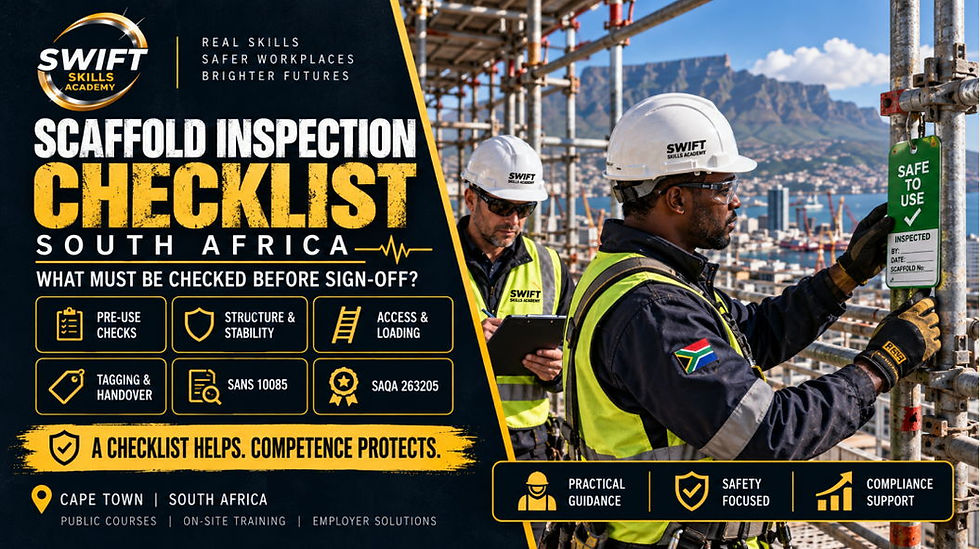
This article answers course price, comparisons and purchasing decisions. The Scaffold Inspector career guide answers job-pathway and salary questions; the SAQA 263205 guide explores unit-standard outcomes; and the scaffold inspection checklist covers defect records, tags, sign-off and handover. Linking those resources gives readers the full pathway without filling every article with duplicate sales copy.
Frequently Asked Questions About Scaffold Inspector Courses
How much does a scaffold inspector course cost in South Africa?
SSA advertises Inspector training from R1,028 VAT included in its official 2026 list. Confirm the current written quote and what is included.
How long does scaffold inspector training take?
SSA's Cape Town format is advertised as one day; other programmes vary by scope, assessment and prior experience.
What is SAQA 263205?
A legacy NQF Level 4 unit standard worth six credits, titled Inspect access scaffolding.
Is SAQA 263205 still open for enrolment?
Official SAQA display records checked on 31 October 2026 show a passed registration end date and transitional last enrolment on 30 June 2028, but eligibility depends on provider and programme arrangements.
What are the entry requirements?
Communication and Mathematical Literacy at NQF Level 3 and access scaffolding erection competence at NQF Level 3 are assumed by the legacy standard.
Must I complete scaffold erector training before inspection?
An appropriate erection foundation is assumed; your provider should advise what training or prior-learning evidence is accepted.
Does attendance automatically award six credits?
No. Any award requires valid enrolment, assessment and applicable quality assurance.
Can safety officers attend?
They may need scaffold-specific prior learning or experience depending on the intended inspector duties.
Does Working at Heights qualify a scaffold inspector?
No. Fall-risk awareness is different from inspecting access-scaffold systems.
Does a certificate authorise me to inspect a site?
No. Competence, job scope, experience and the employer's required arrangements must be established.
Can employers book group or on-site training?
Yes. Use SSA's programme-specific on-site route and provide group size, work roles and location.
Where can I book training in Cape Town?
SSA's official Scaffold Inspector course page and booking contact route provide the current commercial offer.
Authoritative Sources & Regulatory References
The following references support the legacy SAQA, legal and price information. Confirm the training and certificate outcome for the actual learner in writing.
Read More: Three Related Scaffold Guides
Final Word: Compare Competence, Not Just the Headline Price
The correct Scaffold Inspector course is one that fits the learner's previous knowledge, the actual scaffold system, the assessed outcomes and the employer's intended responsibilities. Verify VAT-inclusive fees, course scope, certificate authority, SAQA transition status, dates and assessment arrangements instead of choosing purely by the shortest duration or lowest advertised amount.
Swift Skills Academy's dedicated commercial course page is the appropriate place to confirm its current Cape Town training offer, while its programme-specific contact routes can guide individual learners and employer teams toward an informed decision.