
Stick Welding Course Cape Town: Price, Duration, SMAW Skills, Electrodes & Positions
Updated: 2 days ago
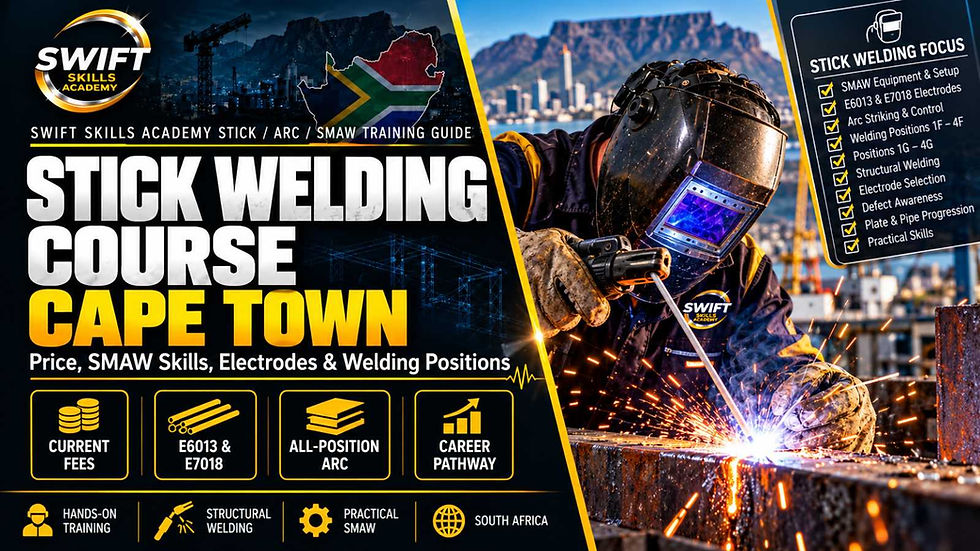
Quick Answer: How Much Does a Stick Welding Course in Cape Town Cost?
A Stick welding course Cape Town option at Swift Skills Academy currently starts from approximately R5,148 for Basic Arc Welding / SMAW. Advanced Structural Arc Welding starts from approximately R11,628, while the combined Arc Welding training bundle starts from approximately R15,128. These are published starting prices; the current written quotation should confirm the exact scope, practical hours, assessment and inclusions before enrolment. Swift Skills Academy
Stick welding is formally called Shielded Metal Arc Welding (SMAW) and is also widely known as ARC welding or Manual Metal Arc welding (MMA). It uses a flux-coated consumable electrode that melts as the weld progresses, while the flux produces shielding and slag around the weld pool.
Stick welding route | Main focus | Current SSA starting price |
Basic Arc / SMAW | Foundational carbon-steel Stick welding | From R5,148 |
Advanced Structural Arc | Vertical and overhead plate positions | From R11,628 |
Arc Welding Bundle | Foundational through advanced SMAW progression | From R15,128 |
SSA's current Stick guide separates basic downhand development from advanced structural positions rather than treating ARC welding as one generic course. Swift Skills Academy
What Is Stick Welding?
Stick welding is a manual arc-welding process in which an electric arc forms between a flux-coated consumable electrode and the workpiece.
As the electrode burns:
its metal core becomes filler metal;
the flux coating helps protect the molten weld;
slag forms over the finished bead;
and the electrode becomes progressively shorter.
That final point is important.
Unlike MIG, where wire is fed automatically through a welding gun, a Stick welder has to compensate continually for the electrode becoming shorter while still controlling:
arc length;
electrode angle;
travel angle;
travel speed;
amperage;
weld-pool size;
slag behaviour;
joint position;
and body position.
AWS describes SMAW training as requiring control over amperage, polarity, arc starting, arc length, work angle, travel speed and electrode handling. American Welding Society
That is why apparently simple equipment does not mean Stick welding is technically simple.
Is ARC Welding the Same as Stick Welding?
In everyday training and workshop language, ARC welding is frequently used to mean Stick welding.
More precisely:
Stick welding = SMAW = Shielded Metal Arc Welding.
“Arc welding” is technically a broader family of processes because MIG, TIG, FCAW and SMAW all use an electric arc.
So when somebody advertises an “ARC welding course”, ask which process is actually being taught.
For SSA's course structure, the ARC pathway refers to SMAW / Stick welding.
Is SMAW the Same as MMA Welding?
Yes, in this context.
Two widely used terms describe essentially the same process:
SMAW — Shielded Metal Arc Welding
MMA / MMAW — Manual Metal Arc Welding
The terminology differs geographically and between standards, training organisations and industries.
A learner searching for:
Stick welding courseARC welding courseSMAW courseMMA welding training
may therefore be looking for the same core welding process.
That semantic distinction matters because it lets the article answer several real search variations without stuffing unrelated keywords onto the page.
Why Is Stick Welding Still Used?
Stick welding remains useful because the process is relatively portable and does not normally depend on an external shielding-gas cylinder.
That can make it practical for work involving:
construction;
structural fabrication;
maintenance;
repairs;
field work;
outdoor applications;
heavy steel;
site work;
agricultural repairs;
plant maintenance;
and some pipe-welding applications.
This does not mean SMAW works perfectly in every outdoor condition.
Wind, rain, contamination, electrode condition, joint preparation and the welding procedure still matter.
The correct conclusion is:
Stick welding can be highly practical for field and structural work, but process suitability still depends on the actual job.
What Do You Learn in a Stick Welding Course?
A strong Stick course should build the learner from machine setup and safe arc striking toward controlled fillet and groove welds.
1. SMAW Equipment Setup
Learners should understand equipment such as:
welding power source;
electrode holder;
work-return clamp;
welding leads;
electrode;
welding helmet;
protective clothing;
chipping hammer;
wire brush;
grinder;
joint-preparation tools;
and suitable ventilation/extraction controls.
Training should also cover pre-use inspection.
Damaged leads, loose connections or poor work-return placement can create both safety and welding-quality problems.
2. Striking and Maintaining the Arc
One of the first frustrations for a beginner is the electrode sticking to the plate.
Arc initiation commonly involves a controlled:
scratch technique;
or tapping technique.
AWS identifies both scratch-start and tap-start techniques as foundational SMAW skills. American Welding Society
Once the arc starts, the learner must maintain a suitable arc length.
Too long an arc can contribute to:
instability;
excessive spatter;
poorer shielding;
irregular bead shape;
and potential porosity.
Too short an arc can result in:
sticking;
unstable movement;
and loss of weld-pool control.
3. Electrode Angle
A Stick electrode is not simply pointed at the joint.
The welder has to control both:
work angle — the electrode's relationship to the joint;
and
travel angle — the electrode's relationship to the direction of travel.
The correct angle varies with:
joint configuration;
welding position;
electrode type;
technique;
and procedure requirements.
4. Travel Speed
Travel too slowly and the bead may become excessively wide or convex.
Travel too quickly and the weld may become too narrow or suffer from insufficient fusion or inadequate bead size.
The learner must therefore read the weld pool—not simply move at a memorised speed.
5. Slag Control
Because SMAW uses a flux-coated electrode, slag forms over the weld.
Slag must be managed and removed appropriately before subsequent weld passes.
Poor slag control can contribute to slag inclusions, particularly during:
multi-pass welding;
vertical welding;
poor bead placement;
inadequate cleaning;
or incorrect manipulation.
Stick Welding Electrodes Explained
This is one of the biggest semantic opportunities in the article.
A welding rod is not simply “a rod.”
Different electrode classifications have different intended characteristics.
Common carbon-steel electrodes encountered in training and industry include:
E6010;
E6011;
E6013;
E7018.
The exact electrode used should follow the:
material;
welding procedure;
position;
polarity;
power source;
mechanical-property requirements;
and manufacturer specifications.
AWS training material, for example, discusses E6010 and low-hydrogen E7018 as distinct electrode types with different care and application considerations. American Welding Society
What Does E6013 Mean?
The electrode classification contains information about properties and intended use.
Rather than teaching learners merely to memorise the number, good training should help them understand that electrode selection affects:
arc behaviour;
deposition;
penetration;
slag;
positional suitability;
polarity;
mechanical properties;
and handling requirements.
E6013 is commonly encountered in general fabrication and training environments because of its comparatively user-friendly arc characteristics.
That does not mean E6013 is the correct electrode for every structural weld.
What Is E7018?
E7018 belongs to a low-hydrogen electrode family widely used where stronger control over hydrogen and mechanical properties may be required.
Its handling can therefore be more demanding than simply opening a packet and welding.
Depending on the specification and product, low-hydrogen electrodes may require controlled storage and exposure management.
A learner should understand:
Correct electrode selection and storage are part of welding quality—not housekeeping trivia.
AWS specifically distinguishes the handling and use of E7018 from other electrode types in foundational SMAW education. American Welding Society
E6013 vs E7018: Which Electrode Is Better?
Neither electrode is universally “better.”
They are used for different requirements.
Question | E6013 | E7018 |
Common in introductory training? | Often | Often introduced as skills progress |
Electrode family | Rutile-type general-purpose applications | Low-hydrogen family |
Handling sensitivity | Generally less demanding | More controlled handling may be required |
Arc behaviour | Often considered relatively learner-friendly | Requires disciplined technique |
Typical decision factor | General fabrication / procedure | Structural/mechanical requirements / procedure |
Should it be chosen solely by preference? | No | No |
The correct choice should come from the application and welding procedure—not from which electrode produces the nicest-looking bead for one welder.
What Amperage Should You Use for Stick Welding?
There is no single correct amperage for every Stick electrode.
Required current depends on factors including:
electrode classification;
electrode diameter;
material;
joint;
welding position;
polarity;
machine;
and the applicable procedure or manufacturer's data.
AWS describes electrode diameter as one factor used to establish an initial amperage range during training, while WPS requirements ultimately govern production work. American Welding Society
So searches such as:
“What amps for a 3.2 mm welding rod?”
should not be answered with one universal number.
The correct training behaviour is:
identify electrode → check product data / WPS → select permitted range → make controlled adjustment based on the weld.
Which Polarity Should Be Used for Stick Welding?
Again, there is no universal answer.
Depending on the electrode and procedure, Stick welding may use:
DC electrode positive;
DC electrode negative;
AC;
or more than one permitted option.
TWI specifically notes that not every MMA electrode can be used with every polarity and that polarity choice depends on electrode specification, material, welding position and joint design. TWI Global
So the correct rule is:
Do not choose polarity from habit. Follow the electrode specification and welding procedure.
Stick Welding Positions Explained
Training level changes dramatically once welding moves away from the flat position.
Position | General description |
1F | Flat fillet weld |
2F | Horizontal fillet |
3F | Vertical fillet |
4F | Overhead fillet |
1G | Flat groove weld |
2G | Horizontal groove weld |
3G | Vertical groove weld |
4G | Overhead groove weld |
SSA's current Basic Arc pathway focuses on foundational positions such as 1F, 2F and 1G, while Advanced Structural Arc progresses into 3F, 4F, 3G and 4G. Swift Skills Academy
Why Does Vertical Stick Welding Become Harder?
Gravity changes weld-pool behaviour.
The welder must manage:
molten metal;
slag;
sidewall fusion;
electrode angle;
travel speed;
arc length;
manipulation;
and heat input.
A technique that produces an acceptable flat weld may perform poorly in vertical welding.
That is why a beginner should not treat 3G as simply “1G while standing differently.”
It is another level of process control.
Why Is Overhead Stick Welding Difficult?
In an overhead position, gravity works directly against the weld pool.
The welder must control:
pool size;
arc length;
electrode manipulation;
heat;
travel speed;
and body position
while also managing increased exposure to hot slag and spatter.
This is where correct PPE and disciplined technique become particularly important.
Does All-Position Stick Welding Include 5G and 6G Pipe?
No—not automatically.
This is a very important distinction.
An all-position structural plate course may cover:
1G;
2G;
3G;
4G;
and associated fillet positions.
Pipe introduces separate geometry and technique.
Typical pipe-position terminology includes:
1G — rolled pipe;
2G — fixed vertical-axis pipe;
5G — fixed horizontal pipe;
6G — fixed inclined pipe.
SSA's current Stick article correctly distinguishes its advanced structural plate route from pipe-specific training. Swift Skills Academy
A learner who can weld 4G plate should therefore not automatically claim 6G pipe competence.
That deeper intent belongs to the dedicated Pipe Welding guide.
Basic ARC vs Advanced Structural ARC vs the ARC Bundle
Question | Basic ARC | Advanced Structural ARC | ARC Bundle |
Best suited to | Beginners | Learners with foundational SMAW control | Learners seeking structured progression |
Main material | Carbon steel | Carbon steel | Carbon steel |
Main development | Arc and downhand control | Vertical and overhead | Basic through advanced |
Typical positions | 1F, 2F, 1G development | 3F, 4F, 3G, 4G development | Broader plate progression |
Starting price | R5,148 | R11,628 | R15,128 |
Automatically coded? | No | No | No |
Automatically Red Seal? | No | No | No |
Current pricing is taken from SSA's September 2026 welding-price guide and current Stick page. Swift Skills Academy
For an inexperienced learner, jumping directly into advanced positions simply because “advanced” sounds better can waste practical time.
The correct route depends on demonstrated competence.
Stick Welding Course Cape Town: How Long Does Training Take?
SSA currently publishes an eight-week duration for its broader Shielded Metal Arc Welding programme, while individual Basic Arc, Advanced Arc and bundled programmes can differ according to practical scope, positions, experience and assessment requirements. Swift Skills Academy
That distinction is important.
Course duration is not the same as time required to become a highly competent welder.
Competence develops through:
guided practice;
repetition;
correction;
positional progression;
troubleshooting;
workplace exposure;
and assessment.
Two learners can attend the same programme and still progress at different speeds.
Is Stick Welding Good for Beginners?
Yes—provided the learner understands that Stick is not necessarily the easiest process.
It is a strong foundational process because poor technique becomes visible quickly.
A beginner has to learn to control:
arc starting;
arc length;
electrode burn-off;
movement;
travel speed;
joint preparation;
slag;
current;
and position.
AWS notes that SMAW is often used as a foundational welding process in technical education precisely because it develops important manual control. American Welding Society
A beginner therefore should not ask only:
“Which welding process is easiest?”
A better question is:
“Which process develops the skills required for the work I want to do?”
Stick vs MIG Welding
Stick and MIG can both weld carbon steel, but the process behaviour is different.
Factor | Stick / SMAW | MIG / GMAW |
Electrode | Flux-coated stick electrode | Continuous wire |
External shielding gas | Usually not required | Normally required |
Electrode feed | Manual consumption | Automatic wire feed |
Slag | Yes | Usually no slag in solid-wire GMAW |
Portability | Strong | Depends on equipment/gas setup |
Outdoor practicality | Often favourable | Shielding gas can be disrupted by wind |
Production speed | Moderate | Often faster |
Beginner coordination | Demanding | Often easier initially |
Structural/site use | Strong application | Also used depending on work |
Workshop production | Useful | Very common |
Neither process wins universally.
MIG can be excellent for productivity.
Stick can be excellent where portability and field practicality matter.
The job decides.
Stick vs TIG Welding
TIG and Stick require very different forms of manual control.
Factor | Stick / SMAW | TIG / GTAW |
Electrode | Consumable coated electrode | Non-consumable tungsten |
Filler | Electrode provides filler | Usually added separately |
Slag | Yes | No flux slag in standard GTAW |
Precision | Good | Very high |
Speed | Moderate | Generally slower |
Field portability | Strong | More equipment/gas dependent |
Specialist thin material | Less typical | Strong application |
Structural/site applications | Strong | Application-dependent |
Manual coordination | High | Very high |
The learner should not move to TIG because it sounds more prestigious.
Choose TIG where the intended work benefits from TIG.
Choose Stick where the intended work benefits from SMAW.
Common Stick Welding Defects and What They Tell You
Strong training should teach learners to diagnose problems, not merely name them.
Slag Inclusion
Possible contributors can include:
inadequate cleaning;
poor bead placement;
poor electrode angle;
excessive weaving;
insufficient fusion;
incorrect technique between passes.
Porosity
Potential contributors can include:
contamination;
excessive arc length;
moisture;
poor electrode condition;
surface contamination;
or unsuitable technique.
Undercut
This can be associated with factors such as:
excessive current;
poor travel angle;
incorrect manipulation;
excessive travel speed;
or poor edge control.
Lack of Fusion
Possible contributors include:
insufficient heat;
incorrect electrode placement;
poor joint preparation;
excessive travel speed;
or poor manipulation.
Electrode Sticking
This is common during beginner training.
Possible causes can include:
inadequate arc-starting technique;
insufficient current for the electrode/application;
holding the electrode too close;
or poor movement.
Excessive Spatter
Contributors may include:
inappropriate current;
excessive arc length;
incorrect polarity;
contamination;
or electrode/application mismatch.
A competent learner should progressively move from:
“My weld looks bad.”
to:
“I can identify what is happening and know what variable to check.”
Can Stick Welding Be Used on Stainless Steel?
Yes, SMAW can be used to weld stainless steel when the correct stainless-steel electrode, procedure, preparation and parameters are used.
But that does not mean a basic carbon-steel ARC course automatically creates stainless-steel competence.
The learner should confirm:
material;
filler classification;
electrode;
joint;
position;
procedure;
and training scope.
Can You Stick Weld Aluminium?
There are specialised coated electrodes intended for some aluminium repair applications, but aluminium is not normally the material most learners should use to judge foundational Stick-welding competence.
For dedicated aluminium fabrication and higher-control aluminium work, processes such as TIG or MIG may be more appropriate depending on the application.
Therefore, if a learner's actual objective is aluminium fabrication, choose training around the intended aluminium process rather than enrolling in a generic ARC course because “Stick can weld metal.”
What Are E6010 and E6011 Used For?
E6010 and E6011 belong to electrode families associated with stronger digging arc characteristics and fast-freezing slag behaviour in appropriate applications.
Exact suitability depends on:
power source;
polarity;
procedure;
material;
position;
and code requirements.
AWS standards show E6010 being used in specific SMAW carbon-steel procedures, including pipe applications followed by E7018. AWS Publications
That does not mean every learner should simply copy E6010 + E7018 into every job.
A qualified welding procedure governs production welding where applicable.
What Certificate Do You Get After Stick Welding Training?
This must be clarified before enrolment.
Different programmes may lead to different evidence, such as:
training certificate;
attendance certificate;
competency certificate;
statement of results;
occupational programme evidence;
or separate welder-performance qualification.
SSA's broader welding programme presents its practical process pathways around competence development, but a short Stick course should not be confused with an artisan qualification or a coded-welder performance qualification. Swift Skills Academy
Before paying, ask:
What exact ARC/SMAW module am I taking?
What material is included?
Which positions are trained?
Which electrodes are used?
How much practical welding is included?
How is competence assessed?
What document is issued?
Does the fee include assessment?
Is retesting included?
Is coded-welder testing separate?
Does a Stick Welding Course Make You a Coded Welder?
No.
A Stick course develops welding skill within its training scope.
A coded-welder qualification is normally tied to a defined performance test and variables such as:
process;
material;
procedure;
position;
thickness;
pipe diameter;
joint configuration;
filler/electrode;
and qualification range.
SSA's coded-welding guide correctly emphasises that “coded” is not one universal certificate detached from process, position and procedure. Swift Skills Academy
So:
3G SMAW training ≠ universal coded welder
and:
6G pipe qualification ≠ qualification for every welding process and material.
Is Stick Welding Training the Same as Red Seal?
No.
These are separate concepts.
Outcome | Meaning |
Stick/SMAW short-course training | Develops defined welding-process skills |
Coded-welder test | Qualifies welding performance within a defined test range |
Occupational welding qualification | Formal occupational learning pathway |
Trade test | Formal artisan competence assessment |
Red Seal | Artisan recognition through the applicable trade pathway |
SAQA's Occupational Certificate: Welder, ID 94100, is an NQF Level 4 occupational qualification with 373 credits; its current record shows the registration end date has passed, with the stated last-enrolment date of 30 December 2026 and achievement deadline of 30 December 2029. SAQA
A short Stick course should therefore never be marketed as though it automatically creates Red Seal status.
What If You Already Have Welding Experience?
Experienced workers should not automatically repeat beginner training.
Depending on their objective, a better route may be:
practical skills assessment;
targeted gap training;
advanced positional training;
pipe development;
coded-welding preparation;
ARPL;
or trade-test preparation.
The starting point should be based on demonstrated competence, not only years worked.
Someone may have ten years of repetitive flat-position experience and still need substantial development for 6G pipe.
Conversely, an experienced welder should not be forced through basic material they can already demonstrate competently.
Stick Welding for Structural Fabrication
SMAW remains relevant to many structural applications because it can provide a practical combination of:
portability;
positional capability;
electrode variety;
equipment simplicity;
and field usability.
But structural welding is not simply “make a strong bead.”
Quality may depend on:
approved procedures;
material;
joint preparation;
fit-up;
electrode classification;
electrode handling;
preheat/interpass requirements;
weld sequence;
inspection;
and welder qualification.
Training should therefore build process discipline rather than encourage the idea that any weld that survives a hammer strike is acceptable.
Stick Welding for Employers and Welding Teams
Employers often do not need “a welding course.”
They need a specific production problem solved.
Common SMAW skills gaps can include:
inconsistent electrode selection;
incorrect polarity;
incorrect amperage;
excessive electrode waste;
poor electrode storage;
weak vertical welding;
poor overhead control;
slag inclusions;
excessive undercut;
poor restarts;
weak joint preparation;
unreliable visual quality;
high repair rates;
and unsafe equipment practices.
A stronger employer approach is:
assess → identify gap → train → reassess
Employer training can then be aligned with:
the company's own equipment;
electrode brands;
material;
joint types;
production environment;
procedures;
defect history;
and employee competency gaps.
That is far more useful than sending every employee through the same generic module.
How to Compare Stick Welding Schools in Cape Town
This is where the rebuilt article can outperform thin competitor pages.
One current Cape Town provider advertises a five-day Arc Stick Welding course at R7,590 including VAT, with a short theory/practical description. PST Academy
Price alone does not tell you whether two courses are equivalent.
Before comparing providers, ask:
Training Scope
Is it genuinely SMAW?
Carbon steel or another material?
Which electrodes?
Which joints?
Which positions?
Basic or advanced?
Practical Time
How much actual arc time?
How many learners share equipment?
Are vertical and overhead positions included?
Is groove welding included?
Consumables
Are electrodes included?
Is plate included?
Grinding discs?
Cutting?
Additional practice materials?
Assessment
Is competence assessed?
Which welds must be completed?
Is destructive or non-destructive testing included?
Are retests included?.
Certificate
Who issues it?
What does it state?
Which process?
Which positions?
Is it merely attendance evidence or assessed competence?
Progression
Can the learner progress into:
advanced structural welding;
pipe;
coded testing;
ARPL;
or trade-test preparation?
That is a much stronger comparison than:
Course A costs R5,148 and Course B costs R7,590.
If the scope differs, those are not equivalent products.
Before You Book: Stick Welding Course Checklist
Ask this | Why it matters |
Is this SMAW / Stick? | “ARC welding” can be vague |
Which material? | Training scope changes |
Which electrodes? | E6013, E7018 and others behave differently |
Which positions? | Flat and overhead are not the same competency |
Plate or pipe? | Pipe requires separate progression |
How much practical welding? | SMAW is a motor skill |
What does the fee include? | Prevents price surprises |
What certificate is issued? | Prevents qualification misunderstanding |
Is coded testing included? | Usually separate |
What progression follows? | Helps avoid dead-end training |
Frequently Asked Questions
How much does a Stick welding course cost in Cape Town?
Swift Skills Academy currently publishes Basic Arc/SMAW from approximately R5,148, Advanced Structural Arc from R11,628 and the Arc Welding Bundle from R15,128. Current written quotations should confirm the final scope and price. Swift Skills Academy
What is the difference between ARC and Stick welding?
Stick welding is SMAW. “ARC welding” is often used conversationally to mean Stick, although arc welding technically describes a broader family of welding processes.
What does SMAW stand for?
SMAW stands for Shielded Metal Arc Welding.
Is SMAW the same as MMA?
Yes. MMA or MMAW means Manual Metal Arc welding and commonly refers to the same basic process.
Is Stick welding difficult to learn?
It can be demanding because the welder manually controls arc length, electrode angle, travel speed and the progressively shortening consumable electrode. AWS treats those variables as foundational SMAW skills. American Welding Society
Is Stick welding suitable for beginners?
Yes. It can be an excellent process for developing manual arc control, though beginners should expect the electrode to stick occasionally while learning arc initiation and length control.
Which is better: E6013 or E7018?
Neither is universally better. Electrode selection depends on the required procedure, material, joint, mechanical properties, position and application.
What amps should I use for a 3.2 mm welding rod?
There is no universal setting. Current depends on the specific electrode classification, manufacturer range, position, polarity and welding procedure. Use the product data and applicable WPS rather than one generic internet number. American Welding Society
Can I use any polarity for a welding rod?
No. TWI notes that not all MMA electrodes are suitable for all polarities; the permitted polarity depends on electrode specification and welding requirements. TWI Global
Can Stick welding be done outdoors?
SMAW is often well suited to field work because it does not normally rely on external shielding gas, but weather, contamination, safety and the applicable procedure still matter.
Does all-position Stick welding mean 6G?
No. Advanced plate positions such as 3G and 4G do not automatically establish 5G or 6G pipe competence.
Can Stick weld stainless steel?
Yes, with the correct stainless-steel electrode, material preparation and procedure.
Can Stick weld aluminium?
Specialised aluminium electrodes exist for some applications, but dedicated aluminium fabrication is often better addressed through an appropriate aluminium MIG or TIG route.
Does Stick training make me coded?
No. Coded-welder status normally requires a specific performance test against defined variables.
Does Stick welding make me Red Seal?
No. Short-course process training and formal artisan/Red Seal recognition are different outcomes.
Do I need Matric for a beginner Stick welding course?
Not every short practical programme requires Matric. SSA's broader requirements guidance notes that selected foundational welding programmes may accept learners from approximately Grade 9 level, subject to the specific programme and readiness requirements. Swift Skills Academy
Authoritative Sources & Regulatory References
Source | Why it matters |
SMAW amperage, polarity, arc starting, electrode handling and technique | |
Explains why polarity is electrode- and procedure-dependent | |
Demonstrates defined electrode/process variables in formal SMAW procedures | |
Official South African occupational-qualification record | |
Current SSA ARC/SMAW pricing | |
Commercial welding pathway and progression |
Read More
Related Guide | Why Read It Next |
Check entry requirements before choosing foundational or advanced welding training. | |
Progress from structural plate into pipe positions and combination-process welding. | |
Understand how practical SMAW skills can progress toward procedure-specific coded-welder testing. |
Final Word
Stick welding looks simple from a distance.
A machine.Two cables.An electrode.An arc.
But the process exposes weak technique quickly.
The welder—not an automatic wire-feed system—must manage the shortening electrode, arc length, angle, travel speed, current, slag, weld pool and body position simultaneously.
That is exactly why SMAW remains such a valuable welding skill.
For a beginner, the correct objective is not to chase the most advanced certificate.
It is to build repeatable arc control.
For an intermediate welder, the next objective may be vertical and overhead positions.
For an experienced welder, the gap may be pipe, coded-welding preparation, ARPL or trade-test progression rather than another beginner course.
The strongest pathway is therefore:
Choose the welding capability you need → train the correct process and positions → prove the skill → progress only when the next job requires it.


