Automotive Workshop PPE Requirements South Africa: Mechanic Safety, Legal Duties & Workshop Checklist
Updated: 7 days ago
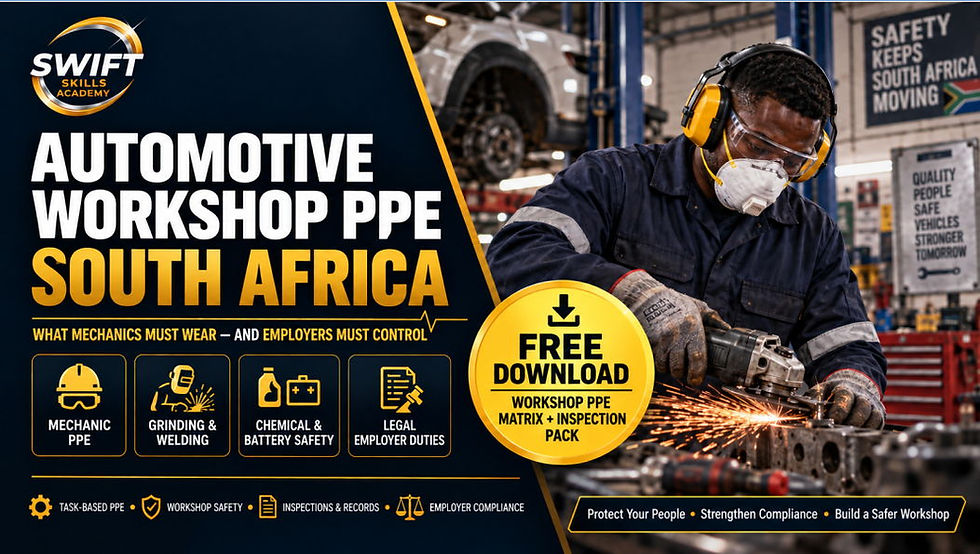
An automotive workshop is not one hazard.
A mechanic carrying out routine servicing, a technician grinding a seized component, an auto electrician working around batteries, a welder repairing an exhaust and a spray painter handling coatings may all work for the same employer while facing completely different risks.
That is why there is no single universal PPE kit that automatically makes every South African automotive workshop safe or compliant.
The correct sequence is:
Task → hazard → eliminate or reduce the hazard → assess residual risk → select suitable PPE → train the worker → inspect the equipment → keep evidence → correct failures.
South Africa's Occupational Health and Safety Act requires employers, as far as reasonably practicable, to provide and maintain a working environment that is safe and without risk to employees' health.
Section 8 requires employers to identify hazards, determine precautionary measures, provide information, instruction, training and supervision, and take reasonably practicable steps to eliminate or mitigate hazards before relying on personal protective equipment. (Government of South Africa)
So the correct employer question is not:
“Did everyone receive boots, gloves and glasses?”
It is:
“Did we identify what each workshop task can do to someone, control the hazard as far as reasonably practicable and provide suitable PPE for the risk that remains?”
Quick Answer: What PPE Is Required in an Automotive Workshop in South Africa?
Depending on the work being performed, an automotive mechanic or workshop employee may need suitable protective footwear, workwear, eye protection, face protection, task‑specific gloves, hearing protection, welding PPE, respiratory protection or high‑visibility clothing.
But not every employee needs every item for every task.
The General Safety Regulations require employers and users of machinery to evaluate workplace risks and take steps to make the condition or situation safe. Where the risk cannot practicably be safeguarded completely, necessary safety equipment may be required. The regulations also provide that necessary safety equipment be supplied free of charge and maintained in good, clean condition. (Department of Labour)
This is why Automotive Workshop PPE Requirements South Africa must be understood as a compliance framework, not a checklist. The result should be a task‑based automotive workshop PPE matrix, not a generic PPE shopping list.
Automotive Workshop PPE Checklist at a Glance
Workshop activity | Typical hazards | PPE that may need consideration |
Routine mechanical servicing | oil, fluids, sharp edges, components, slips | workwear, suitable footwear, eye and hand protection according to task |
Grinding / wire brushing | high-velocity particles, sparks, noise | eye protection, supplementary face protection, hearing protection, suitable clothing |
Welding / cutting | radiation, sparks, hot metal, fumes, noise | welding helmet, eye protection, welding gloves, protective clothing, footwear, hearing/RPE where required |
Battery work | corrosive electrolyte, electrical and ignition risk | splash-resistant eye/face protection, chemical-compatible gloves and clothing where required |
Solvents / degreasers / cleaners | skin exposure, splash, vapour | chemical-compatible gloves, eye protection and respiratory protection where assessed as necessary |
Spray / coating work | hazardous chemicals, aerosols, vapours | protective clothing, eye/face protection and suitable respiratory protection where required |
Brake / component cleaning | particles, chemicals, contaminated material | task-specific eye, hand and respiratory protection where assessment requires it |
Impact tools / compressors / panel beating | occupational noise | engineering/administrative controls plus hearing protection for residual exposure |
Vehicle movement | collision / visibility risk | high-visibility clothing where the risk assessment identifies a need |
Vehicle lifts / jacks | crushing and falling-load hazards | PPE may help, but safe lifting equipment and procedures remain essential |
This is a planning guide only.
The actual PPE requirement should follow the specific workshop risk assessment, substance involved, Safety Data Sheet, equipment instructions and applicable regulations.
What PPE Should a Mechanic Wear in South Africa?
The answer depends on the mechanic's actual work.
Someone carrying out general servicing may face different hazards from somebody grinding, welding, using hazardous chemicals or servicing batteries.
Typical protective categories can include protective footwear, workwear, safety spectacles, goggles, face protection, task-specific gloves, hearing protection and respiratory protection.
But a mechanic should not be issued PPE simply because the item is common in workshops.
Each item should solve an identified problem.
That is the difference between a PPE uniform and a PPE control system.
Is PPE Legally Required in South African Automotive Workshops?
PPE may be legally necessary where workplace risks remain after reasonably practicable steps have been taken to eliminate or reduce the hazard.
Section 8 of the OHS Act specifically requires employers to identify hazards and take precautionary measures, and it places hazard elimination or mitigation before reliance on PPE. (Government of South Africa)
Regulation 2 of the General Safety Regulations requires risk evaluation and, where the condition cannot practicably be safeguarded completely, requires the risk to be reduced as much as practicable and necessary protective equipment to be provided. (Alternative Waste Treatment Guide)
So PPE is not optional merely because a workshop has “never had an accident.”
The employer must assess the exposure.
Automotive Workshop PPE Requirements by Task
PPE for Routine Vehicle Servicing
Even basic servicing can expose workers to sharp components, hot engines, oils, coolants, slippery floors and falling tools or parts.
Appropriate controls can include good housekeeping, safe work methods, correct lifting methods, suitable tools and proper storage.
Depending on the remaining risk, the employee may also require protective footwear, workwear, gloves or eye protection.
Routine work should never be treated as automatically low risk simply because it happens every day.
Familiarity can hide poor controls.
What Eye Protection Should Mechanics Wear?
Automotive work can expose the eyes to grinding particles, wire-wheel debris, chemical splash, battery electrolyte, hot fragments, dust and welding radiation.
The correct protection depends on the exposure.
Safety spectacles may be suitable for some particle risks.
Goggles may be necessary where splash or fine material can reach around ordinary spectacles.
A face shield can provide additional face protection for certain grinding, splash or high-energy exposures.
But a face shield should not automatically be treated as a substitute for suitable eye protection.
Welding requires process-appropriate eye and face protection.
Damaged, heavily scratched or badly fitting equipment should not remain in use.
Does a Face Shield Replace Safety Glasses for Grinding?
Not automatically.
Grinding particles can travel around the edge of a face shield.
A face shield may therefore be used as supplementary face protection while suitable spectacles or goggles protect the eyes.
The workshop should assess the grinder, wheel, workpiece, particle direction, neighbouring employees and any additional exposure before defining the required protection.
The employee standing nearby matters too.
Workshop PPE rules should protect exposed people — not just the person holding the tool.
What Gloves Should Mechanics Wear?
There is no single “mechanic glove” suitable for every task.
Glove selection should consider the substance, temperature, sharp edges, puncture potential, abrasion, dexterity and duration of contact.
A glove suitable for general mechanical handling may not resist a particular solvent.
A disposable glove may provide little protection against sharp metal.
A welding gauntlet may protect against heat but be impractical for precision work.
Where hazardous chemical agents are involved, the Hazardous Chemical Agents Regulations address exposure assessment, control of exposure, information and training, respiratory zones, records and PPE. (Department of Labour)
The Safety Data Sheet and glove manufacturer's compatibility information should therefore form part of chemical glove selection.
Can Mechanics Wear Gloves Around Rotating Machinery?
Gloves can create a serious entanglement risk around rotating equipment.
Drills, shafts, lathes and similar moving machinery can catch loose material and pull the worker into the equipment.
That means a workshop should not simply publish:
“Gloves must be worn at all times.”
The rule should be:
“Wear the protection required for the task without introducing a more serious hazard.”
Task-specific assessment matters.
Are Safety Shoes Compulsory for Mechanics?
Protective footwear may be required where the risk assessment identifies hazards such as falling components, sharp objects, penetration hazards, slippery surfaces, hot work or other foot injuries.
The footwear itself should match the hazard.
A workshop should consider features such as grip, toe protection, sole protection, heat resistance and the work environment where relevant.
The presence of “safety boots” alone does not make unsafe floors acceptable.
Automotive Workshop Housekeeping Requirements
Workshop housekeeping is now an even more important compliance issue.
The 2025 General Safety Regulations amendment requires workplaces to be kept clean and orderly and requires floors, walkways, stairs, passages and gangways to be maintained in good repair, skid-free and free of obstructions, waste or materials. (Department of Labour)
For an automotive workshop, that can directly affect how oil spills, coolant, tools, waste, hoses, parts and work areas are controlled.
A worker can wear excellent safety footwear and still slip on an unmanaged oil spill.
PPE does not replace housekeeping.
What PPE Is Required for Grinding in an Automotive Workshop?
Grinding can produce several hazards simultaneously:
high-velocity particles → sparks → hot fragments → wheel failure → noise → exposure to people nearby
Suitable eye protection is critical.
Depending on the assessed risk, supplementary face protection, protective clothing and hearing protection may also be necessary.
But the PPE should sit behind controls such as correct wheel selection, machine guarding, wheel condition, work positioning and control of the spark/fragment path.
The workshop should also ask:
Who else is inside the exposure zone?
A nearby employee or customer can be injured even though they are not operating the grinder.
What PPE Is Required for Welding in an Automotive Workshop?
Automotive welding may be used for exhaust repair, body repairs, brackets, fabrication and other repair work.
The hazards can include arc radiation, hot metal, sparks, burns, fumes, noise and ignition of nearby material.
Suitable protection may include an appropriate welding helmet, safety eyewear, welding gloves, flame-resistant clothing, protective footwear and hearing or respiratory protection where required.
Ventilation or local extraction should be considered before relying on respiratory PPE alone.
Hot-work controls must also consider nearby employees, vehicles, fuels, coatings, upholstery and other combustible materials.
Do Mechanics Need Respiratory Protection?
Sometimes.
But respiratory protection should never be selected simply because a task “looks dusty.”
Grinding dust, paint vapour, welding fume and solvent vapour are not the same exposure.
Respirator selection depends on the contaminant, concentration, duration, process, ventilation and other controls.
Where respiratory protection is necessary, the system should also consider fit, compatibility with other PPE, cleaning, inspection, storage and replacement.
A generic disposable mask should not automatically be treated as adequate respiratory protection for every automotive exposure.
What PPE Is Required for Solvents, Degreasers and Cleaning Chemicals?
Automotive workshops commonly use cleaning products, degreasers, oils, coolants, fuels, adhesives and other chemicals.
The Hazardous Chemical Agents Regulations require employers to address exposure through information and training, assessment, control measures, records and appropriate PPE where necessary. (Department of Labour)
For chemical tasks, PPE selection may need to consider:
chemical-compatible gloves, suitable eye protection, protective clothing, ventilation and respiratory protection where exposure assessment shows it is required.
The workshop should maintain current Safety Data Sheets and use them when evaluating chemical controls.
Never select chemical PPE solely by appearance.
What PPE Is Required When Working With Vehicle Batteries?
Traditional battery servicing can involve corrosive electrolyte, electrical short-circuit, manual-handling risks and ignition hazards.
Depending on the activity and assessment, controls may include splash-resistant eye or face protection, chemical-compatible gloves, appropriate protective clothing, safe charging procedures and ventilation.
The workshop should also consider emergency arrangements appropriate to the chemical exposure.
Normal workshop gloves should not automatically be assumed to provide battery-acid protection.
What PPE Is Required for Spray Painting and Coating Work?
Spray painting and coating work can create airborne chemical exposure that differs substantially from normal mechanical servicing.
Protective clothing, eye/face protection and suitable respiratory protection may be necessary depending on the substance and process.
The correct system should be based on the chemicals being used, the Safety Data Sheet, ventilation/extraction arrangements and actual worker exposure.
Bodyshop and spray-painting operations should therefore not simply copy the PPE requirements used by general mechanics.
Do Mechanics Need Hearing Protection?
Automotive workshops can generate substantial noise through grinders, impact tools, compressors, panel beating, engine testing and other activities.
South Africa promulgated new Noise Exposure Regulations in 2025, with the Department of Employment and Labour stating that the new framework would come into effect on 5 September 2026. That date has now passed, so workshops should be reviewing current noise exposure and hearing-conservation arrangements against the applicable framework rather than treating the regulations as a future change. (Department of Labour)
Hearing protection is not the first control.
Noise should first be eliminated or reduced at source where reasonably practicable.
Hearing protection addresses the residual exposure that remains.
Vehicle Lift Safety: Why PPE Is Not Enough
Vehicle lifts and lifting equipment create one of the most serious workshop risks.
PPE cannot stop an inadequately supported vehicle from crushing someone.
The Driven Machinery Regulations contain requirements relating to lifting machinery and associated controls, examination, testing and safe operation. (Government of South Africa)
Workshop controls should address matters such as correct load rating, approved lifting points, equipment condition, examination and testing, maintenance and competent operation.
The critical rule is:
Never treat safe vehicle lifting as a PPE problem.
It is primarily a machinery and safe-system-of-work problem.
High-Visibility Clothing and Vehicle Movement
Some automotive workshops have significant interaction between workers, customer vehicles, forklifts, delivery vehicles or yard traffic.
Where poor visibility or vehicle interaction creates a risk, high-visibility clothing may form part of the control system.
But it does not replace safer controls such as separated pedestrian routes, traffic management, speed controls, reversing procedures, lighting and supervision.
The fluorescent vest is not the traffic-management plan.
Must Employers Pay for Required PPE?
Where Regulation 2 of the General Safety Regulations requires necessary safety equipment because the risk cannot practicably be made safe through other means, the regulation provides for the employer or user of machinery to supply the equipment free of charge and maintain it in good and clean condition. (Alternative Waste Treatment Guide)
A workshop should therefore be capable of showing which employees require which PPE and how the equipment is controlled.
Useful evidence can include:
employee → PPE item → type/size where relevant → issue date → replacement date → condition → training/instruction
An issue register is useful.
But it does not prove that the PPE was correctly selected.
How Often Should Automotive Workshop PPE Be Replaced?
There is no single replacement period for every PPE item.
Replacement can depend on manufacturer instructions, service life, visible deterioration, contamination, damage, fit, storage conditions and the nature of the exposure.
A workshop should define rejection criteria so employees do not have to guess whether damaged equipment can still be used.
Typical triggers include cracks, damaged straps, contaminated materials, badly scratched lenses, deterioration, expired components where applicable or any defect that compromises the equipment's protective function.
What PPE Records Should an Automotive Workshop Keep?
A defensible workshop safety system may need records showing how PPE and related hazards are being managed.
That can include the workshop risk assessment, task-based PPE matrix, PPE issue records, employee instruction/training records, inspection and replacement records, Safety Data Sheets, chemical controls, relevant noise documentation, lifting-equipment records, incident records and corrective actions.
The purpose is not paperwork for paperwork's sake.
It is to show that the employer:
identified the problem → selected a control → implemented it → communicated it → checked it → corrected failures.
Automotive Workshop PPE Inspection Checklist
Inspection area | What to verify |
Hazard assessment | Are hazards assessed by task rather than job title alone? |
PPE selection | Does each item match the actual exposure? |
Eye protection | Is the required level of eye/face protection defined? |
Hand protection | Is glove material suitable for the task and chemical? |
Footwear | Does footwear match workshop hazards? |
Chemical safety | Are current Safety Data Sheets available? |
Respiratory PPE | Has the contaminant been identified before selecting protection? |
Noise | Has workshop noise exposure been assessed and controlled? |
Training | Can employees explain when and how PPE must be used? |
PPE condition | Is damaged or contaminated equipment removed? |
Storage | Is reusable PPE stored and maintained correctly? |
Replacement | Are rejection and replacement rules defined? |
Lifts / machinery | Are machinery controls managed separately from PPE? |
Contractors | Are contractor PPE requirements verified? |
Corrective action | Are inspection findings actually closed out? |
If several of these answers are no, the organisation does not merely have a PPE problem.
It has a workshop safety-management problem.
10 Automotive Workshop PPE Mistakes Employers Should Avoid
Giving every employee the same PPE regardless of task.
Choosing gloves without checking chemical compatibility.
Treating a face shield as automatic replacement for eye protection.
Requiring gloves around rotating machinery without assessing entanglement risk.
Using PPE instead of fixing the hazard.
Ignoring occupational noise from grinders, impact tools and compressors.
Choosing respiratory protection without identifying the contaminant.
Leaving damaged PPE in service because it “still looks usable.”
Issuing PPE without documenting instruction or training.
Treating unsafe vehicle lifting as though PPE can compensate for poor machinery controls.
The theme behind all ten is the same:
PPE should be selected because of the hazard—not because it is standard workshop equipment.
What Should an Employer Check Before Buying PPE for Mechanics?
Before purchasing PPE, establish what task will be performed, what hazard exists, how the exposure is being controlled, what risk remains and whether the proposed equipment actually protects against that residual risk.
Then check fit, compatibility with other PPE, manufacturer instructions, worker usability, maintenance, cleaning, storage and replacement requirements.
For chemical work, use the Safety Data Sheet and compatibility information.
For respiratory risks, identify the contaminant first.
For machinery work, make sure the PPE itself does not introduce an entanglement or visibility problem.
Buying PPE should be the end of the risk-selection process, not the beginning.
Frequently Asked Questions
What PPE should a mechanic wear in South Africa?
The required PPE depends on the task and risk assessment. Depending on the work, this may include protective footwear, workwear, eye/face protection, task-specific gloves, hearing protection, welding PPE or respiratory protection.
What PPE is required in an automotive workshop?
There is no one universal PPE list for all workshops. PPE should be selected according to the specific work, hazards, machinery, substances and residual risk.
Are safety boots compulsory for mechanics?
Protective footwear may be necessary where the risk assessment identifies falling-object, penetration, slip, heat or similar foot hazards. The footwear specification should match the actual exposure.
Must automotive workshops provide PPE free of charge?
Where Regulation 2 of the General Safety Regulations requires necessary safety equipment, the regulation provides for it to be supplied free of charge and maintained in good and clean condition. (Alternative Waste Treatment Guide)
What PPE is needed for grinding?
Grinding may require suitable eye protection and, depending on the exposure, supplementary face protection, hearing protection and protective clothing. Machine guarding, wheel condition and work positioning remain essential controls.
Does a face shield replace safety glasses?
Not automatically. A face shield may provide supplementary face protection while suitable spectacles or goggles protect the eyes against particles or splash reaching around the shield.
Can mechanics wear gloves around rotating machinery?
Gloves can create an entanglement hazard around rotating machinery. The task should be assessed before making gloves compulsory.
What gloves should mechanics use for oil and solvents?
The answer depends on the specific product and contact conditions. Check the Safety Data Sheet and glove manufacturer's chemical-compatibility information rather than assuming one glove material works for all substances.
What PPE is required for vehicle battery work?
Depending on the task, suitable controls may include splash-resistant eye/face protection, chemical-compatible gloves and protective clothing, alongside safe charging and ventilation arrangements.
What PPE is required for automotive welding?
Depending on the welding process, suitable PPE may include process-appropriate welding eye/face protection, welding gloves, protective clothing, suitable footwear and hearing or respiratory protection where required.
Do mechanics need hearing protection?
Where workshop noise creates significant occupational exposure, employers should assess and reduce the noise as far as reasonably practicable and provide suitable hearing protection for residual exposure where required. South Africa's new Noise Exposure Regulations were scheduled to commence on 5 September 2026. (Department of Labour)
Do mechanics need respiratory protection?
Only where the assessed airborne exposure requires it. The contaminant and exposure should be identified first so suitable respiratory protection can be selected.
How often should mechanic PPE be replaced?
There is no universal interval. Replacement depends on damage, deterioration, contamination, service life, manufacturer instructions and the risk assessment.
What PPE records should an automotive workshop keep?
Useful records can include task-based PPE requirements, issue records, employee instruction/training, inspections, maintenance, replacement records and corrective actions.
Is PPE enough to make an automotive workshop compliant?
No. The OHS Act requires a broader system including hazard identification, precautionary measures, safer systems of work, information, instruction, training and supervision. PPE is only one component. (Government of South Africa)
Authoritative Sources
South African Government — Occupational Health and Safety Act 85 of 1993The primary legal framework establishing employer duties relating to workplace health and safety, hazard identification, precautionary measures, training and supervision. (Government of South Africa)
Department of Employment and Labour — General Safety Regulations Amendment, 2025Current amendments covering risk evaluation and general workplace controls including housekeeping, clear workspaces and skid-free, unobstructed floors and walkways. (Department of Labour)
General Safety Regulations — Regulation 2Sets out the risk-evaluation framework and provision of necessary safety equipment where risks cannot practicably be safeguarded by other means. (Alternative Waste Treatment Guide)
Department of Employment and Labour — Regulations for Hazardous Chemical Agents, 2021Relevant to solvents, fuels, degreasers, cleaning chemicals, paints and other hazardous workshop substances, including exposure assessment, control measures, records and PPE. (Department of Labour)
South African Government — Driven Machinery RegulationsRelevant to lifting machinery and safe machinery operation in environments using vehicle lifts and similar equipment. (Government of South Africa)
Department of Employment and Labour — Noise Exposure RegulationsThe Department promulgated the replacement framework in 2025 and stated that it would commence on 5 September 2026. (Department of Labour)
Final Word
Automotive workshop PPE should never be reduced to:
boots + gloves + glasses + overalls.
A serious workshop asks much better questions.
What work is being performed?
What can injure or harm the employee?
Can the hazard be eliminated or reduced before PPE is needed?
What protection is appropriate for the remaining exposure?
Does the employee understand the equipment?
Is it inspected and replaced?
Can the employer prove that the system is actually being managed?
That is the difference between distributing PPE and operating a real safety system.
The strongest automotive workshop PPE rule is therefore:
Every task gets the controls its hazards require.
Not every worker gets the same equipment.