Fire Risk Assessment South Africa: Workplace Guide + Free Employer Template
Quick Answer: What Is a Fire Risk Assessment in South Africa?
A fire risk assessment South Africa workplace review identifies how a fire could start, what could burn, who could be harmed, what controls already exist and what additional action is needed.
For employers, it should not end with a list of hazards.
A useful assessment should move through:
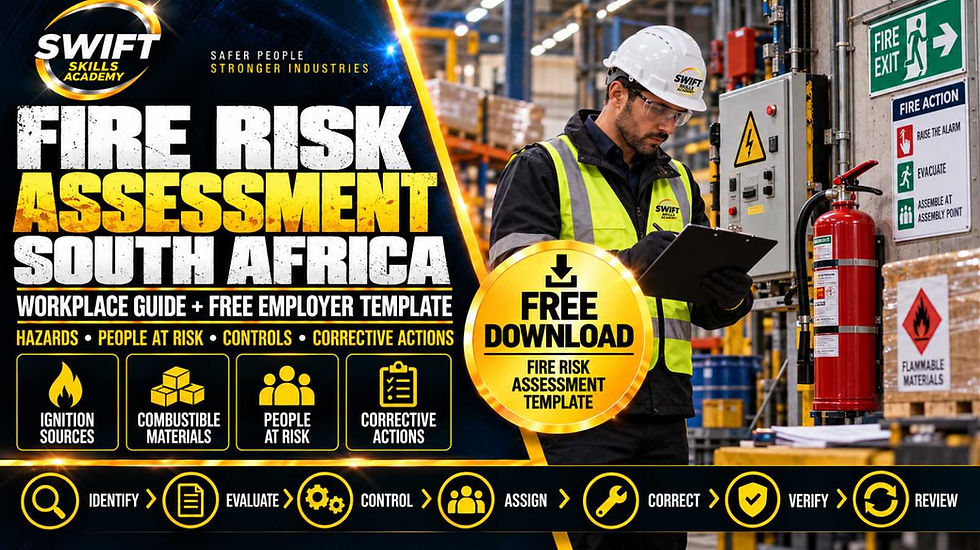
IDENTIFY → EXPOSE → EVALUATE → CONTROL → ASSIGN → CORRECT → VERIFY → REVIEW
South Africa's Occupational Health and Safety Act places a general duty on employers to provide and maintain, as far as reasonably practicable, a working environment that is safe and without risk to employees. Section 8 also addresses eliminating or mitigating hazards before relying on personal protective equipment. Department of Labour
Current General Safety Regulation 13J deals specifically with fire precautions and means of egress. It requires employers to address matters such as usable escape routes and suitable firefighting equipment, taking account of characteristics including the workplace, people, activities and flammable materials present. Department of Labour
A fire risk assessment is therefore best treated as a structured decision process — not simply another form stored in the safety file.
Assessment question | What the employer is trying to establish |
What can start a fire? | Ignition sources |
What can burn or intensify it? | Fuel and combustible load |
Who could be harmed? | Employees, contractors, visitors and others |
What controls already exist? | Prevention, detection, equipment, escape, procedures and people |
How serious is the remaining risk? | Priority for action |
What must change? | Corrective controls |
Who owns the action? | Accountability |
Was it actually fixed? | Verification |
What Is the Purpose of a Workplace Fire Risk Assessment?
The purpose is not to predict exactly when a fire will occur.
It is to identify credible fire scenarios before an emergency forces the workplace to discover its weaknesses under pressure.
A useful assessment asks:
Where can ignition occur?
What materials could become fuel?
Could fire or smoke spread rapidly?
Who would be exposed?
Can people detect the danger?
Can they escape?
Is suitable firefighting equipment available?
Are assigned people prepared for their responsibilities?
What existing controls could fail?
What needs to be corrected first?
The assessment connects fire prevention, emergency preparedness and corrective action.
That is different from simply checking whether extinguishers are hanging on a wall.
Is a Fire Risk Assessment Legally Required in South Africa?
This needs careful wording.
It would be misleading to state that one single law universally requires every South African workplace to complete a document specifically titled “Fire Risk Assessment” once every year.
The actual legal framework is broader.
Section 8 of the Occupational Health and Safety Act establishes an employer's general duty to provide and maintain a working environment that is safe and without risk to health and to take reasonably practicable steps to eliminate or mitigate hazards. Department of Labour
General Safety Regulation 13J now addresses workplace fire precautions and means of egress, including escape arrangements and provision of suitable firefighting equipment in relation to workplace circumstances and the nature and amount of flammable material. Acts Online
As of September 2026, the former Environmental Regulations for Workplaces have reached their scheduled repeal under the Physical Agents Regulations. Employers relying on old documents should therefore make sure their fire-safety references have been updated rather than continuing to cite superseded provisions. Government of South Africa
Building legislation, municipal fire-safety provisions, occupancy, industry-specific requirements, client standards and insurer requirements can add further obligations.
The practical employer question is therefore not:
“Does the law use my exact form title?”
It is:
“Have we systematically identified our workplace fire hazards, evaluated who could be affected, and implemented appropriate controls for the actual risk?”
Fire Risk Assessment vs Fire Safety Checklist: What Is the Difference?
These are related tools, but they should not compete for the same search intent.
Fire Safety Checklist
A checklist asks whether common controls are present or satisfactory.
Examples:
Is the exit clear?
Is the extinguisher accessible?
Is the alarm available?
Are emergency procedures documented?
The existing Swift Skills Academy Workplace Fire Safety Checklist owns that broader inspection intent.
Fire Risk Assessment
A risk assessment goes further.
It asks:
What specific fire scenario could occur?
What would cause it?
Who would be exposed?
What controls are already in place?
How significant is the remaining risk?
What additional control is needed?
Who must implement it?
How will completion be verified?
In simple terms:
CHECKLIST = WHAT IS THERE?
RISK ASSESSMENT = WHAT COULD HAPPEN, HOW SERIOUS IS IT, AND WHAT MUST WE DO ABOUT IT?
What Should a Fire Risk Assessment South Africa Cover?
A useful fire risk assessment South Africa employer process should examine the entire path from ignition to consequence.
1. Workplace and Premises Information
Record enough information to understand the environment being assessed.
This may include:
company or employer;
premises or site;
department;
assessor;
assessment date;
activities performed;
normal occupancy;
operating shifts;
visitors or public access;
contractors;
building layout;
and relevant high-risk areas.
A warehouse, restaurant, welding workshop and office should not automatically receive identical assessments.
2. Sources of Ignition
Identify anything capable of starting a fire.
Possible examples include:
electrical equipment;
damaged wiring;
overloaded electrical connections;
heaters;
cooking appliances;
machinery generating heat;
hot surfaces;
batteries and charging equipment;
welding;
cutting;
grinding;
open flames;
smoking;
static or sparks where relevant;
and uncontrolled hot work.
The objective is to identify the credible ignition mechanisms for that particular workplace.
3. Fuel and Combustible Materials
A fire needs material capable of burning.
Look for:
paper;
cardboard;
packaging;
timber;
textiles;
plastics;
waste;
oils;
flammable liquids;
gases;
chemicals;
combustible dust where applicable;
stored products;
furniture;
and process materials.
Do not assess ignition sources and fuel in isolation.
The risk becomes more meaningful when the employer asks:
Can this ignition source realistically reach this combustible material?
4. Oxygen and Fire Development
Normal air already supplies oxygen, but certain operations or substances may increase fire intensity or change how a fire behaves.
Relevant situations may require specialist assessment.
The template should provide a field for unusual factors rather than pretending every fire scenario can be reduced to a generic tick box.
Who Could Be at Risk From Fire?
A proper assessment should not consider permanent daytime employees only.
Potentially exposed people may include:
employees;
night-shift workers;
contractors;
cleaners;
security personnel;
delivery drivers;
visitors;
customers;
learners;
members of the public;
people working alone;
employees in remote areas;
and anyone who may require additional assistance during evacuation.
The question is:
Who could be in the danger area when this fire scenario occurs?
Which People May Need Additional Evacuation Consideration?
Some people may not be able to respond to an alarm or evacuate in the same way as the majority of occupants.
The assessment should consider, where relevant:
mobility limitations;
hearing limitations;
visual limitations;
temporary injuries;
unfamiliar visitors;
young people;
older occupants;
language or communication barriers;
and people working in isolated areas.
This should feed into emergency planning rather than being recorded and forgotten.
How Do You Conduct a Workplace Fire Risk Assessment?
The practical process can be structured into seven stages.
Step 1 — Identify the Fire Hazard
Describe the credible scenario.
For example:
Hot work sparks contacting combustible packaging in a fabrication area.
That is more useful than simply writing:
“Fire.”
The hazard description should make clear how ignition and fuel could come together.
Step 2 — Identify Who Could Be Harmed and How
Record the people potentially exposed and the foreseeable consequences.
Consider:
burns;
smoke exposure;
inability to escape;
secondary explosions;
structural or process hazards;
panic;
and obstruction of emergency routes.
Step 3 — Record Existing Controls
Before rating the remaining risk, document controls already in place.
Examples may include:
housekeeping;
separation of combustibles;
hot-work controls;
alarms;
fire detection;
suitable extinguishing equipment;
emergency routes;
fire doors;
signage;
emergency lighting;
procedures;
Fire Wardens;
practical training;
drills;
maintenance;
and access control.
Existing controls matter because risk after controls may differ significantly from uncontrolled risk.
Step 4 — Evaluate the Remaining Risk
Use a consistent system.
A simple workplace screening tool can use:
Likelihood × Severity = Risk Rating
This is a management method, not a universal legal formula.
The employer should use a rating method appropriate to its own risk-management system and competent advice where necessary.
Step 5 — Decide What Additional Controls Are Required
Do not automatically jump to training.
A fire hazard may require:
elimination;
removal of combustible material;
substitution;
engineering changes;
electrical repair;
improved separation;
ventilation;
fire detection;
suppression;
maintenance;
improved storage;
route changes;
emergency planning;
permit controls;
staffing;
training;
or specialist fire-protection intervention.
Step 6 — Assign the Corrective Action
Every significant finding should have:
an action;
an owner;
a target date;
a priority;
and required evidence.
Step 7 — Verify and Review
A closed action should mean:
THE CONTROL WAS IMPLEMENTED AND VERIFIED
not:
AN EMAIL WAS SENT.
Example Fire Risk Assessment Matrix
A simple matrix can help employers prioritise findings.
Likelihood
Rating | Example interpretation |
1 | Rare |
2 | Unlikely |
3 | Possible |
4 | Likely |
5 | Very likely |
Severity
Rating | Example interpretation |
1 | Minor consequence |
2 | Moderate injury / limited damage |
3 | Serious injury / significant disruption |
4 | Major injury / major fire impact |
5 | Potential fatality / catastrophic consequence |
Then:
LIKELIHOOD × SEVERITY = RISK SCORE
For example:
Likelihood 4 × Severity 5 = 20
The numerical score is only useful if the organisation has defined what different scores mean and what action each category requires.
Do not copy somebody else's red/amber/green thresholds without understanding their methodology.
What Should a Fire Risk Assessment Template Contain?
The SSA free template should go beyond a one-page generic form.
It should function as a:
Workplace Fire Risk Assessment & Corrective Action Pack
with sections for:
workplace and assessment details;
assessment scope;
ignition-source register;
fuel and combustible-material register;
people-at-risk assessment;
vulnerable-person considerations;
existing prevention controls;
alarm and detection review;
firefighting-equipment review;
escape-route and exit review;
emergency-role coverage;
Fire Warden coverage;
training evidence;
drill history;
likelihood rating;
severity rating;
risk score;
additional control required;
responsible person;
corrective-action due date;
evidence of completion;
management verification;
review trigger;
follow-up assessment.
The useful workflow is:
IDENTIFY → EVALUATE → CONTROL → ASSIGN → CORRECT → VERIFY → REVIEW
Fire Risk Assessment: Ignition Sources to Check
Electrical Sources
Consider:
damaged electrical equipment;
exposed conductors;
overheating;
makeshift electrical arrangements;
overloaded circuits;
poor maintenance;
and equipment operating in unsuitable environments.
Technical electrical defects should be referred to an appropriately competent person.
Hot Work
Welding, flame cutting, soldering, grinding and similar operations can create ignition sources.
A risk assessment should examine:
sparks;
hot metal;
nearby combustibles;
flammable atmospheres;
gas cylinders;
work location;
post-work monitoring;
and permit or authorisation arrangements where applicable.
Heating and Cooking
Consider:
portable heaters;
ovens;
cooking equipment;
boilers;
hot plates;
heat-producing process equipment;
and clearance from combustible materials.
Smoking and Open Flames
Assess whether controls are appropriate to the premises and materials present.
Batteries and Charging Areas
Depending on the workplace and battery technology, consider:
charging arrangements;
physical damage;
heat;
electrical protection;
battery location;
ventilation where applicable;
and escalation procedures.
Specialist advice may be required for higher-risk battery systems.
Fire Risk Assessment: Combustible and Flammable Materials
The assessment should identify both normal stock and material that accumulates because of poor management.
Combustible Waste
Examples include:
cardboard;
packaging;
paper;
timber offcuts;
rags;
and general combustible waste.
The City of Cape Town's workplace fire-safety checklist specifically addresses housekeeping, machinery, plant and combustible materials as part of fire prevention. Cape Town Resource
Flammable Liquids and Gases
These require more careful assessment than ordinary office combustibles.
Consider:
quantity;
storage;
containers;
ignition sources;
handling;
separation;
leakage;
ventilation;
and emergency arrangements.
Do not use a generic template as a substitute for technical controls required by legislation, municipal requirements or relevant standards.
How Should Existing Fire Controls Be Assessed?
A risk assessment should evaluate whether controls are suitable for the actual hazard.
Fire Prevention
Ask whether ignition and fuel are being effectively separated.
Alarm and Detection
Ask:
Can occupants be warned?
Is the warning suitable for the environment?
Can people hear or otherwise recognise it?
Does the system cover the areas that need it?
Firefighting Equipment
General Safety Regulation 13J requires an adequate supply of suitable firefighting equipment at strategic locations, taking workplace factors and flammable materials into account, and requires that equipment to be maintained in good working order. Acts Online
A risk assessment should therefore not ask only:
“Do we have extinguishers?”
It should ask:
“Is the firefighting provision suitable for the actual workplace fire risk?”
Technical selection, installation and servicing may require competent specialists.
Escape Routes
Assess the complete route to safety.
That includes:
doors;
passages;
stairways;
final exits;
obstructions;
congestion;
signage;
lighting where required;
and changes to workplace layout.
Regulation 13J includes requirements intended to support quick and safe egress during a fire. Acts Online
Emergency Procedures
The assessment should ask whether people know:
what the alarm means;
what to do;
where to go;
who coordinates evacuation;
how visitors are managed;
how accountability works;
and who has authority to permit re-entry.
How Do Fire Wardens Fit Into the Fire Risk Assessment?
A Fire Warden appointment should follow the needs of the workplace.
The assessment can help determine:
which areas require coverage;
which shifts require coverage;
which roles must be performed;
whether absence cover exists;
and whether people assigned to those responsibilities understand them.
Avoid fixed ratios unless an applicable rule for the specific workplace genuinely establishes one.
The correct question is:
“Does this workplace have enough competent and available people to perform its emergency roles when needed?”
How Does Fire Fighting Training Fit Into the Assessment?
Training may be one corrective control.
But it should not be the automatic answer to every fire-safety problem.
If the assessment reveals that designated employees may be expected to:
identify an early-stage fire;
select appropriate portable equipment;
operate firefighting equipment;
perform limited initial response;
monitor changing conditions;
understand when continued response is unsafe;
or form part of a workplace fire-response arrangement,
the employer should assess whether those people have suitable training for those duties.
Training does not repair:
blocked fire exits;
defective wiring;
failed alarm systems;
inappropriate storage;
damaged fire doors;
inadequate fire-protection design;
or other physical defects.
Those need the appropriate technical corrective action.
Does Fire Fighting Training Make Someone a Professional Firefighter?
No.
Workplace basic Fire Fighting training and professional emergency-service firefighting are different roles.
A trained workplace responder should operate only within:
their training;
their authority;
workplace procedures;
available equipment;
and safe escape conditions.
If conditions deteriorate, life safety and evacuation take priority.
When Should a Fire Risk Assessment Be Reviewed?
Avoid publishing an invented universal rule such as:
“Every fire risk assessment must legally be renewed once a year.”
A sensible review should occur when the assessment may no longer represent the workplace.
Triggers may include:
significant layout changes;
new machinery;
changed production processes;
new flammable materials;
changed storage;
increased occupancy;
altered shifts;
changes to escape routes;
new battery or energy systems;
a fire;
a near miss;
a failed drill;
major corrective action;
or evidence that controls are no longer effective.
An organisation may also set a periodic review cycle within its own safety-management system.
The important point is that the assessment remains current enough to represent the real workplace.
Fire Risk Assessment for Offices
Office environments can still contain meaningful fire risks.
Assess:
electrical equipment;
kitchens;
heaters;
server or equipment rooms;
paper storage;
escape routes;
visitor arrangements;
fire doors;
alarms;
and assembly arrangements.
Do not mistake lower industrial fire loading for zero risk.
Fire Risk Assessment for Warehouses
Warehouse assessments should pay particular attention to:
quantity and type of stock;
packaging;
rack storage;
charging equipment;
forklifts;
loading areas;
ignition sources;
separation;
escape distances;
night shifts;
contractors;
and changes to storage configuration.
High storage can also change the consequences of a fire and the suitability of existing protection measures.
Fire Risk Assessment for Factories and Workshops
Industrial workplaces may combine:
HEAT + ENERGY + FUEL + PEOPLE + COMPLEX EVACUATION
Assess:
production machinery;
electrical hazards;
hot work;
oils;
gas cylinders;
flammable liquids;
combustible dust where relevant;
maintenance work;
contractors;
noise affecting alarms;
process shutdown;
and shift coverage.
This is where a generic office fire checklist quickly becomes insufficient.
Fire Risk Assessment for Welding and Fabrication Areas
Welding environments deserve particular attention because normal work itself can create ignition sources.
Assess:
welding arcs;
sparks;
hot slag;
cutting;
grinding;
gas cylinders;
hoses and equipment;
combustible materials;
screens and work areas;
adjacent operations;
temporary work;
and post-work fire risk.
Risk controls may include changing the work area, removing combustibles, introducing permit arrangements, improving separation or implementing other site-specific controls.
Fire Risk Assessment for Construction Sites
Construction sites change continuously.
Today's safe route can become tomorrow's storage area.
Consider:
temporary electrical systems;
hot work;
fuel;
gas cylinders;
combustible construction materials;
temporary structures;
changing access;
subcontractors;
security;
temporary accommodation where applicable;
and emergency access.
Assessments should reflect the current phase of work, not just the site as it looked at mobilisation.
Fire Risk Assessment for Hospitality and Commercial Kitchens
Potential hazards can include:
cooking equipment;
hot oils;
extraction systems;
gas;
electrical equipment;
storage;
cleaning chemicals;
staff turnover;
guests;
members of the public;
and unfamiliar occupants.
Fire response and evacuation arrangements must account for people who may have no knowledge of the premises.
Fire Risk Assessment for Solar, Inverter and Battery Installations
Where workplaces introduce solar, inverter or battery systems, the fire assessment should be reconsidered.
The assessor may need to consider:
electrical faults;
isolation;
battery location;
charging;
heat;
ventilation where relevant;
access;
signage;
emergency response;
and manufacturer or specialist requirements.
The assessment should not invent controls for complex systems.
Escalate technical design and protection questions to the relevant competent specialists.
What Should Happen After a Fire Risk Assessment?
The assessment is not finished when the risk matrix has been completed.
It is finished when unacceptable risks have been acted on.
Use a corrective-action register:
Finding | Risk priority | Corrective action | Responsible person | Due date | Evidence | Verified by |
Example: combustible packaging stored beside hot-work area | High | Relocate combustible storage and revise hot-work controls | ______ | ______ | ______ | ______ |
The management process is:
FIND → PRIORITISE → ASSIGN → FIX → VERIFY
What Is the Difference Between a Hazard and a Risk?
These terms are often mixed together.
Hazard
Something with the potential to cause harm.
Example:
Grinding sparks near combustible packaging.
Risk
The combination of how likely harm is to occur and how serious the consequence could be, using the organisation's chosen assessment method.
The assessment therefore does more than list hazards.
It helps decide which hazards require the most urgent action.
Can You Use a Generic Fire Risk Assessment Template?
Yes — as a starting framework.
No — if you treat the template as the assessment itself.
A template cannot know:
your building;
your machinery;
your chemicals;
your stock;
your employees;
your shifts;
your fire-protection systems;
your municipal requirements;
or your emergency procedures.
That is why the SSA template should contain adaptable fields rather than manufactured statements such as:
“Compliant.”
The employer still has to assess the actual workplace.
Does a Completed Fire Risk Assessment Prove Legal Compliance?
No.
A completed document does not automatically prove that:
the assessment was suitable;
all hazards were identified;
the assessor was competent for every technical issue;
building requirements were satisfied;
municipal requirements were satisfied;
equipment was professionally serviced;
fire systems were correctly designed;
employees were competent;
or corrective actions were implemented.
The template is an employer-management tool.
It does not replace statutory or technical inspections, professional fire-system design, competent-person assessments, municipal approvals or other specialist work required for the premises.
When Should a Specialist Be Involved?
Escalate beyond a general employer assessment when the question requires expertise the internal assessor does not have.
Examples may include:
building fire design;
structural fire protection;
fire detection design;
suppression systems;
complex industrial processes;
hazardous chemical environments;
major flammable-liquid storage;
specialised battery risks;
electrical defects;
fire-engineering calculations;
legal certification;
or technical interpretation of applicable standards.
South Africa's National Building Regulations framework governs building standards, while the City of Cape Town states that buildings must be designed, constructed and equipped for fire in accordance with national building legislation. Government of South Africa
Do not use an employer template to substitute for those technical functions.
What Should Management Ask Before Signing Off?
Before the assessment is closed, management should be able to answer:
Have credible ignition sources been identified?
Have combustible and flammable materials been considered?
Have people at risk been identified?
Have shift and contractor arrangements been considered?
Are existing controls actually present?
Are escape routes usable?
Is firefighting equipment suitable for the assessed risks?
Are assigned emergency roles covered?
Are training gaps identified?
Does every significant finding have an owner?
Are deadlines recorded?
Has completion evidence been verified?
Is a review trigger defined?
If the answer to the final three questions is no, the assessment is probably still only a list of problems.
Frequently Asked Questions
What Is a Fire Risk Assessment?
A fire risk assessment is a structured process for identifying how a fire could start, what could burn, who could be harmed, what controls already exist and what further action is required.
Is a Fire Risk Assessment Mandatory in South Africa?
South African employers operate under general occupational safety duties and specific fire, egress, building and other applicable requirements. It is safer to describe a workplace fire risk assessment as a structured method of meeting risk-based fire-safety responsibilities rather than claiming that every employer is subject to one universal annual document requirement. Department of Labour
Is There a Legal Annual Fire Risk Assessment Requirement?
There is no responsible basis for stating that every South African workplace is universally required to renew a document called a fire risk assessment every 12 months. Review frequency should reflect applicable requirements and whether the workplace, hazards or controls have changed.
Who Should Conduct the Fire Risk Assessment?
The person should have sufficient knowledge and understanding for the scope being assessed. More complex technical fire, electrical, building or process issues may require appropriately competent specialists.
What Are the Main Fire Hazards in a Workplace?
Typical categories include ignition sources, combustible or flammable materials, hot work, electrical equipment, heating, cooking, machinery, poor housekeeping and workplace-specific processes.
What Is a Fire Risk Assessment Matrix?
A risk matrix is a method for comparing likelihood and consequence to help prioritise action. A 5×5 matrix is commonly used as a management tool, but it is not a universal legally mandated fire-risk formula.
What Should Be Included in a Fire Risk Assessment Template?
Include premises details, hazards, people at risk, existing controls, likelihood, severity, risk rating, required controls, responsible persons, due dates, completion evidence and verification.
Is a Fire Safety Checklist the Same as a Fire Risk Assessment?
No. A checklist generally checks whether known controls or conditions are satisfactory. A risk assessment evaluates specific fire scenarios, the people exposed, remaining risk and the controls required.
Should Fire Wardens Be Included in the Assessment?
Yes, where they form part of the workplace emergency system. The assessment should consider role coverage, areas, shifts, absence cover and whether appointed people understand their responsibilities.
Does a Fire Risk Assessment Determine How Many Employees Need Fire Fighting Training?
It can help determine the workplace's actual coverage and response needs. There is no sound basis for using an invented universal employee-to-firefighter ratio for every workplace.
Does Fire Fighting Training Solve Every Fire-Risk Finding?
No. Some findings require maintenance, engineering, electrical work, improved storage, alarms, building changes, fire-protection work or other technical controls rather than training.
Does a Completed Template Prove Compliance?
No. The quality of the assessment, implementation of controls and compliance with applicable workplace, building, municipal and technical requirements still need to be established.
When Should a Fire Risk Assessment Be Reviewed?
Review it when workplace conditions, processes, occupancy, materials, layouts, equipment, emergency arrangements or relevant requirements change, after significant incidents or where evidence shows existing controls may no longer be effective.
Authoritative Sources & Regulatory References
Authoritative Source | What It Supports |
Section 8 employer duties relating to a safe working environment and reasonably practicable hazard elimination or mitigation. | |
Current workplace fire precautions, means of egress and suitable firefighting-equipment requirements. | |
Confirms repeal of the Environmental Regulations for Workplaces 18 months after promulgation, relevant to updating legacy fire-safety references in 2026. | |
National legislative framework governing building standards and associated fire-protection requirements. | |
Local Cape Town fire-safety guidance, workplace checklist resources, emergency escapes and municipal context. |
SANS note: Where a particular SANS standard applies, use the current authorised standard or appropriate competent advice. Do not reproduce proprietary SANS content inside the article or template.
Read More
Related guide | Why read it next |
Workplace Fire Safety Checklist South Africa: 50 Employer Checks + Free PDF — https://www.swiftskillsacademy.com/post/workplace-fire-safety-checklist-south-africa | Use the broader 50-point inspection to find obvious fire-readiness gaps before or alongside the risk assessment. |
Fire Drill Checklist South Africa: Workplace Evacuation Drill Guide + Free PDF — https://www.swiftskillsacademy.com/post/fire-drill-checklist-south-africa-workplace-evacuation | Test whether emergency and evacuation controls identified in the assessment actually work in practice. |
Fire Warden South Africa: Fire Warden vs Fire Marshal vs Fire Fighter — Duties, Training & Employer Guide — https://www.swiftskillsacademy.com/post/fire-warden-south-africa-fire-marshal-fire-fighter | Determine how workplace fire roles, area coverage, shifts and training should fit into the fire-response system. |
Final Word
A workplace does not become safer because somebody completed a risk matrix.
The value of a fire risk assessment South Africa employers can actually use comes from what happens after the hazards are identified.
A strong process is:
IDENTIFY → EXPOSE → EVALUATE → CONTROL → ASSIGN → CORRECT → VERIFY → REVIEW
Find how a fire could start.
Identify what could burn.
Determine who could be harmed.
Examine whether existing controls are actually suitable.
Prioritise what needs to change.
Assign responsibility.
Then verify that the corrective action was completed.
And where the assessment reveals that employees are genuinely expected to undertake basic workplace fire response, determine whether the right people, on the right shifts, have suitable Fire Fighting training for those responsibilities.