Hot Work Permit South Africa: Welding, Cutting & Grinding Guide + Free Template
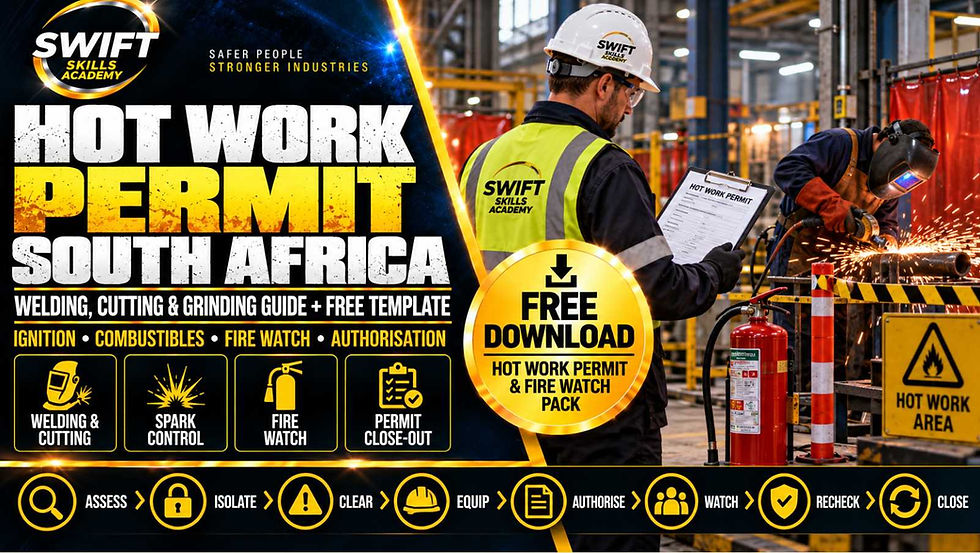
Hot work can turn an ordinary maintenance, construction or fabrication task into a serious fire risk within seconds.
Welding, flame cutting, brazing, soldering, grinding and other activities that produce heat, flame or sparks can ignite combustible material far beyond the immediate work area.
A well-designed hot work permit forces the workplace to answer the important questions before the job starts:
What exactly is being done?
Where will the work take place?
What could ignite?
What combustible materials are nearby?
Can the job be moved to a safer designated area?
Has the area been inspected?
Is suitable firefighting equipment available?
Does a fire watch need to be appointed?
Who authorises the work?
What happens when the work is complete?
Who confirms that the area remains safe afterward?
This guide explains how South African employers, contractors, maintenance teams and supervisors can build those controls into a practical permit-to-work process.
Quick Answer: What Is a Hot Work Permit?
A hot work permit is a documented authorisation process used before work that may generate flames, heat, sparks or other potential ignition sources.
It commonly applies to activities such as:
welding
oxy-fuel cutting
brazing
soldering
grinding
gouging
torch-applied work
some heat-shrinking activities
work involving open flames
other operations capable of igniting nearby materials
The permit does not make the work safe by itself.
It is a control mechanism used to confirm that hazards have been assessed, precautions have been implemented, responsible persons have been identified and the work has been authorised before it begins.
The process should continue beyond the moment the permit is signed.
A useful model is:
ASSESS → ISOLATE → CLEAR → EQUIP → AUTHORISE → WATCH → COMPLETE → RECHECK → CLOSE
Before hot work begins, ask | Why it matters |
Can the work be avoided or moved? | Eliminating the ignition source may be safer than controlling it |
What could burn? | Sparks and heat can ignite materials away from the work point |
What is above, below or behind the work? | Fire can spread through openings, voids and adjoining areas |
Are flammable materials present? | Vapours and combustible substances can dramatically increase risk |
Is suitable firefighting equipment available? | Early control may be critical if ignition occurs |
Who is performing the work? | The person must understand the task and controls |
Is a fire watch required? | Some work needs dedicated observation during and after the activity |
Who authorises the permit? | Responsibility must be clear |
Who checks the area afterward? | Smouldering material may ignite after work has stopped |
Is a Hot Work Permit Legally Required in South Africa?
This needs careful wording.
There is not a single universal South African rule stating that every instance of welding or grinding in every workplace must always use a document specifically titled “Hot Work Permit.”
However, South African occupational health and safety law places broader duties on employers to identify hazards, assess risks and provide and maintain, as far as reasonably practicable, a working environment that is safe and without risk to employees.
Section 8 of the Occupational Health and Safety Act places that general duty on employers. Government of South Africa
The current General Safety Regulations also contain specific fire-related requirements. Regulation 13J requires employers to consider the workplace, activities, people and flammable materials when providing suitable firefighting equipment and maintaining safe means of egress. Government of South Africa
In practice, a hot work permit may therefore become part of the employer's control system because of:
the workplace risk assessment
company safety procedures
contractor requirements
client specifications
permit-to-work systems
insurance conditions
municipal requirements
building or fire-safety controls
sector-specific requirements
the nature of the hot work itself
Some South African public-sector contractor specifications explicitly require prior permission for hot work and state that a hot-work permit may apply after the necessary precautions have been taken. eTenders
The important question is therefore not merely:
“Does legislation contain the words hot work permit?”
The better question is:
“Has the employer identified the fire and explosion hazards created by this work and implemented an adequate system to control them?”
For many higher-risk environments, a formal hot-work permit is a practical way of documenting that control.
Hot Work Permit vs Hot Work Risk Assessment
These are related, but they are not the same thing.
Hot Work Risk Assessment
The risk assessment examines:
what can cause harm
who may be harmed
likelihood and consequence
existing controls
additional controls required
whether the work should proceed
Hot Work Permit
The permit records that the specific work has been:
identified
assessed
prepared
controlled
authorised
monitored
completed
checked
formally closed
A permit should therefore not replace the risk assessment.
The risk assessment identifies what must be controlled.
The permit verifies that those controls are actually in place for the particular job.
What Counts as Hot Work?
Hot work is broader than arc welding.
A useful employer definition includes any activity capable of creating sufficient:
flame
heat
sparks
molten metal
hot slag
hot surfaces
friction-generated ignition
to start a fire or ignite a hazardous atmosphere.
Welding
This may include:
MIG / CO₂ welding
TIG welding
stick / MMA welding
flux-cored welding
gas welding
Welding can generate intense heat, molten metal and sparks capable of travelling beyond the immediate work point.
Oxy-Fuel and Flame Cutting
Cutting operations can generate:
open flame
hot metal
molten droplets
slag
radiant heat
The fire risk can remain after the cut itself is complete.
Grinding
Grinding is frequently underestimated.
A grinder can project a stream of sparks several metres away from the operator.
Those sparks may reach:
cardboard
timber
insulation
packaging
dust
plastic
stored chemicals
waste material
roof spaces
gaps in walls and floors
Brazing and Soldering
Depending on the equipment and temperature involved, these operations can introduce:
open flame
heated surfaces
gas cylinders
localised ignition sources
Torch-Applied Work
Roofing, heating, thawing, paint removal and similar activities involving flame or substantial heat may need to be managed within the same hot-work system.
When Should an Employer Consider Using a Hot Work Permit?
A permit becomes particularly valuable when hot work is performed:
outside a permanently designated welding or fabrication area
inside an operating workplace
near combustible materials
near flammable substances
inside warehouses
on construction sites
in roof spaces
near insulation
in maintenance areas
near machinery containing oil or combustible residues
around conveyors
in workshops with mixed activities
inside tanks, vessels or confined spaces
near gas cylinders
close to electrical installations
in areas occupied by other employees or contractors
where sparks can travel into adjoining areas
The less controlled and predictable the environment, the more important formal authorisation becomes.
Can Hot Work Be Avoided?
This should be one of the first questions.
Before issuing a permit, ask whether the job can be:
moved to a designated workshop
completed using a cold-cutting method
mechanically fastened instead of welded
completed away from stored combustible materials
postponed until the area can be isolated
performed when the facility is less occupied
redesigned to remove the ignition source
The safest hot-work permit is sometimes the one that never needs to be issued because the hazard has been eliminated.
Step 1: Define the Hot Work
The permit should identify the exact activity.
Avoid vague descriptions such as:
“maintenance work.”
Instead record something like:
“Angle-grind damaged steel bracket and weld replacement bracket to conveyor support.”
Useful permit fields include:
job description
exact location
contractor or department
person performing the work
supervisor
date
proposed start time
expected completion time
type of hot work
equipment being used
The permit must relate to a defined job, location and period.
Step 2: Inspect the Work Area
The person assessing the job should physically inspect the area.
Do not complete the permit from an office without seeing the workplace.
Look:
above
below
behind
inside
underneath
through openings
on the opposite side of walls
beneath platforms
into ceiling spaces
into floor penetrations
along the likely direction of sparks
The immediate work point is only one part of the fire-risk area.
Step 3: Identify Combustible Materials
Possible fuels include:
cardboard
paper
timber
plastic
packaging
fabric
insulation
paint
solvents
oils
grease
waste
dust
dry vegetation
combustible roofing material
stored chemicals
A good hot-work permit asks:
What can burn if a spark reaches it?
Then:
Can it be removed?
Removal is usually preferable to trying to protect unnecessary combustible material during the work.
Step 4: Identify Flammable Atmospheres and Substances
Hot work near flammable vapours can present a much more severe hazard than ordinary combustible material.
The work may require specialist controls where there are:
fuels
solvents
gases
volatile chemicals
process vapours
tanks
vessels
pipelines
enclosed spaces
drains
pits
chemical residues
Do not assume that an apparently empty tank, drum or pipe is safe.
Residual vapours may remain.
Where hazardous atmospheres could exist, appropriate isolation, cleaning, ventilation, testing and competent technical assessment may be necessary before hot work is considered.
A generic permit downloaded from the internet is not a substitute for specialist controls in hazardous locations.
Step 5: Remove or Protect Combustibles
The permit should record what has actually been done.
Possible controls include:
moving combustible material away
clearing waste
protecting immovable combustibles
covering openings
shielding adjoining equipment
containing sparks
protecting lower floors
isolating vulnerable materials
creating an exclusion zone
Do not simply tick:
“Area safe.”
Record the action.
For example:
“Cardboard stock removed from welding bay and floor penetration covered with suitable non-combustible protection.”
That creates a much better audit trail.
Step 6: Check Firefighting Equipment
The workplace should consider the type and amount of combustible material, the activity being performed and the location when deciding what firefighting equipment is appropriate.
South Africa's current General Safety Regulations require adequate suitable firefighting equipment at strategic locations having regard to factors including the workplace and flammable materials present. Government of South Africa
The permit can therefore verify:
suitable extinguisher available
equipment accessible
equipment in serviceable condition
hose reel available where applicable
access to firefighting equipment unobstructed
persons understand how to raise the alarm
The permit should never imply that simply placing an extinguisher nearby makes an unsafe hot-work job acceptable.
Step 7: Protect Escape Routes
Hot work must not compromise evacuation.
Check whether:
escape routes remain open
exit doors remain accessible
fire doors are not obstructed
welding leads do not create trip hazards across exits
equipment does not block passages
contractors have not stored materials in escape paths
Regulation 13J specifically addresses maintaining clear and usable means of egress from workplaces. Government of South Africa
Step 8: Control Gas Cylinders and Equipment
Where gas cylinders are used, the permit or supporting procedure should consider:
cylinder condition
secure positioning
correct regulators
hose condition
flashback protection where applicable
valve condition
separation from unnecessary heat
safe routing of hoses
transport and storage
protection from damage
Gas-cylinder hazards should not be reduced to a simple tick box.
Where LPG, acetylene, oxygen or other gases are involved, additional technical and fire-safety requirements may apply.
Step 9: Decide Whether a Fire Watch Is Required
A fire watch is a person assigned to observe for fire conditions associated with the hot work.
The fire watch should not simply be somebody whose name happens to appear on the form.
Their role may include:
monitoring sparks
watching adjacent areas
detecting smouldering material
maintaining access to firefighting equipment
raising the alarm
stopping unsafe work
monitoring after the work ends
Whether a dedicated fire watch is needed should follow the risk assessment, workplace procedure and site requirements.
Avoid inventing a universal rule that every hot-work task must always have exactly one fire watch for an identical fixed period.
The appropriate arrangements depend on the specific risk.
What Should a Fire Watch Check?
A practical fire-watch checklist can include:
Before Work
area inspected
combustibles removed or protected
openings checked
adjoining spaces inspected
firefighting equipment available
alarm procedure understood
escape routes clear
flammable substances controlled
work boundaries established
During Work
sparks remain controlled
no smoke or smouldering develops
adjoining areas remain safe
combustible material does not enter the area
firefighting equipment remains accessible
conditions do not change
unauthorised persons remain clear
After Work
work area inspected
adjoining areas inspected
surfaces checked for retained heat
waste checked
cavities or hidden spaces checked where relevant
smouldering material ruled out
permit left open until required monitoring is complete
final clearance recorded
Step 10: Authorise the Work
The person authorising the permit should be someone who has sufficient authority and understanding of the workplace control system.
Their signature should mean:
“I have verified that the required conditions for this work have been addressed.”
It should not mean:
“I signed the paperwork, therefore the work is automatically safe.”
Good authorisation systems distinguish between:
person performing the work
supervisor
permit issuer / authoriser
fire watch
area owner where applicable
person completing final close-out
Separating roles can improve accountability.
What Should a Hot Work Permit South Africa Template Contain?
A robust employer template should include more than a signature line.
Job Details
permit number
date
location
department
contractor
task description
equipment used
start time
expiry time
Hot Work Type
welding
grinding
cutting
brazing
soldering
torch work
other
Fire Risk Controls
combustibles removed
combustible surfaces protected
floor/wall openings checked
adjacent rooms inspected
flammable liquids controlled
gases controlled
ventilation addressed
equipment isolated where required
escape routes clear
firefighting equipment available
People and Responsibilities
person performing hot work
supervisor
permit authoriser
fire watch
area owner where relevant
Authorisation
controls verified
work authorised
conditions of permit
start time
expiry time
signatures
Completion
work finished
equipment removed
area inspected
adjoining spaces inspected
fire watch completed
residual heat checked
no signs of fire/smouldering
permit closed
When Should a Hot Work Permit Be Stopped or Cancelled?
The permit should not be treated as permission to continue regardless of changing conditions.
Work should be reconsidered if:
combustible material enters the area
a leak develops
flammable vapours are suspected
ventilation fails
firefighting equipment becomes unavailable
weather affects outdoor work
the job scope changes
the work moves location
alarms or fire systems are impaired
a process starts nearby
other contractors introduce new hazards
the fire watch leaves
site conditions materially change
A strong permit system gives workers and supervisors the authority to stop the work.
Does One Permit Cover the Entire Day?
Not automatically.
The permit should have a clearly defined:
location
scope
start time
expiry time
If conditions change substantially, the original permit may no longer reflect the actual risk.
Examples:
A welder moves from a cleared fabrication area into a chemical-store maintenance zone.
A grinder starts work on a different floor.
The original permit described one bracket but the job expands into cutting a pipe.
The permit should then be reviewed and, where required by the workplace procedure, reissued.
Can a Hot Work Permit Be Reused?
A blank template can be reused.
A completed authorisation should not simply be copied forward without reassessing the work.
Yesterday's controls do not prove today's workplace conditions are unchanged.
Hot Work in Warehouses
Warehouses deserve particular attention because sparks can travel into stored material that appears distant from the work.
Risk can arise from:
cardboard
pallets
packaging
plastics
high-level stock
racking
insulation
shrink wrap
flammable goods
inaccessible voids
Consider whether the hot work can be moved outside the storage area.
If it cannot, the permit process should address the full spark path and surrounding storage environment.
Hot Work in Factories
Factories can introduce additional complexity through:
oils
lubricants
process gases
extraction systems
dust
conveyor systems
machinery cavities
electrical installations
combustible production materials
A generic hot-work permit is not enough if the job interacts with technical process hazards.
The site risk assessment must drive the controls.
Hot Work on Construction Sites
Construction sites change constantly.
Today's cleared work area may contain:
timber
insulation
packaging
membranes
fuel
temporary wiring
gas cylinders
tomorrow.
Permit controls should therefore reflect the actual conditions at the time of the job.
The Department of Employment and Labour has been revising the Construction Regulations, with Draft Construction Regulations published for public comment in 2025. Employers should therefore verify which current construction requirements apply to their specific project rather than relying on outdated checklists. Government of South Africa
Hot Work on Roofs
Roof hot work can be particularly dangerous where flame or sparks can reach:
waterproofing material
insulation
timber
ceiling voids
combustible membranes
hidden structural cavities
A fire can develop out of sight.
The permit should therefore consider both the exposed work surface and the concealed construction underneath it.
Hot Work Near Flammable Liquids
This requires greater caution.
Examples include work near:
petrol
diesel
solvents
paint products
cleaning chemicals
adhesives
LPG
combustible residues
The City of Cape Town classifies fuels, LP gas and similar substances as dangerous goods because of hazards including flammability and explosion. Cape Town City Council
Hot work should not proceed merely because the substance has been moved a short distance away.
The risk assessment must consider:
vapour
leakage
ventilation
drains
low points
residues
containers
nearby storage
Specialist assessment may be necessary.
Hot Work Near Tanks, Pipes and Vessels
Do not assume something is safe because it is “empty.”
Tanks, pipelines and vessels may retain:
vapours
residue
pressure
combustible deposits
hazardous chemicals
Controls may include:
isolation
draining
cleaning
purging
ventilation
atmospheric testing
lockout
specialist authorisation
These controls extend beyond the scope of a generic downloadable hot-work permit.
Hot Work and Confined Spaces
When hot work occurs inside a confined space, employers may face overlapping hazards
involving:
fire
explosion
oxygen deficiency
toxic fumes
welding fumes
restricted escape
gas cylinders
ventilation
rescue
A hot-work permit alone is therefore inadequate.
The confined-space control system and hot-work controls must operate together.
Hot Work and Welding Fumes
Fire prevention is not the only concern.
Welding, cutting and related activities can also create occupational exposure to:
fumes
gases
particulates
radiation
noise
heat
The hot-work permit should therefore operate within the broader workplace risk-management system.
It should not become a substitute for exposure assessment, ventilation, PPE selection or other technical controls.
Hot Work and PPE
PPE requirements should come from the risk assessment.
Depending on the activity, controls may involve:
welding helmet
suitable eye protection
face protection
gloves
protective clothing
footwear
hearing protection
respiratory protection where appropriate
PPE is important, but PPE does not control the wider fire risk to the workplace.
A perfectly protected welder can still start a building fire.
Hot Work and Fire Fighting Training
A hot-work permit can identify the need for suitable firefighting equipment and competent emergency arrangements.
That does not mean everyone performing hot work automatically becomes a firefighter.
Employees expected to perform limited basic workplace fire response should understand:
alarm procedures
evacuation priorities
when not to fight a fire
extinguisher limitations
basic equipment selection
personal safety
escalation
Training is only one control.
If the underlying problem is flammable storage, poor isolation, damaged equipment or an unsuitable work area, training does not replace correction of that physical hazard
.
Hot Work Permit vs Fire Fighting Training
These serve different purposes.
Hot Work Permit | Fire Fighting Training |
Controls a specific ignition-producing job | Develops practical employee response capability |
Identifies job-specific hazards | Builds knowledge and practical skills |
Authorises work | Does not authorise work |
Records precautions | Does not replace risk assessment |
Can include fire-watch arrangements | Does not replace hot-work control |
Ends when the specific job is closed | Competence must be maintained appropriately |
A workplace may need both.
One cannot substitute for the other.
Hot Work Permit vs Fire Risk Assessment
A workplace fire risk assessment examines the broader environment.
A hot-work permit focuses on a specific task at a specific location and time.
For example:
The fire risk assessment may identify welding and grinding as workplace ignition sources.
The hot-work permit then controls Wednesday's welding repair beside a warehouse loading area.
That is the relationship.
Hot Work Permit vs Welding Procedure
A welding procedure addresses how the weld itself is made.
A hot-work permit addresses whether the environment around that welding activity is safe enough for the task to proceed.
Do not confuse:
weld quality
with
fire-risk control.
A technically excellent weld can still be performed in an unsafe location.
What Does a Poor Hot Work Permit Look Like?
Warning signs include:
everything pre-ticked
no job-specific description
no physical area inspection
no expiry time
no identifiable authoriser
vague “PPE worn” control
no combustible-material review
no consideration of adjacent spaces
no final inspection
no fire-watch decision
permit signed after work has already started
one generic permit covering multiple changing locations
photocopied permits with yesterday's answers
The purpose of a permit is decision-making, not paperwork generation.
What Does a Strong Hot Work Permit Look Like?
It should answer:
What are we doing?
Where are we doing it?
What can ignite?
What can burn?
What have we removed?
What have we protected?
What equipment is available?
Who is responsible?
Who authorised the work?
Who is watching for fire?
When does the permit expire?
Who checks the area after completion?
Who closes the permit?
If those questions cannot be answered clearly, the permit is probably too weak.
Hot Work Permit Example
Imagine a contractor must grind and weld a damaged steel bracket inside a warehouse.
Hazard
Grinding and welding will generate sparks and hot metal.
Exposures
Nearby:
cardboard packaging
timber pallets
shrink wrap
racking
employees working in adjacent aisles
Controls
The employer may decide to:
isolate the work zone
remove packaging and pallets
protect immovable surfaces
inspect behind and beneath the work
confirm suitable firefighting equipment
control access
appoint a fire watch based on the assessment
authorise the job
inspect the area after work
record final clearance
The permit documents that those decisions were actually implemented.
Who Should Issue the Hot Work Permit?
There is no benefit in appointing someone simply because their job title sounds senior.
The authoriser should understand:
the site
the task
the hazards
the permit system
the controls being verified
their authority to stop unsafe work
In some workplaces this may be:
supervisor
maintenance manager
safety officer
facilities manager
site manager
responsible area owner
designated permit issuer
The exact role depends on the organisation's safety-management system.
Who Should Keep the Permit?
The workplace procedure should define retention.
Useful records can help demonstrate:
what work occurred
where it occurred
who authorised it
what controls were applied
whether incidents or near misses occurred
whether contractors followed procedure
recurring risk patterns
Retention periods should follow applicable organisational, contractual, legal and risk-management requirements rather than an invented universal period.
Can Contractors Use Their Own Hot Work Permit?
Potentially — but the host employer should not assume that a contractor's paperwork automatically satisfies site requirements.
The host site may need to verify:
contractor competence
scope
work area
site hazards
emergency procedures
access control
permit authority
local rules
firefighting arrangements
interaction with other work
A contractor's permit and the site's permit-to-work system may need to be aligned.
What If Hot Work Is Performed Every Day?
A permanent fabrication or welding workshop may be controlled differently from temporary welding in an office, warehouse or plant area.
A properly designed dedicated hot-work area may include permanent controls such as:
non-combustible surroundings
controlled storage
extraction
appropriate fire protection
designated equipment areas
controlled gas-cylinder management
exclusion zones
established procedures
Employers should still assess the risks.
Frequent work does not make ignition hazards disappear.
When Should Specialist Advice Be Obtained?
Escalate where hot work involves:
flammable atmospheres
hazardous chemicals
tanks
vessels
pipelines
confined spaces
combustible dust
explosive atmospheres
gas installations
fire-protection systems
structural fire protection
specialist industrial processes
complex buildings
uncertain material composition
potentially contaminated equipment
A downloadable permit is a management tool.
It is not engineering approval.
Hot Work Permit Employer Audit Questions
Use these questions to test your current system:
Governance
Do we have a defined hot-work procedure?
Does everyone know when it applies?
Who can issue permits?
Who can stop the work?
Planning
Is the task defined?
Has the area been inspected?
Have alternatives been considered?
Is the permit location-specific?
Fire Prevention
Are combustibles removed?
Are hidden spaces checked?
Are sparks controlled?
Are flammable materials isolated?
Emergency Readiness
Is suitable firefighting equipment accessible?
Can an alarm be raised?
Are exits clear?
Is a fire watch required?
Close-Out
Is the area inspected afterward?
Are adjoining spaces checked?
Is post-work monitoring documented where required?
Is the permit formally closed?
A “no” answer identifies a control gap that deserves attention.
Free Hot Work Permit South Africa Template
Swift Skills Academy's downloadable Hot Work Permit & Fire Watch Pack is designed to give employers a practical starting point.
The pack should include:
hot-work permit form
pre-work fire-risk checklist
combustible-material check
ignition-source assessment
fire-watch appointment section
firefighting-equipment verification
adjoining-area inspection
authorisation section
permit validity period
change-of-condition stop-work check
completion inspection
post-work monitoring record
permit close-out
corrective-action section
The document should be adapted to the actual workplace and its risk profile.
A generic template cannot establish compliance by itself.
The Most Important Principle: The Permit Is Not the Control
This distinction matters.
A permit saying:
“Combustibles removed.”
does not remove combustible material.
A permit saying:
“Extinguisher available.”
does not prove the extinguisher is appropriate or serviceable.
A permit saying:
“Fire watch appointed.”
does not prove that person understands the role.
A signature does not create competence.
A form does not eliminate risk.
The value of the permit comes from the real controls it verifies.
Build the Hot Work System Around Verification
A stronger model is:
ASSESS
Understand the job and surrounding hazards.
ISOLATE
Separate the task from hazardous energy, processes or materials where required.
CLEAR
Remove unnecessary combustible materials.
EQUIP
Provide suitable equipment and protective controls.
AUTHORISE
Confirm that the work can proceed under defined conditions.
WATCH
Monitor the activity and surrounding area where required.
COMPLETE
Stop the hot work and restore the area.
RECHECK
Look for residual heat, sparks, smoke or smouldering material.
CLOSE
Record that the permit conditions have been satisfied and the work area has been released.
That turns the permit from a form into a safety process.
Frequently Asked Questions About Hot Work Permits in South Africa
What is a hot work permit?
A hot work permit is a documented authorisation process used to control work that can create flame, heat or sparks capable of starting a fire.
Is a hot work permit compulsory in South Africa?
There is not a single universal statutory rule requiring a document with that exact title for every hot-work task in every workplace. Employers nevertheless have broad duties under South African occupational health and safety law to identify and control workplace hazards. Site procedures, risk assessments, client requirements, insurance conditions and specific environments may require a formal permit system. Government of South Africa
Is welding considered hot work?
Yes. Welding is a common form of hot work because it produces substantial heat, sparks and molten metal.
Is grinding considered hot work?
It can be. Grinding commonly generates sparks capable of igniting combustible material and should be assessed accordingly.
Does cutting require a hot work permit?
Flame cutting and other cutting processes capable of generating sufficient heat or sparks should be assessed under the workplace's hot-work control procedure.
What should be on a hot work permit?
Typical fields include the task, location, hazards, combustible materials, controls, firefighting equipment, responsible people, authorisation, permit validity, fire-watch arrangements and close-out inspection.
What is a fire watch?
A fire watch is a designated person who observes the hot-work area for signs of fire or unsafe conditions where the risk assessment or site procedure requires that control.
How long should a fire watch remain after hot work?
There is no responsible universal answer for every workplace and hot-work activity. The required monitoring period should be determined from the actual fire risk, hidden spaces, materials, workplace procedures and applicable site or insurer requirements.
Can I download a hot work permit template?
Yes. Swift Skills Academy provides a free employer hot-work permit and fire-watch template that workplaces can adapt to their own risk profile and procedures.
Does signing a hot work permit make the job compliant?
No. The permit documents controls and authorisation. The actual workplace conditions, legal requirements, competent work, equipment, risk assessment and physical safety controls still need to be appropriate.
Can a contractor issue their own hot work permit?
A contractor may operate its own permit system, but the host workplace may still have additional site, safety and authorisation requirements that must be satisfied.
Does a hot work permit replace a risk assessment?
No. The risk assessment identifies and evaluates hazards. The permit confirms that the required controls have been implemented for a particular job.
Is a fire extinguisher enough for hot work?
No. Firefighting equipment is only one part of the control system. The preferred approach is to eliminate or control ignition and combustible-material hazards before relying on emergency response.
Authoritative Sources
Source | Relevance |
General employer duties and occupational health and safety framework | |
Current General Safety Regulations, including Regulation 13J fire precautions and means of egress | |
Municipal fire-safety guidance and links to the City's Community Fire Safety By-law | |
Guidance relating to flammable and dangerous substances | |
Current Department source for promulgated occupational safety regulations |
Read More
Final Word
Hot work incidents are rarely caused by the existence of welding, grinding or cutting alone.
They happen when an ignition source meets a workplace condition capable of turning that ignition into a fire.
A strong hot work permit South Africa system therefore does more than collect signatures.
It forces the employer to:
ASSESS → ISOLATE → CLEAR → EQUIP → AUTHORISE → WATCH → COMPLETE → RECHECK → CLOSE
That is the real purpose of the permit:
not permission to create sparks — but verification that the workplace is ready for the work before those sparks are created.