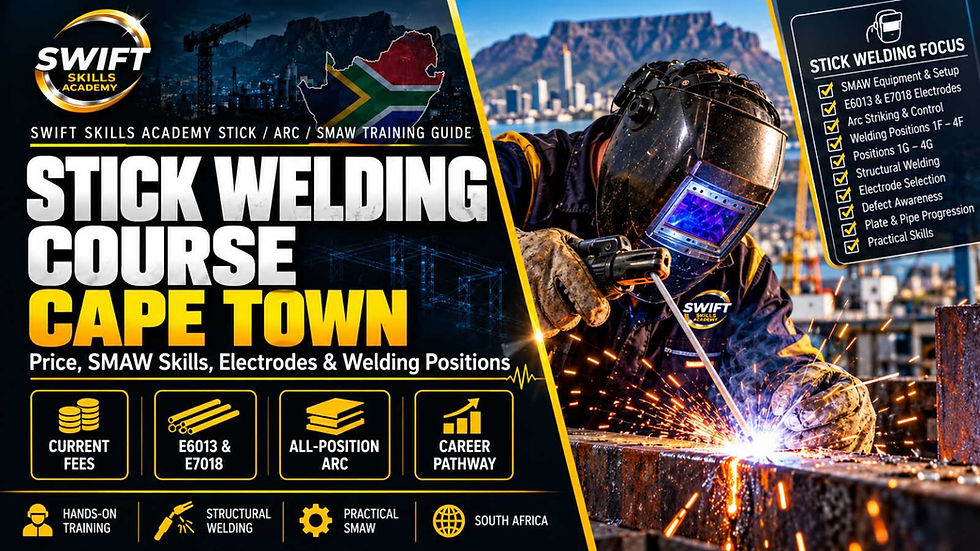
Welding Rods South Africa: E6013 vs E7018, Types, Sizes, Amps & Free Selector

Quick Answer: Which Welding Rod Should You Use in South Africa?
Welding rods are commonly used to mean the flux-coated consumable electrodes used in stick/ARC welding (SMAW). For clean, general-purpose mild-steel fabrication, an E6013 electrode is a common option; E7018 is a low-hydrogen electrode often specified where weld-metal properties and hydrogen control matter. E6011 and E6010 are associated with more forceful penetrating arcs, while E7024 suits certain flat and horizontal applications.
These are starting points for understanding classifications—not a substitute for the applicable Welding Procedure Specification (WPS), electrode manufacturer data, material grade, power source, or qualified welding supervision.
This South African guide explains electrode numbers, common rod diameters, manufacturer-specific amperage examples, electrode storage, material compatibility and beginner errors. It includes a free interactive electrode-selection guide that directs welders and employers toward the appropriate next question, and connects practical learners to Swift Skills Academy's stick/ARC training in Cape Town. SSA provides training; we do not sell welding electrodes through this article.
Welding Rods South Africa: At-a-Glance Selection Table
Question | Practical answer |
|---|---|
What is a welding rod? | A flux-coated consumable electrode for SMAW/stick welding in everyday workshop usage. |
E6013 | General-purpose mild-steel applications where the manufacturer’s instructions and WPS permit. |
E7018 | Low-hydrogen steel electrode; controlled handling matters and project WPS may specify it. |
E6010 / E6011 | Penetrating, cellulosic electrode families; machine/current compatibility differs. |
Common diameters | Often 2.5 mm, 3.2 mm and 4.0 mm, but selection is job- and product-specific. |
What controls the choice? | Metal grade → WPS → joint and position → product sheet → machine → operator competence. |
Need to learn? | See SSA stick/ARC welding training, not a retail welding rod product listing. |
What Are Welding Rods and Welding Electrodes?
In everyday South African workshop language, a welding rod commonly means a covered stick electrode. The electrode has a metal core and a flux coating. In SMAW, the electrical arc melts the electrode and the workpiece; the coating supports shielding and creates slag that is removed according to the welding procedure. A welder must choose the correct electrode specification for the material, weld position, power source, joint geometry, service conditions and WPS.
Welding rod, MIG wire and TIG filler rod: not interchangeable
SMAW electrodes are flux-coated consumables held in a stick electrode holder.
MIG/GMAW normally feeds a continuous wire, while TIG/GTAW may use a separate filler rod and non-consumable tungsten electrode. Those filler products have different classification and handling rules. If you searched for a TIG filler rod or aluminium MIG wire, this page's E6013/E7018 examples are not the right material specification.
Why electrode brand and classification both matter
Two boxes labelled E6013 may comply with the same broad classification but list different current ranges, recommended polarities, operating characteristics, approvals or storage instructions. Always read the exact manufacturer’s product data sheet and keep the batch information when traceability is required. Avoid selecting a rod merely because the packaging says “general purpose.”
E6013 vs E7018 Welding Rods: The Differences That Matter
Both are common steel SMAW electrode classifications, but their flux, applications, hydrogen-control characteristics and handling differ. The choice should begin with the job requirement rather than which electrode seems easier to strike.
Factor | E6013 vs E7018 |
|---|---|
Typical coating / role | E6013: general-purpose rutile family; E7018: low-hydrogen iron-powder family. |
Common focus | E6013: suitable general steel practice; E7018: specified structural or quality-controlled applications. |
Handling | E6013: follow manufacturer storage; E7018: low-hydrogen packaging, exposure and oven controls as specified. |
Polarity / machine | Both depend on exact product data; do not assume universal AC/DC capability. |
Qualification warning | Neither classification independently certifies the welder or makes an unapproved WPS substitution valid. |
E6013: general-purpose rutile electrode
An E6013 typically provides a relatively soft, smooth arc and is frequently used for clean mild steel, thinner sections, training and general fabrication where the relevant procedure permits it. The current type and polarity depend on the exact product. It is not automatically approved for critical load-bearing or pressure equipment simply because the weld bead looks neat.
E7018: low-hydrogen electrode
An E7018 is a commonly specified low-hydrogen, iron-powder electrode for applications in which strength, toughness and hydrogen control can be important. It requires appropriate storage and exposure control to preserve the low-hydrogen properties, as specified by the manufacturer and project WPS. Do not tell someone that every 7018 brand is suitable for every inverter, polarity, material or weld procedure.
What does the “60” versus “70” actually indicate?
In the common AWS carbon-steel SMAW classification pattern, the first two digits indicate a minimum specified tensile-strength class in thousands of psi for deposited weld metal (for example, E60xx and E70xx). They are not percentages of steel or a guarantee of the strength of a finished, inspected joint. The subsequent digits identify position and coating/current characteristics under the applicable electrode classification. Use the actual specification and manufacturer documentation for final interpretation.
Can you substitute E6013 for E7018 on a job?
Not when a project WPS, engineer or specification calls for E7018. A lower-hydrogen control requirement, toughness requirement, application-specific testing or qualification range may make substitution unacceptable. Conversely, using E7018 does not automatically cure poor fit-up, wrong joint design, contamination or unqualified work.
How to Read Common Welding Rod Numbers: E6010, E6011, E6013, E7018 and E7024
The classification is a compact technical identifier. It should guide your questions, not be treated as a complete welding procedure or as a universal amperage chart.
Common classification | Typical educational meaning |
|---|---|
E6010 | Cellulosic penetrating electrode, commonly DCEP; check machine compatibility. |
E6011 | Cellulosic penetrating electrode, commonly AC or DC as product permits. |
E6013 | Rutile/general-purpose steel electrode with smoother arc; confirm current/polarity on box. |
E7018 | Low-hydrogen iron-powder steel electrode; controlled moisture handling. |
E7024 | High-deposition electrode; typically flat/horizontal fillet work, not all-position. |
E308L / E316L | Examples from specialist stainless electrodes; base metal/service match is essential. |
What does the letter E mean?
For these AWS stick-electrode examples, E identifies an electrode classification. Not every filler metal in a welding workshop uses the same naming system or standard.
What does the position digit mean?
Within the common AWS carbon-steel stick-electrode designation, a third digit of 1 is associated with all-position capability, whereas 2 indicates flat and certain horizontal applications. Actual vertical progression, permitted weld types and qualification scope must still match the product and WPS. For a detailed explanation of 1G–6G and 1F–4F work, read our Welding Positions South Africa guide.
Why the last digits matter
The coating and current/polarity capabilities differ between classifications. A 6010 typically requires suitable DC electrode-positive output, whereas 6011 is available for AC or DC, subject to manufacturer guidance. E6013 and E7018 products can have distinct AC/DC compatibility. Look at the exact box or product sheet rather than inferring that all DC inverter welders will run every electrode well.
Welding Rod Sizes: 2.0 mm, 2.5 mm, 3.2 mm, 4.0 mm and 5.0 mm
The diameter of the metal core is one factor affecting current needs, deposition rate, access and control. Common South African stock ranges often include 2.5 mm, 3.2 mm and 4.0 mm for ordinary workshop applications, with other sizes available according to brand and use. Thicker electrodes generally need more current, but the relationship is manufacturer-specific and dependent on position and material.
Nominal rod diameter | What to verify before use |
|---|---|
2.0 mm | Availability, exact manufacturer’s current range, joint size and machine output. |
2.5 mm | Product and position limits; often useful in lower-current practice but not universally. |
3.2 mm | Machine capacity, metal thickness, required position and electrode’s actual data. |
4.0 mm | Often higher current demand, deposition and duty-cycle considerations. |
5.0 mm | Typically substantial power and process capability requirements; confirm manufacturer and WPS. |
Why a 2.5 mm rod may suit different practice from a 4.0 mm rod
A smaller diameter can help with access, lower-current training and thinner material, subject to the procedure. Larger diameters can deposit more weld metal when equipment, position and workpiece permit it. That does not mean a novice should simply increase rod size to speed up learning.
Is the rod diameter the same as the coating diameter?
Usually the stated nominal diameter is the core-wire dimension, not the full outer diameter including flux coating. Check packaging conventions and the specific electrode standard rather than measuring an unknown rod and guessing.
Welding Rod Amperage Chart: Verified E6013 Manufacturer Example
Searchers frequently ask how many amps a 2.5 mm or 3.2 mm rod needs. There is no single safe setting that applies to every brand, electrode classification, joint, position and power source. The following is a named, official ESAB example to show how manufacturer tables are used—not an instruction to apply these settings to different electrodes.
ESAB Weld 6013 diameter | ESAB product-listed amperage, not a universal rule |
|---|---|
2.5 × 350 mm | 50–90 A; exact ESAB Weld 6013 product example. |
3.2 × 350 mm | 80–130 A; exact ESAB Weld 6013 product example. |
4.0 × 400 mm | 150–200 A; exact ESAB Weld 6013 product example. |
5.0 × 400 mm | 180–240 A; exact ESAB Weld 6013 product example. |
Source and caution |
How to use a manufacturer’s amperage range correctly
Confirm the exact product name, electrode diameter, polarity and actual workpiece. Start from the manufacturer’s permitted range under competent supervision, apply the approved WPS where applicable, and assess arc behaviour, fusion and bead quality. Follow safe equipment setup and PPE instructions. Some work requires engineering approval or additional qualification before welding.
Are E7018 amperages identical to E6013 amperages?
No. E7018 is a different electrode class and exact operating ranges can vary with brand, coating, diameter and application. The E6013 values above must not be copied over to E7018, E6011 or stainless-steel rods.
Which Welding Rod Fits Which Material?
Material compatibility is a common search trap. A product sold as a steel welding rod is not automatically appropriate for stainless steel, cast iron or aluminium, regardless of an eye-catching “all purpose” label. Consult the correct filler metal specification and any required corrosion-resistance, strength, preheat or heat-treatment conditions.
Material | Electrode-selection question |
|---|---|
Mild/carbon steel | Match carbon-steel grade, strength/toughness, procedure and suitable E60/E70 class. |
Stainless steel | Match stainless grade and service; specialist stainless consumable, not ordinary E6013. |
Cast iron | Consider specialist nickel-based repair filler and approved repair/preheat/cooling procedure. |
Aluminium | Requires aluminium-specific process and consumables; not ordinary carbon-steel stick rods. |
Unknown / mixed alloy | Identify materials first; seek qualified welding engineering guidance. |
Mild steel
Common carbon-steel electrode classifications may be suitable where the procedure permits, including E6013, E6011 and E7018 in their intended applications. The specific steel grade, weld design and required mechanical properties still control selection.
Stainless steel: the filler metal must match the application
Stainless work uses specialist electrode or filler classifications chosen for base-metal composition, corrosion service and any dissimilar-metal requirements. References such as E308L or E316L may appear on packaging, but neither is a universal stainless-steel solution. The correct filler and process should be confirmed by a knowledgeable welding professional.
Cast iron: repair risks are different
Nickel-based or specialist electrodes may be used in qualified cast-iron repairs, depending on the casting, joint and method. Cracking risk, preheat, weld sequence and cool-down require an application-specific procedure; do not infer that E6013 is a general cast-iron repair electrode.
Aluminium: avoid a false equivalence
Aluminium welding frequently requires suitable MIG or TIG equipment and correctly matched filler metal. Some specialised aluminium stick electrodes exist, but they do not make ordinary E6013/E7018 carbon-steel rods suitable for aluminium. If aluminium training is your objective, ask SSA about the actual material and process scope of its available training.
AC vs DC Welding Rods: Check Polarity and Machine Compatibility
“AC compatible” and “DC compatible” are not interchangeable with a universal guarantee that a rod will strike and run well on every welding machine. An inverter's open-circuit voltage, arc force, output curve and electrode-specific modes can matter alongside the declared polarity.
Power-source condition | What to check |
|---|---|
AC output | Exact rod formulation, compatible current range, machine OCV and electrode specification. |
DCEP / DC+ | Specific electrode compatibility, correct lead connections, WPS and machine instructions. |
DCEN / DC− | Manufacturer/WPS allowance; cannot infer solely from the rod classification name. |
Small inverter welder | Rated output and duty cycle, arc-starting characteristics and actual electrode capability. |
Unknown polarity/machine | Stop and identify model, output type and manufacturer’s instructions before welding. |
What do DC+, DCEP and DCEN mean?
DCEP means direct-current electrode positive; DCEN means electrode negative. A data sheet may use DC+ or DC− as shorthand. Do not switch connections solely because a social media chart says one polarity “always penetrates better”—the electrode manufacturer’s specification and WPS take priority.
Can an E7018 run on AC?
Certain E7018 products are intended for AC as well as DC, while others specify different operating requirements or have formulations marketed for low open-circuit-voltage AC machines. Check the product variant and machine compatibility, not simply the number 7018.
Welding Rod Storage, Moisture and E7018 Low-Hydrogen Control
Electrode storage matters because flux coatings have different moisture requirements. A low-hydrogen electrode may require sealed packaging, controlled exposure after opening, and a holding or redrying system when authorised. The rules are not universal temperatures for all brands or all electrode types.
Electrode family | Handling implication |
|---|---|
Low-hydrogen E7018 | Keep dry under product-specific packaging, exposure and approved holding/redrying procedures. |
Cellulosic E6010/E6011 | Different moisture/coating needs; do not treat like low-hydrogen rods. |
Rutile/general-purpose E6013 | Protect against damage and moisture; follow its own handling instructions. |
Damaged, damp or untraceable rods | Quarantine and use qualified judgement; reject if required by quality system. |
Why E7018 storage differs from E6010 or E6011
Low-hydrogen electrodes need protection from excess moisture to maintain their specified performance. Cellulosic electrodes rely on different coating characteristics; storing them as though they were low-hydrogen rods can damage performance. ESAB warns that mixing these electrode types in the same holding conditions can create problems. Follow the product instructions and site quality system.
Can a wet or damaged electrode be “saved” in any oven?
Do not attempt an improvised redry or domestic-oven treatment. Some low-hydrogen electrodes may be redried under controlled manufacturer conditions, while others may need rejection. Traceability and acceptance are particularly important for critical fabrication.
How to Choose a Welding Rod: Six Checks Before You Weld
The correct process is a decision sequence, not a “pick E6013 for everything” shortcut. For learner practice, training should help you build these checks into normal workshop behaviour.
Step 1 — Identify the exact base metal
Write down the known steel grade or other material specification. If unknown, stop and clarify rather than asserting a filler-metal match.
Step 2 — Check the drawings and applicable WPS
The drawing, welding procedure and any client or engineering specification take priority over a general electrode guide. They may prescribe filler-metal classification, weld size, position, current range and inspection.
Step 3 — Confirm the joint, thickness and welding position
A flat plate fillet differs from a vertical groove or a fixed-pipe root. Position, access and fit-up affect the acceptable electrode size, skill requirement and technique.
Step 4 — Check the power source and the actual product sheet
Verify AC/DC compatibility, polarity, open-circuit voltage and the allowed manufacturer amperage range for the exact electrode diameter and product.
Step 5 — Check electrode condition and storage history
Inspect the packaging, flux condition, exposure and lot information. Apply the project's quality procedures for low-hydrogen consumables. Do not use questionable rods in structural or critical repairs without an authorised decision.
Step 6 — Practise under safe supervision, then inspect the result
Welding involves hot metal, ultraviolet radiation, fumes, electrical energy and fire risk. Use appropriate face/eye protection, gloves, ventilation, work controls and qualified instruction. Check your welds to the actual acceptance requirements; bead appearance alone cannot establish fitness for service.
Welding Rod Mistakes That Waste Money and Training Time
Buying the right consumable is only one part of making a quality weld. The following errors are especially important when beginners move between electrode classes or into unfamiliar work.
Common mistake | Better decision |
|---|---|
Picking by colour or pack price | Use specified classification, brand data, lot and correct size. |
Reusing generic amp charts | Check product-specific table for exact classification/diameter. |
Assuming 7018 always runs on AC | Confirm variant and machine characteristics first. |
Putting cellulosic and low-H in same oven | Use correct separate manufacturer-controlled storage. |
Selecting rod before metal/WPS | Identify base metal, design, joint, position and qualified procedure. |
Judging weld only by appearance | Use specified inspection and acceptance criteria. |
Mistaking retail price for technical suitability
The cheapest or most expensive 5 kg pack is not necessarily the correct one. Compare the right classification, diameter, authenticity, approvals and packaging, then compare prices on a like-for-like basis. Supplier prices change; SSA is a training provider and does not list retail rod prices here.
Using the same settings for every rod
An E6013 and E7018 can have different behaviour and operating ranges; even two E6013 brands may specify different guidance. Consult the relevant manufacturer table instead of relying on an internet chart without a product name.
Confusing weld appearance with acceptance
Undercut, porosity, overlap, lack of fusion and other indications require evaluation against the proper inspection criteria. A smooth bead cannot prove that a weld meets a code. For a dedicated quality-checking guide, read Visual Weld Inspection South Africa.
Ignoring training requirements for positional work
A welder comfortable with flat fillets may struggle with vertical or overhead joints. The electrode, process, position and material must match the person's demonstrated skill. This article intentionally links to the Welding Positions South Africa guide rather than repeating its full position syllabus.
How South African Beginners and Employers Can Turn Rod Knowledge Into Welding Skills
Searches for electrode types are often purchase-led, but a visitor asking why E6013 sticks, how to read electrode codes or which size to practise with may also need structured skills development. Choose the correct commercial next step rather than sending everyone to an unrelated contact form.
Beginner welders: develop consistent SMAW fundamentals
Practical stick-welding training should cover safe equipment setup, reading rod markings and packaging, electrode handling, arc initiation, bead control, position awareness and basic visual evaluation. Specific course duration, equipment and assessments need to be confirmed for the actual available programme.
Experienced welders: learn the procedure, not just the rod number
A competent welder moving into low-hydrogen, positional, structural or unfamiliar material applications may need skills-gap training and procedure-specific assessment. A rod-selection checker cannot declare someone coded or qualified.
Employers: reduce rework with documented electrode competence
A workshop training plan can cover storage, WPS interpretation, materials, position competency and how operators verify their consumables. Employers should scope needs against their actual operations; successful training is not a guarantee of a project passing acceptance testing.
Electrode Selection for Real Welding Jobs: Five Practical Examples
Example 1 — Training on clean mild-steel plate
A beginner sees E6013 in a training setting. The instructor first confirms the material, machine, diameter and position, then checks the specific electrode’s allowed ranges and safe procedure. The aim is consistent fundamentals, not learning one setting by heart.
Example 2 — A structural job specifies low-hydrogen consumables
The job WPS demands a specified low-hydrogen classification and storage control. The welder must follow the procedure and handling system; swapping to general-purpose rods because they are cheaper is inappropriate.
Example 3 — Maintenance welding on contaminated metal
Some E6010/E6011 classifications provide a penetrating arc suited to certain maintenance work, but cleaning the material and checking the repair procedure remain essential. Do not use a “dirty-metal rod” claim as a reason to ignore contamination and safety requirements.
Example 4 — A stainless-steel fabrication request
The team must verify the actual stainless grade, service conditions and matching consumable process. Carbon-steel E6013 is not a substitute for the required stainless electrode or filler wire.
Example 5 — A welding supervisor wants consistent workshop results
The supervisor can create an electrode register: manufacturer, classification, diameter, lot number, power-source compatibility, storage status, WPS permitted use, operator training and inspection outcome. This helps make technical decisions auditable.
Welding Rod Prices in South Africa: What to Compare Without Guessing
Prices vary by brand, pack weight, diameter, classification, approvals and distribution. Searches for “welding rods price” often have retailer intent, so this article does not invent a current market price or portray SSA as an electrode stockist.
Compare this | Why it matters |
|---|---|
Classification and material match | Avoid buying rods incompatible with the required metal or WPS. |
Diameter and length | Affects use, compatible equipment and required access. |
Pack weight and actual contents | Compare equivalent units and reputable supplier availability. |
Approvals, lot/traceability, storage | Especially important for project-specific or low-H consumables. |
Current supplier price | Check actual quotations; this training page does not sell rods. |
Retail purchases versus welding course enquiries
Buy the specified consumables from a reputable welding supplier and verify the data sheet. If your goal is to learn safe SMAW technique and electrode selection, use the appropriate course route. If your employer needs workforce development, ask for a scoped on-site training quotation.
Where Swift Skills Academy Fits in the Electrode-Selection Journey
Swift Skills Academy's role is to help learners and employers develop the practical training skills behind electrode choices: reading designations, applying procedures, understanding material and position limits, safe setup, and weld-quality checking. We do not promise that one welding course qualifies every process or material, or that a digital selector overrides an employer's WPS.
For available programmes, see our Welding Courses Cape Town page or explore the dedicated Stick Welding Course Cape Town guide. The course page retains booking and fees intent; this article owns the classification and selection questions.
Frequently Asked Questions About Welding Rods in South Africa
What welding rods are best for beginners?
E6013 is a common general-purpose electrode used in training with clean mild steel when the procedure and instructor permit it. The right rod still depends on the base metal, position, machine and actual manufacturer’s instructions.
What is the difference between 6013 and 7018 rods?
E6013 is commonly a rutile general-purpose rod; E7018 is a low-hydrogen iron-powder classification used where specified strength and hydrogen control matter. Their storage and operating requirements differ.
What is E6013 used for?
General mild-steel fabrication, thinner sections and suitable supervised training work where the particular electrode and WPS are appropriate.
What is E7018 used for?
Appropriate low-hydrogen steel welding applications under an approved procedure. It is not automatically a substitute for every other steel filler and needs controlled handling.
What do E6013 numbers mean?
Under the common AWS naming pattern, “E” indicates a covered electrode, “60” indicates a specified tensile-strength class, “1” denotes positional capability and the final digit is part of the coating/current classification.
Can I use 2.5 mm rods on a small inverter?
Only if the exact electrode’s recommended current and polarity match your specific machine and safe operating conditions. Consult its data sheet and equipment specifications.
What amps are needed for a 3.2 mm welding rod?
There is no universal number. As one ESAB Weld 6013 product example, 3.2 mm is listed at 80–130 A; that range does not apply to all 3.2 mm welding rods.
Is E6013 suitable for stainless steel?
Ordinary carbon-steel E6013 is not a general stainless-steel filler. Choose a material-appropriate specification for the actual steel grade and intended service.
Are welding rods and welding electrodes the same thing?
In common stick-welding language, yes: people use both names for covered SMAW electrodes. TIG filler rods and MIG welding wires are different consumable categories.
Do E7018 rods need an oven?
Low-hydrogen storage and exposure procedures may require controlled ovens or sealed packaging. The exact rules come from the electrode manufacturer and applicable WPS; never improvise temperatures.
What is the difference between E6010 and E6011?
They are both cellulosic-style electrode classifications associated with penetrating arcs, but their current compatibility differs; E6010 commonly requires suitable DCEP while E6011 can be suitable for AC or DC, subject to the product sheet.
Can E7018 be used on an AC welding machine?
Certain E7018 variants are AC capable, but the exact product and machine voltage/arc characteristics determine compatibility. Check its data sheet.
Which welding rod should I use for 3G or 4G?
Choose an electrode authorised for the required welding position by the applicable classification, procedure and qualification requirements. The selected rod alone does not prove the welder is competent in the position.
Are welding rod prices listed here?
No. This guide provides educational selection information; electrode retail prices change and SSA does not sell rods through this page. Reputable suppliers can provide current quotations and correct product data.
Where can I learn stick welding in Cape Town?
Swift Skills Academy offers welding training pathways in Cape Town. Confirm the currently offered stick/ARC programme, practical scope, schedule, fees and any relevant assessment with SSA before booking.
Authoritative Sources & Technical References
The following manufacturer and training references support the technical distinctions in this article. Brand-specific current values are identified as such, and a product sheet must be checked for the exact consumable, not merely a similar classification.
Authoritative source | What it establishes |
|---|---|
Electrode strength, position, thickness, current and procedure-selection factors. | |
Classification, material and choosing different SMAW electrodes. | |
Common 6010/6011/6013/7018 characteristics and dependence on electrode diameter. | |
Named 2.5–5.0 mm E6013 current/diameter ranges with limitations. | |
Why hydrogen-controlled and cellulosic electrodes require different handling. | |
Example showing a separate E6013 product can have different settings. |
Read More: Three Related Swift Skills Academy Welding Guides
Related Swift Skills Academy article | Best next step |
|---|---|
Compare practical stick-welding training and actual course requirements. | |
Understand fillet, groove, plate and pipe position requirements. | |
Learn about weld defects, visual checks and inspection limitations. |
Final Word: Choose the Right Electrode—Then Learn the Skill Behind It
The best welding rod for a South African welder is the one that matches the base material, position, joint, approved WPS, machine, manufacturer specifications and real skill level. E6013 versus E7018 is a useful starting comparison, but it is not a complete design or qualification decision.
Use the free electrode selector to clarify your learning questions. If your real need is structured practical stick-welding training, assessment readiness or workforce skills development, Swift Skills Academy can help you identify the correct training enquiry route—without promising a welding qualification or job outcome from an online chart.