Fire Extinguisher Requirements South Africa: Types, Placement & Workplace Compliance Guide
QUICK ANSWER

South African employers should not choose workplace fire extinguishers by copying a generic quantity from another building. Regulation 13J(2) of the General Safety Regulations requires an adequate supply of suitable fire-fighting equipment at strategic locations, taking account of the workplace and the amount and type of flammable articles used, handled or stored. The practical job is therefore to match equipment to the actual hazards, keep it accessible and in good working order, use the correct authorised servicing route, and reassess the arrangement when the workplace changes.
This employer guide explains fire extinguisher requirements South Africa businesses should manage without pretending that one extinguisher type, one quantity formula or one servicing rule fits every premises. It is general workplace information, not a site-specific fire design, SANS specification, engineering approval or legal opinion.
Employer question | What to control | Evidence to retain |
Do we have the right equipment? | Match the actual fire hazards to suitable, correctly rated equipment. | Risk assessment, fire plan, equipment register, specialist advice where needed. |
Is there enough equipment? | Assess size, construction, location, activities, flammable materials and local fire requirements. | Approved plan or assessment basis, location schedule, change records. |
Can people reach it? | Keep equipment visible, identifiable and unobstructed at strategic locations. | Routine readiness checks and corrective-action records. |
Is it serviceable? | Maintain equipment in good working order and use the correct authorised servicing route. | Service labels, provider records, defect and replacement history. |
Can employees respond safely? | Separate equipment readiness from employee competence and evacuation arrangements. | Training records, role allocation, drills and emergency procedures. |
Found a Fire-Response Training Gap?
Fire Extinguisher Requirements South Africa: What Employers Must Control
The legal starting point is not a shopping list of extinguisher sizes. The March 2025 amendment to the General Safety Regulations states in regulation 13J(2) that the employer must consider the size, construction and location of the workplace and the amount and type of flammable articles used, handled or stored, then provide an adequate supply of suitable fire-fighting equipment at strategic locations and maintain it in good working order.
That wording matters. It means adequacy, suitability, location and condition are connected decisions. A wall-mounted extinguisher can still be a weak control if it is the wrong type for the hazard, blocked by stock, difficult to identify, overdue for corrective action or no longer suitable after the workplace changes.
Start with the workplace, not the extinguisher catalogue
Before deciding what to install, review the actual work areas: offices, workshops, warehouses, kitchens, plant rooms, charging areas, flammable-liquid use, hot work, electrical equipment and any specialist process hazards. Different areas can require different equipment decisions.
Do not turn a minimum into a universal rule
The General Safety Regulations do not provide one universal extinguisher count that can safely be applied to every South African workplace. Detailed requirements may also arise from the approved building or fire plan, incorporated standards, local fire authority requirements, the manufacturer, a competent fire specialist, insurer requirements or sector-specific rules. Where those requirements apply, they must be checked for the actual premises.
How Many Fire Extinguishers Does a Workplace Need?
There is no responsible one-number answer for every workplace. The right question is whether the premises has an adequate supply of suitable equipment for its actual risk profile and layout.
Factors that can change the quantity or distribution include:
The size, construction and layout of the premises.
The number and separation of work areas, floors, rooms and hazard zones.
The activities performed and the ignition sources present.
The amount and type of combustible or flammable materials present.
Electrical, kitchen, battery, workshop or specialist process hazards.
Changes to stock, racking, partitions, machinery, charging areas or occupancy.
The approved fire plan, building requirements and recommendations of the local fire authority where applicable.
Do not copy another company's extinguisher count simply because its building looks similar. The correct equipment arrangement must be defensible for your own workplace.
Which Fire Extinguisher Type Matches Which Workplace Hazard?
Extinguisher type should follow the fire hazard and the product's approved rating and markings. The table below is a practical orientation tool, not a site-specific specification. A competent fire-equipment provider or fire specialist should confirm the exact product and rating where the decision is technical or uncertain.
Workplace hazard | Common equipment options to assess | Important qualification |
Paper, wood, cardboard, fabric and similar ordinary combustibles | Water, foam or suitable multipurpose dry chemical equipment may be appropriate depending on the product rating. | Confirm the extinguisher's marked suitability and nearby electrical or other hazards. |
Flammable liquids | Suitable foam, dry chemical or CO₂ equipment may be considered depending on the liquid, environment and rating. | The exact agent must match the hazard; do not generalise across all liquids or processes. |
Energised electrical equipment | Equipment specifically suitable for electrical risk, commonly CO₂ or an appropriate dry chemical extinguisher. | Electrical isolation, safe approach and the extinguisher's marked suitability matter. |
Commercial cooking oils and fats | A wet-chemical extinguisher designed and rated for cooking-oil or fat fires. | Do not substitute an unsuitable general-purpose extinguisher for a specialist cooking-oil hazard. |
Combustible metals or specialist industrial hazards | Specialist extinguishing media matched to the specific material and process. | Escalate to competent specialist advice; the wrong agent can worsen some metal fires. |
Do not choose by colour alone
Labels, ratings and manufacturer information matter more than a casual colour assumption. Product markings and the actual hazard should drive the choice, especially where several risks exist in the same area.
One extinguisher does not have to solve every hazard
A workplace can need different equipment for different zones. Trying to make one general-purpose unit cover every possible fire scenario can create a false sense of readiness.
Where Should Fire Extinguishers Be Positioned?
Regulation 13J(2) uses the phrase strategic locations. In practical terms, equipment should be positioned so that it can be identified and reached without creating a new hazard, while the exact arrangement remains consistent with the site's approved fire plan, applicable standards and local fire-authority requirements.
An employer readiness review should ask:
Is the extinguisher in its designated location?
Is access clear of pallets, boxes, furniture, vehicles, doors or temporary work?
Can a person identify the equipment quickly?
Has a new partition, rack, machine or storage area changed access or visibility?
Has the hazard moved while the extinguisher stayed behind?
Would a person have to move toward an unsafe fire condition simply to reach the equipment?
Does the current arrangement still match the approved fire plan and any local fire-authority requirements?
Exact mounting heights, travel distances, quantities and technical placement rules should not be invented in a generic article. Where they matter, verify the applicable building/fire standard, approved plan, equipment specification and local authority requirements for the premises.
Maintenance, Servicing and Routine Readiness Checks Are Different
A common employer mistake is to treat a quick visual check as the same thing as formal extinguisher inspection, testing or servicing. They are not the same activity.
Routine employer readiness checks
A workplace can routinely verify non-invasive readiness matters such as whether equipment is still present, visible, accessible and free from obvious damage or interference. This is an operational control: it helps detect a problem early and trigger corrective action.
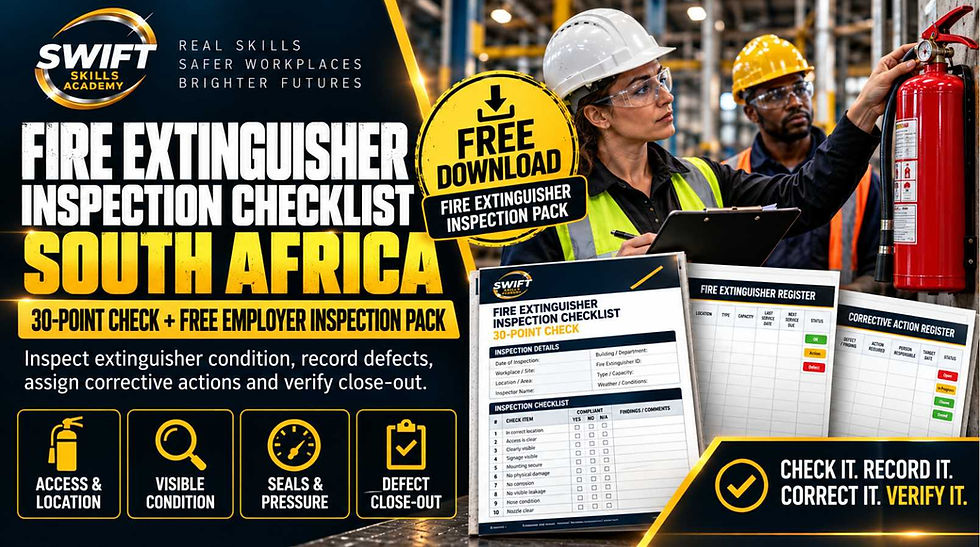
Typical readiness observations include location, access, obvious physical damage or corrosion, missing or disturbed safety features, an abnormal pressure indicator where one is fitted, unreadable instructions, evidence of discharge and service-record concerns. These checks should not involve opening, recharging, pressure-testing, dismantling or repairing the extinguisher.
Formal servicing, inspection, testing, recharge and repair
Regulation 19 of the Pressure Equipment Regulations framework regulates work such as filling, recharging, reconditioning, modifying, repairing, inspecting and testing fire extinguishers. The official guidance notes state that this work must be performed through the authorised-person and permit-holder framework described there. Employers should therefore avoid treating technical extinguisher service work as a general in-house maintenance task.
Cape Town employers should note the City's local guidance
The City of Cape Town's fire-safety guidance says commercial, industrial, health-care and accommodation facilities must install and maintain fire-safety equipment; it also states that fire equipment should be serviced at least once a year and refers businesses to SABS 1475-approved companies for supply and service. The City further states that removing or relocating fire equipment or an emergency exit requires the necessary Fire and Rescue Service approval. Those statements are Cape Town guidance and should not be presented as a universal municipal rule for every part of South Africa.
When Fire Extinguishers Should Be Escalated for Corrective Action
A readiness check should not end with a tick. When something is wrong, assign the finding, control the risk and close it only after verification.
The extinguisher is missing from its designated location.
Access is blocked or visibility has been compromised.
The unit appears discharged, leaking, damaged, corroded or physically compromised.
The hose, nozzle, handle, pin, seal or tamper feature appears damaged or missing.
The pressure indicator, where fitted, appears outside its normal marked range.
Instructions or identification are unreadable.
Service information is missing, unclear or appears overdue against the applicable requirement.
The workplace hazard has changed and the existing extinguisher may no longer be suitable.
The approved fire plan or fire-equipment arrangement has changed without the required review or approval.
Do not ask an unqualified employee to 'fix' a technical extinguisher defect. Escalate it through the appropriate authorised equipment or specialist route and keep the temporary risk under control until the issue is resolved.
Reassess Fire Equipment When the Workplace Changes
Fire equipment can become inadequate even when every extinguisher is physically in good condition. The reason is simple: the workplace changes.
New flammable or combustible materials are introduced.
Racking, partitions, shelving or storage heights change.
Machinery or electrical equipment is added or relocated.
Battery-charging areas are introduced or expanded.
Hot-work activities become routine in a new zone.
A kitchen, canteen or cooking process changes.
The number of employees, shifts, visitors or contractors changes materially.
A renovation changes exits, compartments, access routes or the approved fire plan.
Treat these changes as triggers to reassess fire hazards, equipment adequacy, emergency arrangements and responder coverage rather than waiting for the next incident or inspection.
Which Fire-Safety Problem Are You Actually Trying to Fix?
Training Does Not Replace Suitable Fire Equipment
A trained employee cannot make an unsuitable or defective extinguisher compliant. Equally, a perfectly serviced extinguisher does not prove that employees know when to use it, when not to use it, or when evacuation is the safer decision.
Employer fire safety works best when prevention, engineering and building controls, suitable equipment, clear escape routes, emergency arrangements and competent people operate together. Basic Fire Fighting training should be used to close a genuine competence or response gap, not to hide an equipment, maintenance or building defect.
If smoke, heat, fire growth, hazardous materials or a threatened escape route make intervention unsafe, evacuation and emergency escalation take priority over attempting to fight the fire.
Build an Employer Fire Extinguisher Control System
Instead of managing extinguishers as isolated wall-mounted objects, manage them as assets inside a repeatable control cycle:
ASSESS → ALLOCATE → RECORD → CHECK → SERVICE → CORRECT → VERIFY
Stage | Employer action | Evidence |
Assess | Identify the workplace fire hazards and the areas that need suitable equipment. | Fire-risk information, approved plan, specialist recommendations. |
Allocate | Place suitable equipment at the required strategic locations. | Location schedule and asset IDs. |
Record | Keep a controlled register of equipment, type, rating, location and service information. | Equipment register. |
Check | Verify presence, access, visibility and obvious readiness conditions routinely. | Readiness checklist or inspection record. |
Service | Use the appropriate authorised servicing route for technical extinguisher work. | Service label and provider documentation. |
Correct | Assign defects, obstructions, wrong-location issues or suitability concerns. | Corrective-action register. |
Verify | Confirm the action actually restored the control before closing it. | Close-out evidence and responsible-person sign-off. |
Common Fire Extinguisher Compliance Mistakes
Buying a standard quantity without assessing the workplace hazards and layout.
Using one extinguisher type as a supposed answer to every fire hazard.
Allowing stock, furniture, vehicles or temporary work to block access.
Relocating equipment after a layout change without checking the approved fire arrangement.
Treating a visual readiness check as a substitute for regulated servicing or testing.
Keeping service paperwork while ignoring an obvious physical defect or obstruction.
Training employees while leaving defective or unsuitable equipment unresolved.
Assuming a serviced extinguisher means the whole workplace is fire compliant.
Failing to reassess the arrangement after new hazards, machinery, storage or occupancy changes.
What Records Should Employers Keep?
The exact statutory record set depends on the workplace and applicable requirements, but a defensible employer management system should make it possible to show what equipment exists, why it is there, whether it is ready and how defects were closed.
A fire-equipment asset register with unique identification where practical.
Location or zone for each extinguisher.
Extinguisher type, rating or other product identification relevant to the site decision.
Service and maintenance information supplied by the authorised provider.
Routine readiness-check records where the employer uses them.
Defect, obstruction, replacement and corrective-action records.
Changes to the approved fire plan or equipment arrangement where applicable.
Relevant fire-risk-assessment evidence and specialist recommendations.
Training and emergency-role records for employees expected to perform fire-response duties.
Good records do not replace the control. They help prove that the employer identified the requirement, assigned responsibility, acted on defects and verified close-out.
Turn the Finding Into the Right Corrective Action
Frequently Asked Questions
How many fire extinguishers are required in a workplace in South Africa?
There is no single quantity in regulation 13J(2) that applies to every workplace. The employer must provide an adequate supply of suitable fire-fighting equipment at strategic locations, taking account of the workplace and flammable materials. The approved fire plan, applicable standards, local fire authority and competent specialist advice may add more specific requirements for the premises.
How often must fire extinguishers be serviced in South Africa?
Do not rely on one generic national interval without checking the applicable standard, equipment requirement and local authority. The City of Cape Town's current fire-safety guidance states that fire equipment in the commercial, industrial, health-care and accommodation facilities it addresses must be serviced at least once a year. Employers elsewhere should verify the rule that applies to their own premises and equipment.
Can employees inspect fire extinguishers themselves?
Employees can be assigned non-invasive workplace readiness checks such as confirming location, access, visibility and obvious defects. Technical inspection, testing, recharge, reconditioning or repair is different: the Pressure Equipment Regulations framework regulates that work and it should be handled through the appropriate authorised route.
Can a business move a fire extinguisher to another wall or area?
Do not treat relocation as a cosmetic decision. Moving equipment can alter the approved fire arrangement and leave a hazard area under-protected. In Cape Town, the City's guidance specifically says removal or relocation of fire equipment or an emergency exit requires the necessary Fire and Rescue Service approval. Verify the applicable requirements before changing the layout.
What fire extinguisher should be used for electrical equipment?
Use equipment that is specifically suitable for the electrical hazard and check the product marking and site assessment. CO₂ and appropriate dry chemical extinguishers are commonly considered for energised electrical risks, but the exact choice depends on the equipment, environment, nearby fuel and safe isolation arrangements.
Does every employee need Fire Fighting training?
Not every employee necessarily performs the same emergency role. Employers should determine the response structure, shift coverage, evacuation arrangements and competence needed for the workplace. Employees who are expected to attempt first-response firefighting need suitable instruction and practical competence, while everyone should understand the emergency and evacuation arrangements relevant to them.
Does a serviced extinguisher mean the workplace is fire compliant?
No. Servicing is only one control. Overall fire safety also depends on suitability, quantity, placement, access, escape routes, prevention, alarms or other fire-protection systems where required, emergency arrangements, employee roles, training and corrective action.
Is a monthly visual check the same as professional servicing?
No. A routine readiness check is intended to identify obvious operational problems such as obstruction, missing equipment or visible damage. Professional servicing, technical inspection, testing, recharge and repair are different activities and must follow the applicable authorised framework.
Authoritative Sources & Regulatory References
Authoritative Source | What It Supports |
Regulation 13J: fire precautions, means of egress, adequate supply of suitable fire-fighting equipment at strategic locations and maintenance in good working order. | |
Authorised-person / permit-holder framework for filling, recharging, reconditioning, modifying, repairing, inspecting and testing fire extinguishers. | |
Primary regulatory framework for pressure equipment, including fire-extinguisher requirements read with incorporated standards. | |
Cape Town guidance on commercial/industrial fire equipment, servicing, approved suppliers/service providers and relocation/removal approval. | |
Building-owner responsibility for maintaining fire-protection measures shown on the approved fire plan before an inspection request. |
Read More
Read More | Why Read It |
Use it for routine readiness checks after this requirements guide has established what the equipment system should control. | |
Start here when you are unsure what hazards should drive the extinguisher and broader fire-control decisions. | |
Expand beyond extinguishers to prevention, exits, alarms, equipment, people, drills, records and corrective action. |
Final Word
Fire extinguisher compliance is not achieved by buying a few red cylinders and attaching service stickers. A defensible employer system starts with the workplace hazards, selects suitable equipment, positions it strategically, keeps it accessible and serviceable, separates routine readiness checks from regulated technical servicing, and reassesses the arrangement when work changes.
Use this guide as a management framework, then verify the approved fire plan, applicable standards, local fire-authority requirements and specialist advice for the actual premises. Where the remaining finding is a genuine employee competence or response-coverage gap, address that gap through appropriate training without confusing it with equipment compliance.