Gas Welding Course Cape Town: Oxy-Acetylene Cost, Duration, Flame Types, Safety & Skills
Updated: Oct 2

QUICK ANSWER
A gas welding course Cape Town learner should expect practical training in oxy-acetylene equipment identification, cylinder and regulator safety, leak checking, flame adjustment, workpiece preparation, weld-pool control, filler-rod coordination, torch movement, defect recognition and safe shutdown.
Swift Skills Academy’s current welding pathway lists Oxy-Acetylene Welding & Brazing at approximately 3–5 days, depending on programme scope. The academy does not currently publish a confirmed standalone gas-welding fee on its main welding page, so the correct price should be confirmed in a written quotation before enrolment. Swift Skills Academy
At a Glance | Gas Welding Course Cape Town |
Main process | Oxy-acetylene fusion welding |
Current SSA pathway duration | Approximately 3–5 days |
Typical focus | Setup, flame control, thin-section welding, filler control, safety |
Primary heat source | Oxygen + acetylene flame |
Electric arc required? | No |
Related processes | Brazing, heating and oxy-fuel cutting |
Best starting point for | Beginners, maintenance workers, fabricators and learners building torch-control skills |
Current standalone fee | Confirm by written quotation |
Location | Cape Town, South Africa |
Important: gas welding, brazing and gas cutting may use related oxy-acetylene equipment, but they are different processes and should not be treated as interchangeable competencies.
What Is Oxy-Acetylene Gas Welding?
Oxy-acetylene welding is a fusion-welding process that uses oxygen and acetylene mixed in a torch to create a high-temperature flame.
Unlike MIG, TIG, Stick and Flux Core welding, it does not use an electric arc.
The flame heats the edges of the workpieces until a molten pool forms. Depending on the joint and application, the operator may introduce a separate filler rod into that molten pool.
TWI describes oxy-acetylene welding as a combustion-based process and identifies three principal flame settings: neutral, oxidising and carburising. TWI notes that a neutral flame is commonly used for welding. TWI Global
That makes gas welding particularly useful for developing fundamental skills such as:
observing how metal responds to heat;
controlling a molten weld pool;
coordinating torch and filler rod;
managing heat input;
maintaining travel speed;
controlling torch angle;
understanding distortion;
recognising oxidation;
and learning how preparation affects the final joint.
These skills remain useful even when a learner later progresses into MIG, TIG, Stick or other welding processes.
Why Is Gas Welding Still Relevant?
Modern fabrication workshops may rely heavily on electrical processes such as MIG, TIG and Stick welding, but that does not make oxy-acetylene welding irrelevant.
Gas welding places much of the heat control directly in the operator’s hands.
There is no:
automatic wire feed;
electronic arc-length control;
programmed pulse;
synergic setting;
inverter-managed arc;
or machine-controlled heat cycle doing the work for the learner.
The operator must physically coordinate:
flame → torch → weld pool → filler → travel → heat distribution
That makes oxy-acetylene training useful for understanding the fundamentals of molten-metal control.
Oxy-fuel systems may also support related workshop tasks such as:
heating;
brazing;
preheating;
straightening;
bending;
selected repair work;
and oxy-fuel cutting.
The important qualification is that using the same gas system does not make these the same skill.
Gas Welding vs Brazing vs Gas Cutting
This distinction is essential because these processes are frequently confused.
Process | What Happens to the Base Metal? | Main Purpose |
Gas welding | Joint edges are intentionally melted | Fusion joining |
Brazing | Base metal remains solid while filler melts and flows | Joining without melting the parent metal |
Oxy-fuel cutting | Suitable hot steel reacts with a cutting-oxygen stream | Separating or profiling material |
Heating | Workpiece is heated without necessarily joining or cutting | Bending, straightening, preheating, maintenance |
Gas welding
Gas welding creates a fusion joint.
The heat from the flame melts the parent metal at the joint. A filler rod may be added where required.
Brazing
Brazing uses a filler alloy that melts and flows into a prepared joint without intentionally melting the parent material.
Joint clearance, cleanliness, filler selection and heat distribution are therefore crucial.
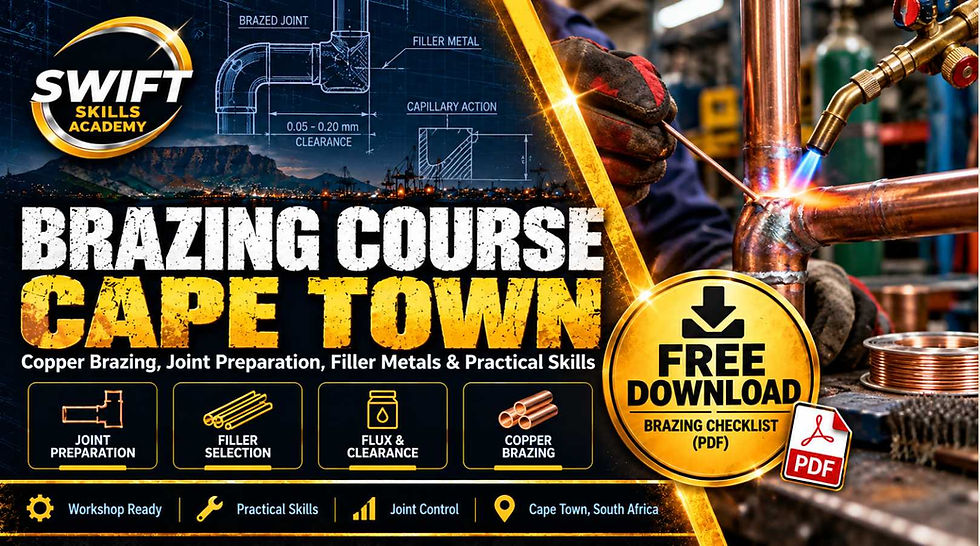
Swift Skills Academy already has a dedicated Brazing Course Cape Town article, so readers wanting brazing-specific depth should continue there rather than treating this Gas Welding article as the primary brazing resource.
Gas cutting
Oxy-fuel cutting uses a different torch arrangement and cutting-oxygen jet.
Suitable steel is preheated and then rapidly oxidised by the oxygen stream.
This is fundamentally different from producing a welded joint.
What Will You Learn in a Gas Welding Course Cape Town Programme?
A strong course should do far more than show the learner how to ignite a torch.
Equipment identification
Learners should understand the purpose and relationship between:
oxygen cylinders;
acetylene cylinders;
cylinder valves;
regulators;
pressure gauges;
hoses;
flashback arrestors;
non-return valves;
torch body;
mixer;
welding nozzles;
spark lighter;
filler rods;
flux where applicable;
clamps and workholding equipment;
and PPE.
Knowing the names is not enough.
A learner must understand why the equipment is configured correctly and what can happen if unsuitable fittings, damaged hoses, incorrect regulators or incorrect pressure settings are used.
Equipment inspection and setup
Training should include supervised inspection of:
cylinders;
regulators;
hoses;
fittings;
torch components;
welding tips;
flashback protection;
valves;
connectors;
work area;
ventilation;
and fire controls.
The learner should also understand approved leak-testing procedures.
A flame should never be used to search for a gas leak.
SAQA Unit Standard 243072 specifically includes equipment selection, assembly, pre-operational checking, leak testing and hazard identification as part of oxy-acetylene welding competence. SAQA
The Three Oxy-Acetylene Flame Types
One of the most important gas-welding skills is learning to recognise and control the flame.
Neutral flame
A neutral flame has approximately balanced oxygen and acetylene.
It is commonly used for general oxy-acetylene welding.
Typical visual characteristics include:
a clearly defined inner cone;
a stable outer envelope;
no pronounced acetylene feather;
and balanced flame behaviour.
TWI identifies the neutral flame as the normal general-welding setting. TWI Global
Carburising or reducing flame
A carburising flame contains excess acetylene.
It may display a visible feather between the inner cone and outer flame.
Depending on the application, it can produce a reducing or carbon-rich atmosphere.
That does not mean a carburising flame is automatically better because it appears softer.
Its suitability depends on:
parent metal;
filler metal;
procedure;
joint;
and required result.
Oxidising flame
An oxidising flame contains excess oxygen.
Typical characteristics may include:
a shorter inner cone;
sharper appearance;
more intense sound;
and a stronger oxidising effect.
Incorrect use can affect:
weld chemistry;
surface condition;
porosity;
oxidation;
bead appearance;
and mechanical properties.
Flame selection should therefore never be guesswork.
How Torch Angle, Tip Distance and Travel Speed Affect a Gas Weld
Gas welding can look simple because the equipment is visually uncomplicated.
The actual control is demanding.
Torch angle
Torch angle changes where heat is concentrated.
It influences:
edge fusion;
penetration;
pool shape;
heating balance;
and oxidation behaviour.
Too much angle can overheat one side of the joint or direct heat away from the required fusion zone.
Tip-to-work distance
If the flame is too far from the workpiece, heating may become slow and unstable.
If the inner cone is held too close, the operator can disturb the pool and increase the risk of poor flame behaviour or tip overheating.
Travel speed
Moving too quickly can contribute to:
inadequate fusion;
shallow penetration;
irregular bead shape;
poor filler integration.
Moving too slowly can create:
excessive heat input;
wide weld pools;
burn-through;
distortion;
excessive oxidation;
and loss of joint control.
The goal is not to copy someone else’s hand speed.
The learner must learn to read the pool.
Filler Rod Coordination
One of the skills that makes gas welding valuable for beginners is the requirement to coordinate two hands.
One hand controls:
torch angle;
heating;
pool size;
travel.
The other manages:
filler-rod position;
filler timing;
quantity;
consistency.
Poor filler control can produce:
oversized reinforcement;
insufficient fill;
irregular profile;
trapped contamination;
poor penetration;
and inconsistent bead appearance.
A learner should therefore practise rhythm rather than simply feeding rod continuously.
Joint Preparation: The Weld Begins Before the Flame Is Lit
Poor joint preparation can ruin a technically competent weld.
Training should address:
material identification;
surface cleaning;
rust removal;
oil removal;
coating removal;
measuring;
marking;
cutting;
edge preparation;
fit-up;
root gap;
alignment;
clamping;
tack placement;
and distortion planning.
Coated, painted or contaminated metal also introduces a safety concern because heating can release hazardous fumes.
Material identity and surface condition should therefore be checked before applying heat.
What Materials Can Be Gas Welded?
The correct answer depends on:
material;
thickness;
filler;
flame;
joint;
procedure;
and training scope.
South Africa’s legacy oxy-acetylene welding unit standard 243072 is specifically framed around carbon-steel plate in downhand positions, with a minimum material thickness of 1.6 mm. SAQA
Another older SAQA unit standard, 258920, historically covered basic gas welding, brazing and cutting with oxygen-acetylene equipment and included limited mild-steel and copper work. That unit standard has already passed its enrolment deadline and is now in teach-out status. SAQA
The important point for a learner is:
do not assume that every Gas Welding course automatically covers every metal.
Ask which materials are included in writing.
Gas Welding Defects Learners Should Recognise
A completed joint should not be judged only by whether it “looks neat.”
Learners should be introduced to defects or imperfections such as:
Possible Problem | What the Learner Should Consider |
Lack of fusion | Heat, torch position, preparation, speed |
Incomplete penetration | Joint preparation, root gap, heat input |
Burn-through | Excessive heat or slow travel |
Porosity | Contamination, gas/flame control, surface condition |
Undercut | Torch position, heat distribution, travel |
Excessive reinforcement | Filler addition or slow travel |
Underfill | Insufficient filler or poor manipulation |
Oxidation | Flame condition or excessive exposure |
Distortion | Heat input, sequence and restraint |
Cracking | Material, contamination, stress or technique |
Irregular bead profile | Poor speed, angle or filler coordination |
SAQA 243072 includes inspection of welded workpieces for defects and conformance with drawing or procedure requirements. SAQA
Gas Welding Safety: Why Supervised Training Matters
Oxy-acetylene welding combines:
compressed oxygen;
flammable acetylene;
regulators;
high-pressure cylinders;
hoses;
open flame;
intense heat;
hot metal;
sparks;
molten metal;
fumes;
and potential fire sources.
A mistake is therefore not limited to an ugly weld.
Potential consequences include:
burns;
fire;
flashback;
gas leakage;
cylinder damage;
hose failure;
eye injury;
regulator damage;
oxygen enrichment;
and ignition of nearby combustible materials.
The practical course should treat safety as part of the welding skill itself.
Essential Oxy-Acetylene Safety Controls
Cylinders must be secured
Cylinders should be protected against falling, impact and uncontrolled heat.
They are pressure vessels, not ordinary workshop containers.
Oxygen equipment must remain free from oil and grease
Oil, grease and high-concentration oxygen are a dangerous combination.
Oxygen components should never be casually lubricated.
Use the correct regulator
A regulator that physically screws onto a fitting is not necessarily suitable for the gas or pressure involved.
Inspect hoses
Hoses should be checked for:
burns;
cracks;
cuts;
loose connections;
contamination;
damaged fittings;
and makeshift repairs.
Leak-test correctly
Connections should be checked using an approved leak-detection method.
Use suitable flashback protection
Gas systems require suitable reverse-flow and flashback controls according to equipment configuration, manufacturer instructions and workplace procedure.
Maintain ventilation
Heating metal can release:
fumes;
coatings;
combustion products;
contaminants;
and gases.
Ventilation and material assessment matter.
Gas Welding vs MIG Welding
Factor | Gas Welding | MIG / GMAW |
Heat source | Oxy-fuel flame | Electric arc |
Wire feed | Manual filler where required | Continuous wire |
Electrical welding power required | No | Yes |
Heat control | Direct manual flame control | Machine + operator |
Typical productivity | Lower | Higher |
Thin repair work | Can be useful | Often used depending on setup |
Production fabrication | Less common | Very common |
Learning benefit | Excellent heat/pool fundamentals | Strong production-welding skills |
A learner choosing between these two should ask:
Am I trying to understand flame and heat control, or am I preparing for production fabrication?
Gas Welding vs TIG Welding
Gas welding and TIG can both involve close control over a molten pool and separately added filler metal.
But the heat source is fundamentally different.
TIG uses:
an electric arc;
non-consumable tungsten electrode;
shielding gas.
Gas welding uses:
oxygen;
acetylene;
combustion flame.
TIG is typically selected where greater precision, modern fabrication requirements and specific material applications justify it.
Gas welding remains useful for foundational heat-control skills, certain repair situations and oxy-fuel workshop capability.
Gas Welding vs Stick Welding
Stick welding uses an electric arc and flux-coated consumable electrode.
Gas welding uses a torch and flame.
Stick welding is widely associated with:
structural fabrication;
construction;
repair;
outdoor work;
and heavier carbon-steel applications.
Gas welding is generally more closely associated with:
thin sections;
repair;
manual heat control;
maintenance;
foundational welding;
and torch-related fabrication skills.
The correct course depends on the work the learner wants to perform.
Is Gas Welding Good for Beginners?
It can be.
Gas welding gives a beginner a clear visual relationship between:
heat → melting → pool movement → filler → solidification
That can help the learner understand welding fundamentals.
However, the process also exposes beginners to significant gas and fire hazards.
The correct conclusion is therefore not:
“Gas welding is simple.”
It is:
Gas welding is technically instructive, but it must be learned with disciplined equipment and safety supervision.
How Long Is a Gas Welding Course in Cape Town?
Swift Skills Academy’s current welding course page lists its Oxy-Acetylene Welding & Brazing pathway at approximately 3–5 days. Swift Skills Academy
This current public information should replace the older six-week language presently found in the existing Gas Welding blog. Swift Skills Academy
Actual training time can vary according to:
starting competence;
individual versus group delivery;
practical scope;
materials;
joint range;
brazing inclusion;
assessment requirements;
remedial practice;
and employer-specific outcomes.
When comparing training providers, ask for the number of actual supervised practical hours, not only the calendar duration.
How Much Does a Gas Welding Course in Cape Town Cost?
Swift Skills Academy’s current main welding page does not publish a confirmed standalone price for the Oxy-Acetylene Welding & Brazing pathway.
That means a trustworthy article should not manufacture one.
The total cost may depend on:
Cost Driver | Why It Matters |
Practical hours | More workshop time increases delivery cost |
Gas consumption | Oxygen and acetylene are consumables |
Material | Plate, copper and other materials vary in cost |
Filler rods | Different exercises require different consumables |
Flux | Relevant to selected brazing work |
Class size | Individual vs group training differs |
Assessment | Assessment route affects delivery |
Retesting | Additional testing may carry a separate cost |
PPE | Some items may be learner-supplied |
Employer delivery | On-site logistics can change the quotation |
A proper quotation should state:
exact course title;
process;
duration;
practical hours;
material;
joints;
gases;
filler;
PPE;
assessment;
certificate;
VAT;
retesting;
and any additional charges.
What Certificate Do You Receive?
This question requires careful wording.
A short gas-welding course certificate is not automatically equivalent to:
a Red Seal;
an artisan qualification;
a coded-welder qualification;
an occupational certificate;
or every historical SAQA unit standard relating to gas welding.
The exact certificate must match the actual programme delivered.
Current SAQA Status: What Learners Should Know
SAQA Unit Standard 243072
243072 — Weld workpieces using the oxy-acetylene gas welding process in the downhand position
SAQA currently records:
Item | Status |
NQF Level | 2 |
Credits | 10 |
Registration end date | 30 June 2023 |
Last enrolment date | 30 June 2028 |
Last achievement date | 30 June 2031 |
Current record status | Passed the end date |
Its scope includes equipment setup, workpiece preparation, oxy-acetylene welding, defect inspection and care/storage of equipment. SAQA
The phrase “passed the end date” does not mean the last-enrolment date has already passed.
As of October 2026, SAQA still records a last-enrolment date of 30 June 2028 for this unit standard. SAQA
That does not mean every provider may offer it.
The exact provider scope and learner-registration route must still be verified.
SAQA Unit Standard 243053
SAQA 243053 — Weld carbon steel workpieces using the oxy-acetylene gas welding process in all positions is NQF Level 3, 10 credits.
Its last enrolment date was 30 June 2024, and its last achievement date is 30 June 2027. It is therefore in teach-out territory rather than open new-enrolment territory. SAQA
SAQA Unit Standard 258920
SAQA 258920 — Carry out basic gas welding, brazing and cutting in an electrical environment is NQF Level 2, 8 credits.
Its last enrolment date was 30 June 2024, with last achievement by 30 June 2027. SAQA
Again, that does not mean learners can newly enrol on it until 2027.
Does a Gas Welding Course Make You a Qualified Welder?
No.
Completing a short oxy-acetylene course can demonstrate defined training or competence within its scope.
It does not automatically make someone:
a Red Seal artisan;
occupationally qualified welder;
coded welder;
pipe welder;
or specialist welding practitioner.
Those outcomes require their own routes.
A learner who ultimately wants to become a professional welder should think in terms of progression:
Workshop fundamentals → Process skills → Practical experience → Advanced welding → Assessment → Artisan / coded-welding pathway where applicable
Where Gas Welding Fits Into the Wider Welding Pathway
A sensible progression could look like this:
Learner Goal | Possible Next Step |
Learn basic workshop control | Engineering Tools & Cutting |
Learn oxy-acetylene joining | Gas Welding |
Learn brazing | Brazing-specific training |
Learn structural welding | Stick / SMAW |
Learn production welding | MIG / GMAW |
Learn precision welding | TIG / GTAW |
Learn higher-deposition structural welding | FCAW |
Progress into pipe work | Pipe Welding |
Prove code-specific welding ability | Coded-welder preparation |
Pursue artisan recognition | ARPL / Trade Test pathway |
The best route depends on what the learner actually needs to produce at work.
Who Should Consider Gas Welding Training?
It may suit:
complete beginners;
welding assistants;
maintenance workers;
fabricators;
automotive repair personnel;
plumbing-related metalworkers;
sheet-metal workers;
artisans needing oxy-fuel familiarity;
employers training technical staff;
learners progressing into broader welding;
and people who need stronger manual heat-control skills.
Employer Gas Welding Training
For employers, the starting point should not simply be:
“We need certificates.”
The more useful question is:
What must employees be able to do safely and competently after training?
Employer training should consider:
actual equipment;
material type;
joint type;
work environment;
production requirements;
hazard controls;
employee starting skill;
supervision;
assessment;
and evidence requirements.
Swift Skills Academy also supports on-site welding and workplace team training where the facilities, equipment, safety controls and programme requirements are suitable. Swift Skills Academy
Questions to Ask Before Booking
Before paying, ask the training provider:
Is this specifically oxy-acetylene gas welding?
Is brazing included or separate?
Is gas cutting included or separate?
What materials will I actually weld?
What thicknesses will I practise?
Which joints will I complete?
How much practical torch time is included?
Is equipment setup assessed?
Are leak checks and flashback safety covered?
What PPE must I bring?
What certificate will I receive?
Is the training credit-bearing or non-credit-bearing?
If a SAQA unit standard is advertised, what is the exact unit-standard number?
Is the provider currently approved for that route?
What is the complete fee?
Does retesting cost extra?
That checklist alone protects a learner from comparing completely different programmes as if they were the same course.
Frequently Asked Questions
How long does a gas welding course in Cape Town take?
Swift Skills Academy’s current public welding pathway lists Oxy-Acetylene Welding & Brazing at approximately 3–5 days. The exact duration can vary according to training scope, learner competence, practical exercises and assessment. Swift Skills Academy
How much does a gas welding course cost?
A confirmed standalone SSA gas-welding fee is not currently published on the main welding page. Request a written quotation showing total cost, practical scope, consumables, assessment and certificate.
What is oxy-acetylene welding?
It is a fusion-welding process that burns oxygen and acetylene in a torch to generate the heat needed to melt the joint edges and form a weld pool.
Does gas welding use electricity?
The heat source is the oxy-acetylene flame rather than an electric arc.
What are the three main oxy-acetylene flame types?
Neutral, carburising/reducing and oxidising. TWI identifies these three distinct flame settings. TWI Global
Is gas welding the same as brazing?
No. Gas welding melts the parent metal. Brazing normally melts a filler alloy while the parent material remains solid.
Is gas welding the same as gas cutting?
No. Gas cutting separates suitable steel using preheat and a cutting-oxygen reaction. Gas welding joins metal by producing a molten weld pool.
Can beginners learn gas welding?
Yes, provided the programme is appropriate to the learner and the work is properly supervised. Oxy-acetylene equipment introduces significant gas, pressure, heat and fire hazards.
Does a gas welding certificate make me a qualified welder?
No. A short-course certificate is not automatically equivalent to a Red Seal, occupational qualification or coded-welder approval.
Is SAQA 243072 still relevant in 2026?
Yes, with an important distinction. SAQA records the unit standard as having passed its registration end date, but its published last-enrolment date is 30 June 2028, followed by a last-achievement date of 30 June 2031. Provider scope and learner-registration arrangements still need verification. SAQA
Authoritative Sources & Regulatory References
Authoritative Source | What It Supports |
Official NQF Level 2 oxy-acetylene welding outcomes, equipment setup, safety, workpiece preparation, downhand welding, inspection, credits and current transition dates. | |
Historical NQF Level 3 all-position oxy-acetylene welding route and its enrolment/achievement dates. | |
Historical South African gas welding, brazing and cutting scope, equipment, safety and teach-out dates. | |
Technical explanation of the oxy-acetylene process and neutral, oxidising and carburising flame settings. | |
Current SSA public Oxy-Acetylene Welding & Brazing pathway, 3–5 day duration and wider welding progression. |
Read More
Read More | Why Read It |
Go deeper into filler flow, capillary action, flux, joint clearance and the differences between brazing, welding and soldering. | |
Learn how oxy-acetylene equipment is used for carbon-steel cutting, including preheat, cutting oxygen, torch control and cut-quality inspection. | |
See how safety, preparation, practical welding, defects, assessment and process development fit into a broader welding-training pathway. |
Final Word
A good gas welding course Cape Town programme should teach far more than how to light an oxy-acetylene torch.
The real skill lies in controlling:
equipment → flame → heat → weld pool → filler → movement → quality → safety
That foundation can make oxy-acetylene welding valuable for beginners, maintenance personnel, fabricators and learners progressing into more advanced welding processes.
The right course, however, depends on the work you actually need to perform.
Before enrolling, confirm the current duration, fee, materials, practical hours, assessment route and certificate in writing—then choose the programme that builds the skills you genuinely need.