
Brazing Course Cape Town: Cost, Copper Brazing, Joint Preparation, Filler Metals & Practical Skills
Updated: Oct 3
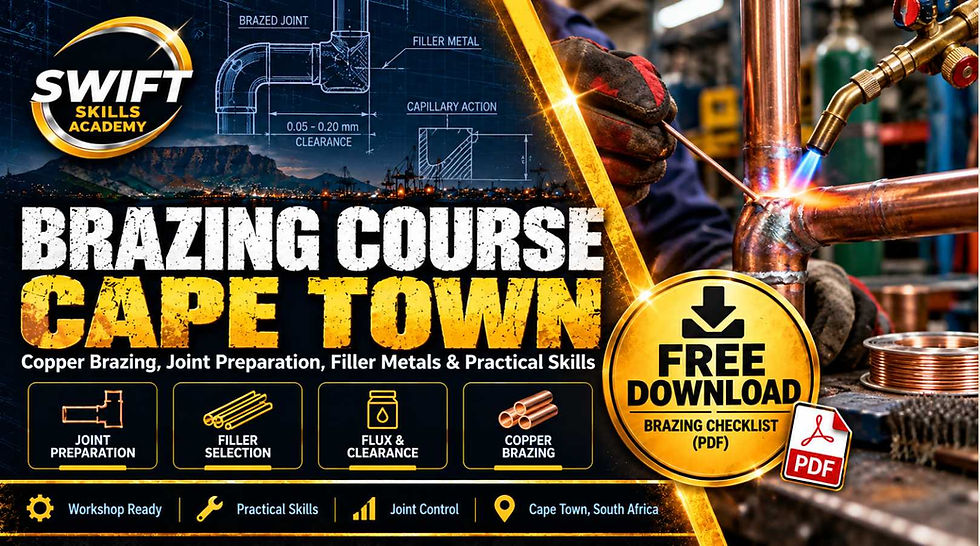
Quick Answer: Where Can You Learn Brazing in Cape Town?
Swift Skills Academy offers practical oxy-acetylene welding and brazing training in Cape Town. Its current welding programme lists an Oxy-Acetylene Welding & Brazing pathway covering gas welding, brazing and copper brazing, with a published duration of 3–5 days. Swift Skills Academy
A brazing course should teach considerably more than how to heat metal and melt a rod. Effective brazing depends on joint design, surface preparation, fit-up, suitable filler metal, flux where required, controlled heating, wetting, capillary action and post-braze inspection. AWS describes brazing as a joining process in which the filler metal melts and flows while the components themselves do not melt. AWS Publications
If You Want to Know… | Fast Answer |
Does brazing melt the base metal? | Normally no — the brazing filler melts while the base materials remain solid. |
Is brazing the same as welding? | No. Fusion welding generally melts the base material; brazing does not. |
Is brazing the same as soldering? | No. Brazing uses filler metal above 450°C; soldering occurs below that threshold. TWI Global |
What makes filler flow into the joint? | Correct wetting plus capillary action through an appropriately designed joint. |
Is joint clearance important? | Yes. Poor clearance can restrict filler flow or weaken the resulting joint. Lucas Milhaupt |
How long is the SSA pathway? | Current SSA welding information lists 3–5 days for Oxy-Acetylene Welding & Brazing. Swift Skills Academy |
What does it cost? | SSA does not currently publish a standalone brazing fee on its main welding page; request the current written fee and inclusions before booking. |
Is there a free guide? | Yes — download the Brazing Joint Preparation, Filler Selection & Pre-Braze Checklist. |
What Is Brazing?
Brazing is a metal-joining process in which a brazing filler metal is melted and distributed into a joint while the base materials remain below their melting temperature.
TWI describes brazing as a joining process in which the molten filler flows into the joint, with a filler melting point above 450°C but below the melting temperature of the components being joined. TWI Global
AWS similarly describes the process as relying on the melting, flow and solidification of brazing filler metal while the components themselves remain unmelted. AWS Publications
That distinction is fundamental.
In brazing:
BASE METAL → stays solid
FILLER METAL → melts
JOINT CLEARANCE → provides a path
WETTING + CAPILLARY ACTION → distribute filler
COOLING → produces the completed joint
This is very different from simply pointing a torch at two pieces of metal and feeding rod into the gap.
Brazing vs Welding vs Soldering
People frequently use these terms interchangeably.
They should not.
Process | Base Metal | Filler Metal | Main Joining Principle | Typical Character |
Brazing | Normally remains solid | Melts | Wetting + capillary distribution | Suitable for close-fitting joints and many similar/dissimilar metal combinations |
Fusion welding | Locally melted | May or may not use filler | Fusion of base metal | Produces a welded joint through melting |
Soldering | Remains solid | Melts below brazing temperature threshold | Wetting / filler flow | Lower-temperature joining |
TWI uses 450°C as the conventional dividing temperature between soldering and brazing. TWI Global ISO 857-2 remains the current ISO vocabulary standard covering soldering and brazing terminology after its most recent confirmation. ISO
The simplest way to remember it
Welding
The parent material is normally part of the molten joint.
Brazing
The filler melts; the parent material does not.
Soldering
The filler also melts without melting the parent material, but at a lower process temperature.
Why Brazing Is Not “Easy Welding”
This is one of the most important misconceptions to eliminate.
Brazing may not require a conventional weld pool, but joint quality depends heavily on things that can be easy to overlook:
fit-up
clearance
cleanliness
filler compatibility
flux selection
heating balance
temperature control
filler placement
capillary flow
cooling
cleaning
inspection.
A person can produce a visually shiny joint that has poor penetration of filler through the joint area.
A good brazed joint starts before the torch is lit.
How Brazing Actually Works
Step 1: Identify the Base Materials
Before selecting filler metal or heat input, establish what is being joined.
Depending on the application, brazing may be used with combinations involving materials such as:
carbon steel
stainless steel
copper
brass
certain nickel alloys
other compatible engineering materials.
Material identification matters because filler selection, flux requirements, heating behaviour and joint design can change.
Do not select brazing consumables simply because the rod “looks right”.
Step 2: Prepare the Joint
Joint preparation determines whether the filler can reach the surfaces it needs to bond to.
Preparation can involve:
cutting
deburring
fitting
alignment
cleaning
removal of oil
removal of grease
removal of rust
removal of scale
removal of oxides or contamination.
Lucas Milhaupt's brazing guidance emphasises cleaning because contamination can prevent proper wetting and obstruct filler-metal flow. Lucas Milhaupt
Workshop rule
Heat does not repair dirty fit-up.
Step 3: Establish the Correct Joint Clearance
This is one of the highest-value concepts a brazing student can learn.
Brazing filler is drawn through appropriately designed gaps partly through capillary action.
If the gap is inappropriate:
filler may not penetrate adequately;
capillary action may be reduced;
voids may remain;
the joint may not develop the intended properties.
Lucas Milhaupt notes that brazing generally depends on close, controlled clearances and that clearances must also be considered at brazing temperature, because different materials expand differently when heated. Lucas Milhaupt
Do not memorise one universal gap
There is no single joint clearance that should blindly be applied to every:
material combination;
filler alloy;
joint type;
brazing temperature;
engineering specification.
TWI notes that permissible joint gap can depend on base-metal composition, brazing temperature, dwell time and filler-metal composition. TWI Global
Therefore:
Follow the filler-metal manufacturer's data, drawing, procedure and engineering specification applicable to the actual job.
What Is Capillary Action in Brazing?
Capillary action is the mechanism that helps molten filler move through a narrow joint clearance.
Think of it as the filler being drawn through the prepared joint rather than simply being piled onto the outside.
A properly prepared brazed joint therefore depends on a combination of:
CLEARANCE
CLEAN SURFACES
WETTING
SUITABLE TEMPERATURE
CORRECT FILLER
Lucas Milhaupt specifically identifies proper fit/clearance, cleaning, fluxing, assembly, heating and cleaning after brazing as fundamental process steps. Lucas Milhaupt
What Is Wetting?
Wetting describes the ability of molten filler to spread over and adhere to the base material under suitable brazing conditions.
AWS lists the ability to spread and adhere — wetting — as an important property of brazing filler metals. AWS Publications
Poor wetting can be associated with issues such as:
contamination
oxidation
unsuitable filler
insufficient temperature
excessive heating
incorrect flux application
material incompatibility.
This is why brazing skill involves surface preparation and heat control, not just filler-rod handling.
What Does Flux Do in Brazing?
Flux can help protect and clean the surfaces during heating and support proper filler-metal wetting.
But the correct flux depends on:
base material
filler metal
process temperature
brazing method
manufacturer recommendations.
The role of flux is important enough that AWS dedicates specific brazing-handbook coverage to fluxes and atmospheres. AWS Publications
More flux is not automatically better.
Excess, incorrect or inadequately removed flux can create its own problems.
Use the process specification and consumable manufacturer's instructions.
Brazing Filler Metals: What Should You Choose?
There is no one “best brazing rod”.
Filler selection depends on the application.
Important considerations can include:
base material
service temperature
joint design
corrosion conditions
required mechanical properties
brazing temperature
flow characteristics
compatibility
applicable specification.
AWS identifies filler-metal behaviour, wetting, melting range, capillary distribution and final mechanical/physical properties as important filler considerations. AWS Publications
A good learner question is not:
“Which rod do brazers use?”
It is:
“Which filler is specified for these materials, this joint and this service requirement?”
That is professional process thinking.
Copper Brazing
pipework
refrigeration
HVAC
maintenance
heat-transfer equipment
fabrication
utilities.
But “copper brazing” is not one universal process recipe.
A learner needs to understand how factors such as:
tube size
material combination
joint fit
cleanliness
filler alloy
flux requirements
heat distribution
service conditions
affect the job.
Swift Skills Academy's current Oxy-Acetylene Welding & Brazing pathway specifically lists gas welding, brazing and copper brazing as its focus. Swift Skills Academy
Brazing Copper to Copper vs Copper to Another Metal
Joining two similar materials is not necessarily the same as joining dissimilar materials.
When different metals are heated together, they may:
conduct heat differently;
expand at different rates;
respond differently to filler metal;
have different oxidation behaviour.
Thermal expansion is especially important in close brazed joints because the clearance at room temperature can change significantly at brazing temperature. Lucas Milhaupt
This is exactly why practical training is valuable.
The learner needs to develop an understanding of what the joint is doing while it is being heated.
Torch Brazing With Oxy-Acetylene
Torch brazing is one way of supplying heat to a brazed joint.
TWI notes that brazing can use a number of heating methods, including torch, furnace and induction heating. TWI Global
In oxy-acetylene brazing training, important skills can include:
safe cylinder handling
regulator setup
hose and torch checks
flashback protection
ignition and shutdown
flame management
heating pattern
filler application
maintaining alignment
avoiding local overheating
inspection and cleanup.
Brazing should not be taught in isolation from safe oxy-fuel equipment handling.
What Is the Correct Flame for Brazing?
The required heating condition depends on the:
base material
filler
flux
torch setup
brazing procedure.
Learners should not choose a flame merely from memory or habit.
The goal is controlled, appropriate heating of the joint area — not melting the parent material.
This is also an important point of separation from the dedicated Gas Welding Course Cape Town article.
Gas Welding article owns:
flame selection for fusion welding
weld pool manipulation
filler coordination into the molten parent metal
gas-welding technique.
Brazing article owns:
joint clearance
wetting
capillary action
filler flow
joint preparation
flux
brazed-joint inspection.
That separation protects both pages from SEO cannibalisation.
Brazing Joint Types
Brazing can be used with different joint arrangements.
Two important broad families are:
Lap joints
Lap joints can provide increased bonding area.
Because brazed-joint behaviour depends partly on the relationship between joint geometry, clearance and filler distribution, joint overlap needs to be designed deliberately rather than arbitrarily.
Butt joints
Butt joints may be appropriate in certain applications but generally provide less bonding area than appropriately designed overlap arrangements.
The correct joint geometry is an engineering/application decision.
Do not redesign a specified joint at the torch.
What Can Go Wrong With Brazing?
A brazed joint can look acceptable externally while still containing problems.
Possible issues include:
incomplete filler penetration
voids
poor wetting
excessive filler buildup
movement during solidification
overheating
base-metal erosion
flux entrapment
oxidation
contamination
excessive joint clearance
insufficient joint clearance
poor alignment.
AWS's current brazing handbook separates out entire technical areas for brazement design, wetting/capillarity, filler metals, fluxes, pre-cleaning, fixturing and inspection — which illustrates how many variables affect the finished joint. AWS Publications
Why Brazing Filler Sometimes Refuses to Flow
When filler beads up or stays near the entry point rather than flowing through the joint, possible causes include:
Contaminated surfaces
Oil, grease, rust or scale can prevent effective wetting.
Poor clearance
The filler does not have an appropriate capillary path.
Wrong temperature
The assembly may be too cold for proper flow.
Uneven heating
The filler tends to move toward the hotter region.
Incorrect consumable combination
The filler or flux may not suit the base material/application.
Oxidation
Unprotected surfaces can interfere with wetting.
The wrong response is:
“Just add more rod.”
More filler does not fix the root cause.
Why Overheating Is a Problem
Brazing requires enough heat to allow the filler to melt, wet and flow.
But more heat is not automatically better.
Excessive heat can contribute to:
excessive oxidation
flux breakdown
filler-metal behaviour outside intended conditions
distortion
base-metal damage
degraded joint quality.
The operator should heat the joint assembly appropriately, rather than simply directing maximum heat at the filler rod.
Should You Melt the Brazing Rod Directly With the Flame?
The important concept is that the workpiece should be at the appropriate brazing temperature so that the filler can melt and flow because of heat in the assembly.
Lucas Milhaupt's manual-brazing guidance describes filler being applied against the heated joint so that the assembly melts the required filler and capillary action draws it through the joint. Lucas Milhaupt
Simply melting filler directly in the flame and dripping it onto cold material is not the same thing as producing a correctly brazed joint.
How Do You Inspect a Brazed Joint?
Inspection depends on the application and governing requirements.
Basic visual checks may consider:
filler distribution
evidence of wetting
joint alignment
excessive filler
surface condition
oxidation
visible cracking
cleanliness
dimensional conformity.
Critical service applications can require more formal inspection or testing.
Do not imply that visual appearance alone proves internal joint integrity.
Is Brazing Strong?
A properly designed and executed brazed joint can be strong enough for many engineering applications.
But asking:
“Is brazing strong?”
without context is like asking:
“Is welding strong?”
The meaningful questions are:
Which materials?
Which filler?
Which joint design?
What overlap?
What clearance?
What loading?
What temperature?
What environment?
Which specification?
What quality requirement?
Strength comes from the complete joint system, not merely the name of the process.
Is Brazing Suitable for Dissimilar Metals?
Brazing is often useful for joining different compatible materials because the base metals are not normally melted.
TWI specifically notes the ability to braze similar or dissimilar metals, provided filler and parent materials are metallurgically compatible. TWI Global
However, dissimilar metals can introduce additional considerations involving:
thermal expansion
corrosion
filler compatibility
service conditions.
So “brazing joins dissimilar metals” should never be interpreted as:
any metal + any filler + any flux = acceptable joint.
Brazing vs TIG Welding
These two processes can both produce neat, precise-looking joints.
But they work very differently.
Brazing | TIG / GTAW |
Parent materials remain solid | Parent material is normally melted |
Filler flows through prepared joint | Filler is added into a weld pool where used |
Capillary action is important | Arc control and fusion are critical |
Often lower heat than fusion welding | Local fusion temperatures are much higher |
Useful for many thin/dissimilar material applications | High-control welding process |
Joint design/clearance critical | Joint preparation/fusion critical |
A learner should choose based on the required joint and application, not which process looks more advanced.
Brazing vs Gas Welding
Both can use oxy-fuel equipment.
That does not make them the same process.
Gas welding
The flame melts the base material to establish a fusion weld pool.
Brazing
The base material remains solid while the brazing filler melts, wets and flows through the prepared joint.
This is one reason combined oxy-acetylene training can be valuable: the learner experiences different joining behaviours using related equipment.
SSA currently groups Oxy-Acetylene Welding & Brazing within a 3–5 day gas-process pathway. Swift Skills Academy
Brazing vs Braze Welding
Another distinction worth understanding is brazing versus braze welding.
Traditional capillary brazing relies strongly on filler flow into a close-fitting joint.
Braze welding uses brazing-type filler in a joint arrangement more analogous to depositing a fillet, rather than relying primarily on capillary filling of a narrow clearance.
They should not automatically be treated as identical techniques.
This is the type of terminology learners should learn in context rather than from social-media shortcuts.
ISO 857-2 provides international vocabulary for brazing and soldering processes and remains current. ISO
Brazing Safety: What Learners Need to Understand
Brazing involves hazards that can include:
fuel gases
oxygen
fire
hot metal
hot filler
fluxes
fumes
burns
sparks
pressurised cylinders
flashback
ignition of nearby combustible materials.
Training should therefore include safe:
cylinder storage and handling
regulator use
hose inspection
flashback protection
torch ignition
shutdown
PPE
ventilation
hot-work controls
work-area preparation.
Historical South African brazing and gas-process unit standards also explicitly included oxy-fuel equipment, regulators, flashback arrestors, hoses, torches, filler materials, flux, cleaning materials and PPE in their training ranges. SAQA
What PPE Is Used for Brazing?
The exact PPE must match the task and workplace risk assessment.
Depending on the operation, this can include:
appropriate eye protection
protective gloves
flame-resistant or suitable workwear
protective footwear
additional face protection where required.
Historical SAQA gas-process standards referenced brazing goggles, gloves, overalls and protective clothing as part of the equipment range. SAQA
PPE does not replace correct equipment setup and safe operating procedure.
South African Qualification Context: Is Brazing Still a SAQA Unit Standard?
This is where many training pages become misleading.
Several historical SAQA unit standards involving brazing have passed their registration end dates.
For example:
SAQA Unit Standard 243069
Braze metals using the oxy-fuel brazing process
NQF Level: 2
Credits: 6
registration end: 30 June 2023
last enrolment: 30 June 2024
last achievement: 30 June 2027
current status: passed end date. SAQA
That means the 2027 achievement date is not a new-enrolment deadline. It is part of the teach-out period for learners legitimately enrolled before the final enrolment date.
SAQA Unit Standard 258920
This older electrical-environment standard covered basic gas welding, brazing and cutting using oxygen-acetylene equipment. It likewise passed its registration end date, with last enrolment on 30 June 2024 and last achievement on 30 June 2027. SAQA
What should a learner ask today?
Before enrolling, request written confirmation of:
exact programme name
practical scope
training duration
assessment method
certificate issued
quality-assurance status where applicable
whether the programme is a standalone practical short course or part of a wider registered occupational route.
Do not assume that an old SAQA unit-standard number shown online means new enrolment against that unit standard remains open.
How Long Is a Brazing Course in Cape Town?
Swift Skills Academy's current main welding programme lists:
Oxy-Acetylene Welding & Brazing
Duration: 3–5 days
with gas welding, brazing and copper brazing identified as the focus. Swift Skills Academy
Actual course scheduling and scope should be confirmed before enrolment because practical duration can depend on the specific programme and learner requirement.
How Much Does a Brazing Course Cost in Cape Town?
There is currently no standalone brazing price published on SSA's main welding course page.
That is better handled transparently than inventing a number.
The current fee can depend on matters such as:
programme scope
practical duration
consumables
assessment
individual or group training
company/on-site requirements.
Request the written fee before enrolment.
The quotation should make clear what is included.
What Should a Good Brazing Course Teach?
A useful brazing course should not consist of a demonstration followed by a certificate.
The learner should understand and practise the sequence.
Before brazing
identify materials
understand job requirements
inspect equipment
prepare surfaces
select filler
select flux if required
establish joint fit
secure components
prepare the work area.
During brazing
control heating
monitor the joint
apply filler correctly
encourage appropriate filler distribution
avoid overheating
maintain alignment.
After brazing
allow appropriate cooling
clean the joint
remove residues where required
visually examine the joint
check alignment
identify obvious defects or incomplete flow.
This mirrors recognised brazing fundamentals far more closely than teaching only torch movement. Lucas Milhaupt
Who Should Consider Brazing Training?
Brazing can be useful for people working or developing skills in:
welding and fabrication
maintenance
mechanical work
refrigeration/HVAC environments
pipe and tube work
automotive repair
electrical and engineering environments
light fabrication
equipment repair
general engineering.
It can also be useful as part of broader oxy-fuel competence for learners who need to understand the difference between:
heating → brazing → gas welding → gas cutting.
Is Brazing Good for Beginners?
It can be.
Brazing introduces several valuable fabrication habits:
cleanliness matters
fit-up matters
heat distribution matters
consumable selection matters
visual observation matters
process discipline matters.
But “beginner-friendly” does not mean “risk-free”.
Oxy-fuel systems involve gases, cylinders, regulators, hoses, flashback risks and hot-work hazards.
Practical supervision matters.
Can You Learn Brazing Without Learning Welding?
Yes, brazing is its own joining process.
But people who work in fabrication benefit from understanding where brazing sits relative to:
gas welding
TIG
MIG
Stick
soldering
cutting
mechanical fastening.
Knowing several processes makes it easier to choose the correct method instead of forcing every job into the one process you know.
Which Is Better: Brazing or Welding?
Neither.
The correct process depends on the application.
Choose based on:
materials
joint design
service conditions
required strength
temperature exposure
distortion constraints
thickness
production requirements
engineering specification.
If the drawing specifies welding, brazing is not an automatic substitute.
If the design is engineered for brazing, welding is not automatically an improvement.
Brazing for HVAC and Refrigeration Work
Brazing is widely associated with refrigeration and HVAC tube joining.
But this does not mean any generic brazing training automatically authorises someone to work on:
refrigerant systems
pressure systems
regulated installations
specialised plant.
Additional competence, trade requirements, employer authorisation or industry-specific rules may apply.
The SSA article should educate readers about the joining process without pretending one short brazing course grants every downstream occupational authorisation.
Brazing in Automotive and Repair Work
Brazing and related joining techniques can appear in:
repairs
brackets
tubing
specialist automotive work
heat-sensitive components
certain dissimilar-material applications.
Again, the required method should be dictated by the component design, repair specification and service requirement.
Do not replace a specified structural weld with a brazed joint because brazing seems easier.
Brazing for Employers
Employer training has a different objective from an individual beginner course.
A company may need workers to produce a specific joint repeatedly and consistently.
An employer-focused programme should therefore consider:
actual workplace equipment
materials
existing procedures
joint types
quality expectations
production environment
safety controls
inspection requirements
competence gaps.
The relevant question becomes:
Can this employee produce the required brazed joint safely and consistently under our actual workplace conditions?
That is much more useful than simply asking whether the employee “attended a brazing course”.
Pre-Braze Checklist
Before applying heat, check:
Job
What materials am I joining?
What joint is specified?
Is there a drawing/procedure?
Which filler is required?
Is flux required?
Preparation
Are the surfaces clean?
Is oxide/scale removed where required?
Is joint clearance correct?
Are the parts aligned?
Is the joint secure?
Equipment
Cylinders secure?
Regulators correct?
Hoses inspected?
Flashback protection installed where required?
Torch/nozzle appropriate?
Leak checks completed according to procedure?
Work area
Combustibles controlled?
Ventilation adequate?
Correct PPE?
Fire controls available?
Other personnel protected?
After brazing
Did filler distribute through the required joint area?
Is the joint aligned?
Are residues removed as required?
Are there visible defects?
Does the finished joint comply with the job requirement?
Common Brazing Mistakes
1. Treating the filler rod like welding wire
Brazing depends on wetting and filler distribution.
Fix: heat the assembly appropriately and allow the joint to draw filler.
2. Ignoring joint clearance
A gap that looks “close enough” may not suit the specified brazing system.
Fix: follow the applicable procedure, filler data and joint requirement.
3. Brazing dirty metal
Heat does not make grease, oxide or corrosion disappear harmlessly.
Fix: clean the surfaces properly before heating.
4. Heating only one tiny area
Uneven heating can produce poor filler flow.
Fix: learn controlled heating of the assembly.
5. Using excessive filler
A huge external fillet is not proof that filler penetrated the joint.
Fix: judge the process by required filler distribution and finished-joint requirement, not decorative buildup.
6. Overheating
More heat is not more skill.
Fix: use the temperature range and heating technique appropriate to the materials and consumables.
7. Choosing filler by colour
A rod's appearance is not a material specification.
Fix: identify and select the consumable deliberately.
8. Assuming a short course equals an artisan qualification
It does not.
Fix: establish exactly what training outcome and certificate you need.
Brazing Course vs Full Welding Career Pathway
A brazing course can develop a valuable practical skill.
It does not automatically make someone a qualified welder or Red Seal artisan.
A wider welding development pathway can include:
hand tools and fabrication preparation
grinding and cutting
gas cutting
brazing and gas welding
Stick / SMAW
MIG / GMAW
TIG / GTAW
plate and pipe skills
coded-welding preparation
occupational / ARPL / trade-test pathways where applicable.
SSA's current welding programme includes practical routes from engineering tools and cutting through brazing, SMAW, MIG, FCAW, TIG, specialist materials, pipe welding, competency assessment and artisan-related pathways. Swift Skills Academy
Should You Learn Brazing Before TIG Welding?
There is no universal required sequence.
But brazing can help develop:
hand control
filler coordination
awareness of heat distribution
joint preparation
visual observation
patience around molten filler.
TIG requires different skills because it is an arc-welding process involving fusion of the base material.
Choose the learning sequence according to the work you want to perform.
What Certificate Should You Expect?
This is one of the most important enrolment questions.
Ask the provider:
“Exactly what certificate will I receive?”
Do not accept vague wording such as:
accredited certificate
international certificate
recognised certificate
without establishing exactly what it means.
For the SSA Oxy-Acetylene Welding & Brazing pathway, the current welding page identifies the certification outcome as a Certificate of Competency and lists the pathway under its welding training programme. Swift Skills Academy
Before paying, obtain current written confirmation of:
programme scope
certificate
assessment
duration
fee
quality-assurance status applicable to that specific programme.
Questions to Ask Before Booking a Brazing Course
Ask:
Does the course include actual practical brazing?
Is oxy-acetylene equipment used?
Is copper brazing included?
Which joints are practised?
Does training cover joint clearance?
Does it cover flux and filler selection?
Does it teach equipment setup and shutdown?
Is brazed-joint inspection included?
How long is the practical training?
What certificate is issued?
What does the fee include?
Are consumables included?
Is PPE provided or must I bring it?
Is there an assessment?
Can employers request company/on-site training?
A serious provider should be able to answer those questions clearly.
How to Choose Between Brazing, Gas Welding, MIG, TIG and Stick
Goal | Process Worth Investigating |
Close-fitting joints / filler flow without melting parent material | Brazing |
Oxy-fuel fusion welding | Gas welding |
Production-oriented carbon-steel welding | MIG / GMAW |
High-control precision welding | TIG / GTAW |
Structural/site/maintenance versatility | Stick / SMAW |
Need broader fabrication development | Combined welding pathway |
This is a starting point, not a substitute for the actual job specification.
Where Is Brazing Training Available in Cape Town?
Swift Skills Academy operates in Cape Town and currently lists Oxy-Acetylene Welding & Brazing Course Cape Town within its practical welding portfolio. The live programme describes:
gas welding
brazing
copper brazing
3–5 day duration
Certificate of Competency. Swift Skills Academy
Learners should confirm the next available dates, current fees and exact practical scope before enrolment.
Frequently Asked Questions About Brazing Courses in Cape Town
What is brazing?
Brazing is a joining process in which a filler metal melts and flows into a prepared joint while the base materials remain below their melting temperature. Capillary action and wetting are important to filler distribution. TWI Global
What is the difference between brazing and welding?
In conventional fusion welding, the base material is locally melted. In brazing, the brazing filler melts while the base materials remain solid.
What is the difference between brazing and soldering?
Both normally join materials without melting the base metal, but brazing uses filler with a melting point above 450°C, while soldering uses lower-temperature filler. TWI Global
How long does a brazing course take in Cape Town?
Swift Skills Academy's current Oxy-Acetylene Welding & Brazing pathway lists a duration of 3–5 days. Swift Skills Academy
How much does a brazing course cost?
SSA does not currently publish a standalone brazing fee on its main welding page. Request a current written quotation before enrolment.
Does the course include copper brazing?
SSA's current Oxy-Acetylene Welding & Brazing programme specifically identifies copper brazing as part of the focus. Swift Skills Academy
Does brazing melt the metal being joined?
The base materials normally remain solid. The brazing filler melts and forms the joint.
What makes brazing filler flow through a joint?
Proper surface condition, suitable filler, wetting, temperature and joint clearance allow capillary action to distribute molten filler through the joint.
Why is joint clearance important in brazing?
An unsuitable clearance can restrict filler distribution or reduce joint performance. The correct clearance depends on the material, filler, temperature, joint and applicable technical requirements. Lucas Milhaupt
Is brazing suitable for copper pipe?
Brazing is widely used with copper tubing in relevant applications, but the correct filler, flux, procedure and any industry-specific requirements depend on the particular system.
Is brazing easier than TIG welding?
They are different joining processes. Brazing avoids melting the parent metal but requires disciplined control of fit-up, cleanliness, clearance, heating and filler flow. TIG requires precise arc and weld-pool control.
Can brazing join dissimilar metals?
Brazing can join many compatible dissimilar-metal combinations because the parent materials are not normally melted. Material and filler compatibility still need to be established. TWI Global
Is brazing training the same as becoming a qualified welder?
No. A short practical brazing course and a full occupational/artisan welding pathway are different training outcomes.
Is SAQA Unit Standard 243069 still open for new enrolment?
No. SAQA shows the unit standard as having passed its end date, with its last enrolment date on 30 June 2024. The last achievement date of 30 June 2027 relates to the teach-out period for appropriately enrolled learners. SAQA
Can companies arrange brazing or oxy-fuel training for employees?
Employer training may be possible depending on programme scope, equipment, workplace conditions, learner numbers and delivery requirements. Employers should request a company-training discussion and written quotation.
Sources
Authoritative Source | What It Supports |
ISO 857-2:2005 — Welding and allied processes: Soldering and brazing terminology | International brazing and soldering terminology; ISO confirms the standard remains current. ISO |
AWS Brazing Handbook / Basics of Brazing | Brazing principles including filler-metal melting, wetting, capillarity, filler metals, joint design, flux and inspection. AWS Publications |
TWI — What Is Brazing? | Brazing definition, >450°C filler threshold, parent-metal behaviour, dissimilar metals and capillary joint design. TWI Global |
Lucas Milhaupt — Brazing Fundamentals | Joint fit, cleaning, fluxing, assembly, heating, filler flow and post-braze cleaning. Lucas Milhaupt |
SAQA Unit Standard 243069 | Historical South African oxy-fuel brazing competency and its current passed-end-date / teach-out status. SAQA |
Swift Skills Academy — Accredited Welding Courses Cape Town | Current SSA Oxy-Acetylene Welding & Brazing pathway, copper-brazing focus and 3–5 day published duration. Swift Skills Academy |
Read More
Read More | Why Read It |
Understand the key difference between brazing and oxy-acetylene fusion welding, including torch setup and gas-welding technique. | |
Learn how technical drawings communicate joint location, weld type, size, side and other fabrication requirements. | |
Go beyond the weld symbol and learn how revisions, views, dimensions, materials, joints and WPS requirements work together. |
Final Word
Brazing is not simply “welding without melting the metal.”
A quality brazed joint comes from a controlled sequence:
MATERIAL → JOINT DESIGN → CLEANING → CLEARANCE → FILLER → FLUX → CONTROLLED HEATING → WETTING → CAPILLARY FLOW → COOLING → CLEANING → INSPECTION
Miss one of those steps and adding more heat or more filler does not automatically rescue the joint.


