Plasma Cutting vs Oxy-Fuel Cutting: Cost, Speed, Materials, Thickness & Which to Learn First
Updated: Oct 2
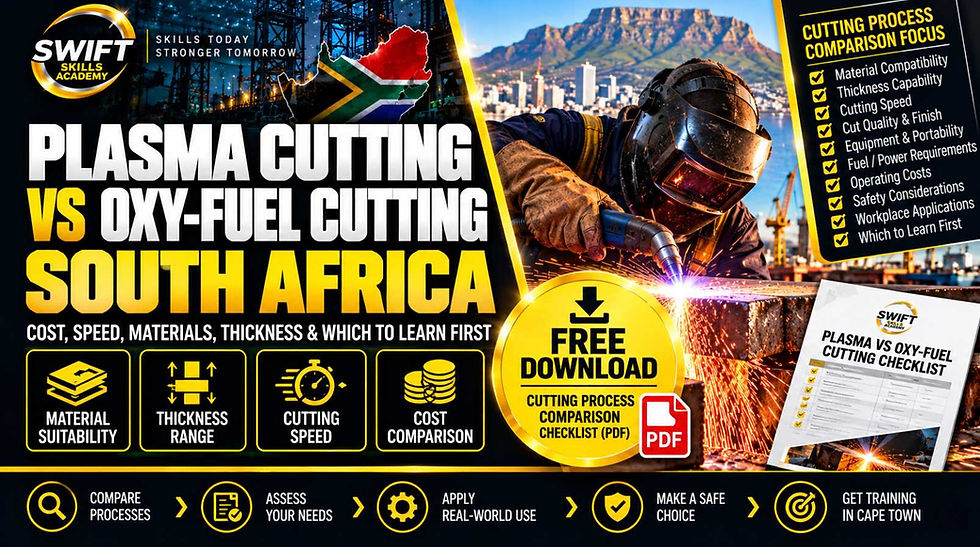
Quick Answer Plasma cutting vs oxy-fuel cutting
Plasma cutting is usually the stronger first choice when a workshop needs fast cutting across electrically conductive metals such as carbon steel, stainless steel and aluminium. Oxy-fuel is especially valuable for thick carbon steel, field work, heating, preheating and environments where a suitable electrical plasma system is unavailable.
Neither process universally replaces the other.
Plasma works by using an electrically conductive ionised gas and concentrated arc to melt metal and eject it from the cut. Oxy-fuel preheats suitable steel and then uses a high-purity oxygen jet to drive an oxidation reaction that creates the cut. TWI Global
Decision factor | Plasma cutting | Oxy-fuel cutting |
Carbon steel | Yes | Yes |
Stainless steel | Yes | Conventional oxy-fuel generally unsuitable |
Aluminium | Yes | Conventional oxy-fuel generally unsuitable |
Copper / conductive metals | Often yes, system-dependent | Generally unsuitable |
Thin sheet | Strong choice | Usually less attractive |
Medium plate | Strong choice with correctly sized system | Possible |
Very thick carbon steel | Equipment-dependent | Strong traditional application |
Preheat required | No conventional preheat cycle | Yes |
Electrical power | Required | Not required for manual torch cutting |
Compressed air | Common on air-plasma systems | No |
Fuel-gas cylinders | No | Yes |
Heating / straightening | Not the core purpose | Major advantage |
Field portability | Equipment dependent | Strong advantage |
Skill emphasis | Machine setup + torch control | Gas system + flame + torch control |
The existing Swift Skills Academy article already has a good base. The reengineering opportunity is to make it the South African process-selection authority, not merely another generic “plasma is faster / oxy is thicker” comparison. Swift Skills Academy
What Is the Fundamental Difference Between Plasma and Oxy-Fuel Cutting?
The processes may both separate metal, but they do it through fundamentally different mechanisms. Plasma cutting vs oxy-fuel cutting
Plasma Cutting
Plasma cutting creates an electrical arc through a gas stream.
That gas becomes ionised and forms plasma.
The concentrated plasma jet:
melts the metal,
ejects molten material,
creates the kerf,
and progresses through the workpiece as the torch travels.
Because an electrical circuit is involved, the workpiece must be electrically conductive.
That is why plasma is suitable for metals such as:
carbon steel,
stainless steel,
aluminium,
copper,
and other conductive metals,
within the capacity of the specific plasma system. Hypertherm
Oxy-Fuel Cutting
Oxy-fuel does not primarily cut by melting the whole kerf.
The flame first heats suitable steel to ignition temperature.
TWI places this preheat range for steel at roughly 700–900°C.
The cutting-oxygen jet then creates an exothermic oxidation reaction and blows the resulting oxide away from the cut. TWI Global
That chemistry explains why ordinary oxy-fuel cutting works extremely well on suitable carbon steels but not equally well on stainless steel, aluminium and many non-ferrous metals. TWI Global
Plasma Cutting vs Oxy-Fuel by Material
Material is usually the fastest way to eliminate the wrong process.
Mild and Carbon Steel
Both plasma and oxy-fuel can cut carbon steel.
The choice depends on:
thickness,
production speed,
edge-quality requirement,
available power,
compressed air,
fuel-gas availability,
portability,
equipment capacity,
and downstream finishing.
For thin and medium-gauge fabrication, plasma often offers a substantial productivity and cut-quality advantage.
For thick and very thick carbon steel, oxy-fuel remains highly relevant. TWI describes oxy-fuel as suitable for a very wide thickness range and particularly useful for heavy carbon-steel work. TWI Global
Stainless Steel
For conventional shop cutting, plasma is normally the clear choice between these two processes.
Plasma can cut conductive stainless steel.
Conventional oxy-fuel has difficulty because stainless forms refractory oxides that interfere with the standard oxidation cutting mechanism. TWI Global
Aluminium
Again, plasma normally wins this comparison.
Aluminium is electrically conductive, so an appropriately specified plasma system can cut it.
Conventional oxy-fuel is not the normal process choice because aluminium does not sustain the same useful oxidation reaction as carbon steel. Hypertherm
Copper
Plasma can cut conductive copper where the machine, amperage and consumables support it.
Oxy-fuel is generally not the normal choice.
Do not assume that simply because a small plasma machine can strike an arc on copper it can produce production-quality cuts at every thickness.
Machine capacity still governs the result.
Plasma vs Oxy-Fuel by Thickness
This is where internet comparisons often become misleading.
There is no universal maximum plasma thickness.
There is also no single oxy-fuel thickness limit applicable to every torch and nozzle.
Capacity depends on:
equipment design,
amperage,
torch,
consumables,
fuel gas,
nozzle,
cutting pressure,
pierce capability,
material,
and required cut quality.
Hypertherm's general process-selection guidance positions plasma strongly in roughly the mid-range and oxy-fuel particularly strongly in thick carbon steel, but individual machines have their own ratings. Hypertherm
Recommended Cut vs Maximum Cut vs Severance
This distinction matters enormously when buying or training on plasma equipment.
A manufacturer may specify:
Recommended / quality capacity
Thickness where the machine should produce useful production cuts.
Maximum capacity
A heavier cut that may be slower or lower quality.
Severance capacity
The maximum thickness the machine can physically separate.
A machine being able to sever 30 mm steel does not mean it should be purchased as a production 30 mm cutting machine.
The result may involve:
slower travel,
greater bevel,
rougher surface,
heavier dross,
consumable wear,
and greater cleanup.
So when comparing plasma with oxy-fuel:
Do not compare an oxy-fuel production cut with a plasma machine's marketing-level severance number.
Which Cuts Faster: Plasma or Oxy-Fuel?
On thinner and medium carbon-steel material, plasma is generally faster.
There is no conventional preheat cycle and the concentrated plasma arc can move rapidly through the work.
Hypertherm reports very large productivity advantages over oxy-fuel on thinner material, although those figures are manufacturer comparisons and actual performance depends on the equipment used. Hypertherm
For practical decision-making, do not compare only torch travel speed.
Compare the entire cut cycle:
setup,
preheating,
piercing,
travel,
repositioning,
consumable changes,
cylinder changes,
dross removal,
grinding,
rework,
and final fit-up.
A faster torch does not automatically create the lowest-cost finished part.
Which Gives Better Cut Quality?
For many thin and medium fabrication applications, correctly configured plasma can produce:
narrower kerf,
smaller heat-affected area,
less distortion,
smoother edge,
less cleanup,
and better productivity.
Hypertherm strongly promotes these advantages for plasma, while TWI likewise lists high-quality edges and narrower heat effects among plasma's strengths. Hypertherm
But poor plasma settings can still produce:
bevel,
dross,
rounded edges,
poor arc stability,
excessive kerf,
and heavy consumable wear.
Good equipment does not replace skill.
Which Creates More Heat-Affected Zone?
Oxy-fuel generally introduces more total heat into the workpiece because it requires preheating and typically progresses more slowly on thinner material.
Plasma concentrates energy into a much smaller area and generally moves faster.
This can mean:
less distortion,
less surrounding heat,
and reduced downstream correction
for many plasma applications. Hypertherm
However, the actual HAZ depends on:
thickness,
cutting speed,
process,
equipment,
amperage,
and material.
What Is Kerf?
The kerf is the width of material removed by the cutting process.
Kerf affects:
part dimensions,
nesting,
hole accuracy,
material utilisation,
and final geometry.
Plasma often produces a narrower kerf than conventional oxy-fuel on comparable thinner and medium steel applications.
For precision fabrication, that difference can matter significantly.
What Is Dross?
Dross is unwanted material that remains attached to the cut edge.
With plasma, dross can appear when parameters such as:
cutting speed,
amperage,
torch height,
air quality,
or consumable condition
are unsuitable.
With oxy-fuel, attached slag can result from:
speed,
nozzle condition,
oxygen purity,
preheat,
pressure,
or torch control.
The correct question is not:
“Which process produces zero dross?”
It is:
“Which process produces acceptable edges most consistently on the work we actually perform?”
Which Is Easier for a Beginner?
Many beginners can produce an acceptable basic plasma cut relatively quickly.
Modern manual plasma systems can simplify:
arc starting,
amperage selection,
torch handling,
and consumable management.
Oxy-fuel requires coordination between:
regulators,
gas pressures,
fuel valves,
oxygen,
flame adjustment,
torch height,
preheat,
cutting lever,
and travel.
Your current article already captures this distinction well: initial plasma operation may be easier to learn, but ease of making one cut is not the same as complete competence. Swift Skills Academy
Does Plasma Need Compressed Air?
Many common manual air-plasma systems do.
The compressed air must provide sufficient:
pressure,
flow,
cleanliness,
and dryness.
Poor air quality can affect:
torch performance,
cut quality,
arc stability,
and consumable life.
A workshop buying plasma equipment without checking compressor capacity can create a bottleneck before the machine makes its first production cut.
Does Oxy-Fuel Need Electricity?
A basic manual oxy-fuel torch does not require electrical cutting power.
That is one reason it remains so useful in:
remote field work,
repair,
demolition,
heavy fabrication,
agricultural work,
and sites where sufficient electrical supply or compressed air is unavailable.
TWI identifies portability and the absence of electrical requirements as major oxy-fuel advantages. TWI Global
Which Is More Portable?
The answer depends on the equipment.
Oxy-Fuel
Requires:
cylinders,
regulators,
hoses,
torch,
tips,
and associated safety equipment.
But it can operate without electrical cutting power.
Plasma
A portable plasma system can be physically compact.
But it may also require:
electrical supply,
suitable extension or generator capacity,
compressor,
dry air,
earth/work lead,
and consumables.
So:
A small plasma cutter is not automatically the more portable solution if the site cannot supply its electrical and air requirements.
Which Is Better for Field Work?
For heavy carbon-steel field cutting, oxy-fuel remains extremely useful.
It can combine:
cutting,
heating,
straightening,
preheating,
and related thermal work.
This multifunction ability is a major reason oxy-fuel has not disappeared despite newer cutting technology. TWI Global
Plasma can still be excellent for site work where:
electrical power is available,
air supply is adequate,
material is suitable,
and faster, cleaner cuts justify the equipment.
Which Is Better for Workshop Production?
For mixed-material fabrication and repeated cutting, plasma is often compelling.
It can suit:
sheet-metal fabrication,
brackets,
profiles,
stainless components,
aluminium work,
repetitive cuts,
automotive fabrication,
decorative metalwork,
and CNC systems.
Plasma's material flexibility is one of its biggest structural advantages over oxy-fuel. Hypertherm
Plasma vs Oxy-Fuel Cost
There are at least three different costs that should not be confused.
1. Equipment purchase cost
Basic oxy-fuel equipment can have a comparatively low initial capital cost.
Plasma cost varies enormously from small manual systems to sophisticated CNC high-definition installations.
TWI lists low equipment cost as a major oxy-fuel advantage. TWI Global
2. Operating cost
Oxy-fuel consumes:
oxygen,
fuel gas,
tips,
cylinder handling,
and labour.
Plasma can consume:
electricity,
compressed air or specialised gas,
electrodes,
nozzles,
cartridges,
shields,
and compressor resources.
3. Cost per finished part
This is often the more important measure.
Include:
cut speed,
labour,
dross removal,
grinding,
edge preparation,
consumable life,
scrap,
distortion,
machine downtime,
rework,
and final fit-up.
Hypertherm argues that plasma can lower overall operating cost through higher productivity, although this should be treated as manufacturer evidence rather than a universal promise for every workshop. Hypertherm
Which Process Is Cheaper?
There is no universal winner.
Oxy-fuel may make more economic sense when:
carbon steel is very thick,
cutting volumes are low,
capital budget is limited,
equipment must also heat or straighten,
site power is limited.
Plasma may make more economic sense when:
cutting is frequent,
materials are mixed,
speed matters,
parts require less cleanup,
stainless or aluminium is involved,
productivity drives cost per part.
The workshop should calculate cost per usable component, not merely gas price versus electricity price.
Plasma Cutting Safety
Plasma eliminates fuel-gas cylinders from the cutting process, but it is not risk-free.
Hazards can include:
electricity,
arc radiation,
sparks,
hot metal,
fumes,
noise,
compressed air,
sharp cut edges,
fire,
and incorrect equipment setup.
Plasma safety training should therefore cover:
PPE,
work-return connection,
power isolation,
torch inspection,
consumable condition,
ventilation,
compressed-air condition,
fire risk,
material coatings,
and hot-metal handling.
Oxy-Fuel Safety
Oxy-fuel adds a different group of hazards because it uses pressurised oxygen and fuel gas.
Training needs to cover:
cylinder handling,
securing cylinders,
regulators,
hoses,
connections,
leak testing,
flashback protection,
non-return protection,
torch setup,
flame control,
shutdown,
and fire prevention.
That deeper technical territory belongs primarily to Swift Skills Academy's dedicated Gas Cutting Course Cape Town guide rather than being duplicated here.
Which Process Has Greater Fire Risk?
Both can ignite combustible material.
Plasma creates:
sparks,
molten metal,
hot workpieces.
Oxy-fuel adds:
open flame,
fuel gas,
oxygen,
hot slag,
heated steel.
The correct workplace control depends on the actual risk assessment.
Neither process should be presented as inherently “safe” simply because the other process has additional hazards.
What Happens When Cutting Painted or Coated Metal?
Heating coatings can produce hazardous fumes.
This affects both plasma and oxy-fuel.
Before cutting, determine:
what coating is present,
whether it should be removed,
ventilation requirements,
respiratory controls,
and workplace procedure.
The process-selection question should therefore include material condition, not only material type.
Plasma Cutting Defects
Common plasma problems can include:
High-speed dross
Often associated with moving too quickly.
Low-speed dross
Can occur when travel is too slow.
Excessive bevel
May relate to:
torch height,
worn consumables,
cutting direction,
machine condition,
or speed.
Double arcing / consumable damage
Can occur under unsuitable operating conditions.
Poor pierce
May result from machine-capacity, consumable or technique issues.
Oxy-Fuel Cutting Defects
Common oxy-fuel problems can include:
Heavy slag
Potential causes:
wrong speed,
nozzle problems,
oxygen purity,
incorrect pressures,
poor heating.
Rough cut face
May reflect inconsistent travel or poor oxygen flow.
Incomplete severance
Can result from excessive speed or insufficient cutting conditions.
Rounded top edge
Can indicate excessive heating or unsuitable technique.
Excessive drag
May indicate speed, nozzle or oxygen problems.
Which Is Better for Bevel Cutting?
Both can bevel-cut suitable material.
Plasma beveling
Can be highly productive, particularly with mechanised or CNC systems.
Oxy-fuel beveling
Remains useful for:
thick carbon steel,
heavy fabrication,
manual preparation,
and field work.
The better process depends on:
material,
thickness,
accuracy,
volume,
machine capability,
and downstream welding requirements.
Which Is Better Before Welding?
Both can produce welding-preparation edges.
The important issue is the actual condition of the edge after cutting.
Before welding, the fabricator may need to evaluate:
dross,
oxide,
roughness,
bevel angle,
root face,
dimensional accuracy,
cracks or gouges,
contamination,
and fit-up.
A cutting process should be evaluated partly on how much secondary preparation it creates.
Plasma vs Oxy-Fuel for Mild Steel
For thinner and medium carbon steel:
Plasma often wins on speed and productivity.
For progressively thicker plate:
oxy-fuel becomes increasingly attractive, although high-capacity industrial plasma remains capable of substantial thicknesses.
This is why thickness discussions must always include the actual machine.
Plasma vs Oxy-Fuel for Stainless Steel
Between these two choices:
Plasma.
Conventional oxy-fuel is not the normal process for stainless steel because of the material's oxide behaviour. TWI Global
Plasma vs Oxy-Fuel for Aluminium
Again:
Plasma is generally the appropriate choice between these two processes.
An appropriately specified plasma system can cut electrically conductive aluminium. Hypertherm
Plasma vs Oxy-Fuel for Very Thick Carbon Steel
Oxy-fuel retains an important advantage here.
TWI describes oxy-fuel as being used across an extremely broad carbon-steel thickness range, including heavy sections. TWI Global
However:
Do not interpret this as “plasma cannot cut thick steel.”
Industrial plasma systems can cut substantial plate.
The decision is economic and equipment-specific.
Which Process Is Better for CNC?
Plasma is extremely well suited to CNC fabrication, particularly where the workshop needs:
high throughput,
multiple profiles,
nesting,
complex shapes,
stainless steel,
aluminium,
carbon steel,
and repeatability.
Oxy-fuel can also be mechanised and CNC-controlled and remains highly effective for thick carbon-steel plate.
So CNC is not synonymous with plasma.
Can Plasma Completely Replace Oxy-Fuel?
For many workshops, no.
Plasma may replace oxy-fuel for a substantial proportion of cutting work.
But oxy-fuel retains important advantages for:
very thick carbon steel,
heating,
straightening,
preheating,
heavy field work,
demolition,
and situations where electrical supply is unsuitable.
The two processes overlap but do not have identical capabilities.
Can Oxy-Fuel Completely Replace Plasma?
Again, no — particularly in a mixed-metal workshop.
Oxy-fuel cannot conventionally perform the same role on:
aluminium,
stainless steel,
copper,
and many other conductive non-carbon-steel materials.
That makes plasma strategically valuable where material variety matters. Hypertherm
Do Fabricators Need to Learn Both?
For broad fabrication capability, learning both can be highly valuable.
A fabricator may encounter:
Plasma for:
profiles,
stainless,
aluminium,
sheet,
repeated parts.
Oxy-fuel for:
thick carbon steel,
structural modification,
repair,
demolition,
preheating,
field work.
The stronger question is not:
“Which process wins?”
It is:
“Which process should I learn first for the work I actually expect to perform?”
South African Qualification Context
South African qualification history also reflects the fact that plasma and oxy-fuel are distinct skills.
SAQA Unit Standard 253734 — Cut materials using plasma cutting was registered at NQF Level 4 with four credits. Its record has passed its registration end date and shows final enrolment as 30 June 2024 and final achievement as 30 June 2027. SAQA
SAQA Unit Standard 243067 — Cut materials using the oxy-fuel gas cutting process (manual cutting) is an NQF Level 2, six-credit unit standard. Its current SAQA record shows that although registration has ended, its listed teach-out dates extend further. SAQA
Important
Do not conclude from those records that every modern short course is automatically delivered or certified against those unit standards.
The learner must confirm:
current programme,
provider scope,
assessment route,
certification,
and applicable occupational pathway.
Plasma and Oxy-Fuel in the Welder Occupational Pathway
SAQA's Occupational Certificate: Welder, qualification 94100, explicitly includes performing cutting and gouging using oxy-fuel, carbon arc and plasma equipment as part of the broader welder capability. SAQA
That makes the strategic relationship clear:
Cutting is not separate from fabrication development.
It supports the broader ability to:
prepare materials,
fabricate,
repair,
fit components,
prepare joints,
and progress into welding.
Which Process Should a Beginner Learn First?
Use the intended job as the decision.
Learn plasma first if your likely work is:
stainless fabrication,
aluminium fabrication,
thin/medium plate,
repetitive profiles,
sheet-metal production,
automotive fabrication,
CNC work,
decorative fabrication.
Learn oxy-fuel first if your likely work is:
thick carbon steel,
structural modifications,
repair,
demolition,
agricultural work,
remote field work,
heating,
straightening,
preheating.
Learn both if your goal is:
broad fabrication,
welding,
boilermaking,
maintenance,
artisan development,
employer versatility.
Which Process Should an Employer Train First?
Employers should start with the production problem.
Ask:
What metals are actually cut?
What thickness range dominates?
Is cutting performed in a workshop or on site?
Is electrical power reliable at the job location?
Is compressed air available?
Does the business need stainless or aluminium capability?
Does the business need heating or preheating?
What edge quality is required?
How much cleanup follows the cut?
What machinery is already owned?
What near misses or defects are occurring?
What competency does the employee need to demonstrate?
The answer should determine training priority.
Not whichever machine is currently fashionable.
Decision Matrix for South African Fabricators
Workplace requirement | Stronger first process |
Thin mild-steel sheet | Plasma |
Stainless sheet | Plasma |
Aluminium | Plasma |
Mixed-metal workshop | Plasma |
Repetitive profiles | Plasma |
CNC production | Plasma |
Medium plate | Often plasma |
Thick carbon steel | Depends on equipment |
Very thick carbon steel | Often oxy-fuel |
Remote field repair | Often oxy-fuel |
Heating / straightening | Oxy-fuel |
Preheating | Oxy-fuel |
Heavy demolition | Oxy-fuel |
Mixed fabrication career | Learn both |
This matrix is a starting point, not a universal engineering specification.
Machine capacity and procedure always matter.
Frequently Asked Questions
Is plasma cutting better than oxy-fuel?
Not universally. Plasma is usually more versatile across electrically conductive metals and highly productive on thinner and medium material. Oxy-fuel remains particularly useful for thick carbon steel, field work and heating applications.
Which cuts faster?
Plasma generally cuts thinner and medium material faster because it does not require the same preheat stage. Actual speed depends on equipment and thickness. Hypertherm
Which cuts thicker steel?
Both can cut substantial thicknesses with the right equipment. Oxy-fuel retains a particularly strong position in very thick carbon steel. TWI Global
Can plasma cut stainless steel?
Yes. Stainless steel is electrically conductive and is a common plasma application. Hypertherm
Can oxy-fuel cut stainless steel?
Conventional oxy-fuel is generally unsuitable because stainless forms oxides that interfere with the normal cutting reaction. TWI Global
Can plasma cut aluminium?
Yes, provided the plasma system is suitable for the material and thickness.
Can oxy-fuel cut aluminium?
Conventional oxy-fuel is generally not the appropriate method.
Which process has lower equipment cost?
Basic oxy-fuel equipment typically has a relatively low capital cost. Plasma system costs vary widely. TWI Global
Which has the lower operating cost?
It depends on the actual work. Compare electricity, air, gases, consumables, labour, cut speed and secondary finishing rather than one consumable price.
Does plasma need compressed air?
Many common air-plasma systems do. Some industrial plasma systems use other gases.
Does oxy-fuel need electricity?
Manual oxy-fuel cutting does not require electrical cutting power.
Which is more portable?
Oxy-fuel is particularly useful where electrical supply or compressed air is unavailable. Portable plasma can be very convenient where appropriate power and air are available.
Which is easier to learn?
Basic plasma cutting can often produce acceptable beginner results sooner, but professional cutting with either process requires training and technique.
Which has better edge quality?
Plasma often gives cleaner, narrower cuts with less secondary work on many thinner and medium applications. Equipment and technique still matter. Hypertherm
Which creates less distortion?
Plasma generally introduces less total heat into thinner and medium workpieces, helping reduce distortion.
Can plasma replace oxy-fuel?
In some workshops it can replace much oxy-fuel cutting, but not every heating, thick-plate or field application.
Can oxy-fuel replace plasma?
Not effectively in mixed-metal fabrication involving stainless, aluminium or other non-ferrous conductive metals.
Which should a welder learn first?
Choose based on intended work. For broad welding and fabrication development, both processes can be useful.
Does plasma training make someone a qualified welder?
No. Plasma cutting is one fabrication capability within a much broader welding occupational pathway.
Is there a South African plasma-cutting unit standard?
SAQA Unit Standard 253734 covered plasma cutting, but its record has passed its registration/end-enrolment period; its final achievement date is listed as 30 June 2027. SAQA
Is oxy-fuel cutting part of South African welder development?
Yes. SAQA's Occupational Certificate: Welder includes oxy-fuel and plasma cutting within the broader occupational capability. SAQA
Authoritative Sources & Regulatory References
Authoritative Source | What It Supports |
Explains oxidation-based cutting, fuel gases, preheat temperatures, oxygen purity and material limitations. | |
Covers portability, thick steel, fuel-gas selection, nozzle design and industrial applications. | |
Independent comparison covering oxy-fuel, plasma, laser and waterjet characteristics. | |
Manufacturer comparison of plasma, oxy-fuel, laser and waterjet by material, thickness and application. | |
Historical South African plasma-cutting competency standard. | |
South African manual oxy-fuel cutting competency standard and teach-out record. | |
Confirms plasma and oxy-fuel cutting within broader occupational welder development. |
Read More
Read More | Why Read It |
Go deeper into oxy-acetylene cylinders, regulators, flashback protection, torch setup, flame adjustment, piercing and manual cutting technique. | |
Compare thermal cutting with mechanical cutting, disc selection, grinding, bevel preparation and safe fabrication-tool use. | |
See how cutting, preparation, fabrication skills and welding processes fit into a broader practical training pathway. |
Final Word
The wrong way to compare these processes is:
Plasma = modern.Oxy-fuel = old.
The right comparison is:
material + thickness + cut quality + location + equipment + power + air + production volume + heating requirement + downstream welding + total cost per usable part.
Plasma has a major advantage where a fabricator needs:
speed + conductive-metal versatility + stainless + aluminium + narrower cuts + repeated profiles + production efficiency.
Oxy-fuel remains extremely valuable where the job requires:
thick carbon steel + field portability + heating + straightening + preheating + heavy repair + demolition.